
Many people new to SEO hear that backlinks are important for ranking and immediately look for quick ways to get lots of them. Some turn to spamming links — creating low-quality or irrelevant backlinks in hopes of boosting their site fast.
This approach seems tempting because it feels easy and cheap. But in 2026, link spamming is one of the fastest ways to damage your website’s rankings and reputation. Google has become extremely good at spotting and penalizing manipulative link practices.
In this guide, you’ll learn exactly what spamming links are, the different types, why they usually backfire, the real risks involved, and, most importantly, much safer, ethical ways to build links that actually help your site grow sustainably.
Whether you’re a beginner blogger, small business owner, or affiliate marketer, understanding link spamming will help you avoid costly mistakes and focus on strategies that work long-term.
Table of Contents
What is link spamming?
Link spamming is the practice of creating low-quality, irrelevant, or manipulative backlinks to a website in an attempt to artificially improve its search engine rankings.
In simple terms, instead of earning links naturally by creating valuable content that people genuinely want to share, spammers try to force links through automated tools, paid services, comment spam, or low-effort directory submissions.
For example, someone might use software to post the same comment with a link on thousands of blogs, or buy cheap backlinks from networks of low-quality sites. These links usually add no real value to readers and exist only to manipulate Google.
Google calls this “link spam” and actively works to detect and devalue it. The goal of spamming links is short-term ranking gains, but the result is often long-term damage to your site’s visibility and trustworthiness.
The practice has been around since the early days of SEO, but it has become much riskier over time as search engines have improved their detection methods. What might have worked in 2015 is now likely to cause problems in 2026.
How link spamming started ?
Link spamming started because early search engines heavily relied on backlinks to measure a website’s popularity and authority.
In the late 1990s, search engines were much simpler than they are today. When Google introduced the PageRank algorithm, it changed SEO forever. PageRank treated links like “votes.” The idea was simple:
If many websites link to a page, that page is probably valuable.
At first, this system worked very well because quality websites naturally attracted links. But SEO marketers quickly realized something important:
Many backlinks often meant higher rankings ___ even if the links were low quality.
That discovery led to the birth of link spam.
Types of link spamming
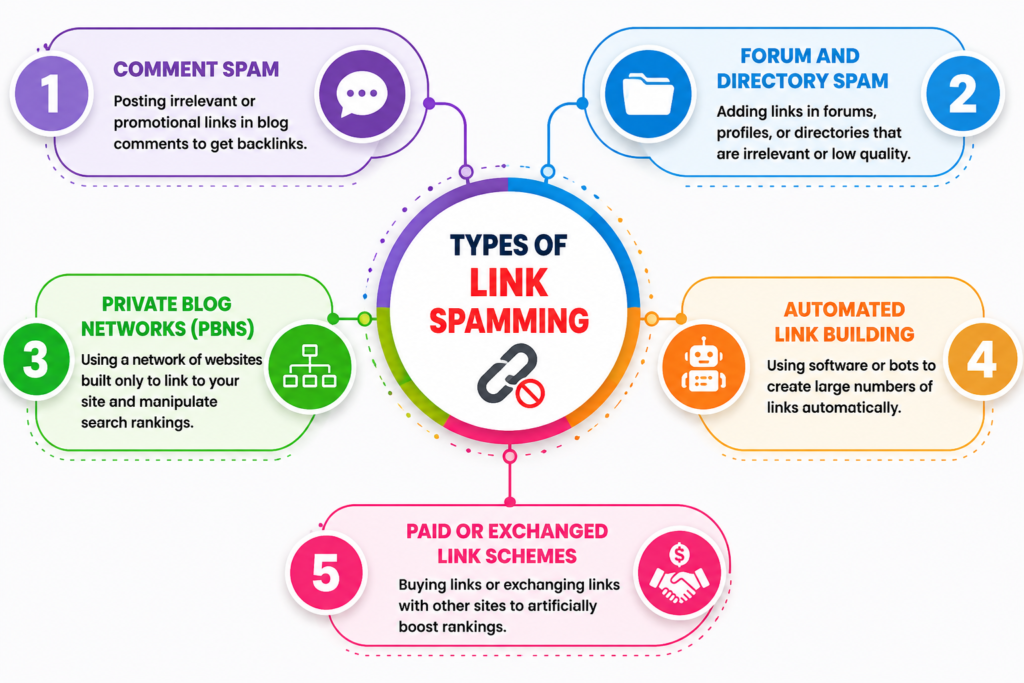
There are several common ways people engage in link spamming. Understanding the different types helps you recognize and avoid them.
1. Comment spam
Posting generic comments like “Great post! Check out my site” with a link on blogs, forums, or social media. This used to work years ago, but is now easily detected and ignored by both site owners and search engines.
2. Forum and directory spam
Submitting websites to hundreds of low-quality directories or forum profiles just to get a link. Most of these directories have little authority and can actually hurt your site by associating it with low-quality neighborhoods on the web.
3. Private Blog Networks (PBNs)
Creating or buying networks of low-quality sites solely to link back to a main “money site.” Google’s SpamBrain is now very effective at detecting these networks through shared hosting patterns, similar content footprints, and unnatural linking behavior.
4. Automated link building
Using software or services that automatically generate thousands of links from low-quality sources. These tools create unnatural patterns — sudden spikes in links, identical anchor text, or links from sites that look automatically generated — that search engines spot quickly.
5. Paid or exchanged link schemes
Buying links or participating in “ link exchange ” programs where sites link to each other just for ranking purposes. These schemes often involve reciprocal linking or paid placements that violate Google’s guidelines.
All these methods share one fundamental problem: they focus on quantity and manipulation instead of quality and genuine value. They try to trick search engines rather than earn links through useful content.
Why do people use link spamming ?
The main reason is the desire for quick results with minimal effort and cost.
Many beginners hear that “backlinks are one of the most important ranking factors” and look for the fastest way to get lots of them. Cheap services on marketplaces promise hundreds or thousands of links for a small fee, making it seem like an easy shortcut to better rankings.
Some people also feel pressured by competition. When they see other sites ranking higher with seemingly less effort, they assume aggressive link spamming is the only way to catch up quickly.
Others simply don’t know any better. They follow outdated advice from old blog posts or YouTube videos that still recommend aggressive link-building tactics that no longer work safely.
Unfortunately, these shortcuts almost always fail in the long run. Modern search engines are designed to reward genuine value and penalize manipulation. What looks like fast progress often turns into a ranking drop or even a manual penalty when Google releases its next algorithm update.
Does link spamming still work?
In short, very rarely, and only temporarily.
Google’s SpamBrain and regular link spam updates have made it much harder for low-quality link schemes to succeed. Links from spammy sources are often ignored or actively devalued by the algorithm.
Any short-term ranking boost from spamming links usually disappears after the next major update. In many cases, sites end up worse off than before because Google applies penalties or simply stops trusting the site’s overall authority.
The few cases where spammy links still appear to “work” are usually in very low-competition niches with almost no real competition. Even then, the risk far outweighs any temporary gain because one update can wipe out months of apparent progress.
The bottom line in 2026 is clear: sustainable rankings come from creating valuable content and earning links naturally, not from trying to game the system with spamming links.
Risks of link spamming
The risks are serious and can have lasting effects on your website:
- Algorithmic penalties: Google automatically reduces the value of spammy links or lowers your entire site’s rankings across many keywords.
- Manual actions: In severe cases, Google issues a manual penalty that can remove your site from search results completely until you fix the issues.
- De-indexing: Some sites lose their entire presence in Google if the spam is extreme and widespread.
- Loss of trust and credibility: Readers and potential customers quickly notice low-quality links and may stop trusting your site or brand.
- Wasted time and money: Time and budget spent on spammy links could have been used for sustainable strategies that deliver real, lasting results.
Recovering from link spam penalties can take months and sometimes requires disavowing large numbers of links through Google Search Console, rebuilding content, and waiting for re-evaluation. In some cases, full recovery is never guaranteed.
Google’s approach to link spamming
Google uses advanced machine learning called SpamBrain, along with regular algorithm updates, to detect link spam at scale.
They look for unnatural patterns such as sudden spikes in low-quality links, identical anchor text across many different domains, links from irrelevant or low-trust sites, and footprints left by automated tools.
Google’s dedicated link spam updates specifically target manipulative practices. When they roll out, sites relying heavily on spammy links often see significant ranking drops — sometimes losing visibility for weeks or months.
The message from Google has been consistent for years: focus on creating valuable content that naturally attracts links rather than trying to manipulate the system with artificial link schemes.
Examples of link spam
Here are clear examples of what link spam looks like in practice so you can recognize and avoid it:
Bad example 1 – Comment spam:
On a cooking blog, someone posts: “Nice recipe! Visit my site for cheap supplements [link to unrelated supplement store].”
This is spammy because the comment adds no value to the discussion, and the link is completely irrelevant to the topic.
Bad example 2 – Directory spam:
Submitting the same website to hundreds of low-quality “free directory” sites that have thin content and exist only to host links.
These directories usually have very low authority and can hurt rather than help by associating your site with low-quality neighborhoods on the web.
Bad example 3 – PBN spam:
Creating multiple low-quality blogs on cheap hosting, all linking back to one main site with exact-match anchor text like “best cheap hosting.”
Google can easily spot the shared hosting patterns, similar content style, and unnatural linking behavior, and devalue all the links.
In contrast, a good link is one that a real person would naturally click because it provides useful information or a helpful resource.
How to identify spammy links
Look for these common warning signs when reviewing your backlink profile:
- Links from sites with very low domain authority and thin, low-quality content
- Links with over-optimized or exact-match anchor text repeated across many different domains
- Links from completely unrelated niches or industries
- Suddenly, large numbers of links appear in a short period of time
- Links from sites that look automatically generated or full of ads and pop-ups
Use free tools like Google Search Console or Ahrefs’ free backlink checker to review your link profile regularly. If something looks suspicious, investigate further or consider disavowing the link.
How to avoid link spamming
The best way to avoid link spamming is to focus on quality from the very beginning:
- Create genuinely valuable content that people want to link to naturally.
- Build real relationships with other website owners and creators in your niche.
- Avoid any service that promises “hundreds of backlinks fast” or “cheap SEO links.”
- Never use automated link-building tools or software.
- Always ask yourself: Would a real person find this link helpful and relevant?
By focusing on ethical practices and long-term value, you protect your site and build sustainable SEO results that last through algorithm updates.
White-hat alternatives to link spamming
Instead of spamming links, use these proven, safe, and effective strategies:
- Content marketing: Create in-depth, helpful guides, tools, calculators, or resources that naturally attract links because they solve real problems.
- Guest posting: Write valuable, original articles for reputable sites in your niche and include a relevant link when it adds value for readers.
- Broken link building: Find broken links on relevant pages and politely suggest your content as a high-quality replacement.
- Resource page outreach: Reach out to sites that have “useful resources” or “best tools” pages and offer your content if it fits.
- Digital PR and HARO: Get mentioned in news articles or respond to journalist queries as an expert source.
These methods take more effort and time, but they deliver much better, longer-lasting results without any risk of penalties. Many successful sites have grown their traffic and authority using only these white-hat approaches.
What to do if you already have spammy links
If you discover you have low-quality or spammy backlinks pointing to your site, take these steps:
- Audit your backlinks using Google Search Console or a tool like Ahrefs.
- Identify harmful links (low-quality, irrelevant, or spammy domains).
- Reach out to webmasters politely to ask for removal when possible.
- Use Google’s Disavow Tool as a last resort for links you cannot remove.
- Focus on creating high-quality content and earning natural links to rebuild trust and authority.
Recovery takes time and patience, but consistent white-hat efforts usually restore rankings eventually. The key is to stop creating new spammy links immediately and shift your focus to sustainable practices.
Common mistakes to avoid
Here are the most common mistakes that lead to link spam problems:
- Buying cheap backlinks from marketplaces or Fiverr gigs.
- Using automated link-building software or “SEO services” that promise fast results.
- Ignoring the quality of sites you link to or that link to you.
- Focusing only on the quantity of links instead of relevance and authority.
- Neglecting regular backlink audits and allowing harmful links to accumulate.
Avoiding these mistakes will save you time, money, and potential ranking drops in the future.
Pro tips for sustainable link building
Here are some practical pro tips to build links the right way in 2026:
- Focus on long-term authority building rather than short-term link chasing.
- Create truly link-worthy content that solves real problems or provides unique value for your audience.
- Build genuine relationships with other creators and website owners in your niche.
- Combine strong content with smart, manual outreach instead of automation.
- Monitor your backlink profile regularly and disavow harmful links quickly if they appear.
- Be patient — sustainable link building takes time, but the results are much more stable and valuable.
The sites that succeed long-term in 2026 are the ones that prioritize quality, user value, and ethical practices over quick shortcuts.
Frequently asked questions
What is link spamming?
Link spamming is the practice of creating low-quality or irrelevant backlinks to manipulate search engine rankings. It includes comment spam, directory spam, PBNs, and automated link building.
Does link spamming still work?
Rarely, and only temporarily. Modern Google updates quickly detect and devalue spammy links, often resulting in ranking drops or penalties.
Can link spamming hurt your website?
Yes. It can trigger algorithmic penalties, manual actions, or de-indexing. Recovery can take months and requires significant effort to rebuild trust.
Can link spamming refurbished?
Yes, link spamming can sometimes be refurbished or cleaned up, but it depends on the quality and history of the backlinks.
How do I remove spam backlinks?
First, audit your links using Google Search Console or Ahrefs, ask webmasters to remove them when possible, and use Google’s Disavow Tool for harmful links you cannot remove. Then focus on earning natural, high-quality links.
Conclusion
Link spamming might seem like an easy shortcut when you’re starting with SEO, but in 2026, it is one of the riskiest things you can do for your website. The potential penalties, ranking drops, and wasted effort far outweigh any temporary gains you might see.
The smartest and safest approach is to focus on ethical, white-hat link-building strategies. Create valuable content that people genuinely want to link to, build real relationships with other creators, and earn links naturally through quality and usefulness.
Start today by auditing your current backlinks and committing to quality over quantity. Focus on helping your audience with useful, well-researched content, and the right links will follow over time.
By choosing ethical SEO practices, you protect your site and build a strong foundation for long-term success. Your future rankings — and your peace of mind — will thank you for making the right choice.
The path of sustainable SEO may feel slower at first, but it leads to much more stable and rewarding results. Choose quality, choose value, and choose to build your site the right way.
