
Most websites don’t have a link building plan. They have link-building wishes.
They hope for backlinks. They contact random websites asking for links. They publish content and hope people link to it. Then they wonder why their rankings stagnate.
A real link building plan is different. It’s a structured strategy that aligns with your SEO goals, targets specific types of links, and executes systematically over months.
The difference between random link building and planned link building is the difference between hoping to succeed and knowing you will.
This guide shows you exactly how to create one—from defining goals to tracking results. We’ll cover frameworks, templates, and execution strategies you can implement immediately.
Table of Contents
What is a Link Building Plan?
A link building plan is a structured, strategic document that outlines how you’ll acquire high-quality backlinks to improve your website’s authority and rankings.
It’s not a list of tactics. It’s not a wishlist of links you hope to get. It’s a documented strategy that includes:
– Clear goals aligned with your SEO objectives
– Target pages you want to rank for specific keywords
– Competitor analysis showing what backlinks they have
– Content assets designed to attract links
– Outreach strategies for acquiring links
– Timeline and milestones for execution
– Tracking metrics to measure success
Why This Matters:
A plan turns link building from a random activity into a systematic process. Without one, you waste time on low-impact activities. With one, every link you pursue contributes to your SEO goals.
Why You Need a Link Building Plan (Beyond Competitor Analysis)
1. Improves Ranking Consistency
Random link building produces random results. A planned approach produces consistent, predictable ranking improvements.
When you know what links you’re targeting and why, you can predict which rankings will improve and by how much.
2. Saves Time and Resources
Without a plan, you chase every opportunity. You reach out to every website that might link to you. You waste time on low-value links.
A plan focuses your effort on high-impact links that actually move your rankings. You do 50% of the work and see 80% of the results.
3. Avoids Spammy Tactics
Low-quality link building (link farms, PBNs, bought links) gets penalized. A planned approach focuses on quality, editorial links from real websites.
This keeps your site safe while building authority that lasts.
4. Scales Your Link Building Effort
Starting link builders might acquire 5 links per month. Experienced teams acquire 50+. The difference isn’t luck. It’s a system.
A documented plan lets you:
– Train team members on what you’re doing
– Delegate tasks to others
– Replicate what works
– Scale outreach systematically
5. Aligns Link Building with Business Goals
Not all links matter equally. Some drive traffic. Some pass authority to money pages. Some build brand awareness.
A plan ensures your link building focuses on links that actually move your business metrics.
Key Elements of a Successful Link Building Plan
Before you start executing, understand what goes into a good link building plan.
1. Target Pages (Money Pages vs. Blog Content)
Money pages = Pages you want to rank for commercial keywords (these drive revenue).
Blog content = Educational content that attracts links and builds authority (supports money pages).
A good plan identifies which pages need links most. Usually:
– 20% of your effort goes to money pages (highest impact)
– 80% of your effort goes to blog content (builds overall authority)
2. Keyword Strategy
Which keywords are you targeting? What search volume do they have? What’s the ranking opportunity?
Your link building plan should align with your keyword targets. If you’re targeting “best project management tools,” you need links that signal relevance to that keyword.
3. Competitor Backlink Analysis
What links do your competitors have? Where are they getting links? What types of websites link to them?
This shows you what’s working in your market and where opportunities exist.
4. Content Assets (Linkable Assets)
What content are you creating specifically to earn links?
Examples:
– Original research or data
– Comprehensive guides
– Industry tools or calculators
– Infographics
– Tools and resources
Without linkable assets, your outreach fails. With them, people want to link to you.
5. Outreach Strategy
How will you contact people? Email? Social media? Press releases? Relationship building?
A good strategy is personalized, relevant to the person you’re contacting, and offers genuine value.
Step-by-Step Link Building Plan (The Core Framework)
This is where most competitors fall short. Here’s a complete framework you can implement.
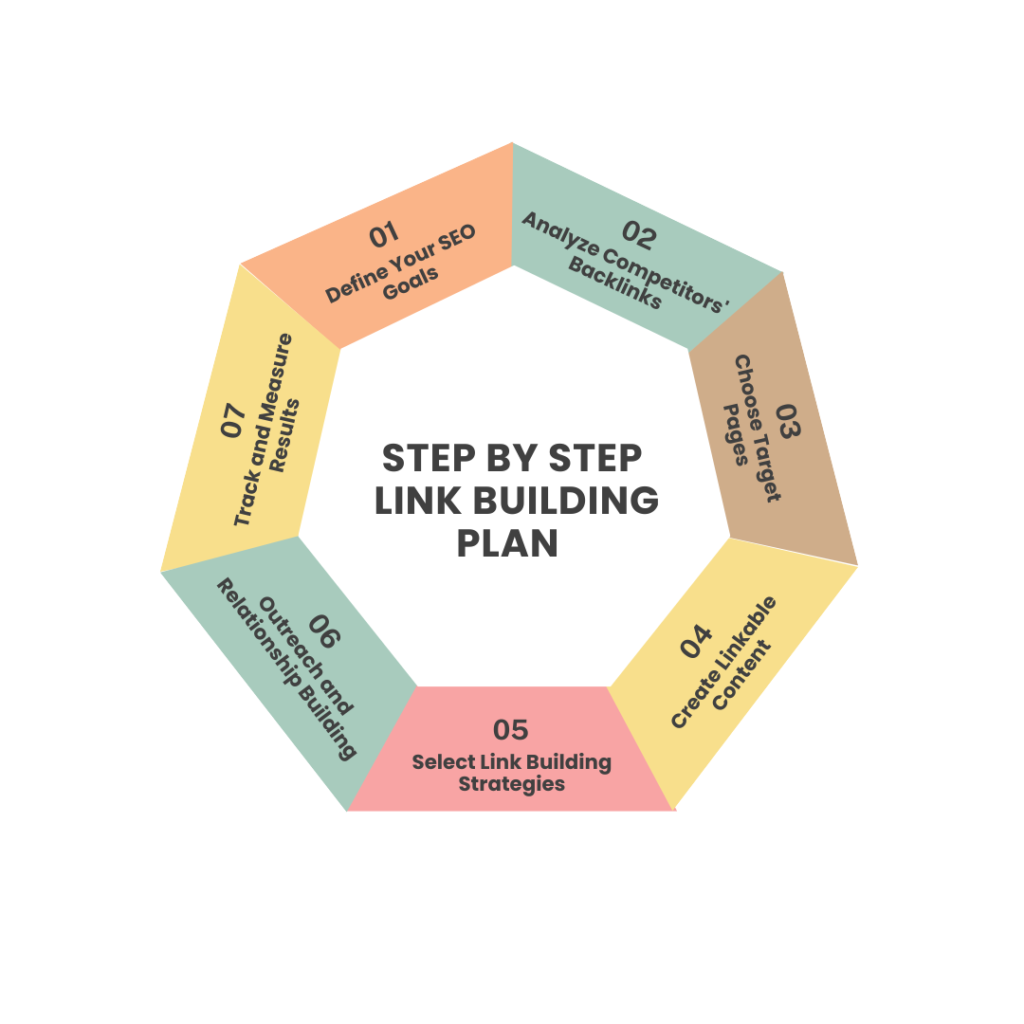
Step 1: Define Your SEO Goals
Before acquiring any links, know what you’re trying to achieve.
Write down:
– Target rankings (which keywords and positions)
– Target traffic (how many organic visitors per month)
– Target authority (Domain Authority or similar metric)
– Timeline (3 months, 6 months, 1 year)
Example:
– Goal: Rank in the top 5 for “project management software” within 6 months
– Current position: #12
– Estimated gap: 15-20 quality backlinks from DR 50+ sites
– Timeline: 6 months = 2-3 links per month needed
This transforms vague goals into concrete targets.
Step 2: Analyze Competitors’ Backlinks
Use Ahrefs, SEMrush, or Moz to answer:
– How many backlinks do top competitors have?
– What types of sites link to them?
– Which of their pages has the most links?
– What anchor text is used most?
– What linking opportunities are they exploiting?
What to look for:
– Guest posting opportunities (they got published on X, so can you)
– Resource pages linking to them (you can get listed too)
– Broken links pointing to them (you can replace with your content)
– PR links from news sites
– Educational resource links
Export this data. It’s your roadmap.
Step 3: Choose Target Pages
Decide which of YOUR pages you want to build links to.
For most sites:
– Homepage (1-2 links)
– Money pages/services pages (50% of effort)
– Pillar blog pages (50% of effort)
Rule: Don’t spread links across 200 pages. Focus on 5-15 strategic pages that matter most.
Step 4: Create Linkable Content
Before reaching out to people, create content worth linking to.
High-link-earning content types:
– Original research (“We surveyed 500 marketers…”)
– Comprehensive guides (3,000+ word ultimate guides)
– Data studies and statistics
– Industry tools or calculators
– Expert interviews
– Infographics
– Case studies with results
– Templates and resources
Rule of thumb: Invest 20% of your effort in creating linkable content. The other 80% is acquiring links for it.
Step 5: Select Link Building Strategies
Choose 3-5 link building strategies to focus on. Don’t do everything. Do a few things well.
High-impact strategies:
– Guest posting on relevant blogs (bring traffic + authority)
– Broken link building (fill a gap + help site owner)
– Digital PR (press coverage leads to links)
– HARO (help reporters get links + brand mentions)
– Skyscraper technique (find top-performing content, make a better version, get links to it)
– Resource link building (get listed on relevant resource pages)
– Niche edits (find relevant pages, suggest your content as an add-on)
For beginners: Start with 2-3 strategies (guest posting + broken link building + digital PR).
For advanced: Use 5+ strategies simultaneously.
Step 6: Outreach and Relationship Building
Now execute your outreach.
Weekly workflow:
– Monday: Identify 10-15 outreach targets
– Tuesday-Wednesday: Research targets, find contact info
– Thursday-Friday: Send personalized outreach emails
– Following week: Follow up with non-responders
Outreach email template:
Subject: [Site name] – [specific mention of their work]
Hi [Name],
I’ve been following your work on [specific article/topic]. Your recent piece on [X] really resonated because [specific compliment].
I thought you might find value in [your content]. We just published [specific thing], and it includes [unique angle they don’t have].
Would it make sense to link to it from [their specific article]?
[Your name]
Key principles:
– Personalize every email (mention their work specifically)
– Lead with value (why they should care)
– Make the ask clear and easy
– Include a preview link
– Follow up after 1 week if no response
Step 7: Track and Measure Results
Use Google Search Console, Ahrefs, or SEMrush to track:
– New backlinks acquired (daily/weekly)
– Referring domains (quality metric)
– Anchor text distribution
– Traffic increases
– Ranking improvements
Monthly reporting:
– Links acquired: ___
– Referring domains: ___
– Top referral traffic sources: ___
– Rankings improved: ___
This data tells you what’s working so you can do more of it.
Best Link Building Strategies to Include in Your Plan
Strategy 1: Guest Posting
Write articles for other relevant websites. Include a link to your site in the author bio or within the article.
Best for: Building authority on specific topics.
Typical result: 1 link per article + referral traffic.
Implementation: Find target sites, pitch relevant topics, write a guest post, and get a link.
Strategy 2: Resource Link Building
Find resource pages that list relevant websites in your industry. Request to be listed.
Best for: Niche authority building.
Typical result: 1-3 links per successful outreach.
Implementation: Find resource pages, research who maintains them, pitch your resource, and get added.
Strategy 3: HARO (Help A Reporter Out)
Reporters ask questions on HARO. You answer. If they use your quote, they link to you.
Best for: Brand mentions + links + thought leadership.
Typical result: 1 link + media mention.
Implementation: Sign up for HARO, answer 2-3 queries per day, and wait for publications to use your expertise.
Strategy 4: Broken Link Building
Find broken links on relevant websites. Offer your content as a replacement.
Best for: High relevance + helping the site owner.
Typical result: 2-5 links per campaign.
Implementation: Find sites with broken links, identify what the dead link pointed to, create replacement content, and pitch the replacement.
Strategy 5: Skyscraper Technique
Find top-performing content in your niche. Create a better version. Pitch to the sites linking to the original.
Best for: Beating competitors on content quality.
Typical result: 5-15 links per successful campaign.
Implementation: Identify top content, analyze why it ranks, create a superior version, and reach out to linking sites.
Strategy 6: Digital PR
Get press coverage, interviews, mentions on news sites, and industry publications.
Best for: Authority + massive link juice.
Typical result: 1-3 high-authority links + significant traffic.
Implementation: Create newsworthy content, pitch to journalists, do interviews, and get covered.
Strategy 7: Niche Edits
Find existing relevant articles. Suggest adding your content as a resource.
Best for: Fast, high-relevance links.
Typical result: 1 link per successful pitch.
Implementation: Find relevant articles, analyze content gaps, pitch adding your resource, and get added to the article.
Link Building Plan Template (Actionable Framework)
Use this template to build your own plan.
Monthly Link Building Roadmap
Month 1: Planning & Asset Creation
– Week 1: Define goals and analyze competitors
– Week 2: Create linkable assets (guides, research, tools)
– Week 3-4: Identify target pages and link opportunities
Month 2-3: Execution Phase
– Week 1: Guest posting outreach (send 20-30 pitches)
– Week 2: Broken link building campaigns (3-5 campaigns)
– Week 3: Digital PR outreach (work with journalists/media)
– Week 4: HARO daily participation (aim for 2-3 links)
Month 4-6: Scale & Optimization
– Continue executing strategies that work best
– Scale volume on successful strategies
– Test new strategies
– Monitor and adjust based on results
Weekly Execution Checklist
– [ ] Identify 10-15 outreach targets
– [ ] Research targets thoroughly
– [ ] Send 10-15 personalized outreach emails
– [ ] Follow up with last week’s non-responders
– [ ] Track new links acquired
– [ ] Update link-building spreadsheet
– [ ] Analyze what’s working best
Outreach Workflow Template
Track this religiously. It shows what works.
Common Mistakes in Link Building Plans (Avoid These)
Mistake 1: Focusing on Quantity Over Quality
Building 100 low-quality links is worse than building 5 high-quality links.
Low-quality links (from irrelevant sites, link farms, PBNs) get penalized or ignored. High-quality links (from relevant authority sites) move rankings.
Fix: Set a quality threshold. Only pursue links from DR 40+ sites relevant to your niche.
Mistake 2: Ignoring Relevance
A link from a random website is worth less than a link from an authority site in your niche.
Getting a link from a fashion blog when you’re in software is weaker than a link from a software review site.
Fix: Analyze competitor links. Only target sites similar to those linking to competitors.
Mistake 3: Poor Outreach
Generic emails get ignored. Personalized emails get responses.
Fix: Spend time researching each person and site. Reference their specific work. Explain why your content is relevant to them specifically.
Mistake 4: Not Tracking Results
If you don’t measure, you can’t optimize.
Fix: Track every link, its quality, where it came from, and what resulted. Identify which strategies work best and do more of those.
Mistake 5: Expecting Immediate Results
Link building takes time. Most campaigns take 3-6 months to show ranking impact.
Fix: Set realistic timelines. Plan for months, not weeks. Track metrics weekly, but expect major ranking changes at 3+ months.
Tools to Support Your Link Building Plan
You don’t need expensive tools, but the right ones save time.
Backlink Analysis Tools
Ahrefs – Best overall for competitor backlink analysis and opportunity identification.
SEMrush – Good alternative to Ahrefs with a slightly different database.
Moz – Budget-friendly option, good for smaller teams.
Email and Outreach Tools
Gmail – Simple and free, works for small-scale outreach.
Lemlist – Automation with personalization, great for scaling.
Outreach.io – Enterprise solution for large teams.
Finding Contact Information
Hunter.io – Find email addresses for any domain.
Clearbit – Email finding + lead intelligence.
Mailshake – Simple outreach with contact finding.
Project Management
Airtable – Build custom link-building workflows.
Notion – Document your plan and processes.
Monday.com – Team collaboration and tracking.
Monitoring Results
Google Search Console – Track rankings and new links.
Rank Tracker – Monitor specific keyword positions.
Backlink Monitor – Get alerts for new backlinks.
How Long Does a Link Building Plan Take to Work?
Realistic expectations prevent disappointment.
Timeline
Month 1: Planning and setup. No ranking changes yet.
Month 2-3: First links acquired. Minor ranking movements possible.
Month 3-4: Significant link volume acquired. Some keywords move.
Month 4-6: Substantial link portfolio built. Major ranking improvements for target keywords.
Month 6+: Full effect of strategy visible. Sustained ranking improvements.
Factors That Affect Timeline
– Starting authority: New sites take longer than established sites
– Competition: High-competition keywords take longer
– Link quality: Better links show faster results
– Link velocity: Building links steadily is faster than sporadically
Conservative estimate: Expect 3-6 months to see significant ranking movement from a new link building plan.
Link Building Plan for Beginners vs. Advanced SEOs
The framework is the same, but the scale and sophistication differ.
Beginner Plan
Focus: 2-3 strategies done well.
Monthly targets: 5-10 links.
Strategies: Guest posting, broken link building, HARO.
Tools: Google Sheets, Gmail, Ahrefs free tier.
Team: Solo operator or part-time.
Timeline: 6-12 months to see results.
Example: Small blogger acquiring 10 links in month 1, 15 in month 2, etc.
Advanced Plan
Focus: 5+ strategies executed simultaneously.
Monthly targets: 30-50+ links.
Strategies: All strategies, plus specialized tactics.
Tools: Full Ahrefs/SEMrush + Lemlist + Outreach.io + custom automation.
Team: Dedicated team with specialist roles.
Timeline: 3-6 months to see results.
Example: Agency acquiring 100+ links per month across client portfolios.
The Difference
Both use the same framework. Advanced teams just execute at higher volume with more sophistication and automation.
Conclusion
A link building plan transforms link-building from a random activity into a systematic, predictable process.
The best link building plans:
– Start with clear SEO goals
– Analyze what competitors are doing
– Focus on quality over quantity
– Execute a few strategies excellently
– Track results religiously
– Adjust based on data
The difference between planning link building and not planning it is the difference between succeeding at SEO and hoping for success.
Start with the framework in this guide. Build your plan this week. Execute this month. Track results for three months.
You’ll be surprised how predictable SEO becomes when you have a plan.
