
Your competitors are ranking for keywords you’re not even targeting.
Right now. This week. Dozens of them.
Some are high-volume keywords with decent traffic. Others are niche long-tails that perfectly align with what your content already covers. A few are quick wins—low-competition keywords that could be pages on your site within weeks.
The problem: you don’t know what they are. You’re guessing. You’re brainstorming. You’re hoping something sticks.
Content gap analysis solves this. It’s the fastest way to turn a blank content calendar into a strategic roadmap based on what’s already proven to work in your market.
Ahrefs’ content gap tool automates a process that used to require complex spreadsheets and hours of manual research. Enter your domain and your competitors’ domains. Ahrefs does the math: it finds every keyword your competitors rank for and subtracts the keywords you already rank for. What’s left is a clear list of opportunities.
This guide walks you through exactly how to use Ahrefs’ content gap analysis, provides real-world examples, and explains how to turn those gaps into content that actually ranks.
Table of Contents
What Is Content Gap Analysis?
Content gap analysis is competitive research that reveals keywords and topics your competitors rank for, but you don’t.
Think of it like a market audit. Your competitors have already done the work to discover what topics resonate with your shared audience. They’ve created content, published it, and proven it can rank. Gaps are the areas they’ve covered that you haven’t.
A Real-World Analogy
Imagine two coffee shops on the same street. Shop A sells coffee, pastries, and sandwiches. Shop B sells coffee, pastries, sandwiches, AND smoothies. Shop B has identified a gap: people want drinks beyond coffee.
In content marketing, a gap might be: “Competitors rank for ‘[Topic] + Tutorial,’ but you only rank for ‘[Topic] + Overview.'” That’s a content gap. You’re missing the tutorial angle your audience is searching for.
Why It Matters: The Numbers
According to Ahrefs’ data, the average website has hundreds of keyword opportunities in content gaps. Not dozens. Hundreds.
For competitive niches, this number is higher. A site in digital marketing might have 500+ gap opportunities. A niche blog might have 50-100.
These aren’t random keywords. They’re proven keywords with real search volume, real competition metrics, and real ranking sites. Your competitors already validated them.
Why Content Gap Analysis is Critical for SEO Today
1. It Reveals What Actually Works
Content gap analysis is based on market evidence. Instead of guessing what topics matter, you see what’s actually ranking and getting traffic in your niche.
This beats brainstorming. Brainstorming produces random ideas. Gap analysis produces validated opportunities.
2. It Identifies High-Value Keywords Faster
Keyword research from scratch takes hours. You brain
storm topics, check search volume, evaluate difficulty, and make decisions.
Content gap analysis skips this. You’re only looking at keywords competitors already rank for—keywords with proven search volume and audience intent.
3. It Closes Your Competitive Disadvantage
If your competitor ranks for 200 keywords and you rank for 150, that’s a 50-keyword gap. Those 50 keywords represent lost traffic.
Gap analysis makes that visible. You see exactly which 50. Now you can build content to close the gap.
4. It Aligns With 2026 SEO Realities
Google now prioritizes comprehensive content that covers entire topics, not just single keywords. Content gap analysis helps you understand topic clusters—groups of related keywords that should live on one page or a series of closely-linked pages.
Instead of creating a single article about “SEO tools,” you create a comprehensive hub covering “SEO tools,” “best free SEO tools,” “SEO tools for agencies,” etc. Gap analysis reveals these clusters automatically.
5. It Improves Content Prioritization
Not all gaps are worth filling. Some are low-traffic. Some have high competition. Some don’t align with your business.
Gap analysis gives you the data to prioritize. You can target low-competition gaps first (quick wins) and save competitive keywords for later (when your site has more authority).
What Is the Ahrefs Content Gap Tool?
The Ahrefs content gap tool is a feature within Ahrefs Site Explorer that compares your domain’s keywords against competitor domains and shows you the gaps.
It’s technically called “Competitive Analysis” in Ahrefs, but the content gap report is the specific view you use for this analysis.
Where To Find It
1. Log into Ahrefs
2. Go to Site Explorer
3. Type your domain
4. On the left sidebar, find “Competitive Analysis.”
5. Select “Content Gap” from the dropdown
That’s it. The tool opens, and you’re ready to compare.
Key Metrics You’ll See
Search Volume: How many searches this keyword gets monthly.
Keyword Difficulty: How hard it is to rank for (0-100 scale).
CPC: Cost per click (shows commercial intent if high).
Intersections: How many of your competitors rank for this keyword? More intersections = stronger signal, it’s a real opportunity.
Search Intent: Does Ahrefs classify it as informational, commercial, or transactional?
SERP Positions: Where competitors currently rank for this keyword.
All of this data helps you decide which gaps to prioritize.
How to Do Content Gap Analysis in Ahrefs (Complete Step-by-Step)
This is the critical section. Get this right, and you’ll have hundreds of content ideas validated by market data.
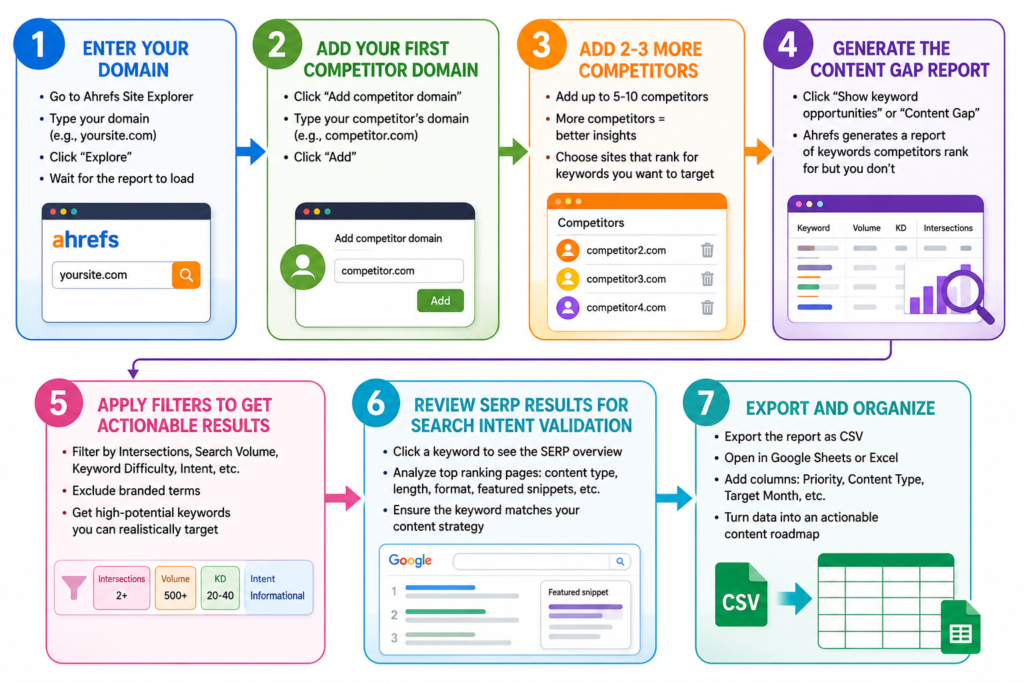
Step 1: Enter Your Domain
1. Go to Ahrefs Site Explorer
2. Type your domain (e.g., yoursite.com)
3. Click “Explore.”
4. Wait for the report to load
Ahrefs crawls your site and compiles all keywords you currently rank for.
Step 2: Add Your First Competitor Domain
On the Competitive Analysis page:
1. Click “Add competitor domain.”
2. Type your competitor’s domain (e.g., competitor.com)
3. Click “Add.”
Ahrefs analyzes what this competitor ranks for.
Pro tip: Choose competitors who rank for keywords you want to target, not just direct business competitors. A SaaS tool company might learn more from a popular blog in its niche than from a direct competitor selling similar software.
Step 3: Add 2-3 More Competitors (Optional but Recommended)
You can add up to 5-10 competitors in Ahrefs.
Why multiple competitors?
One competitor might have a quirky editorial strategy that doesn’t represent the market. Two or three show patterns. Five shows the full picture.
Example: If three competitors all rank for “keyword A” but not “keyword B,” that’s a signal. If only one ranks for “keyword B,” it might be a niche keyword not worth targeting.
Step 4: Generate the Content Gap Report
1. Click “Show keyword opportunities” or “Content Gap.”
2. Ahrefs generates a report showing keywords your competitors rank for, but you don’t
The report appears as a table with:
– Keyword
– Search volume
– Keyword difficulty
– Number of intersections
– Top-ranking pages from competitors
This is your raw list of opportunities.
Step 5: Apply Filters to Get Actionable Results
This step separates useful reports from noise.
Filter 1: Intersections
Set minimum intersections to 2 or higher. This means at least 2 of your competitors rank for this keyword.
Intersections = 1 means only one competitor ranks. These might be outliers.
Filter 2: Search Volume
Set a minimum search volume based on your niche. For a small niche, 100+ monthly searches is solid. For competitive niches, you might want 500+.
Filtering out low-volume keywords eliminates noise.
Filter 3: Keyword Difficulty
If you’re a new site, target keywords with KD 20-40. If you have more authority, you can tackle KD 40-60.
This ensures you’re targeting keywords you can realistically rank for.
Filter 4: Exclude Branded Terms
Add a filter to exclude competitor brand names. You don’t want to target “[Competitor] review” or “[Competitor] pricing.”
Focus on generic, topic-focused keywords.
Filter 5: Search Intent
If you’re creating blog content, filter for “Informational” intent. If you’re building product pages, filter for “Commercial” intent.
This ensures the keywords match your content type.
Step 6: Review SERP Results for Search Intent Validation
Before adding a keyword to your content roadmap, check the actual search results.
In Ahrefs, click the keyword to see the SERP overview:
– What type of content ranks? (Blog posts, comparison pages, tutorials, product pages)
– What’s the content length? (Short snippets, 3,000-word guides, long-form reviews)
– Is there a featured snippet?
This tells you what Google wants for that keyword. Your content needs to match.
Example: If top results are all comparison charts, your content should be a comparison chart—not a 5,000-word guide.
Step 7: Export and Organize
1. Click “Export” (top right of the report)
2. Download as CSV
3. Open in a spreadsheet (Google Sheets, Excel)
Now you have a list of opportunities you can organize further.
In your spreadsheet, add columns:
– Keyword (imported)
– Search Volume (imported)
– KD (imported)
– Intent (imported)
– Priority (add this: High / Medium / Low)
– Content Type (add this: Blog / Guide / Comparison / Product page)
– Target Month (add this: when you’ll create it)
This transforms a data dump into an actionable content calendar.
How to Find the Right Competitors for Content Gap Analysis
This is critical. Bad competitor selection breaks content gap analysis.
Method 1: Organic Competitors Report
In Ahrefs Site Explorer:
1. Click “Organic Competitors” (left sidebar)
2. Ahrefs shows websites that rank for similar keywords to you
These are your SEO-confirmed competitors—sites Google sees as competing with you for the same keywords.
This is usually the best starting point.
Method 2: Check Who Ranks for Your Target Keywords
Search your target keyword in Google.
Look at the top 5-10 results. Whose ranking?
These sites are likely your competitors (or at least, they’re covering your topic).
Add them to your gap analysis.
Method 3: Manual Competitor Research
Who do your customers compare you to?
– Sales team: Ask who comes up in sales calls
– Reddit/forums: Where do people discuss alternatives?
– Review sites: Who’s listed on review sites in your industry?
Add these too.
Critical Warning: Choose Relevantly
Not all top-ranking sites are good competitors for gap analysis.
Example: You run a small SEO blog. Wikipedia ranks for most SEO keywords. Don’t add Wikipedia as a competitor. It will show you thousands of irrelevant gaps (Wikipedia covers everything). Instead, add relevant blogs like Moz, Neil Patel, or Ahrefs.
The Rule: Choose competitors who operate in your niche and serve a similar audience, not just sites that happen to rank for your keywords.
Real Example: Content Gap Analysis in Action
Let me walk you through an actual example so you see exactly how this works.
The Setup
Your site: A small digital marketing blog with 15,000 organic visitors/month
Your competitors: HubSpot, Neil Patel, and Moz
Your target topic: Email marketing
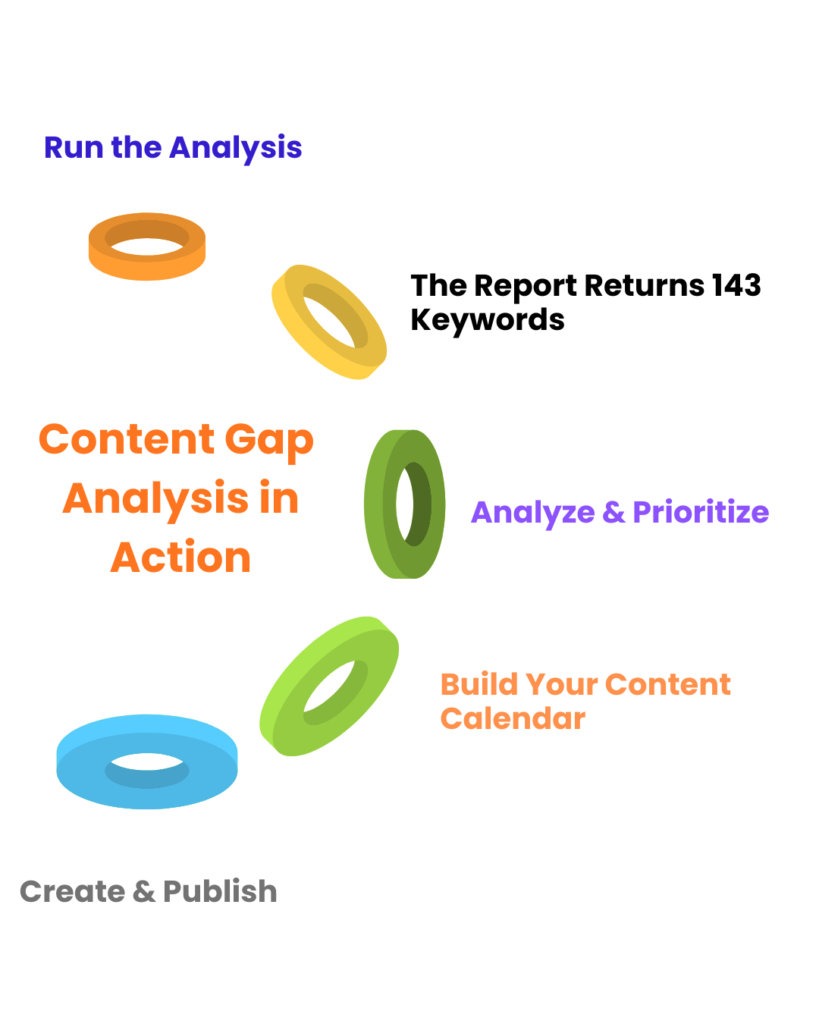
Step 1: Run the Analysis
You enter your domain and add HubSpot, Neil Patel, and Moz.
You filter for:
– Intersections: 2+ (at least 2 competitors rank)
– Search Volume: 500+
– KD: Under 40
– Intent: Informational
– Exclude branded terms
Step 2: The Report Returns 143 Keywords
These are keywords your three competitors rank for, but you don’t.
Your top 10 opportunities:
Step 3: Analyze & Prioritize
You look at the SERP for the top opportunities:
– “Email marketing best practices”: Top results are 3,500-word guides. Lots of lists. Featured snippet opportunity. Priority: High
– “Email marketing strategy”: Same as above. Very similar to the “best practices” keyword. Action: Combine these into one guide
– “Email marketing examples”: Results show blog posts with case studies. Priority: High
– “Cold email template”: Mostly template downloads and tools. Action: Create a downloadable template.
– “Email marketing for e-commerce”: Niche but relevant to your audience. Priority: Medium
Step 4: Build Your Content Calendar
You prioritize 8 of these keywords into your next 2 months:
– Week 1-2: “Email marketing best practices” guide (combining 3 related keywords)
– Week 3-4: “Email marketing examples” with case studies
– Week 5-6: “Cold email templates” downloadable resource
– Week 7-8: “Email marketing for e-commerce” guide
Step 5: Create & Publish
You create the content based on what competitors are doing, but better.
The “Email marketing best practices” guide:
– Includes 25 practices (competitors cover 12-15)
– Has real case studies (competitors have generic examples)
– Includes updated data for 2026 (competitors cite 2024 research)
– Has downloadable checklist (competitors don’t)
The Result
Within 3 months, you’re ranking for:
– “Email marketing best practices” (position 7, trending up)
– “Email marketing examples” (position 4)
– “Cold email templates” (position 2)
– Plus 4-5 related long-tail keywords
Traffic increases 40%. That came from filling content gaps.
How to Analyze Content Gaps (The Deep Dive)
Finding gaps is step 1. Analyzing them properly determines if they’re worth your time.
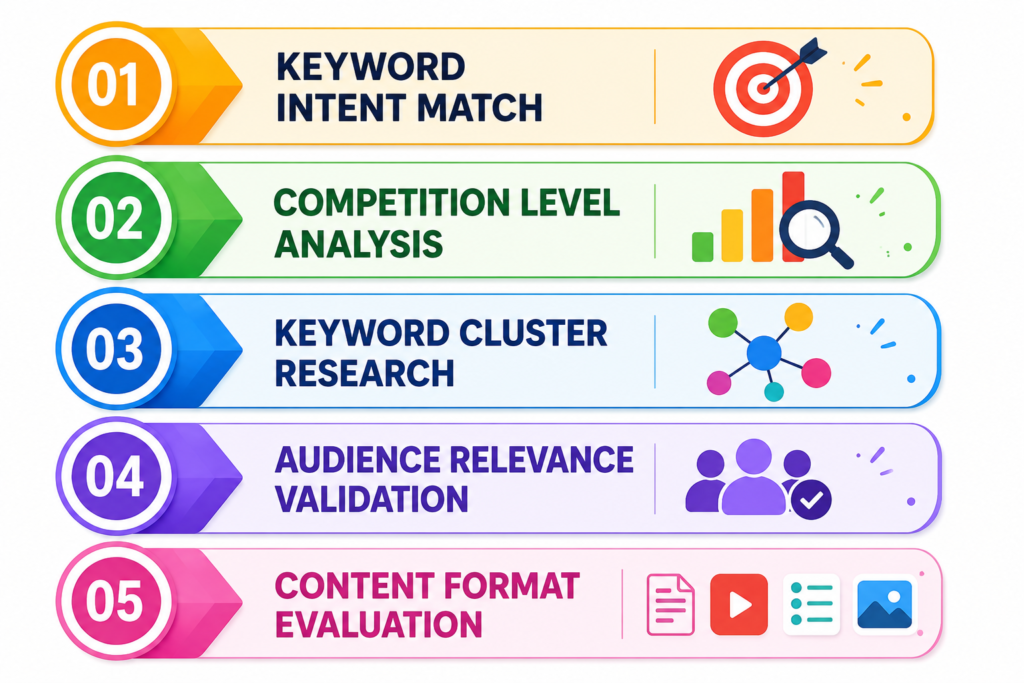
1. Check Keyword Intent Match
A keyword might have 5,000 monthly searches, but if the intent doesn’t match your content angle, skip it.
Example:
– Keyword: “Email marketing software.”
– Your content: A beginner’s guide to email marketing fundamentals
– Match: Poor (people searching this keyword want software recommendations, not basics)
2. Evaluate Competition Level Realistically
Keyword difficulty is a guide, not gospel.
Check the actual SERP. If the top 5 results are all from DR 80+ sites, that keyword is harder than KD 35 suggests.
Filter by “easier” keywords first (KD under 30), build authority, then tackle harder ones.
3. Look for Keyword Clusters
Multiple keywords with nearly identical search results should be combined into one page.
Example:
– “Email marketing tips.”
– “Email marketing best practices.”
– “Email marketing strategies.”
All three searches show similar results. Combine them into one comprehensive guide instead of creating three separate articles.
4. Validate Against Your Audience
Just because a keyword is in your gap doesn’t mean your audience cares.
Ask:
– Does this solve a real problem for my audience?
– Would this lead to conversions (sales, signups, leads)?
– Is this something I’m qualified to write about?
If the answer is no, skip it. Not all gaps are worth filling.
5. Consider Content Format
High-competition gaps often require specific content formats to rank.
– Informational keywords: Long-form guides (3,000-5,000 words)
– How-to keywords: Step-by-step tutorials
– Comparison keywords: Side-by-side comparison charts
– List keywords: Ranked lists or roundups
Check competitor formatting. Match it. Improve on it.
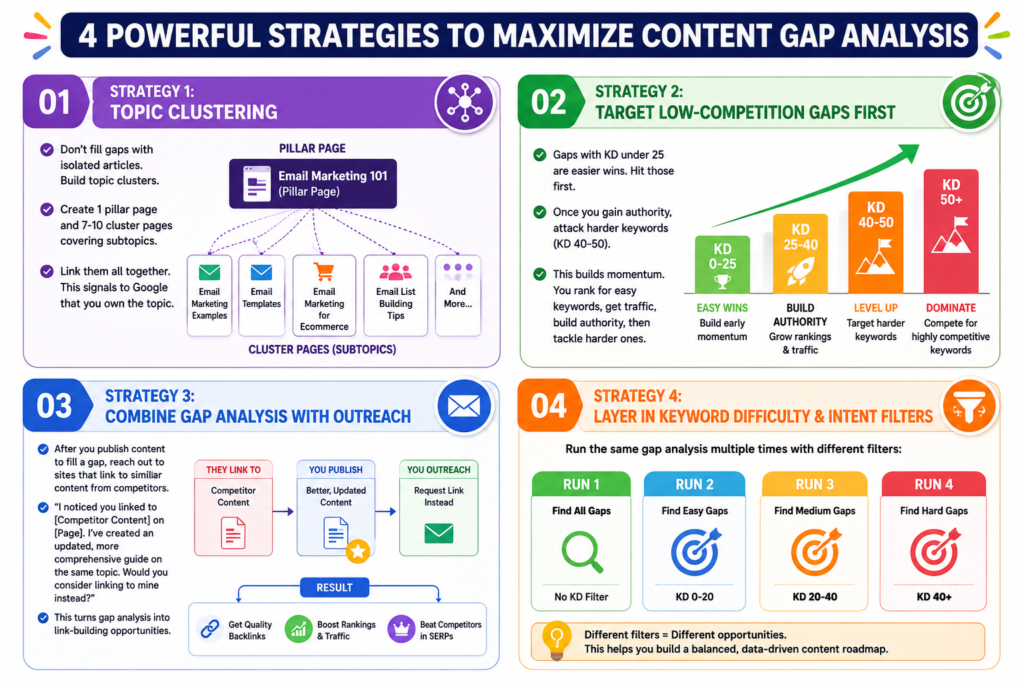
Advanced Content Gap Strategies
Common Mistakes to Avoid
Mistake 1: Targeting Low-Quality Competitor Content
Your competitor’s rank for a keyword doesn’t mean they rank WELL.
Check the SERP. If they’re at position 8 with low traffic, that keyword isn’t actually valuable.
Look for gaps where competitors rank in the top 3. Those are proven high-value keywords.
Mistake 2: Ignoring Search Intent
A keyword might fit your gap, but if it doesn’t match user intent, your content won’t rank.
Example: Targeting “email marketing tools” with a beginner’s guide. People searching this want tool recommendations, not guides.
Always validate search intent before committing content to a keyword.
Mistake 3: Copying Competitor Content
Just because a competitor covers a topic doesn’t mean you should copy their angle.
Your advantage is doing it differently—better research, unique angle, newer data, different format. After drafting the content, you can use AI humanizer to smooth out the wording and give the copy a more natural, conversational feel.
Create content that improves on what competitors did, not content that imitates it.
Mistake 4: Targeting Too Many Competitors
Analyzing 1-2 competitors gives clear gaps. Analyzing 10 creates noise.
If you’re in a crowded niche, focus on 3-4 close competitors, not every site that ranks for your keywords.
Mistake 5: Ignoring Related Keyword Clusters
Content gap tools sometimes split related keywords.
You’ll see:
– “SEO tips”
– “SEO best practices.”
– “SEO strategies”
These are the same topic. Create one comprehensive article covering all three, not three separate articles.
Mistake 6: Not Checking Your Own Site
Before filling a gap, check if you already have content on that topic (possibly not ranking).
It’s faster to update and improve existing content than to create new articles.
Ahrefs vs. Other Content Gap Tools (Comparison)
Verdict: Ahrefs is the industry standard for content gap analysis because of its accuracy and scale. If you’re serious about SEO, the investment is worth it.
Pro Tips for Content Gap Success in 2026
Tip 1: Focus on Low-Hanging Fruit First
Quick wins build momentum. Target gaps with KD under 25 first.
You’ll start ranking within 1-2 months. This builds authority for harder keywords later.
Tip 2: Combine Gap Filling With Content Updates
Don’t just publish new articles.
For existing high-traffic content, analyze if you’re missing subtopics that competitors cover.
Update your article to include those subtopics. Often faster than new content, sometimes more effective.
Tip 3: Build on Trending Gaps
If a gap just appeared (keyword is new), you have a window to rank quickly.
Use Google Trends to identify new keywords in your niche that are rising in search volume.
Then check if they’re in your content gaps.
Tip 4: Layer in User Intent Validation
Ahrefs data is accurate, but always spot-check the actual SERP.
Open the top 3 results for each keyword. Make sure their content matches the search intent.
This 5-minute check saves you from creating content no one’s looking for.
Tip 5: Prioritize Keywords With Multiple Intersections
Gaps where 3+ competitors rank are stronger signals than gaps with 1-2 intersections.
More intersections = more market validation.
FAQs: Content Gap Analysis Ahrefs
What exactly is content gap analysis in SEO?
Content gap analysis identifies keywords and topics your competitors rank for, but you don’t. It reveals opportunities where you’re missing content on topics your audience cares about.
Is the Ahrefs content gap tool worth paying for?
Yes, if you’re committed to SEO. It automates analysis that would take 10+ hours manually. At $99/month, it pays for itself with just one successful piece of content ranking for a gap keyword.
How many competitors should I analyze?
Start with 2-3. Any more than 5 creates noise. You want competitors who serve a similar audience, not every site that ranks for your keywords.
How often should I run content gap analysis?
Every quarter is reasonable. Quarterly updates show new gaps as the market evolves. Monthly is excessive; yearly is too slow.
Can I use content gap analysis for local SEO?
Yes, but with limitations. Local SEO gaps exist (one competitor might cover “plumber Denver” while you don’t), but the tool works better for broader keyword categories.
What if I don’t have competitors identified yet?
Run an Organic Competitors report in Ahrefs Site Explorer first. It automatically shows sites competing with you for keywords. These are your starting competitors.
Should I target every gap keyword?
No. Only target gaps that match your audience’s needs, business goals, and content capabilities. Quality over quantity always wins.
How long does it take to see rankings from gap content?
3-12 weeks, depending on keyword difficulty, your domain authority, and content quality. Low-KD keywords (under 25) often rank within 4-6 weeks. Higher-KD keywords take longer.
Can content gap analysis work for e-commerce sites?
Absolutely. E-commerce sites benefit from finding product comparison gaps, buying guide gaps, and informational content gaps that competitors haven’t covered.
What’s the difference between domain-level and page-level gap analysis?
Domain-level: Shows gaps across your entire site vs. competitor sites. Page-level: Compares individual pages head-to-head. Use domain-level for content strategy, page-level for improving specific articles.
Conclusion
Content gap analysis is one of the highest-ROI SEO activities you can do.
In 4-6 hours, you can:
1. Identify 100+ keyword opportunities
2. Prioritize them by difficulty and value
3. Build a 6-month content calendar
4. Get started on content that’s proven to have audience demand
Here’s what to remember:
Run the analysis: Enter your domain and 2-3 competitors’ domains in Ahrefs Content Gap.
Filter aggressively: Use intersections, search volume, KD, and intent filters to eliminate noise.
Validate manually: Check the actual SERP for your top opportunities. Make sure search intent matches your content plan.
Prioritize: Target low-competition gaps first (KD under 25) to build momentum.
Create better content: Don’t copy competitors. Research more, add unique angles, include updated data, and improve formatting.
Build clusters: Group related gap keywords into topic clusters instead of isolated articles.
Start with your top 10-15 gap opportunities. Create content for those. Track rankings. Iterate. Repeat every quarter.
Content gap analysis won’t guarantee rankings, but it guarantees you’re working on topics with real search demand. That’s the foundation of sustainable SEO success.
