
Grey hat SEO is any search engine optimization tactic that sits between Google-approved optimization and outright spam. It isn’t clearly banned, but it isn’t what Google wants either. Think expired domain redirects, undisclosed paid links, or mass AI pages.
The catch is that Google doesn’t recognize a grey zone. A tactic either fits its spam policies or breaks them. Many “grey” tactics already break them on paper and simply haven’t been caught yet.
We run link building campaigns for SaaS brands and 200+ agency partners, so we see the cleanup work when grey hat SEO goes wrong.
In this guide, you’ll learn what grey hat SEO really means, 12 common techniques ranked by risk, the Google policies each one touches, how AI search changes the picture, and safer ways to get the same results.
What Is Grey Hat SEO?
Grey hat SEO is the use of search tactics that aren’t openly forbidden but bend Google’s guidelines to gain rankings faster. These tactics exploit loopholes, vague wording, or weak detection. They carry more risk than white hat SEO and less than black hat, and many drift into violations over time.
The “hat” labels come from old Western films, where heroes wore white hats and villains wore black. The security world borrowed the terms for hackers first. SEO picked them up in the early 2000s.
You’ll see it spelled two ways. “Grey hat SEO” is the British spelling and “gray hat SEO” is the American one. They mean the same thing.
Google doesn’t recognize “grey”
This is the most important point in the whole topic. Google publishes its spam policies as part of Google Search Essentials (formerly the Google Webmaster Guidelines), and they have no middle category.
So “grey hat” is an industry label, not a Google one. It usually describes one of three situations:
- A violation that’s hard to detect, such as a paid link that looks editorial.
- A legitimate tactic pushed too far, such as a few link swaps that turn into hundreds.
- A tactic in a policy gap that later closes, such as expired domain redirects before March 2024.
The third group matters most. What’s grey today often becomes black after the next spam update.
White Hat vs Grey Hat vs Black Hat SEO
The difference comes down to intent, scale, and risk. White hat SEO follows Google’s rules, grey hat SEO bends them, and black hat SEO breaks them on purpose. The further you move from white, the faster the possible gains and the bigger the chance of losing them.
White hat SEO means ranking by being the best result. You publish high-quality content, improve user experience, fix technical issues, and earn links through outreach and digital PR. It follows Google’s spam policies, carries very little risk, and builds lasting organic traffic. The trade-off is time, since results often take 3 to 6 months.
Grey hat SEO means using shortcuts that look legitimate but bend the rules. Examples include expired domain redirects, undisclosed paid links, and link exchanges at scale. Results can come fast, but the risk is medium to high and grows with every Google spam update.
Black hat SEO means deliberately deceiving search engines. Think cloaking, keyword stuffing, link farms, and hidden links placed on hacked sites. It clearly breaks Google’s policies, and the gains usually vanish once Google catches it, sometimes along with the whole domain.
| White hat | Grey hat | Black hat | |
|---|---|---|---|
| Approach | Follows Google’s rules | Bends the rules | Breaks the rules on purpose |
| Speed | Slow (3 to 6 months) | Fast | Fast |
| Risk | Very low | Medium to high | Very high |
| Gains last? | Yes | Until the next update | Rarely |
Keep one nuance in mind. The same tactic can fall into any of the three groups depending on how you do it. A guest post on a relevant, real publication is a different thing from 50 guest posts on sites that exist only to sell links.
What Makes a Tactic Grey Hat?
A tactic turns into grey hat SEO when its main purpose shifts from helping users to influencing rankings. Four signals decide it: why you’re doing it, how much of it you do, if any payment or favor is hidden, and how relevant it is. Fail one test and you’re in grey. Fail two or more and you’re close to black.
Use these four tests on any tactic before you try it.
- Intent. Would you still do this if search engines didn’t exist? A podcast interview passes. A blog network built only to link to your site fails.
- Scale. Does it look natural at this volume? Five partner links look normal. Five hundred reciprocal links in a month don’t.
- Disclosure. Is a payment, swap, or gift hidden from users and Google? Hidden value exchange is a common reason link tactics get flagged.
- Relevance. Does the link, page, or domain make sense for your topic? A dental clinic linked from a crypto casino blog fails every time.
Google’s own example for expired domains shows this logic. Using an old domain for a new, original site is fine. Using an old medical domain to host casino content is expired domain abuse.
12 Grey Hat SEO Techniques (Ranked by Risk)
The most common grey hat SEO techniques are private blog networks, parasite SEO, expired domain redirects, mass AI content, undisclosed paid links, and link exchanges at scale. Most of them touch a named Google spam policy. Here are all 12, ranked from highest to lowest risk.
1. Private blog networks (PBNs) (High risk)
A PBN is a group of sites you control that exist mainly to link to your money site. Google’s link spam policy covers it directly, and a PBN leaves an obvious pattern in your backlink profile. Footprints like shared hosting, the same theme, or thin posts get networks deindexed. Read our full breakdown of PBN backlinks for the warning signs.
2. Parasite SEO (High risk)
Parasite SEO means publishing your content on a strong third-party site to borrow its ranking power. Google named it site reputation abuse in March 2024. In November 2024, it tightened the policy so that first-party oversight no longer protects the host site.
3. Expired domain redirects and rebuilds (High risk)
You buy an aged domain with good backlinks and domain authority, then 301 it to your site or rebuild it. This was a classic grey hat SEO tactic until March 2024. Now, repurposing a domain mainly to rank low-value content is a named spam policy. A same-niche, same-purpose acquisition is still fine.
4. Mass AI or programmatic pages (High risk)
AI content isn’t banned by itself. Producing many pages mainly to rank, with little original value, is scaled content abuse. Google applies this policy to pages made by AI, by humans, or by both.
5. Undisclosed paid links (High risk)
Paying for a link that passes ranking value without marking it rel=”sponsored” breaks the link spam policy, which Google used to call link schemes. It stays grey in practice because a well-placed paid link looks editorial. We cover this in more depth in the paid links section below.
6. Fake, paid, or gated reviews (High risk)
This includes buying reviews, writing them yourself, or only asking happy customers. In the US, it’s now a legal issue, not only an SEO one. The FTC rule on fake reviews took effect on October 21, 2024.
7. Link exchanges at scale (Medium risk)
A few natural reciprocal links between partners are normal. Google lists excessive link exchanges as link spam. Swapping networks, three-way swaps, and “link for link” spreadsheets cross the line. Our guide to link exchanges shows where it starts.
8. Bot-specific content (Medium risk)
Showing Googlebot a different version of a page than users see is cloaking, a long-standing violation. The grey version is “light” cloaking, like extra keyword text shown only to bots. Legitimate differences such as language by location or mobile layouts are fine.
9. CTR manipulation (Medium risk)
This uses bots or paid click farms to search a keyword and click your result. Results in public tests are mixed and rarely last. Either way, you’re paying for traffic that never converts. Learn more in our post on CTR manipulation.
10. Spun or rewritten content (Medium risk)
Article spinning means rewriting a competitor’s post with tools or cheap writers. It creates near-duplicate content and adds nothing new. It tends to rank briefly, then drop after core updates. At scale, it falls under scaled content abuse.
11. Bulk profile and directory links (Low risk)
Hundreds of forum profiles, bookmarks, and low-quality directories are often the first grey hat SEO move beginners try. They rarely trigger penalties today because Google’s systems mostly ignore them. The risk is wasted budget and a spammy-looking link profile, not a manual action.
12. Clickbait titles (Low risk)
A title that overpromises can lift clicks for a while. If the page doesn’t deliver, users bounce back to the results and the page loses ground. It’s the lowest-risk item here, but it rarely pays off.
Why Do People Still Use Grey Hat SEO?
People use grey hat SEO because it can move rankings faster and cheaper than white hat work, at least for a while. It’s most common in crowded niches like gambling, finance, and affiliate sites, where competitors already use it. The trade is simple: faster gains now for a real chance of losing them later.
Here’s the honest case for it, as its users would make it.
- Speed. An expired domain or a batch of paid links can show movement in weeks, not months.
- Competition. In some niches, the top 10 is full of sites using aggressive links. Staying fully clean feels like bringing a knife to a gunfight.
- Short-term projects. Some affiliate and lead-gen sites are built to earn for a year, then get sold or dropped. A penalty costs them less.
- Testing. Some SEO professionals run grey tactics on test sites to learn how Google reacts, without risking a client.
Now the other side. Most businesses aren’t short-term projects. Your domain holds your brand, your customer trust, and years of work. One manual action can wipe out more value than any grey shortcut ever added.
The Real Risks of Grey Hat SEO
The biggest risks of grey hat SEO are manual actions, algorithmic demotions, links that silently stop counting, and, for reviews, legal fines. Google tightened its spam policies sharply in 2024, so several classic grey tactics are now named violations. The risk isn’t fixed. It grows with every algorithm update.
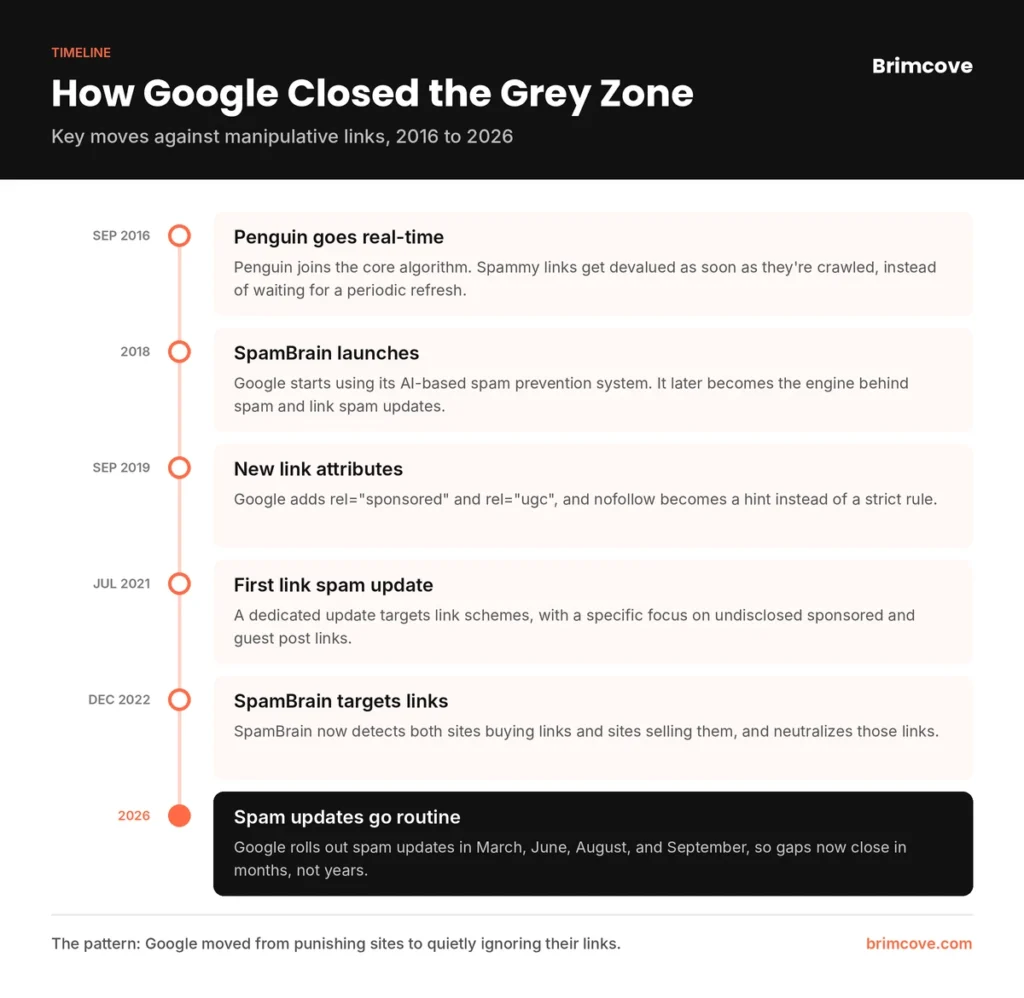
Google’s 2024 spam policies closed the biggest grey areas
In March 2024, Google announced three new spam policies aimed at practices it had seen growing:
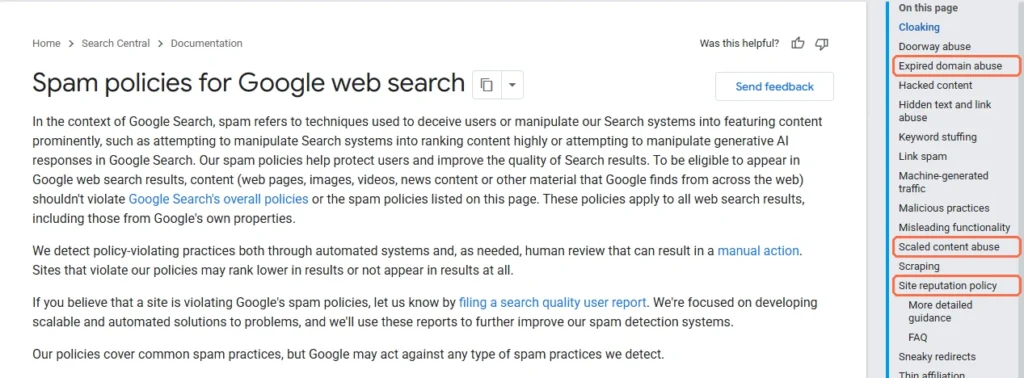
- Expired domain abuse: buying old domains and repurposing them mainly to rank low-value content.
- Scaled content abuse: publishing many pages mainly to manipulate rankings, however they’re produced.
- Site reputation abuse: third-party pages that ride a host site’s ranking signals, also called parasite SEO.
Three of the most popular grey hat SEO tactics of the last decade became named violations in a single announcement. That’s the pattern to expect going forward.
Penalties come in three forms
- Manual actions. A Google reviewer flags your site, often for unnatural links. You get a notice in Search Console, remove what you can, use the disavow tool for the rest, and file a reconsideration request.
- Algorithmic demotion. No notice arrives. Rankings simply drop after a core or spam update.
- Link neutralizing. Google’s systems ignore the links you paid for. Nothing drops, but your budget bought nothing.
The third form is the most common and the least visible. Google’s spam updates are powered by SpamBrain, its AI-based spam detection system, which keeps getting better at spotting paid and manipulative links. Many grey campaigns “work” on a dashboard while doing nothing for rankings.
Reviews carry legal risk, not only SEO risk
The US Federal Trade Commission’s rule on fake reviews took effect on October 21, 2024. It bans buying or selling fake reviews, AI-generated reviews, undisclosed insider reviews, and fake social media followers. Knowing violators face civil penalties of up to $53,088 per violation, the current inflation-adjusted maximum.
Real cases worth remembering
- BMW Germany (2006): Google briefly removed bmw.de from its index for showing search engines keyword-rich pages users never saw.
- J.C. Penney (2011): After a New York Times investigation exposed paid links, its rankings for major product terms collapsed.
- Google Penguin (2012): This algorithm update targeted manipulative links and affected about 3.1% of English search queries, according to Google.
- Forbes Advisor (2024): After the November 2024 site reputation abuse update, sections of the site lost visibility in Google, reportedly even for its own brand name.
These are big, well-known names. If Google acts against them, it won’t hesitate on a mid-sized SaaS or e-commerce site running grey hat SEO.
Paid Links and Sponsored Content: Where Is the Line?
Google’s rule is simple: if you pay for a link that passes ranking value, mark it rel=”sponsored” or rel=”nofollow”. Paid editorial placements are still common in link building, which makes this the most debated area of grey hat SEO. No paid do-follow link is risk-free, so be wary of anyone promising otherwise.
Your risk depends on where the link lives. Use the checklist below, along with our guide to the metrics to check before getting a backlink.
A paid placement is lower risk when:
- The site has real organic traffic, not just a high DR (we require 1,000+ monthly visits in Ahrefs)
- The site’s topic matches your niche
- The post is useful and passes the site’s own editorial review
- The anchor text reads naturally
- The page carries only a few outbound links
Steer clear when:
- The site publishes a public link price list
- Posts are thin and written around the link
- Every placement uses an exact-match anchor
The safest paid option is a disclosed one. Native ads and sponsored links marked rel=”sponsored” follow Google’s policy, so they won’t trigger a penalty. They may not pass ranking value, but they still bring referral traffic and visibility.
If you run guest posting campaigns, check every site against the list above before you pay. Our guest posting service vets every publisher for traffic, relevance, and editorial quality before a single link goes live.
Grey Hat SEO and AI Search
Grey hat SEO is now moving into AI search, aimed at getting brands cited in Google AI Overviews, ChatGPT, and Perplexity. Common examples are self-ranking “best of” listicles, mass-produced comparison pages, and planted brand mentions. The old rules still apply: Google’s spam policies cover these tactics, and some cross legal lines too.
Three patterns to watch:
- Self-serving listicles. A company publishes “best tools” lists that always rank its own product first. If the site claims to be independent, the FTC rule also bans company-controlled review sites that misrepresent their independence.
- Scaled comparison pages. Hundreds of “X vs Y” or “X alternatives” pages made mainly to get picked up by AI answers fall under scaled content abuse.
- Planted mentions. Paid or fake comments in forums and community threads, written to look like real user opinions.
AI tools aim to cite sources they can trust. The safest route to AI visibility is the same as classic SEO: content worth citing and genuine brand mentions on credible sites. We explain the shift in more detail in our post on how AI search is reshaping link building.
Safer Alternatives to Grey Hat SEO
Every grey hat SEO shortcut has a white hat version that reaches the same goal more slowly but keeps the gains. Instead of mass AI pages, for example, publish fewer pages that show real E-E-A-T: experience, expertise, authoritativeness, and trust.
| Grey hat tactic | What it’s trying to do | White hat alternative |
|---|---|---|
| PBN links | Get authority fast | Editorial links from real, relevant publications |
| Expired domain redirects | Inherit old backlinks | Reclaim your own broken links and unlinked brand mentions |
| Undisclosed paid links | Buy placement on strong sites | Vetted guest posts, digital PR, and expert quotes |
| Mass AI pages | Rank for many keywords | Fewer pages with original data, examples, and expert input |
| Link exchanges | Trade authority with peers | Co-marketing: joint webinars, studies, and partner pages |
| Clickbait titles | Raise click-through rate | Specific titles with numbers and a clear promise the page keeps |
| Fake reviews | Build social proof | Ask every customer, not only happy ones, and reply to all reviews |
White hat doesn’t have to mean slow. For CureMD, our in-house team grew organic traffic from 5K to 60K and Domain Rating from 30 to 67 in six months. Every placement was manual, on traffic-verified sites, with no PBNs and no link farms.
Want results like these without the grey hat SEO risk? See how our managed link building service works.
Frequently Asked Questions About Grey Hat SEO
Is grey hat SEO illegal?
Most grey hat SEO isn’t illegal. It breaks Google’s policies, not laws. The exception is reviews. In the US, buying fake reviews or posting undisclosed insider reviews can bring FTC fines of up to $53,088 per violation.
Is grey hat SEO safe?
No grey hat tactic is fully safe. Some carry low risk today, like clickbait titles. Others, like PBNs and parasite SEO, are named violations that lead to manual actions. Risk also rises over time as Google closes gaps.
What is an example of grey hat SEO?
A common example is buying an expired domain in your niche and 301-redirecting it to your site to inherit its backlinks. Others include undisclosed paid links, link exchanges at scale, and mass AI-generated pages.
What is the difference between grey hat and black hat SEO?
Black hat SEO openly deceives search engines through cloaking, hidden text, or hacked links. Grey hat SEO uses tactics that look legitimate but are overdone, undisclosed, or exploit a policy gap. Google treats both the same once it detects a violation.
Does Google penalize grey hat SEO?
Yes, when it detects a violation. Google has no grey category in its spam policies. Penalties range from ignored links to ranking drops to full manual actions shown in Search Console.
Is guest posting grey hat SEO?
Guest posting itself is white hat when the content is useful and the site is relevant. It turns grey when you pay for do-follow links without disclosure, publish on link-selling sites, or use exact-match anchors at scale.
Is AI content grey hat?
AI-assisted content isn’t grey hat by itself. Google judges content by quality and purpose. Publishing many low-value pages mainly to rank falls under scaled content abuse, no matter how the pages were made.
Can grey hat SEO work long term?
Rarely. Grey tactics tend to win until the next spam or core update. Sustainable rankings come from content and links that would still exist if search engines didn’t.
What is grey hat link building?
Grey hat link building means getting backlinks through methods that aren’t obvious spam but still bend Google’s rules. Common examples are undisclosed paid guest posts, link exchanges at scale, and links from expired domains. They can work for a while, but they carry the same risk as other link spam.
Is negative SEO grey hat?
No, negative SEO is black hat. It means attacking a competitor, usually by pointing thousands of spammy links at their site. Google says its systems ignore most of these links, so most sites never need to take action.
Sources
- Google Search Central: March 2024 core update and new spam policies
- Google Search Central: Updating our site reputation abuse policy (Nov 2024)
- Google Search Central: Spam policies for Google web search
- FTC: Final rule banning fake reviews and testimonials
- FTC: Inflation-adjusted civil penalty amounts for 2025
