

Editorial links are the gold standard of SEO—and the hardest to earn.
While most websites are chasing backlinks through guest posts, directory submissions, and questionable link exchanges, the real winners are earning editorial links: natural backlinks from journalists, bloggers, and webmasters who mention their content because it’s genuinely valuable.
Here’s the hard truth: Backlinks aren’t created equal. A link from a major news publication is worth 100 links from random directories. A natural mention in an authoritative blog is worth more than a paid guest post. And a citation in an academic research article is worth more than any scheme you could devise.
Google has always valued editorial links above all others because they’re the hardest to fake. When someone naturally links to your content without being asked, without payment, without any exchange—that’s a signal that your content genuinely deserves attention. That’s an editorial link.
This guide will teach you exactly what editorial links are, why they matter more than any other link type, and most importantly, how to earn them with proven strategies that actually work.
Table of Contents
Quick Definition: What Are Editorial Links?
Editorial links are natural, unpaid backlinks earned by creating valuable content that journalists, bloggers, and webmasters want to link to without being asked.
They are given by editorial decision—not through exchange, payment, or direct request. Someone reads your content, finds it valuable, and decides to link to it because it genuinely deserves the attention.
This is fundamentally different from:
– Guest posts (you create the content on their site)
– Paid links (you pay for the link)
– Directory links (you submit your site)
– Link exchanges (you swap links)
Editorial links are pure merit-based linking.
Why Editorial Links Matter Most for SEO
The Google Perspective
Google’s original PageRank algorithm was built on a simple premise: links are votes. But not all votes are equal. A link from a trusted source is a stronger signal than a link from an untrusted source.
Editorial links represent the strongest possible vote because:
1. They Can’t Be Faked (Authenticity Signal)
You can hire someone to write a guest post. You can buy a link from a private blog network. You can submit to directories. But you can’t directly control whether someone edits an article, reads your content, and decides to link to it naturally.
This authentic editorial decision is exactly what Google values most. It’s the signal that can’t be manipulated.
2. They Indicate Trust and Authority (Trust Signals)
When a respected publication mentions your content, Google infers that your content is trustworthy. If BBC, TechCrunch, or The Guardian links to you, that’s a strong trust signal. Google interprets this as: “If these trusted sites link to you, you must be trustworthy.”
This trust passes through to your entire domain and affects rankings across multiple keywords.
3. They Come From Topically Relevant Sources (Relevance Signals)
Editorial links typically come from sites writing about topics related to your content. A technology blog links to technology content. A marketing publication links to marketing content. This topical relevance strengthens the SEO value of the link beyond generic backlinks from unrelated sites.
4. They Drive Real Referral Traffic (User Behavior Signals)
Editorial links often appear in well-written articles, blog posts, and news pieces where context drives clicks. Someone reading a relevant article sees your link, clicks it, and arrives on your site. This real user behavior—click-through from relevant context—is another positive signal to Google.
5. They Last Longer (Long-Term Value)
Paid links can disappear when payment stops. Broken guest post links decay. But editorial links, once earned, tend to persist because they’re woven into valuable content that stays live for years. This long-term link stability makes them worth much more than temporary links.
Types of Editorial Links: Where They Come From
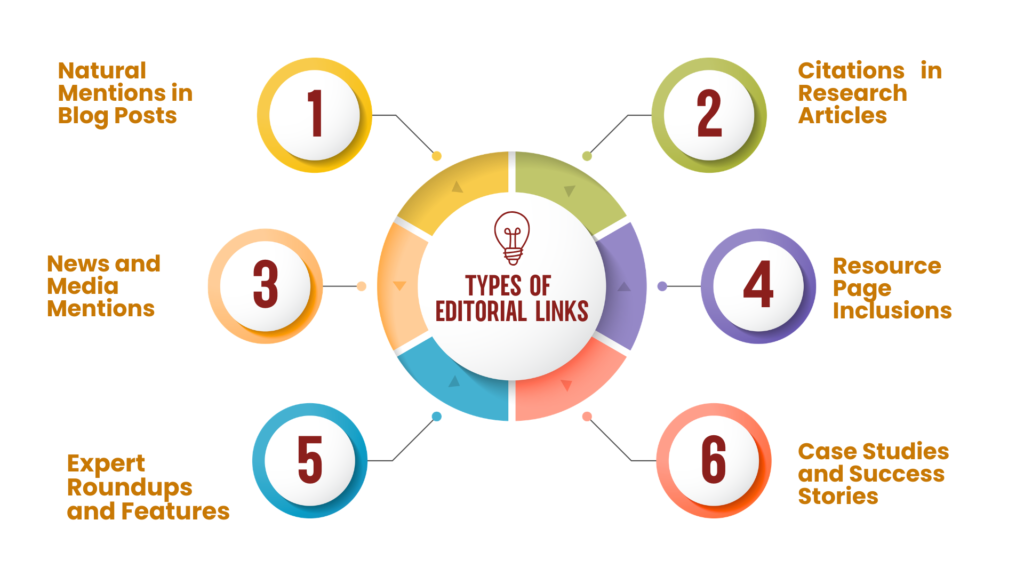
Type 1: Natural Mentions in Blog Posts
A blogger writes an article about a topic related to your content. They naturally discover your content, find it valuable, and link to it as a reference or resource within their article.
Example: You publish a comprehensive guide on “Link Building Strategies.” A marketing blogger writing about “2026 SEO Trends” discovers your guide, finds it excellent, and links to it with the anchor text “comprehensive link building guide.”
How to earn: Create genuinely useful content that others will naturally want to reference.
Type 2: Citations in Research Articles
Academic researchers, industry analysts, or data-driven journalists link to your content as a citation or data source.
Example: You publish original research about “SEO Trends in 2026.” Industry publications and researchers link to your study when discussing SEO trends.
How to earn: Conduct original research, publish unique data, and create citation-worthy insights.
Type 3: News and Media Mentions
Journalists covering your industry or niche discover your content and include it in news articles or press coverage.
Example: You develop a groundbreaking SEO tool. Tech journalists write about it and link to your product page.
How to earn: Create newsworthy content, engage in digital PR, and build media relationships.
Type 4: Resource Page Inclusions
Curators and experts manually compile resource pages of the best content on a topic. They discover your content and add it to their resource list.
Example: You create an SEO learning guide. An SEO expert adds it to their “Best SEO Resources” page.
How to earn: Create exceptionally valuable, comprehensive resources deserving of inclusion in curated lists.
Type 5: Expert Roundups and Features
Publications feature multiple experts answering a question. If you’re recognized as an expert, they link to you when featuring your insights.
Example: A marketing publication publishes “100 Best SEO Experts to Follow.” You’re included with a link to your website.
How to earn: Build thought leadership, establish yourself as an expert, and make yourself known in your industry.
Type 6: Case Studies and Success Stories
When your business or approach becomes noteworthy, other publications feature you in case studies with backlinks.
Example: Your company grows rapidly. Business publications feature a case study about your growth strategy with links to your site.
How to earn: Achieve notable results, build a notable business, and make your story interesting.
Editorial Links vs Guest Posts: Understanding the Critical Difference
This distinction is crucial because many people confuse the two.
Guest Posts:
– You write content on someone else’s website
– You control the content fully
– You decide what gets linked
– The link is part of the arrangement
– Medium SEO value (they’re somewhat predictable)
– Medium effort (you write the article)
Editorial Links:
– Someone else writes about your content
– You don’t control what they say
– They decide to link to you
– No arrangement or negotiation
– Maximum SEO value (they’re authentic)
– High effort (you must create something worth linking to)
The key difference: With guest posts, you’re creating a link arrangement. With editorial links, you’re creating something so valuable that others can’t help but link to it.
Guest posts are faster and easier to scale. Editorial links are more valuable but harder to earn.
The best strategy combines both: use guest posts to build initial authority while simultaneously working to earn editorial links through content excellence.
How to Earn Editorial Links: Five Proven Strategies
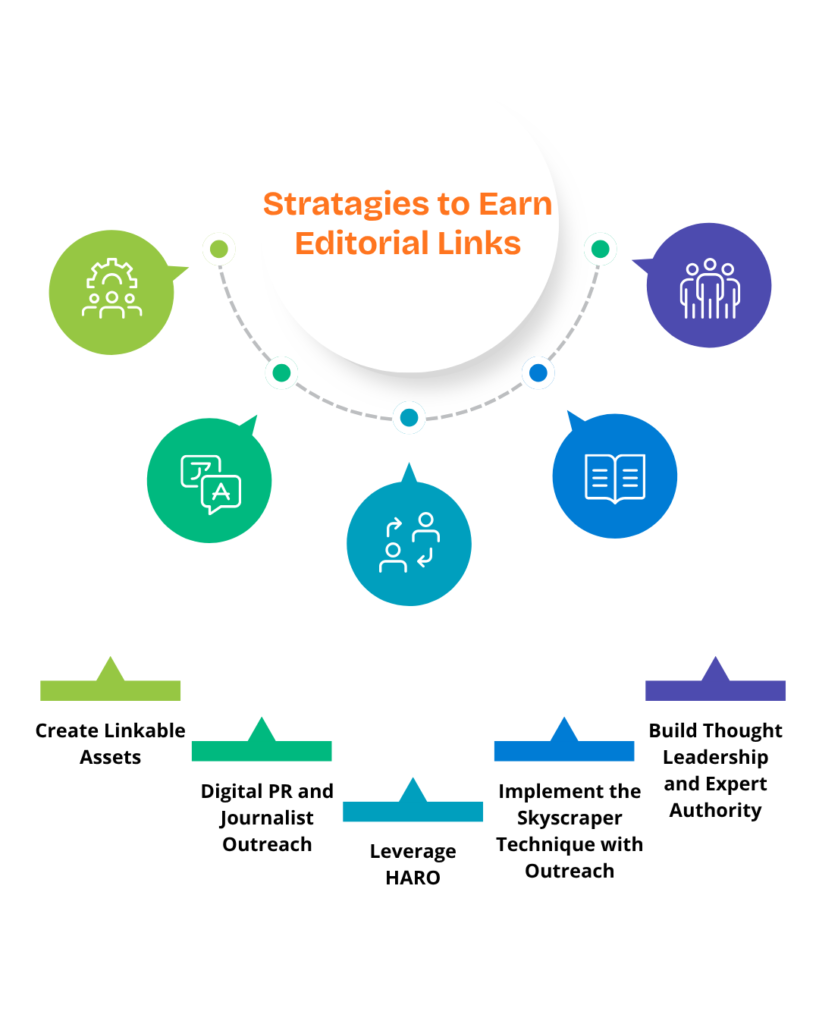
Strategy 1: Create Linkable Assets
This is the foundation of all editorial link earning. You create content so valuable, so useful, so well-researched that people naturally want to link to it.
What makes content linkable:
A. Comprehensive resource guides that become reference material (example: your 5,000-word guide to SEO becomes the standard reference in your industry)
B. Original data and research (examples: surveys, studies, analysis) that journalists and experts cite
C. Infographics that visualize complex data in a shareable format
D. Industry reports that provide unique insights
E. Tools or frameworks that solve real problems
Implementation example: Instead of writing “10 SEO Tips,” write a comprehensive 3,000-word guide that becomes the definitive resource on that topic. Include original data, frameworks, case studies, and insights that make it impossible to ignore. When others write about that topic, they’ll link to it because it’s genuinely the best resource available.
Timeline to results: 2-6 months (slow but sustainable)
Difficulty: High (requires expertise and quality writing)
Strategy 2: Digital PR and Journalist Outreach
You don’t passively wait for editorial links. You actively build relationships with journalists, editors, and media contacts who cover your industry.
How it works:
A. Identify journalists and publications covering your niche
B. Build genuine relationships (follow their work, comment thoughtfully, engage genuinely)
C. Pitch those story ideas related to your expertise
D. Provide expert commentary on trending topics
E. Share your unique insights and data
Implementation example: You run an SEO agency. You identify 20 journalists covering SEO and digital marketing. You follow their work, engage with their articles, and when a trending SEO topic emerges, you pitch them: “I have original data on this topic from analyzing 10,000+ websites. Would you like exclusive access to this data for your article?”
This approach positions you as a valuable source, not a link beggar.
Timeline to results: 2-4 months to build relationships; 1-2 months for coverage
Difficulty: Medium (requires relationship building and pitching skills)
Strategy 3: Leverage HARO (Help A Reporter Out)
HARO connects journalists with expert sources. Journalists post queries, and experts respond. When your response is used in an article, you get an editorial link.
How it works:
A. Sign up for HARO (free or paid)
B. Receive daily queries from journalists
C. Submit thoughtful, expert responses
D. If your response is used, you get quoted and linked
Implementation example: A journalist queries: “Need expert commentary on SEO trends for 2026.” You submit a detailed, insightful response with original data and perspective. Your response is used in their article. You get a backlink from a reputable publication.
Timeline to results: 1-2 weeks per submission; cumulative over months
Difficulty: Low-medium (easy to start; hard to get consistent results)
Strategy 4: Implement the Skyscraper Technique with Outreach
The Skyscraper Technique means:
1. Find popular content in your niche
2. Create something significantly better
3. Reach out to sites linking to the original
4. Ask them to link to your superior version
Implementation example: You find a popular link-building guide with 200+ referring links. You create a more comprehensive version with more tactics, better examples, and updated 2026 data. You identify the 200 sites linking to the original version. You reach out: “I noticed you linked to [original guide]. I’ve created a more comprehensive 2026 update. Would you consider updating your link?”
30% of outreach attempts typically succeed, giving you 60+ new editorial links.
Timeline to results: 3-4 months
Difficulty: Medium (requires content quality + outreach skill)
Strategy 5: Build Thought Leadership and Expert Authority
When you establish yourself as an expert in your field, journalists and editors naturally seek you out for commentary, quotes, and features.
How it works:
A. Create consistently excellent content demonstrating expertise
B. Publish in reputable publications as a contributor
C. Speak at industry conferences
D. Build a recognizable personal brand
E. Engage meaningfully in industry conversations
Implementation example: You become known as “the SEO expert who publishes original data.” You publish three high-quality research reports annually. Journalists know your work. When they cover your topics, they seek you out. You get quoted in articles. Those articles link to your research, your website, and your insights.
This is the long-term, sustainable approach.
Timeline to results: 6-18 months to establish credibility; then ongoing
Difficulty: High (requires consistent excellence and visibility)
Real-World Example: How a Blog Earned 50+ Editorial Links
The Challenge: A new SEO blog wanted to establish authority but had zero editorial links.
The Solution:
1. Month 1-2: Created a comprehensive “SEO Benchmark Report” analyzing 1,000 websites
2. Month 3: Pitched the report to 50 journalists with unique angles for their audiences
3. Month 4-5: 15 journalists published articles featuring their report data
4. Result: 50+ editorial links from media publications, positioning the blog as an authority
Key lesson: The report itself was the “linkable asset.” The media outreach was the distribution. Combined, they generated significant editorial links that a guest post strategy couldn’t match.
Common Mistakes to Avoid When Pursuing Editorial Links
Mistake 1: Creating mediocre content and expecting editorial links
Editorial links require exceptional content. Average content gets average links. If your content is just “good,” it won’t be linked editorially. Create something remarkable.
Mistake 2: Over-optimizing anchor text in outreach
When outreach mentions your content, let editors use natural anchor text. Asking for specific keyword-rich anchor text signals you care more about SEO than value. Editors will reject this.
Mistake 3: Pitching to journalists about your business
Journalists don’t care about your business. They care about your audience. Pitch stories that serve their readers, not yours.
Mistake 4: Giving up too soon
Editorial links take longer than guest posts. Many people quit after a few months. The agencies earning 50+ editorial links annually are typically 6-12 months into their effort before seeing traction.
Mistake 5: Confusing editorial links with earned media
Editorial links are unpaid, unsolicited backlinks. If you paid for media coverage or directly negotiated placement, that’s not an editorial link—that’s paid media.
Mistake 6: Ignoring relationship building
You can’t outreach your way to sustainable editorial links. You must build genuine relationships with journalists and editors who will naturally think of you when relevant stories emerge.
How to Measure Editorial Links and Their Impact
Metrics to Track
1. Editorial Link Count
Track the number of editorial links you’ve earned. Use tools like Ahrefs or SEMrush to identify which links are editorial vs other types.
2. Domain Authority of Referring Sites
Not all editorial links are equal. A link from a DA 80 site is more valuable than a link from a DA 40. Track the average DA of your editorial links.
3. Referral Traffic from Editorial Links
Editorial links should drive real traffic. Measure how much qualified traffic each editorial link sends.
4. Ranking Improvements
Monitor whether earning editorial links correlates with ranking improvements for your target keywords.
5. Brand Search Volume
As editorial links increase, brand mentions increase, which often increases branded searches—a positive SEO signal.
Measurement Framework
Create a simple spreadsheet tracking:
– Link source (publication name)
– Date acquired
– Anchor text used
– Domain Authority
– Referral traffic (first month)
– Keywords ranking improved (3 months later)
This data helps you understand which editorial link sources are most valuable and where to focus future efforts.
Pros and Cons of Pursuing Editorial Links
Pros
R1. Highest SEO value per link
R2. Sustainable long-term (links don’t disappear)
R3. Google-friendly (no risk of penalty)
R4. Drives real referral traffic
R5. Builds genuine authority
R6. Creates competitive advantage (hard for competitors to replicate)
R7. Often leads to additional opportunities (once one publication links, others follow)
Cons
R1. Very difficult to earn (requires exceptional content)
R2. Slow process (3-6 months for results)
R3. Unpredictable timing
R4. Requires consistent excellence (you can’t be mediocre)
R5. Relationship-dependent (takes time to build media connections)
R6. Hard to scale (can’t systematize like guest posts)
R7. Requires skills beyond SEO (PR, content, pitching)
Editorial Links in Your Overall SEO Strategy
Editorial links should be part of a diversified link-building strategy:
50% of effort: Creating exceptional linkable assets
30% of effort: Guest posts and broken link building (faster, easier, still valuable)
20% of effort: Relationship building and digital PR
This allocation balances the slow burn of editorial links with the faster wins of other link types.
Timeline and Expectations
Months 1-2: Create linkable assets, build initial media relationships (0-2 editorial links)
Months 3-4: Implement outreach, see first editorial links appear (3-8 editorial links)
Months 5-8: Editorial links accelerate, relationships pay off (8-20 editorial links)
Months 9-12: Sustainable editorial link flow as authority establishes (5-10 per month)
Year 2+: Consistent editorial links as thought leadership takes hold (10-20 per month)
FAQs: Editorial Links Explained
What’s the difference between an editorial link and a natural link?
Editorial links are natural links. All editorial links are natural (unpaid, unsolicited), but not all natural links are editorial (some come from random blogs, forums, comments). Editorial specifically refers to links given through editorial decision in established publications.
Can I ask someone for an editorial link?
Once you ask, it’s no longer editorial—it’s earned media or relationship-based. True editorial links happen when someone independently decides to link to your content. However, you can build relationships with editors who, when appropriate, naturally think of your content.
How many editorial links do I need to rank?
Quantity matters less than quality. One link from the BBC is worth more than 100 links from random blogs. Focus on editorial links from authoritative, topically relevant publications rather than accumulating volume.
How long do editorial links take to pass link value?
Immediately. Unlike some types of links that take time to pass value, editorial links from established publications pass value and influence rankings relatively quickly (often within 2-4 weeks).
Can I build editorial links for my clients as an agency?
Yes, but it’s slow. Many agencies combine guest posts, broken link building, and PR-based outreach to deliver faster results while also pursuing editorial links as a long-term strategy.
Do editorial links help with featured snippets?
Editorial links don’t directly influence featured snippets, but the authority they build can help. They’re more valuable for domain authority and overall ranking ability than specific features.
Final Thoughts: The Real Value of Editorial Links
Editorial links represent something fundamental about SEO: the best ranking strategy is to create content so valuable that others can’t ignore it. To earn mentions so naturally that people link because they want to, not because they’re paid to or because they feel obligated.
This is the opposite of manipulation. It’s authentic, sustainable, and aligned with Google’s core ranking philosophy.
Pursuing editorial links forces you to think differently about content. Instead of “What keywords should I target?” you ask, “What valuable content can I create that deserves to be linked from major publications?”
This mindset shift—from keyword-focused to value-focused—is ultimately more profitable for business and more effective for long-term SEO success.
Start with one linkable asset. Pitch it to ten journalists. Get your first editorial link. Then repeat. Build momentum. Within a year, you’ll have a pipeline of editorial links that will give you a competitive advantage most competitors will never achieve.
That’s the real power of editorial links: sustainable, authentic, lasting SEO success.
