
Generating website traffic is easy. Generating qualified B2B leads that turn into long-term customers is where the real challenge begins.
Unlike B2C businesses, B2B companies sell products and services through longer sales cycles, multiple decision-makers, and high-value contracts. Before speaking with a sales representative, potential buyers spend weeks, or even months, researching solutions, comparing vendors, and evaluating their options. If your business isn’t visible during this research process, you’re likely losing valuable opportunities to competitors.
That’s where a B2B SEO Consultant makes a difference.
A successful B2B SEO strategy isn’t about ranking for the highest-volume keywords. It’s about attracting decision-makers who are actively searching for solutions, building trust through valuable content, and converting organic traffic into qualified leads.
Whether you’re a SaaS company, enterprise software provider, manufacturer, professional services firm, or technology business, SEO can become one of your most profitable long-term marketing channels when executed strategically.
In this guide, you’ll learn what a B2B SEO consultant does, why SEO requires a different approach for B2B companies, the services you should expect, and how the right strategy can help your business achieve sustainable growth.
Table of Contents
What Is a B2B SEO Consultant ?
A B2B SEO consultant is a search engine optimization specialist who helps business-to-business companies improve their visibility in search engines to attract qualified prospects rather than simply increasing website traffic.
Unlike general SEO professionals, a B2B consultant understands how businesses research solutions, evaluate vendors, and make purchasing decisions. Their focus goes beyond rankings; they create strategies that support lead generation, brand authority, and revenue growth.
Instead of applying generic SEO tactics, they develop a customized strategy based on your business goals, target audience, industry, and competitive landscape.
Core Responsibilities of a B2B SEO Consultant
A consultant’s role extends across every aspect of SEO to ensure your website performs effectively in search results while supporting your sales objectives.
Typical responsibilities include:
- Developing a tailored SEO strategy
- Conducting keyword research based on buyer intent
- Performing technical SEO audits
- Improving website architecture and internal linking
- Creating content strategies aligned with the buyer’s journey
- Optimizing landing pages for conversions
- Analyzing competitors and identifying growth opportunities
- Building high-quality backlinks
- Monitoring rankings, traffic, and lead generation
- Providing ongoing reporting and strategic recommendations
Rather than focusing on vanity metrics like impressions or page views, a consultant prioritizes outcomes that contribute to business growth.
Why B2B SEO Is Different from B2C SEO
Although the fundamentals of SEO remain the same, B2B companies face unique challenges that require a more strategic approach.
Longer Buying Cycles
B2B purchases rarely happen after a single website visit. Buyers spend time researching solutions, comparing providers, and gathering information before deciding.
Multiple Decision-Makers
Purchasing decisions often involve marketing managers, executives, finance teams, IT departments, and procurement specialists. Each stakeholder has different concerns and searches for different information.
Complex Products and Services
B2B businesses typically sell solutions that require education before purchase. Buyers expect detailed information, industry expertise, and proof of results rather than short promotional copy.
Higher Customer Lifetime Value
A single qualified lead can generate thousands—or even millions—of dollars in long-term revenue. Because of this, attracting fewer but highly qualified visitors is often more valuable than generating large amounts of untargeted traffic.
When Should You Hire a B2B SEO Consultant?
Many businesses seek SEO support only after experiencing declining rankings or reduced website traffic. However, the best time to hire a consultant is before these issues impact your growth.
Consider working with a consultant if:
- Your website receives traffic but generates few qualified leads.
- Competitors consistently outrank your business.
- You’re launching a new website or redesigning an existing one.
- Your business relies heavily on paid advertising for lead generation.
- Your content isn’t attracting your ideal audience.
- You want to expand into new industries or geographic markets.
- Your website has unresolved technical SEO issues.
Addressing these challenges early helps build a stronger foundation for sustainable organic growth.
Why B2B Companies Need SEO Consulting
Search engines have become one of the first places business buyers look when researching products and services. Whether they’re searching for industry insights, comparing vendors, or evaluating potential partners, your website needs to appear at every stage of the buying journey.
A B2B SEO consultant helps position your business where it matters most—when potential customers are actively searching for solutions.
Reach Buyers Throughout the Sales Funnel
Most B2B purchases involve several stages before a decision is made.
During the awareness stage, buyers search for educational information.
Examples include:
- What is enterprise SEO?
- Benefits of cloud ERP software
- How to improve lead generation
As they move into the consideration stage, searches become more specific.
For example:
- Best CRM software for healthcare
- Enterprise SEO consultant
- SaaS SEO consultant
Finally, buyers enter the decision stage by searching for providers.
Typical searches include:
- B2B SEO consultant
- SEO consultant for B2B companies
- B2B SEO services
- Request SEO consultation
An effective SEO strategy ensures your business appears throughout this journey rather than only targeting prospects who are ready to buy immediately.
Generate Qualified Leads Instead of Just Traffic
One of the biggest misconceptions about SEO is that success is measured by traffic alone.
In reality, business growth comes from attracting the right visitors.
For example, 200 visitors searching specifically for enterprise software implementation may generate significantly more revenue than 10,000 visitors searching broad informational topics.
A consultant focuses on identifying commercial-intent keywords that bring decision-makers to your website rather than casual browsers.
This results in:
- Higher-quality leads
- Better conversion rates
- More sales opportunities
- Lower customer acquisition costs
Build Trust Before the First Sales Call
Modern buyers prefer to educate themselves before speaking with a salesperson.
By creating valuable resources that answer common questions, explain industry challenges, and demonstrate expertise, your business earns credibility long before a prospect submits a contact form.
This trust often shortens the sales cycle because buyers already recognize your company as a knowledgeable partner.
Reduce Dependence on Paid Advertising
Paid advertising delivers immediate visibility, but traffic stops as soon as the campaign ends.
SEO works differently.
A well-optimized service page or comprehensive industry guide can continue attracting qualified visitors for months or even years with regular updates.
Over time, this creates a sustainable source of organic leads that complements your paid marketing efforts and improves overall return on investment.
Gain a Competitive Advantage
If your competitors consistently appear above your business in search results, they’re capturing potential customers before you even have the opportunity to introduce your services.
An experienced consultant analyzes competitor strategies to identify:
- Keyword opportunities
- Content gaps
- Technical weaknesses
- Backlink opportunities
- User experience improvements
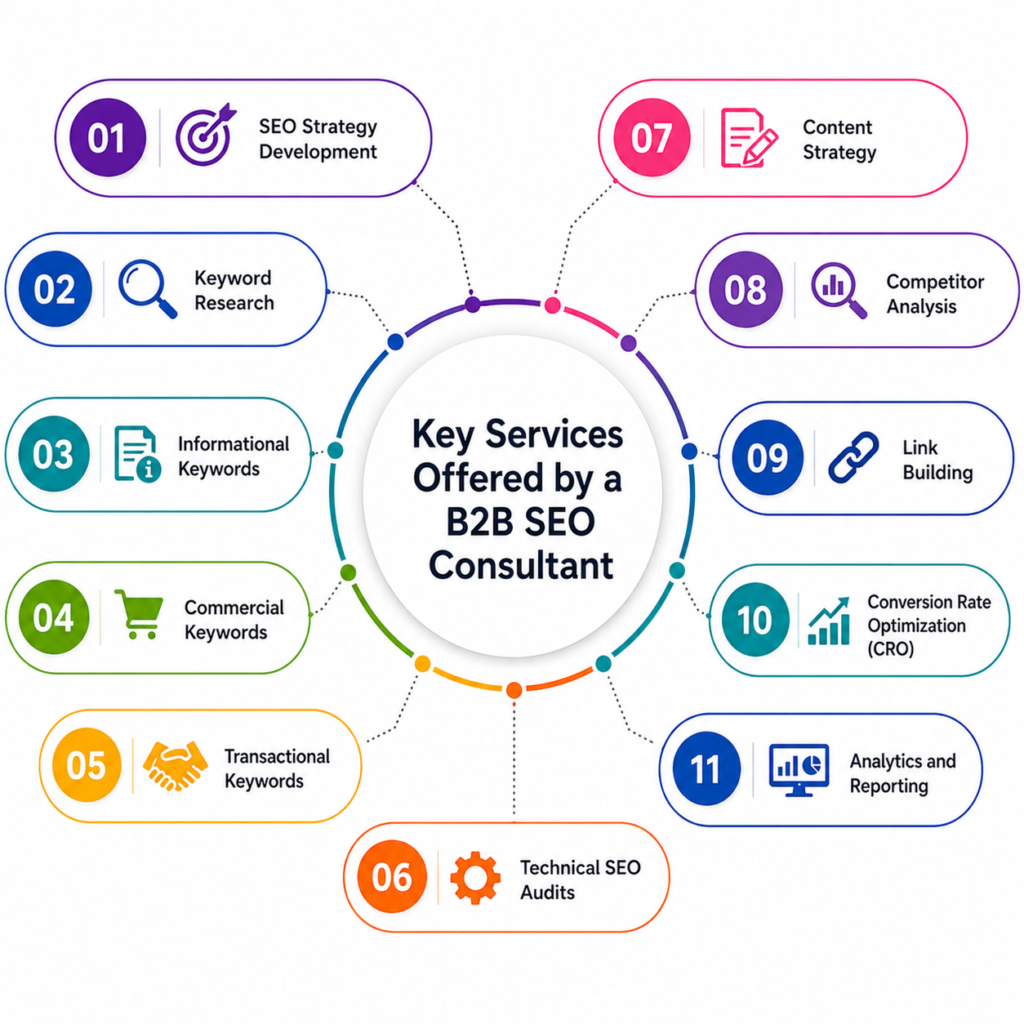
Key Services Offered by a B2B SEO Consultant
A successful SEO campaign is built on strategy, not guesswork. Every business has different goals, audiences, and competitive challenges, so a professional consultant creates a customized plan instead of relying on generic SEO checklists.
Here are the core services you should expect when working with a B2B SEO consultant.
SEO Strategy Development
Every successful SEO campaign begins with understanding the business behind the website.
Before making recommendations, a consultant analyzes:
- Business goals
- Products and services
- Target audience
- Sales process
- Industry competition
- Current website performance
- Existing marketing efforts
Using this information, they create a roadmap that outlines priorities, timelines, and measurable objectives. This strategy ensures every SEO activity contributes to generating qualified leads and supporting long-term business growth.
Keyword Research
Effective keyword research goes beyond search volume. It focuses on understanding how potential customers search for solutions throughout the buying journey.
A consultant identifies keywords based on search intent, including:
Informational Keywords
These attract users during the awareness stage.
Examples include:
- What is B2B search engine optimization?
- Benefits of technical SEO
- How SEO generates B2B leads
Commercial Keywords
These target buyers who are comparing different solutions.
Examples include:
- Best B2B SEO consultant
- Enterprise SEO consultant
- SaaS SEO consultant
Transactional Keywords
These indicate strong buying intent.
Examples include:
- Hire a B2B SEO consultant
- B2B SEO consulting services
- SEO consultant for B2B companies
Balancing all three keyword types helps businesses attract visitors at every stage of the customer journey.
Technical SEO Audits
Even outstanding content cannot perform well if search engines struggle to crawl or understand your website.
A technical SEO audit identifies issues that may limit organic performance, such as:
- Crawl and indexing errors
- Broken links
- Redirect issues
- Duplicate content
- Missing metadata
- Slow page speed
- Mobile usability problems
- Core Web Vitals
- XML sitemap issues
- Schema markup opportunities
Improving technical SEO creates a stronger foundation for every other optimization effort while enhancing the overall user experience.
Content Strategy
Content remains one of the most influential ranking factors in B2B SEO.
However, publishing blog posts without a clear purpose rarely produces meaningful results.
Successful B2B SEO begins with a content strategy that aligns with both search intent and business goals.
This may include:
- Service pages
- Educational blog posts
- Industry guides
- Comparison articles
- Case studies
- Resource hubs
- FAQs
- White papers
Every piece of content should answer a specific question, solve a customer problem, or help buyers move closer to making a purchasing decision.
Rather than creating content for search engines alone, the goal is to create resources that genuinely help prospective customers.
Competitor Analysis
Understanding your competitors provides valuable insight into opportunities within your industry.
A consultant evaluates:
- Top-ranking keywords
- High-performing content
- Backlink profiles
- Website structure
- Content gaps
- User experience
- Internal linking strategies
This research helps identify areas where your business can provide greater value and earn stronger search visibility.
The objective isn’t to copy competitors but to outperform them by creating more useful, comprehensive, and authoritative content.
Link Building
Backlinks remain an important ranking factor because they signal authority and trust.
However, successful link building focuses on quality rather than quantity.
Common strategies include:
- Digital PR
- Guest contributions
- Industry partnerships
- Resource page outreach
- Original research
- Linkable assets
- Reclaiming unlinked brand mentions
Avoiding low-quality link schemes helps protect your website from penalties while building long-term authority.
Conversion Rate Optimization (CRO)
Generating traffic is only part of the equation.
A consultant also focuses on converting visitors into qualified leads by improving the user experience.
Typical CRO improvements include:
- Stronger calls-to-action
- Better landing page layouts
- Simplified contact forms
- Faster loading pages
- Trust signals such as testimonials and certifications
- Mobile optimization
Even small improvements in conversion rates can significantly increase the return on your SEO investment.
Analytics and Reporting
SEO should always be guided by data.
A consultant monitors performance through key metrics such as:
- Organic traffic
- Keyword rankings
- Lead generation
- Conversion rates
- User engagement
- Backlink growth
- Technical website health
Instead of simply reporting numbers, they explain what those metrics mean and recommend actions that support future growth.
Benefits of Hiring a B2B SEO Consultant
Hiring a B2B SEO consultant isn’t simply about improving rankings—it’s about building a sustainable marketing channel that consistently attracts qualified prospects and supports long-term business growth.
Here are some of the biggest advantages.
Generate More Qualified Leads
SEO helps attract people who are actively searching for the products or services you offer.
Unlike interruption-based marketing, organic search reaches buyers with existing intent, making them more likely to convert into leads and customers.
Increase Search Visibility
Improving rankings for relevant keywords allows your business to appear when decision-makers are researching solutions.
Greater visibility leads to:
- More qualified traffic
- Higher brand awareness
- Increased credibility
- More sales opportunities
Achieve Better Marketing ROI
While paid advertising stops generating traffic when budgets end, SEO continues producing results over time.
High-quality service pages, resource guides, and educational content can generate leads for years with ongoing optimization.
This makes SEO one of the most cost-effective long-term marketing investments.
Build Industry Authority
Publishing valuable content positions your business as a trusted source of information.
Over time, this authority encourages:
- Higher search rankings
- More backlinks
- Greater customer trust
- Improved conversion rates
Businesses prefer working with companies they view as experts, and SEO helps establish that credibility.
Support Sustainable Growth
Unlike short-term marketing campaigns, SEO compounds over time.
Each optimized page, authoritative backlink, and helpful article strengthens your website’s ability to rank for additional keywords.
As your online authority grows, attracting new customers becomes easier and more cost-effective.
B2B SEO Consultant vs SEO Agency
Many businesses struggle to decide whether they should hire an SEO consultant or partner with an agency.
The right choice depends on your objectives, budget, and internal resources.
| Feature | B2B SEO Consultant | SEO Agency |
| Strategy | Highly customized | Often standardized |
| Communication | Direct with the consultant | Usually through an account manager |
| Flexibility | High | Moderate |
| Cost | More flexible | Typically higher retainers |
| Best For | Businesses needing strategic expertise | Companies requiring large execution teams |
Choose a Consultant If You:
- Need strategic guidance.
- Already have an internal marketing team.
- Prefer direct communication.
- Want customized recommendations.
- Need flexibility as your business grows.
Choose an Agency If You:
- Need SEO alongside paid advertising, web development, and design.
- Require a larger team for execution.
- Want multiple marketing services managed under one provider.
Both options can deliver results, but the best choice depends on your business needs rather than company size alone.
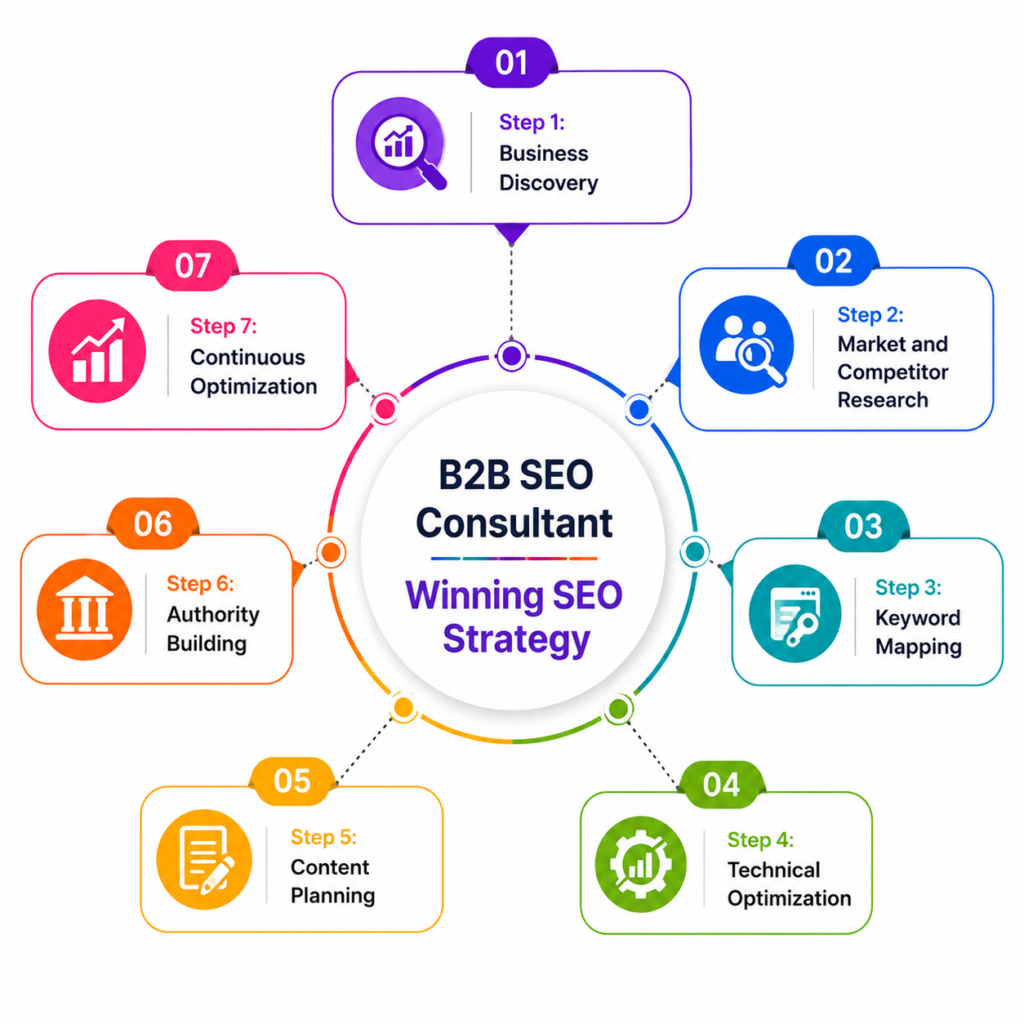
How a B2B SEO Consultant Creates a Winning SEO Strategy
An effective SEO strategy follows a structured framework designed to align search optimization with business objectives.
Step 1: Business Discovery
The consultant begins by understanding:
- Business goals
- Target audience
- Products or services
- Competitive positioning
- Revenue objectives
This foundation ensures every SEO recommendation supports overall business growth.
Step 2: Market and Competitor Research
Next comes an in-depth analysis of competitors, search trends, and industry opportunities.
The consultant identifies:
- Keyword gaps
- Content opportunities
- Competitive strengths
- Areas where your business can differentiate itself
Step 3: Keyword Mapping
Each important keyword is assigned to the most relevant page.
This prevents keyword cannibalization while creating a logical website structure that search engines can easily understand.
Step 4: Technical Optimization
The website is optimized for:
- Speed
- Mobile usability
- Crawlability
- Internal linking
- Structured data
- Core Web Vitals
A technically sound website provides the foundation for sustainable rankings.
Step 5: Content Planning
Instead of publishing random blog posts, the consultant develops a content roadmap aligned with the buyer’s journey.
This includes educational articles, service pages, comparison guides, and case studies that support every stage of the sales funnel.
Step 6: Authority Building
High-quality backlinks are earned through digital PR, partnerships, original research, and valuable content assets.
These efforts strengthen domain authority and improve long-term ranking potential.
Step 7: Continuous Optimization
SEO is never complete.
Performance is reviewed regularly, allowing the strategy to evolve based on:
- Ranking changes
- User behavior
- Lead generation
- Search engine updates
- Business priorities
Continuous improvement helps maintain growth and adapt to changing market conditions.
- Slow-loading pages
- Broken internal links
- Duplicate content
- Poor mobile experience
- Missing metadata
- Crawl and indexing errors
Regular technical audits help identify and resolve these issues before they impact search performance.
Common B2B SEO Mistakes to Avoid
Even businesses that invest in SEO often struggle to achieve consistent results because they overlook fundamental best practices. Avoiding these common mistakes can save time, improve performance, and maximize your return on investment.
1. Targeting Broad Keywords Instead of Buyer Intent
Many businesses focus on keywords with high search volume, assuming they’ll generate more leads. In reality, broad keywords often attract visitors who aren’t ready to buy.
For example, a keyword like “marketing” may generate significant traffic, but a more specific keyword such as “B2B SEO Consultant” or “Enterprise SEO Consultant” attracts users with much stronger purchase intent.
Prioritize keywords that align with your products, services, and target audience rather than chasing traffic alone.
2. Ignoring Technical SEO
Technical issues can prevent even the best content from ranking well.
Common problems include:
- Slow-loading pages
- Broken internal links
- Duplicate content
- Poor mobile experience
- Missing metadata
- Crawl and indexing errors
Regular technical audits help identify and resolve these issues before they impact search performance.
3. Publishing Content Without a Strategy
Publishing articles simply to maintain a blogging schedule rarely produces meaningful results.
Every piece of content should have a clear purpose, whether it’s attracting new visitors, educating prospects, supporting product pages, or generating leads.
A structured content strategy ensures every article contributes to your broader SEO goals.
4. Weak Internal Linking
Internal links help both users and search engines navigate your website.
A strong internal linking strategy:
- Improves crawlability
- Distributes page authority
- Encourages visitors to explore more content
- Supports topic clusters
- Improves user experience
Each page should naturally link to relevant services, blog posts, and resources where appropriate.
5. Failing to Track Conversions
Traffic alone doesn’t measure SEO success.
Businesses should monitor metrics that directly impact revenue, including:
- Contact form submissions
- Demo requests
- Consultation bookings
- Qualified leads
- Conversion rates
Understanding which pages drive conversions allows you to refine your strategy and focus on high-performing content.
6. Expecting Immediate Results
SEO is a long-term investment.
While technical improvements may show results relatively quickly, meaningful increases in rankings, traffic, and lead generation typically take several months.
Businesses that remain consistent and continue optimizing their websites often achieve the strongest long-term results.
How to Choose the Right B2B SEO Consultant
Choosing the right SEO consultant is one of the most important decisions you’ll make for your digital marketing strategy.
Rather than focusing solely on price, evaluate their expertise, communication, and ability to align SEO with your business objectives.
Look for Relevant Experience
B2B SEO differs significantly from B2C marketing.
Choose a consultant with experience working with:
- SaaS companies
- Enterprise businesses
- Professional service firms
- Technology companies
- Manufacturing organizations
- Other businesses with complex buying journeys
Industry experience helps shorten the learning curve and leads to more effective strategies.
Review Case Studies
Ask for examples of previous work that demonstrate measurable results.
Look for improvements in:
- Organic traffic
- Qualified leads
- Keyword visibility
- Conversion rates
- Revenue growth
Strong case studies demonstrate the consultant’s ability to deliver meaningful business outcomes rather than simply improving rankings.
Understand Their Process
A professional consultant should explain their methodology clearly.
Ask questions such as:
- How do you conduct keyword research?
- What does your technical audit include?
- How do you develop a content strategy?
- How do you measure SEO success?
- What reporting will I receive?
Clear answers indicate a structured, strategic approach rather than guesswork.
Evaluate Communication
SEO is an ongoing partnership.
Choose someone who:
- Communicates regularly
- Explains technical concepts clearly
- Provides actionable recommendations
- Sets realistic expectations
- Responds promptly to questions
Strong communication builds trust and keeps projects moving efficiently.
Prioritize Transparency
Avoid consultants who guarantee first-page rankings or promise instant success.
Instead, choose professionals who:
- Set realistic expectations
- Explain their recommendations
- Share regular performance reports
- Focus on long-term business growth
Sustainable SEO is built on consistent improvement—not shortcuts.
Frequently Asked Questions
What does a B2B SEO consultant do?
A B2B SEO consultant develops and manages strategies that improve a company’s visibility in search engines. Their responsibilities include keyword research, technical SEO, content strategy, competitor analysis, link building, and performance reporting, all intending to generate qualified business leads.
How much does B2B SEO consulting cost?
Pricing depends on the scope of work, industry competition, website size, and the consultant’s experience. Some consultants charge hourly, while others offer monthly retainers or project-based pricing. The best approach is to evaluate the expected return on investment rather than choosing solely based on cost.
How long does B2B SEO take?
SEO is a long-term strategy. While some technical improvements can produce early results, most businesses begin seeing meaningful growth within three to six months, with continued improvements over time.
Is SEO worth it for B2B companies?
Yes. SEO helps businesses attract high-intent prospects, build brand authority, reduce reliance on paid advertising, and generate qualified leads over the long term.
What’s the difference between B2B and B2C SEO?
B2B SEO focuses on business buyers with longer sales cycles, multiple stakeholders, and higher-value purchases. B2C SEO typically targets individual consumers making quicker purchasing decisions.
Can SEO generate qualified B2B leads?
Absolutely. By targeting commercial-intent keywords and creating valuable content, SEO attracts decision-makers actively researching products or services, resulting in higher-quality leads.
Should I hire a consultant or an agency?
If you need personalized strategy and direct communication, a consultant is often the better choice. If you require a full-service marketing team with multiple specialists, an agency may be more suitable.
What metrics should I use to measure SEO success?
Important KPIs include:
- Organic traffic
- Keyword rankings
- Qualified leads
- Conversion rates
- Revenue generated through organic search
- Customer acquisition cost
- Return on investment (ROI)
Conclusion
Organic search has become one of the most influential channels in the B2B buying journey. Decision-makers rely on search engines to research challenges, compare solutions, and evaluate vendors long before they speak with a sales representative.
A well-planned SEO strategy ensures your business is visible during these critical moments.
An experienced B2B SEO Consultant combines technical expertise, strategic planning, keyword research, content marketing, and performance analysis to help your business attract qualified traffic and convert it into valuable leads.
Rather than chasing short-term rankings, the focus is on building a sustainable growth engine that continues generating results over time.
Whether you’re launching a new website, improving an existing SEO strategy, or looking to increase qualified lead generation, investing in professional B2B SEO consulting can help you strengthen your online presence and stay ahead of the competition.
Ready to Grow Your Business with SEO?
If you’re looking for a customized SEO strategy that aligns with your business goals, now is the perfect time to invest in expert guidance.
From technical audits and content planning to ongoing optimization and lead generation, the right SEO consultant can help your business increase visibility, attract qualified prospects, and achieve sustainable long-term growth.
The right SEO strategy doesn’t just improve your rankings; it helps your business attract better prospects, generate more qualified leads, and build sustainable growth for years to come.
