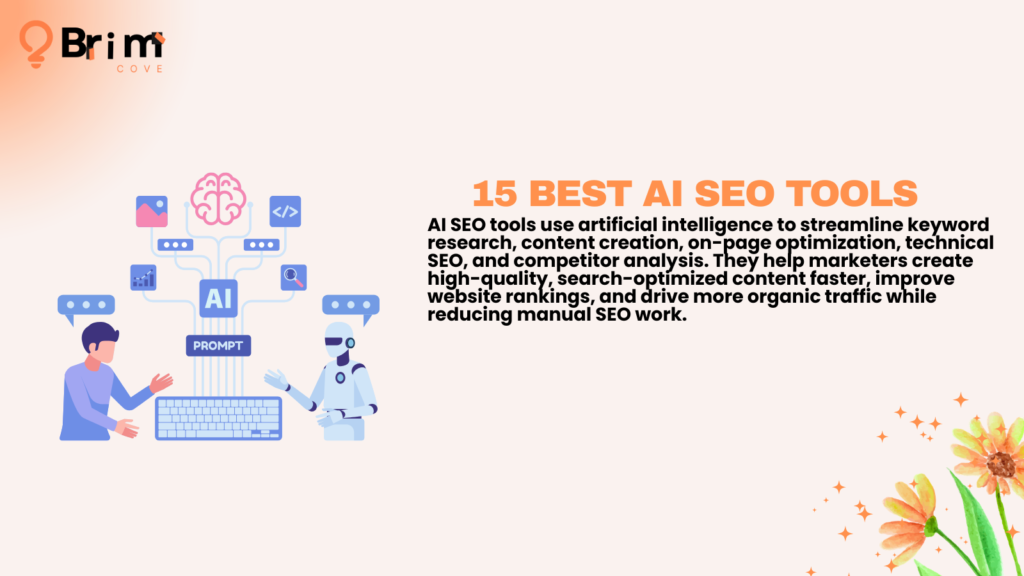
Artificial intelligence has transformed how businesses approach search engine optimization. Tasks that once required hours of manual work—such as keyword research, competitor analysis, content optimization, and technical audits—can now be completed much faster with AI-powered SEO tools.
However, AI has not replaced SEO professionals. Instead, it acts as a powerful assistant that helps marketers work more efficiently, uncover new opportunities, automate repetitive tasks, and make data-driven decisions. The strongest results still come from combining AI capabilities with human expertise, strategic thinking, creativity, and editorial judgment.
As search engines continue to evolve and AI-powered search experiences become more common, businesses are increasingly adopting AI SEO software to improve rankings, scale content production, and streamline their workflows.
The challenge is choosing the right platform.
Some tools specialize in keyword research, while others focus on content optimization, technical SEO, workflow automation, or visibility in AI search results. Choosing the wrong solution can lead to unnecessary costs and limited results.
This guide compares the 15 best AI SEO tools based on features, AI capabilities, usability, pricing, integrations, and overall value. We explain where each platform performs best, its limitations, and which type of user can benefit most.
Whether you’re an SEO beginner, freelancer, agency, in-house marketer, or enterprise organization, this guide will help you choose an AI SEO platform that fits your goals.
Table of Contents
What Is an AI SEO Tool?
An AI SEO tool is software that uses artificial intelligence and machine learning to improve different aspects of search engine optimization. These platforms analyze large amounts of data, identify patterns, and provide recommendations that help marketers make better SEO decisions.
Depending on the platform, AI can assist with:
- Keyword research and clustering
- Search intent analysis
- Content creation and optimization
- Competitor research
- SERP analysis
- Technical SEO audits
- Backlink analysis
- Internal linking
- Rank tracking
- SEO reporting
- Workflow automation
- AI search visibility monitoring
Traditional SEO software primarily presents data for users to analyze. AI-powered tools increasingly help interpret that data and recommend possible actions. This allows SEO professionals to spend less time collecting information and more time developing and executing effective strategies.
The most effective AI SEO tools do not attempt to replace human expertise. Instead, they automate repetitive work and provide insights that help professionals work faster and more strategically.
How We Evaluated These AI SEO Tools
To provide a balanced comparison, we evaluated each platform using several key criteria.
Features: We assessed the depth and range of each tool’s capabilities, including keyword research, content optimization, technical SEO, competitor analysis, reporting, and automation.
Ease of use: We considered the interface, learning curve, workflow efficiency, and suitability for both beginners and experienced SEO professionals.
Pricing and value: Cost was compared with the features, scalability, usage limits, and value offered to freelancers, agencies, small businesses, and enterprise teams.
AI capabilities: We examined how effectively each platform uses AI for content creation, optimization, keyword clustering, search intent analysis, workflow automation, predictive recommendations, and AI search visibility.
Integrations: Integrations with platforms such as Google Search Console, Google Analytics, WordPress, Google Docs, CMS platforms, and other marketing tools can significantly reduce manual work.
Accuracy: Reliable keyword data, technical recommendations, optimization suggestions, and competitor insights are essential for making informed SEO decisions.
Support: Documentation, tutorials, email support, live chat, training, and community resources were also considered.
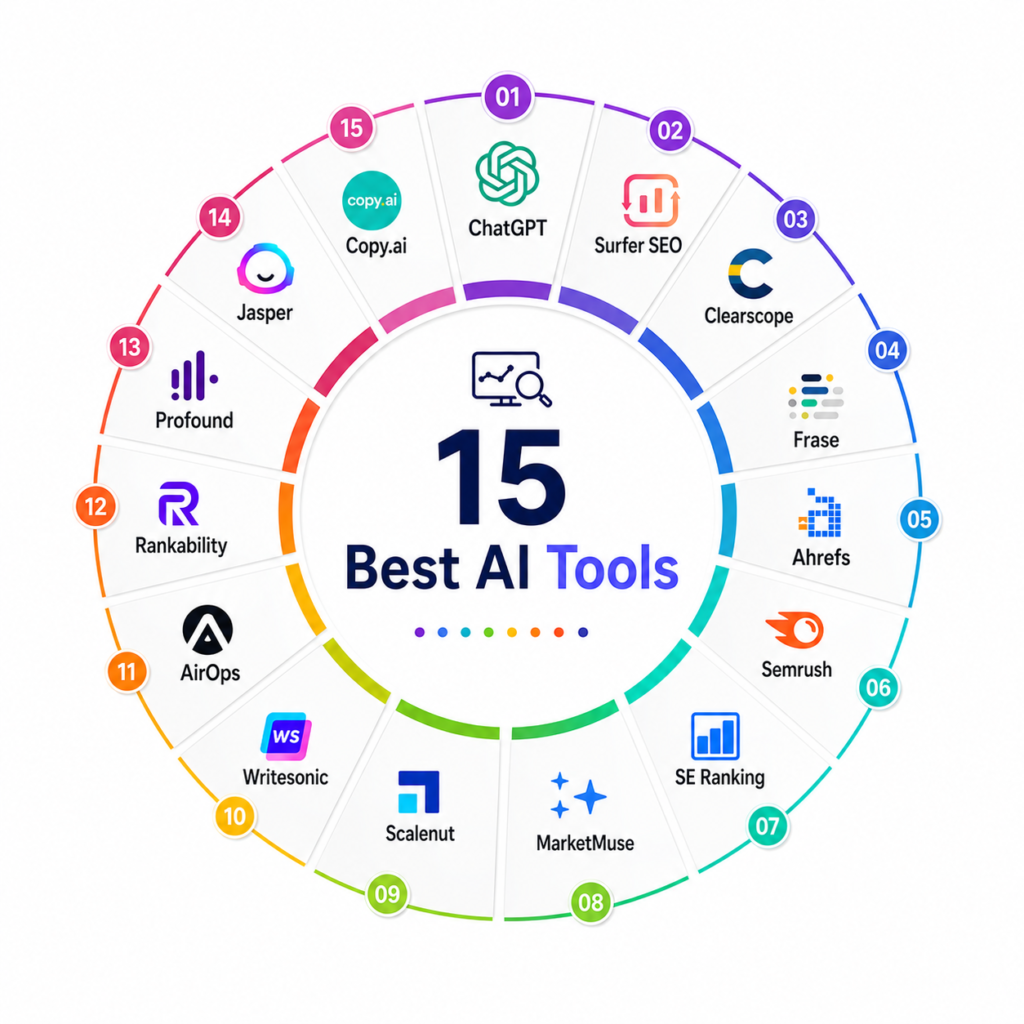
15 Best AI SEO Tools
1. ChatGPT
Developed by OpenAI, ChatGPT is one of the most widely used AI assistants for SEO professionals, content marketers, and businesses. Although it is not a dedicated SEO platform, it can support almost every stage of an SEO workflow.
It can help marketers brainstorm keywords, create content briefs, generate meta titles and descriptions, analyze content, explain technical SEO concepts, develop FAQs, suggest internal links, and automate repetitive tasks.
Key features:
- Keyword brainstorming
- Content brief generation
- Meta title and description creation
- Content rewriting and optimization
- FAQ generation
- Schema markup assistance
- Internal linking suggestions
- Technical SEO explanations
- Content gap brainstorming
- Custom AI workflows
Pros: Easy to use, excellent for brainstorming and content planning, supports multiple writing styles, speeds up repetitive work, and offers a free plan.
Cons: It does not provide comprehensive real-time keyword or backlink data, cannot replace dedicated SEO tools, and AI-generated content requires human review.
Best for: Content marketers, freelancers, SEO consultants, agencies, and small businesses.
Verdict: ChatGPT is one of the best AI assistants for improving SEO productivity. However, it works best alongside dedicated tools for keyword research, backlink analysis, technical audits, and performance tracking.
2. Surfer SEO
Surfer SEO is a popular AI-powered content optimization platform that analyzes top-ranking pages and provides recommendations for improving content quality, topical coverage, and search relevance.
Its Content Editor helps writers create content based on real SERP data, while its optimization recommendations can identify missing topics and opportunities to improve existing pages.
Key features:
- AI Content Editor
- SERP Analyzer
- AI-assisted content generation
- Keyword clustering
- Topical recommendations
- Content audits
- Internal linking suggestions
- Google Docs integration
Pros: Strong content optimization, clear recommendations, useful SERP analysis, and a beginner-friendly interface.
Cons: Can become expensive for larger teams, and optimization scores should not replace editorial judgment.
Best for: Content teams, SEO agencies, bloggers, marketing departments, and in-house SEO specialists.
Verdict: Surfer SEO is one of the strongest options for businesses that prioritize consistent, search-focused content production.
3. Clearscope
Clearscope is a premium content optimization platform designed to help businesses create comprehensive, search-focused content. It analyzes top-ranking pages and recommends relevant terms and topics based on search intent.
Its clean interface, content grading system, and collaboration features make it particularly useful for professional content teams and enterprise organizations.
Key features:
- AI-assisted content optimization
- Content grading
- Keyword and topic recommendations
- Search intent analysis
- Readability insights
- Google Docs integration
- WordPress integration
Pros: Reliable recommendations, clean interface, strong content grading, and excellent collaboration features.
Cons: Premium pricing and limited technical SEO capabilities.
Best for: Enterprise marketing teams, publishers, agencies, and content strategists.
Verdict: Clearscope is an excellent choice for organizations that prioritize content quality and editorial workflows over all-in-one SEO functionality.
4. Frase
Frase combines AI writing with SEO research to simplify content planning and optimization. It analyzes competitor content, identifies important topics, and helps users move from research to content creation quickly.
Key features:
- AI content generation
- Content briefs
- SERP research
- Content optimization
- Keyword recommendations
- Question research
- Outline generation
Pros: Fast brief creation, easy research, user-friendly interface, and a strong combination of writing and optimization tools.
Cons: AI output requires editing, and the platform has limited backlink and technical SEO capabilities.
Best for: Freelance writers, content marketers, agencies, and small businesses.
Verdict: Frase is a practical choice for teams that want to simplify content research, planning, and optimization in one workflow.
5. Ahrefs
Ahrefs is one of the most trusted SEO platforms, particularly known for its backlink database, keyword research, and competitor analysis capabilities. While AI is not its primary focus, its AI-assisted features complement a powerful SEO research toolkit.
Key features:
- Keyword Explorer
- Site Explorer
- Backlink analysis
- Rank tracking
- Site Audit
- Competitor analysis
- Content Explorer
- AI-assisted content features
Pros: Excellent keyword research, extensive backlink data, reliable competitor analysis, and powerful technical SEO tools.
Cons: Premium pricing, a learning curve for beginners, and fewer AI-focused features than specialized AI content platforms.
Best for: SEO professionals, agencies, digital marketers, and enterprise businesses.
Verdict: Ahrefs remains one of the best platforms for users who need in-depth keyword, backlink, and competitor research.
6. Semrush
Semrush is an all-in-one digital marketing platform covering SEO, content marketing, competitor research, PPC, and AI-assisted workflows.
Its extensive feature set makes it suitable for businesses that want to manage multiple areas of digital marketing from one platform.
Key features:
- Keyword research
- AI SEO Writing Assistant
- Competitor analysis
- Site Audit
- Position Tracking
- Backlink Analytics
- Content optimization
- Local SEO tools
- Reporting dashboards
Pros: Extensive SEO capabilities, powerful competitor analysis, strong keyword research, AI-assisted content features, and excellent support for agencies and teams.
Cons: Premium pricing, a potentially overwhelming interface, and some advanced features requiring higher-tier plans.
Best for: SEO agencies, marketing teams, enterprise businesses, and in-house SEO professionals.
Verdict: Semrush is one of the most complete AI-supported SEO platforms available. It is especially valuable for users who need research, technical SEO, content optimization, competitor analysis, and reporting in one ecosystem.
7. SE Ranking
SE Ranking combines essential SEO features with AI-powered content tools at a more accessible price point. It includes rank tracking, website audits, backlink monitoring, competitor research, and content optimization.
Its intuitive interface makes it suitable for beginners while offering enough functionality for experienced professionals.
Key features:
- AI Writer
- Rank tracking
- Website audits
- Backlink monitoring
- Competitor research
- Keyword suggestions
- On-page SEO Checker
- White-label reporting
Pros: Affordable pricing, easy-to-use interface, comprehensive core SEO tools, reliable rank tracking, and agency-friendly reporting.
Cons: Smaller data sets than some enterprise platforms and less advanced AI capabilities than specialized AI tools.
Best for: Freelancers, small businesses, SEO consultants, and growing agencies.
Verdict: SE Ranking offers excellent value for businesses seeking an affordable SEO platform without sacrificing essential functionality.
8. MarketMuse
MarketMuse is an AI-powered content intelligence platform designed for organizations managing large content libraries. Rather than focusing only on individual keywords, it helps businesses develop topical authority through content planning and optimization.
The platform analyzes existing content, identifies gaps, and recommends topics that can strengthen a website’s authority within a niche.
Key features:
- AI content planning
- Content inventory analysis
- Topic modeling
- Content optimization
- Competitive content analysis
- Personalized difficulty scoring
- Content brief generation
Pros: Excellent for topical authority, advanced content recommendations, strong planning capabilities, and enterprise scalability.
Cons: Expensive for smaller businesses and less focused on technical SEO.
Best for: Enterprise SEO teams, large publishers, content strategists, and marketing departments.
Verdict: MarketMuse is particularly valuable for organizations building large-scale content strategies and long-term topical authority.
9. Scalenut
Scalenut combines keyword research, AI writing, and content optimization in a single workflow. Its platform helps users move from keyword discovery to content creation and optimization without relying on multiple tools.
Key features:
- AI writing assistant
- AI content workflows
- Keyword planning
- SERP analysis
- Topic clusters
- Content optimization
- SEO scoring
Pros: End-to-end workflow, beginner-friendly interface, useful optimization recommendations, and good value.
Cons: Limited technical SEO and backlink functionality.
Best for: Bloggers, content marketers, small businesses, and SEO agencies.
Verdict: Scalenut is a strong option for businesses that want an AI-powered platform focused on keyword research, content creation, and optimization.
10. Writesonic
Writesonic is an AI writing platform designed to accelerate the creation of blogs, landing pages, product descriptions, and marketing content. It also includes SEO-focused research and optimization features.
Key features:
- AI article writing
- SEO content generation
- Content rewriting
- Landing page copy
- AI assistant
- Brand voice customization
- Multilingual support
Pros: Fast content generation, easy to use, flexible content formats, and multiple pricing options.
Cons: Content requires fact-checking, and its SEO capabilities are less comprehensive than dedicated SEO platforms.
Best for: Content creators, bloggers, marketing teams, and small businesses.
Verdict: Writesonic is useful for producing marketing content quickly, but pairing it with dedicated SEO software can improve research and optimization.
11. AirOps
AirOps is an AI workflow platform designed for SEO teams that need to automate repetitive tasks at scale. Instead of functioning as a traditional SEO suite, it helps businesses build customized workflows for content creation, keyword clustering, content briefs, and large-scale SEO operations.
Key features:
- AI workflow automation
- Content brief generation
- Custom AI workflows
- Keyword clustering
- Bulk content production
- Marketing tool integrations
- Team collaboration
Pros: Highly customizable, excellent for automation, scalable, and effective for large teams.
Cons: Has a learning curve and requires other tools for comprehensive keyword, backlink, and technical SEO data.
Best for: SEO agencies, enterprise teams, and content operations departments.
Verdict: AirOps is best for organizations that need to automate complex SEO workflows and scale content operations efficiently.
12. Rankability
Rankability is an AI-powered content optimization platform focused on search intent and on-page SEO. It analyzes top-performing content and provides recommendations designed to improve relevance, readability, and organic performance.
Key features:
- AI content optimization
- SERP analysis
- Keyword recommendations
- Content scoring
- Search intent analysis
- Competitor comparisons
Pros: User-friendly interface, practical recommendations, strong focus on search intent, and useful collaboration features.
Cons: Limited technical SEO and backlink capabilities.
Best for: Content marketers, SEO consultants, agencies, and businesses focused on on-page SEO.
Verdict: Rankability is a practical choice for teams looking for straightforward recommendations to improve content relevance and search intent alignment.
13. Profound
Profound focuses on a growing area of SEO: visibility in AI-powered search experiences. As users increasingly receive answers from AI search systems, brands need to understand how often they appear, how they are mentioned, and how their visibility compares with competitors.
Key features:
- AI search visibility tracking
- Brand mention monitoring
- AI search analytics
- Competitive visibility insights
- Performance dashboards
- Trend monitoring
Pros: Innovative AI visibility tracking, useful competitive insights, and enterprise-focused reporting.
Cons: Primarily designed for larger organizations and offers limited traditional SEO functionality.
Best for: Enterprise businesses, large marketing teams, and brands monitoring AI search visibility.
Verdict: Profound is a valuable complement to traditional SEO software for organizations preparing for the future of AI-driven search.
14. Jasper
Jasper is a well-known AI writing platform for businesses producing marketing content at scale. Its strengths include brand voice customization, collaboration, and content generation across multiple marketing channels.
Key features:
- AI content generation
- Brand voice customization
- Long-form content creation
- Marketing templates
- Team collaboration
- Workflow automation
- Multilingual support
Pros: Strong writing quality, consistent brand voice, collaboration features, and support for multiple marketing formats.
Cons: Requires additional SEO tools for detailed keyword research and optimization, and premium plans can be expensive.
Best for: Marketing teams, agencies, copywriters, and content marketers.
Verdict: Jasper is strongest as an AI content and marketing platform. For SEO campaigns, it works best alongside dedicated SEO optimization software.
15. Copy.ai
Copy.ai is an AI writing and workflow platform that helps businesses create marketing copy, blog content, product descriptions, sales content, and other materials more efficiently.
Its workflow automation features can also help teams streamline repetitive marketing tasks.
Key features:
- AI writing assistance
- Workflow automation
- Blog content generation
- Product descriptions
- Marketing copy
- Email writing
- Content repurposing
- Team collaboration
Pros: Fast content creation, beginner-friendly interface, multiple templates, and useful workflow automation.
Cons: Limited SEO analysis and the need for external tools for detailed optimization.
Best for: Small businesses, marketing teams, freelancers, and content creators.
Verdict: Copy.ai is a versatile productivity tool for content teams, but businesses focused heavily on SEO should combine it with dedicated SEO software.
Quick Comparison of the Best AI SEO Tools
| Tool | Best For | AI Strength |
|---|---|---|
| ChatGPT | Content ideation and workflow assistance | Writing, brainstorming, research |
| Surfer SEO | Content optimization | AI content editing and SERP analysis |
| Clearscope | Premium content optimization | Content grading and topic recommendations |
| Frase | Content briefs and optimization | AI writing and SERP research |
| Ahrefs | SEO research | Keyword and backlink analysis |
| Semrush | All-in-one SEO | AI content, research, and automation |
| SE Ranking | Affordable SEO | AI content tools and rank tracking |
| MarketMuse | Enterprise content strategy | AI content planning and topic modeling |
| Scalenut | AI content creation | Writing and SEO optimization |
| Writesonic | AI copywriting | Content generation and SEO assistance |
| AirOps | SEO workflow automation | Custom AI workflows |
| Rankability | On-page optimization | Search intent and content recommendations |
| Profound | AI search visibility | AI visibility analytics |
| Jasper | Marketing content | AI content generation and brand voice |
| Copy.ai | Marketing automation | AI writing and workflow automation |
Best AI SEO Tools by Use Case
The best AI SEO tool depends on your goals, budget, team size, and workflow.
Best for beginners: SE Ranking
Its intuitive interface, affordable pricing, and broad feature set make it an excellent starting point for people learning SEO.
Best for agencies: Semrush
Semrush combines keyword research, competitor analysis, technical SEO, reporting, and collaboration features for managing multiple client campaigns.
Best for enterprise content strategy: MarketMuse
Its content intelligence and topical authority features are particularly useful for organizations managing large content libraries.
Best for content optimization: Surfer SEO
Surfer combines SERP analysis with AI-powered recommendations to help teams create content that better aligns with search intent.
Best for keyword research: Ahrefs
Ahrefs is widely recognized for its keyword data, backlink analysis, and competitor research capabilities.
Best for technical SEO: Semrush
Its Site Audit and technical reporting features help businesses identify and address issues affecting organic performance.
Best for AI search visibility: Profound
Profound focuses on monitoring how brands appear across AI-powered search experiences.
Best budget option: SE Ranking
It offers a strong balance between affordability, usability, and essential SEO capabilities.
Features to Look for in an AI SEO Tool
Choosing the most popular platform does not necessarily mean choosing the right one. Before investing in an AI SEO tool, consider whether its features match your specific goals.
Keyword research: Look for keyword suggestions, search volume data, difficulty scores, search intent classification, long-tail keyword discovery, clustering, and trend analysis.
Content optimization: Useful features include content scoring, topic recommendations, readability analysis, competitor comparisons, and search intent optimization.
AI writing assistance: Many platforms can generate outlines, drafts, metadata, FAQs, rewrites, and grammar improvements. However, human editing remains necessary for accuracy and originality.
SERP analysis: A strong tool should help analyze ranking pages, content structures, search intent, featured snippet opportunities, and common user questions.
Competitor analysis: Look for competitor keyword rankings, backlinks, top-performing pages, content gaps, traffic estimates, and ranking history.
Technical SEO audits: Important capabilities include identifying broken links, crawl errors, duplicate content, indexing problems, missing metadata, page speed issues, Core Web Vitals problems, and mobile usability issues.
Backlink analysis: The platform should ideally help monitor referring domains, evaluate backlink quality, identify link opportunities, compare competitor profiles, and track lost links.
AI search visibility: As AI search grows, some tools now monitor brand mentions, citations, visibility trends, and competitive performance across AI-powered search experiences.
Reporting: Clear dashboards should make it easy to track rankings, organic traffic, technical health, content performance, backlink growth, and conversions.
AI SEO Tools vs. Traditional SEO Tools
AI-powered SEO software has improved how marketers conduct research, create content, and automate repetitive work.
| Feature | AI SEO Tools | Traditional SEO Tools |
|---|---|---|
| Keyword research | AI-assisted clustering and intent analysis | Primarily manual analysis |
| Content creation | AI-generated drafts and recommendations | Mostly manual writing |
| Optimization | Real-time recommendations | More limited automation |
| Workflow automation | Extensive | Usually more manual |
| SERP analysis | AI-assisted insights | Standard competitor reports |
| Technical SEO | Automated recommendations | More manual analysis |
| Reporting | AI-generated summaries | Standard dashboards |
| Productivity | Faster workflows | More time-intensive |
Benefits and Limitations of AI SEO Tools
AI SEO tools can significantly improve productivity by reducing repetitive work and helping marketers make decisions based on large amounts of data.
Faster research: Keyword research, competitor analysis, and content planning can often be completed much faster with AI assistance.
Better content planning: AI can identify search intent, content gaps, related topics, and competitor patterns that may be difficult to discover manually.
Improved optimization: AI recommendations can help improve topical coverage, readability, and on-page SEO.
Workflow automation: Tasks such as keyword clustering, content briefs, metadata creation, internal linking suggestions, reporting, and content updates can be partially automated.
Simplified reporting: AI can summarize data, identify trends, and highlight potential opportunities, making SEO performance easier to communicate.
However, AI SEO tools also have limitations.
AI hallucinations: AI can generate inaccurate or fabricated information, so recommendations and content should always be reviewed.
Human editing remains essential: AI-generated content needs human oversight for accuracy, originality, brand consistency, tone, and quality.
Data differences: Keyword volumes, traffic estimates, and backlink metrics can vary between platforms because they use different data sources.
Over-automation: Automation should improve efficiency, not replace strategic thinking. Successful SEO still requires professionals who understand users, business goals, competition, and long-term strategy.
How to Choose the Right AI SEO Tool
The best platform is not necessarily the one with the most features. It is the one that fits your goals, budget, team, and workflow.
Budget: Free AI assistants may be sufficient for basic content support, while premium tools offer more advanced SEO data and automation. Consider long-term value rather than simply choosing the cheapest option.
Team size: Freelancers may need affordable and simple tools. Small businesses often benefit from all-in-one platforms, while agencies need collaboration and client reporting. Enterprise teams may require advanced permissions, automation, integrations, and scalable reporting.
SEO goals: Identify your primary objective. Are you trying to improve content quality, discover keywords, perform technical audits, build topical authority, monitor AI search visibility, or automate repetitive work?
Content volume: Businesses publishing a few articles each month have different needs from organizations producing hundreds of pages. High-volume teams should prioritize content workflows, automation, collaboration, and bulk optimization.
Technical requirements: Large or complex websites may require advanced crawling, indexation monitoring, Core Web Vitals reporting, structured data recommendations, API access, and custom reporting.
The right AI SEO tool should support your current workflow while providing enough flexibility to grow with your business.
Frequently Asked Questions
What is the best AI SEO tool?
There is no single best option for everyone. Semrush is a strong all-around platform, Surfer SEO is excellent for content optimization, Ahrefs is particularly strong for keyword and backlink research, and ChatGPT is a valuable assistant for content planning and workflow support.
Are AI SEO tools worth it?
Yes. They can save significant time by automating research, content optimization, reporting, and repetitive tasks. Their greatest value comes when AI capabilities are combined with human expertise.
Can AI improve rankings?
AI does not directly improve rankings. However, it can help marketers identify keyword opportunities, analyze competitors, improve content, and streamline SEO workflows—all of which can contribute to stronger organic performance.
Which AI SEO tool is best for content optimization?
Surfer SEO, Clearscope, MarketMuse, and Frase are among the strongest options for content optimization based on search intent, topical relevance, and competitor analysis.
What is the best AI keyword research tool?
Ahrefs and Semrush remain leading choices for keyword research because of their extensive databases, competitive analysis features, and advanced SEO insights.
Are AI-generated articles good for SEO?
They can be, provided the content is accurate, original, useful, and thoroughly reviewed by humans. Publishing unedited AI-generated content can lead to quality and accuracy problems.
Which AI SEO tool is best for agencies?
Semrush is a strong choice for agencies because it combines keyword research, competitor analysis, technical SEO, reporting, and collaboration tools.
Is ChatGPT enough for SEO?
No. ChatGPT is useful for brainstorming, writing, research assistance, and content planning, but it does not replace comprehensive keyword databases, backlink analysis, or technical SEO auditing tools.
How much do AI SEO tools cost?
Pricing varies significantly. Some tools offer free plans, while premium platforms charge based on features, usage, team size, and project limits. Enterprise solutions may use custom pricing.
Can AI replace SEO experts?
No. AI can automate repetitive work and improve productivity, but SEO still requires strategic planning, technical expertise, creativity, critical thinking, and human judgment.
Conclusion
AI has changed how businesses approach SEO. From keyword research and content optimization to technical analysis, workflow automation, and AI search visibility, modern platforms help marketers work faster and make more informed decisions.
However, the best tool depends on your specific needs.
Semrush is a strong choice for businesses seeking an all-in-one SEO platform. SE Ranking offers excellent value for budget-conscious users, while Ahrefs remains a powerful option for keyword, backlink, and competitor research. Surfer SEO is well suited to content optimization, MarketMuse is designed for enterprise content strategy, and Profound helps businesses understand their visibility in AI-powered search.
The most effective SEO strategy combines AI-powered efficiency with human expertise. Use AI to accelerate research, automate repetitive work, and uncover opportunities, while relying on experienced professionals to develop strategy, verify information, maintain quality, and create genuinely useful content.
As search continues to evolve, businesses that adopt the right AI SEO tools while maintaining a user-first approach will be better positioned to improve organic visibility, increase qualified traffic, and achieve sustainable long-term growth.
