
Even after the advent of AI Overview, backlinks remain an important ranking factor in Google’s algorithm. But not every link earns the same value as required. A site can carry a high authority score and still provide little SEO value if it has no organic traffic or sits inside a network of unrelated and manipulative guest posts.
On the other hand, a site having a lower authority score may still pass good link juice if it has a strong organic visibility. Getting a link from such sites may help with your SEO efforts.
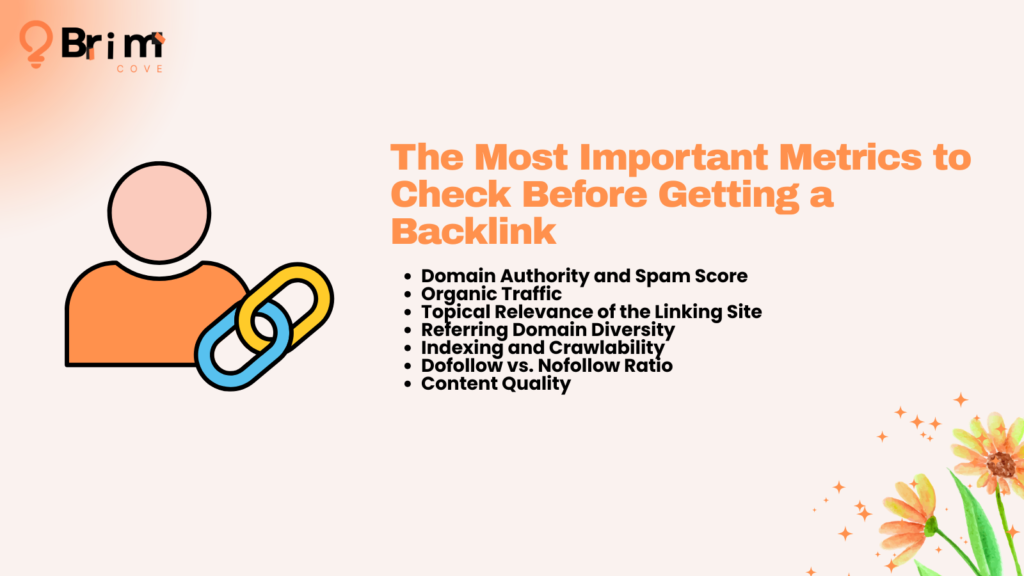
Before you accept or pursue any backlink, there are some metrics worth checking. In this blog, we’ll go through the most important metrics you should always check before getting a backlink for your website.
Table of Contents
1) Domain Authority and Spam Score
The majority of SEO professionals use authority scores as their first filter when evaluating a site. And domain authority remains the most cited metric for link building and prospecting.
But DA alone is not enough. Always check the spam score alongside it. A site with decent DA but a high spam score may have a manipulative backlink profile underneath. And links from it can hurt your SEO efforts.
Another major concern here is the accuracy of DA checker tools. There are plenty of such tools available out there. You can test a few tools and compare them to find a good one. A better approach is to use tools that have established authority in the market instead of testing random tools. An example of such a tool is Prepostseo DA PA checker. It provides both the DA and spam score at once. So you don’t have to use a separate tool to check the spam score.
One more thing worth doing here is checking the PA of the exact page if you are getting a niche edit. Some sites have a strong homepage DA, but the specific blog page may have a much weaker authority. A quick check saves you from assuming the whole domain carries the same strength.
2) Organic Traffic
Links from sites with real organic traffic often carry more SEO value than from sites with high authority but low organic traffic. So, before getting a backlink from any website, check how much organic traffic that site is getting. Also, check if the target site actually gets consistent traffic from search. Look for relatively consistent organic traffic rather than a short-lived spike caused by a trending topic or seasonal event.
You can check the estimated organic traffic of any site using Ahrefs’ traffic checker. A site with steady, real traffic usually means it’s actively ranking for keywords and getting picked up by search engines regularly. It makes a backlink from it more meaningful.
Traffic country also matters here, along with the traffic number. If your business targets the US market, a backlink from a site getting most of its traffic from some other region doesn’t help as much, even if the total traffic number looks decent. Check the traffic breakdown by country, and look for sites that actually get a good share from the same region you’re trying to rank in.
Another thing worth checking is where exactly that traffic is landing. Some sites have solid homepage traffic, but their blog section, where your actual backlink is placed, gets little to no visitors at all.
Getting link juice from Google still helps to some extent, but if real people never see your link because nobody’s reading that blog page, you’re missing out on referral traffic completely. This is just as valuable as the SEO side of a backlink.
3) Topical Relevance of the Linking Site
A site with a high authority score but that is completely unrelated to your niche is not as valuable as a smaller relevant site that is actually talking about your industry.
So before you accept a link, verify that the content of the site is really relevant to your industry. When you get a backlink from a site that covers similar topics, it tells search engines that your content fits that space well.
But a random link from an unrelated niche looks less natural and less useful, even with a high authority number. Even the page linking to you should be closely relevant to your topic, not just the site overall, since Google reads relevance at that level too.
Search engines are now better at understanding context. Relevance carries real weight alongside authority.
4) Referring Domain Diversity
A website with 2000 backlinks from almost all of the same few domains is a weaker signal than a website with 200 links from 200 different domains.
A diverse set of relevant, unique referring domains can generally provide a more natural link profile than a large number of links coming from only a few domains. Getting tons of links from the same small group of sources just doesn’t appear as natural. It doesn’t carry the same weight as getting links from a wider variety of independent, relevant domains.
Therefore, before getting a backlink, it’s worth checking not only the number of backlinks a site has in total, but also the diversity of its referring domains. A site with a small but more varied link profile is often a better and more trustworthy source for a backlink than one with a huge number from very few places.
5) Indexing and Crawlability
A backlink only helps if the page it’s placed on is actually indexed by search engines. If the page isn’t showing up in search results at all, the link added to it won’t really carry much value. A simple but important step before you get a link from a site is to check if its pages are regularly indexed.
Crawlability matters just as much as indexing itself. If a site’s pages take too long to get crawled, or have technical issues blocking search engines from reaching them properly, even a fresh, valuable backlink on that page can sit unnoticed for a while before it actually starts counting. Checking whether a site publishes new content and gets it indexed quickly is a good sign that Google is actively crawling it on a regular basis, not just occasionally.
A well maintained, actively indexed site signals that it’s a genuine, active part of the web. It is not an abandoned or low effort domain just sitting there for the sake of selling links.
6) Dofollow vs. Nofollow Ratio
Not every backlink on a website carries the same SEO value. Before you get a backlink, it’s worth checking the ratio of dofollow and nofollow links on the site. Having almost all of the outbound links dofollow is a sign of a completely unnatural backlink profile and a website built primarily for selling links.
Dofollow links pass ranking signals to your site. Nofollow links tell search engines generally not to pass the same level of ranking credit. But that doesn’t mean nofollow links are garbage. They can still bring in referral traffic, improve visibility, and make your overall backlink profile appear more natural.
It’s also worth looking at the links going out from the specific page if you are getting a niche edit. If you are on a page with dozens of followed links to unrelated sites, it might not be the best place to get a backlink. Look for pages with naturally placed links in useful and relevant content.
7) Content Quality
Content quality matters just as much as other SEO metrics. A site filled with thin, copied, or outdated content doesn’t actually provide much real value to readers. And this reflects on any backlink placed there too. If the content around your link feels low effort, it doesn’t build much trust with either Google or the people actually reading it.
Look for sites that publish original content, not something clearly rewritten or scraped from elsewhere. Check how often the site actually updates its existing pages too. Sites that keep older content refreshed and accurate tend to be more reliable than ones that publish once and never touch a page again.
A backlink from a site like this has far more real value than one from a thin, neglected page. A well-maintained, truly helpful website indicates that it’s an active, real part of the web, not some low-effort domain existing just to sell links.
Things to Avoid When Building Backlinks
Backlinks are important, but how you build them is equally important. Some link-building tactics can make your backlink profile look artificial and damage your SEO. Here are some things you should not do:
- Buying backlinks: Never buy backlinks just to play with search results. Paid links can be a “bad” link profile, especially if they are coming from irrelevant websites.
- Too many backlinks from one domain: When you have too many links coming from the same website, it doesn’t have the same value as links from a variety of relevant domains. It can also signal link spam to search engines. Instead, focus on building a diverse referring domain profile.
- Getting backlinks from irrelevant sites: A backlink from a website that is not related to your industry may not be of much value. Always choose link opportunities that are topically relevant.
- Rapid Backlink Building: If you get too many backlinks in a short amount of time, it can be a red flag as to how you got those links. It may signal link spam. Build links slowly and make sure you are earning them from real sources.
- Repeating the same anchor text: If all of your backlinks use the exact same keyword-rich anchor text, your link profile will look unnatural. Use your anchor text as naturally as possible in the content and vary it.
- Getting links from spammy websites: Stay away from websites with thin content, too many outbound links, or outright selling links. Having a large number of bad-quality backlinks doesn’t necessarily outweigh a few high-quality ones.
Final Words
So these are the metrics that actually matter before getting a backlink: domain authority, organic traffic, topical relevance, referring domain diversity, and indexing with content quality. Chasing a high authority number alone isn’t enough anymore. These other factors decide whether a backlink is actually worth something or just looks good on paper.
Checking these properly before reaching out for a link saves time and effort too. There is no point getting a backlink that ends up doing little to nothing for your rankings. A bit of research beforehand goes a long way in building a link profile that actually helps instead of just adding numbers that don’t mean much.
