
Every day, thousands of websites are sacrificed to the altar of quick rankings and most of their owners never even realize it. They purchase links from shadowy networks, accept placements on irrelevant sites, and watch their traffic skyrocket for three glorious months. Then Google strikes, and their carefully built rankings crumble overnight. The sites that once dominated page one disappear entirely, replaced by competitors who played by the rules.
Link farming might be the oldest trick in the black-hat SEO playbook, but it’s far from dead. In fact, with AI-generated spam sites becoming more sophisticated and search algorithms becoming equally more complex, the line between legitimate link building and link farm manipulation has become harder to detect for both good and bad reasons. The sophistication of these networks has evolved dramatically. What once required obvious, thin content spread across hundreds of domains can now involve reasonably well-written articles that superficially appear legitimate.
This isn’t a scare article designed to make you paranoid about every backlink. Instead, it’s a practical guide that explains what link farming really is, how Google detects it in 2026, the real-world consequences, and, most importantly, the sustainable alternatives that actually build lasting domain authority. This article is grounded in current SEO best practices, documented Google policy, and real-world case studies of websites that have been penalized and those that have recovered.
Table of Contents
What Is Link Farming?
Definition and Core Concept
Link farming is a black-hat SEO tactic in which websites artificially generate large volumes of backlinks through manipulative networks designed to inflate search engine rankings. These aren’t earned links built through genuine merit, engagement, or editorial decisions they’re manufactured links created solely for ranking manipulation. The core mechanism is deceptively simple: create or control multiple low-quality websites, generate vast quantities of hyperlinks pointing to a target website, and collect payment from the website owner who benefits from the artificial ranking boost.
In practical terms, a link farm is typically a network of low-quality websites that exist for one primary purpose: to pass PageRank and artificial authority to money sites the client’s website they’re trying to rank. The content on these farms is often thin, automated, or irrelevant. The links themselves are strategically placed with keyword-stuffed anchor text, all pointing to the same target domains. A link farm operator might control 50 to 500+ domains, all functioning as vehicles for distributing backlinks to paying clients.
The economic model is straightforward: the farm operator charges clients per link, typically between $50 and $500, depending on the perceived authority of the linking domain and the discretion level offered. The farm then profits from selling the same link placements to multiple clients or reselling domain authority across a network. This is a low-cost operation for the farm owner content generation is automated, hosting is cheap, and the domains themselves are often expired or newly registered.
Why Link Farms Exist
The fundamental answer is simple: they work in the short term, and that’s enough for many people. Backlinks remain one of Google’s top ranking factors. A website with 100 backlinks, even poor ones, will initially rank better than a site with zero backlinks. Link farmers exploit this lag time between when links are created and when Google’s algorithm catches up to evaluate them. This creates a temporary window of opportunity where purchased links deliver real ranking improvements.
Additionally, link farms exist because SEO has always been a game of perception. If you can convince search engines that your website is authoritative and popular (through artificial links), you can temporarily convince human visitors to trust you, too. A company struggling to gain traction in a competitive market sees a competitor’s site ranking well and wants the same results. Instead of investing time and resources into content creation and genuine relationship building, they look for quick fixes. Link farms provide exactly that or appear to, anyway.
The psychology of link farming is worth understanding. Clients are often desperate. They’ve tried legitimate SEO and seen slow results. A link farm operator shows them concrete examples: “Here’s a client who ranked page one in 60 days. Here’s another in 45 days. We can deliver those results for you.” These are real results, from real websites, in real competitive niches. The operator conveniently doesn’t mention what happened three months later when Google’s systems caught up.
Historical Context and Evolution
Link farming wasn’t always considered spamming. In the early 2000s, when Google’s algorithm was less sophisticated and link farms were less centralized, participating in link exchange networks and directory submissions was sometimes considered normal SEO. Major directories like DMOZ and Yahoo Directory were legitimate ranking factors. Reciprocal linking was common practice. Forum signatures with links were standard. This was the era when simply having links mattered more than where they came from.
The problem evolved as search engines got smarter. Google realized that artificially manipulating links didn’t correlate with user satisfaction. A highly-linked spam site wasn’t more useful than a poorly-linked informative site. The evolution happened in stages: 2003-2004 marked the emergence of early link farms and reciprocal linking networks. By 2011, Google’s Penguin update specifically targeted unnatural links and link schemes. Between 2012 and 2015, manual actions became common, with thousands of sites receiving warnings. From 2018 to 2019, link farm detection became automated and algorithmic. And from 2024-2026, AI-generated spam sites and PBNs have evolved, while detection is now continuous.
What fundamentally changed was Google’s underlying philosophy. Search intent and user experience became the real ranking factors, not raw backlink counts. Google understood that its ranking factors should reward websites that actually help users, not websites that are best at gaming the system.
How Link Farms Work: The Mechanics
Understanding the operational mechanics of link farms is crucial for identifying them and protecting your own website. Link farms operate with surprising consistency, following a playbook that has remained relatively unchanged despite Google’s evolving detection systems. By understanding these mechanics, you can spot red flags and avoid becoming a victim or, worse, a participant in this scheme.
Step-by-Step Link Farm Workflow
- Network Acquisition and Domain Registration: The link farm operator builds or acquires dozens, sometimes hundreds, of domain names. These might be expired domains with existing authority that were previously used for legitimate purposes but have now expired. Newly registered domains are cheaper and faster to deploy, but start with zero authority. Some operators use subdomain networks under a single parent domain to consolidate infrastructure while appearing as separate websites. The selection of domains is strategic they want enough perceived authority to seem legitimate, but not so much that they attract attention from security researchers or Google’s monitoring systems.
- Content Generation and Automation: Thin content is generated across the network, typically using automated content spinners that rewrite articles, AI language models trained to produce low-quality variations, minimal manual editing to avoid detection, and keyword stuffing for SEO value extraction. The content doesn’t need to be good it just needs to exist so the site appears active and legitimate. Modern link farms often use large language models to generate more coherent content that might fool human readers at first glance, though the content still lacks genuine value and expertise.
- Strategic Link Placement: Links are strategically placed on these farm sites with specific tactics: keyword-rich anchor text that targets profitable search terms, money site URLs pointing to specific pages the client wants to rank, high link density per page to maximize output, and fast link velocity (many links created in a short time) to show rapid deployment. The placement strategy is designed to game Google’s ranking factors without appearing too suspicious at first glance.
- Monetization and Link Sales: The operator sells these backlinks or link placements to SEO agencies and webmasters. Pricing depends on perceived domain authority (higher DA = higher price), anchor text customization (specific keywords cost more), link velocity control (slower placement seems more natural), and anonymity level (complete discretion commands a premium). Prices range from $50 to $500+ per link. Some operators offer packages: “50 links for $3,000” or “100 links for $5,000,” making the proposition seem like a bargain compared to legitimate link-building costs.
- Disassociation and Hidden Relationships: The farm operator works to hide the relationship between the money site and the farm network through multiple tactics: IP masking and proxy servers to hide server relationships, using different registrars and registrant information for each domain, varied website themes and designs to avoid pattern detection, no visible cross-linking patterns that would reveal the network, and different payment processors to avoid financial trail analysis. The goal is to make each farm site look independent and unrelated to the others.
Common Link Farm Tactics
- Interlinked Website Networks: Multiple related websites that link to each other, creating a closed loop of authority. Each site appears independent, but they’re all owned by the same operator. Internal linking patterns are designed to concentrate authority in certain pages before pointing to the money site.
- Paid Backlink Marketplaces: Fiverr-style platforms where you can purchase links in bulk. These are often fronts for link farm networks. The operator maintains a public-facing marketplace while the backend is a massive network of low-quality domains churning out links on demand.
- Expired Domain Abuse: Buying expired domains with existing authority, rebuilding them with spam content, and using them to pass links to money sites. The residual authority from the expired domain’s previous use gets redirected to the new owner’s targets.
- Automated Guest Post Networks: Systems that automatically place guest posts on thousands of sites, often without the host site owner even knowing. This is done through exploited vulnerabilities, compromised credentials, or arrangements with underpaid freelancers in low-cost countries who submit posts without proper vetting.
- Comment Spam Networks: Automated tools that place links in blog comments across thousands of websites. Most modern blog platforms filter these out, but some older, less-maintained sites still accept them. Comment spam is obvious and easily detected, making it less effective now than in earlier eras.
- Directory Submission Farms: Creating or exploiting low-quality directories where links can be submitted in bulk. The directories appear legitimate on the surface, but are actually vehicles for distributing links at scale. Some directories charge submission fees, creating a secondary revenue stream for the operator.
Why Link Farming Is Considered Black-Hat SEO
Violation of Google’s Core Principles
Google’s Webmaster Guidelines explicitly state: “Don’t participate in link schemes designed to increase your site’s ranking. This includes excessive reciprocal links or partner pages exclusively for the sake of cross-linking.” This foundational principle makes clear that Google’s position on link farms isn’t ambiguous. It’s explicitly against the rules. The question isn’t whether link farms are acceptable it’s how severely Google will penalize them.
Link farming violates multiple core principles that underlie Google’s entire ranking system:
- Artificial Authority Manipulation: Creating links that don’t represent genuine endorsement or value. Links should represent editorial votes of confidence. In link farming, they represent financial transactions. The authority being passed is artificial, created through manipulation rather than earned through quality.
- Deception: Hiding the relationship between the money site and the farm network. The deception is fundamental to the model. If Google could easily see that these sites were all owned by the same entity or were obviously not independent, the whole scheme would collapse.
- Content Quality Violation: Hosting thin, often AI-generated content solely for link placement. The content has no purpose except to house links. It provides no value to users. It doesn’t answer questions, provide information, or help anyone achieve their goals.
- User Experience Disregard: Prioritizing rankings over actual value to users. Link farming treats Google’s ranking system as something to be gamed rather than something to be aligned with. It optimizes for algorithm signals, not for the satisfaction of actual human visitors.
Does Link Farming Still Work in 2026?
This is the question that keeps link farmers in business: Does it still work? The answer is nuanced, and understanding the nuance is essential for making good decisions about your own SEO strategy.
Short answer: It works temporarily, but the long-term costs far exceed the short-term gains.
Short-Term Gains Are Real
In the immediate 30-90-day window after purchasing links from a farm, you will likely see ranking improvements. This isn’t a myth it’s real physics. If Google’s crawlers haven’t yet determined the links are unnatural, they’ll contribute to your site’s perceived authority. Your site will have more backlinks than it did before. Your domain authority scores (according to third-party tools like Ahrefs, Moz, etc.) will increase. Your rankings will improve.
Startup SEO agencies selling these links still attract clients because they can show month-one results. A client ranks for their target keyword in position 8, pays $5,000 for a batch of links, and moves to position 3 within 45 days. That’s a compelling before-and-after. The client sees their organic traffic increase. Sales spike. They’re thrilled with the ROI. They recommend the agency to other business owners.
The problem? It’s not sustainable, and the risk is enormous. This short-term gain is built on a foundation that will eventually crumble.
Long-Term Risks and Why Google Catches Link Farms
Where link farming fails catastrophically is in sustainability. The mechanisms that make it work initially are the same mechanisms that eventually expose it:
- Algorithmic Detection Through Link Pattern Analysis: Google’s systems are continuously improving at identifying unnatural link patterns. Most link farm backlinks are caught within 60-180 days. Google looks for clusters of domains with similar characteristics, shared infrastructure, identical linking patterns, and coordinated anchor text strategies. When 50 new backlinks appear simultaneously from seemingly unrelated websites with no referral traffic, Google’s algorithms flag it.
- Link Velocity Anomalies: When a site suddenly acquires 50+ backlinks in a week from unrelated domains, it triggers algorithmic flags regardless of individual link quality. Natural backlink growth follows patterns a popular article accumulates links over weeks and months as people discover it and share it. Artificial backlink growth shows the pattern of a payment being made.
- Anchor Text Distribution Red Flags: Natural backlinks come with varied anchor text sometimes the site’s name, sometimes a generic phrase, sometimes a URL, sometimes something else entirely. Link farms typically use keyword-rich anchor text in 30-50% of links because that’s what their clients requested. The unnatural distribution is obvious to Google’s analysis systems.
- Referral Traffic Mismatch: Real backlinks drive referral traffic. Visitors click the link and visit your site. Farm links typically drive zero traffic because the visitors don’t exist, or the backlinks are in contexts where people won’t click them (like footer text on spam sites). Google can compare your link count to your referral traffic and identify obvious discrepancies.
- Topical Irrelevance: A financial services site receiving links from casino, gambling, and weight loss niches creates topical confusion that doesn’t match a legitimate business. Real links come from contextually relevant sources. Farm links come from anywhere the operator has networks, regardless of relevance.
Link Farm vs. PBN vs. Legitimate Link Building: Detailed Comparison
Understanding the differences between these three approaches is critical. While all operate in the backlink space, they have fundamentally different characteristics, risks, and outcomes. The comparison below breaks down the key differences:
| Factor | Link Farm | PBN (Private Blog Network) | Legitimate Link Building |
| Content Quality | Thin, automated, irrelevant | Medium quality but formulaic | High quality, genuinely useful |
| Anchor Text | 50%+ keyword-rich anchors | Mixed but unnatural patterns | Natural, varied, conversational |
| Traffic from Links | Near-zero referral traffic | Some referral traffic from readers | Significant referral traffic |
| Google Compliance | Violates guidelines explicitly | Gray area, often flagged as unnatural | Fully compliant with guidelines |
| Sustainability | 3-6 months before detection | 6-18 months before detection | Indefinite, compounds over time |
| Average Cost | $50-500 per link | $100-1,000 per link | $0-5,000 depending on strategy |
| Risk Level | Extremely high (manual action likely) | Very high (algorithmic penalty) | Low (legitimate ranking boost) |
Key Distinction
Link farms and PBNs are both black-hat tactics, but PBNs represent a more sophisticated evolution of link farms that attempt to appear legitimate. A PBN might fool human readers better than obvious spam, but Google detects both through network pattern analysis, infrastructure relationships, and backlink pattern abnormalities. The core issue remains the same: artificially manipulating authority through coordinated link networks.
How to Identify a Link Farm
If you’re worried about your current backlink profile or suspicious of an agency’s tactics, here’s how to spot link farm activity. Identifying link farms is essential because your business depends on it. A bad backlink audit and removal strategy can take months or years to recover from. Better to identify and avoid them upfront.
Red Flag Indicators and Checklist
Content Quality Indicators:
- Thin, barely-substantial articles (under 300 words with minimal structure)
- Content that reads like AI-generated spam with unnatural phrasing
- Obvious grammar and spelling errors suggest minimal editing
- No detailed original research, data, or unique perspectives
- Duplicate or spun content across multiple domains
Link Pattern Indicators:
- Excessive keyword-rich anchor text (>30% exact match keywords)
- Links from completely unrelated industries (e.g., casino links to SaaS site)
- Multiple links from a single domain to your site (same domain, different pages)
- Sudden spike in backlink acquisition (50+ links in one week)
Website Quality Indicators:
- Low or no Alexa rank, minimal visible traffic from Similarweb
- Generic, stock-photo-heavy design with no branding
- No author information, “About” page, or contact details
- Multiple unrelated content categories on the same domain
Risks of Link Farming: Real Consequences
Understanding the real consequences is essential for making good decisions about your own SEO strategy. These aren’t theoretical risks they’re documented, repeated consequences that have affected thousands of websites.
- Ranking Drops and Deindexing: The most immediate consequence is often a precipitous ranking drop. Sites that ranked on page 1 have dropped to page 5 or below within days of a penalty. More severe: complete deindexing, where Google removes the site from search results entirely, effectively destroying organic traffic. A site generating $50,000 per month from organic traffic can drop to $0 nearly overnight.
- Manual Actions and Recovery Burden: If Google’s team manually reviews and flags your site for unnatural links, you’ll receive a notification in Google Search Console. This requires identifying and removing the bad links, submitting a reconsideration request, and waiting weeks for human review. The recovery process can take 3-6 months minimum, and often requires multiple resubmissions.
- Lost Traffic and Revenue: For e-commerce or service businesses, ranking drops translate directly to lost revenue. A site losing 80% of organic traffic has lost 80% of a revenue stream. For a B2B services company, this might mean lost leads. For a SaaS business, this means lost trial signups. For an e-commerce site, this means lost sales.
- Damaged Domain Authority and Recovery Difficulty: Even after recovery, a domain’s authority becomes compromised. Google views the domain with suspicion. Legitimate links acquired afterward are worth less because the domain’s history creates doubt. Full authority recovery can take 6-12 months or longer.
- Wasted Marketing Budget: Link farm backlinks cost money upfront with zero long-term value. Compare: Link farm approach ($5,000 for links, boost for 3 months, then penalty, cost of recovery $10,000-50,000) = $15,000-55,000 total cost for temporary rankings. Content marketing approach ($5,000 for content creation, builds authority over 12 months indefinitely) = $5,000 total cost for sustainable rankings.
Safe Alternatives to Link Farming: Building Real Authority
This is where the real money is made in SEO. Sustainable, legitimate link-building strategies that actually compound over time. These strategies require more upfront effort than buying links, but the returns are exponentially greater because they don’t have a built-in expiration date.
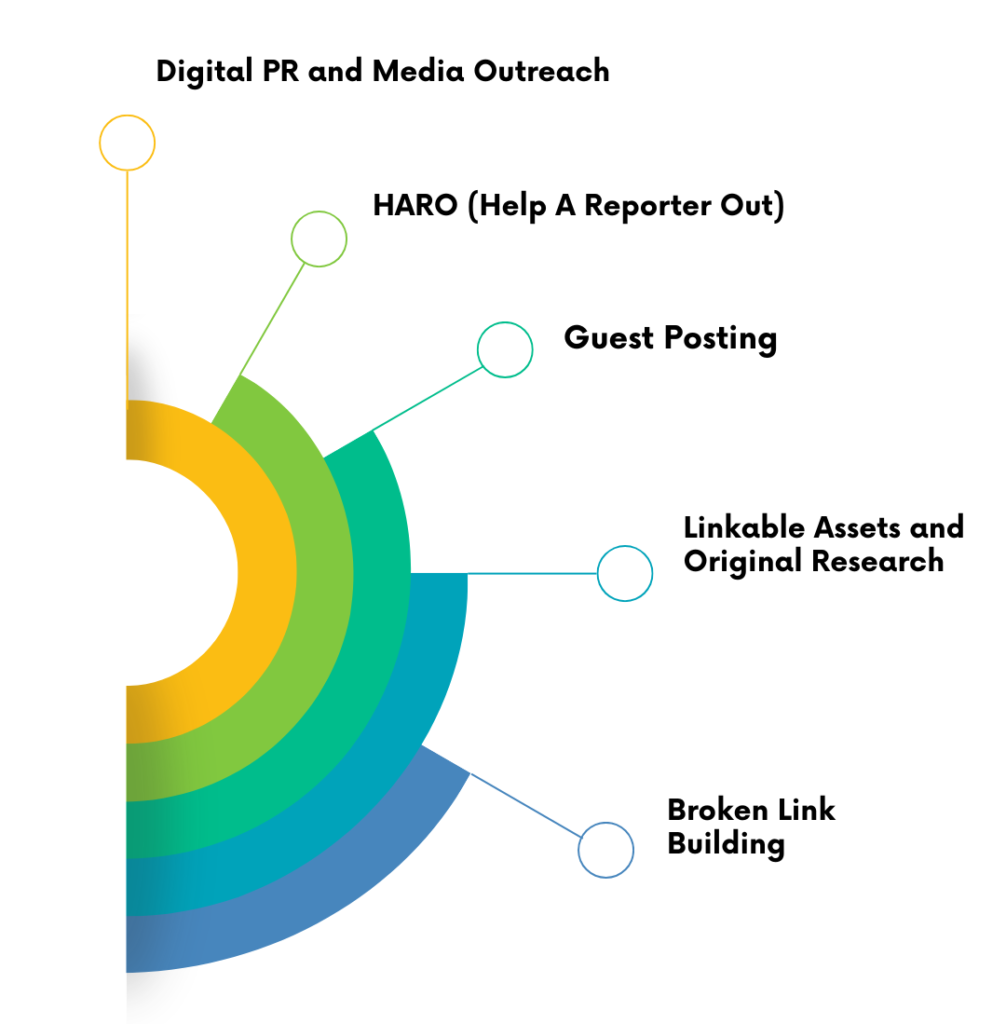
1. Digital PR and Media Outreach
What It Is: Actively pitching journalists, bloggers, and media outlets with newsworthy information about your business, industry expertise, or original research. It’s public relations applied to digital channels.
How It Works: Identify journalists covering your industry, create compelling story angles or data, pitch them with a personalized email, provide exclusive information or expert commentary, and earn coverage with natural backlinks.
Why It Works: Links come from high-authority domains like Forbes, TechCrunch, and industry publications. Links are genuinely editorial, created by journalists who believe your story is newsworthy. Creates brand awareness beyond just SEO. Drives qualified referral traffic. Builds real authority and credibility.
Realistic Outcome: Each successful pitch might generate 1-3 high-quality backlinks from significant publications, plus significant referral traffic and brand mentions.
2. HARO (Help A Reporter Out)
What It Is: A service connecting journalists looking for expert sources with subject matter experts. You receive daily emails with journalist queries related to your industry.
How It Works: Sign up for HARO alerts in your niche, respond to journalist queries where you have genuine expertise, provide quality source material, get quoted and linked in published articles.
Cost: Free or $20/month for faster alerts.
Why It Works: Links come from news and blog articles; you’re providing genuine value to journalists, creating a natural context for links, builds thought leadership positioning. You’re answering real journalist queries, making you credible.
3. Guest Posting (Done Right)
What It Is: Writing quality, original articles for established blogs in your industry. The key difference from link farm guest posting: these are genuine, high-quality contributions.
How It Works: Identify authoritative blogs with your target audience, pitch a genuinely useful article idea, write a high-quality, original piece, include 1-2 natural links back to relevant content, and publish with your author bio.
Why It Works: Links come from contextually relevant websites, provide actual value to the host site’s audience, drive referral traffic from qualified readers, build your brand as an expert, creates relationship with the blog owner for future opportunities.
Realistic Outcomes: Each guest post generates 1 high-quality backlink, 50-200 referral visitors, and thought leadership positioning. The value extends far beyond the single link.
4. Linkable Assets and Original Research
What It Is: Creating original content, data, tools, or resources so useful that other websites naturally want to link to them. Links aren’t earned through outreach they’re attracted by value.
Examples: Original research reports, industry benchmarks, free tools (calculators, audits), comprehensive guides, case studies with quantified results, original visualizations, and infographics.
Why It Works: Links come completely naturally no outreach needed. Other sites link because the resource is genuinely useful. Creates authority and trust. Generates significant referral traffic. Compounds over time as more people discover the asset.
Example Outcome: A marketing agency publishes an annual “State of Social Media Marketing” report with data from 5,000 marketers. Marketers, journalists, and bloggers cite this research for years, creating hundreds of natural backlinks.
5. Broken Link Building
What It Is: Finding broken links on authoritative sites and offering your content as a replacement. You’re helping the website improve user experience while getting a backlink.
How It Works: Identify high-authority sites in your industry, use tools to find broken links on these sites, create content that replaces what the broken link was referencing, reach out offering your content as a replacement, and they link to your content to fix their broken link.
Why It Works: You’re helping the website improve user experience. They get an updated resource link for free. You get a high-quality backlink. Natural fit for the context. Win-win arrangement.
Best Practices for Sustainable Link Building
A practical framework for building links that compound over time and create lasting competitive advantages.
Principle 1: Relevance First, Metrics Second
Instead of seeking only high DA links, focus on sites your audience trusts and visits. Topical relevance and audience overlap matter more than domain authority metrics. A link from a niche blog with 10,000 monthly visitors (even if DA is only 20) is worth more than a link from a spam farm with DA 40 and zero visitors.
Principle 2: Content Quality Is the Foundation
The best link-building strategy is creating better content than competitors. More comprehensive, more original, more useful, more well-researched, better presented. Good content gets linked naturally. Poor content requires buying links. Invest in content quality, and links follow naturally.
Principle 3: Relationship-Based Outreach
Focus on building relationships rather than mass outreach. Engage with bloggers’ content before pitching, comment thoughtfully on their articles, share their content, start conversations unrelated to links, then pitch collaborations. This builds trust and dramatically increases your success rate.
Frequently Asked Questions
Is Link Farming Illegal?
Not in the legal sense, but it violates Google’s terms of service. You won’t be arrested for buying backlinks. However, Google can ban your website from its search engine, which effectively removes a revenue stream. For many businesses, this is far worse than legal consequences. Additionally, if you acquire links through fraud (hacked sites, compromised credentials), there could be legal implications.
Can Bad Backlinks Cause Ranking Drops?
Yes, absolutely. A sudden influx of bad backlinks triggers algorithmic penalties, manual actions, complete ranking loss, or deindexing in severe cases. The harm isn’t just loss of the link value it’s a penalty that can derank your entire site, not just the pages with bad links.
What’s the Recovery Timeline?
- Manual Action Penalty: 1-3 months minimum (identify problem, remove links, submit reconsideration, wait for review)
- Algorithmic Penalty: 2-4 months typically (remove/disavow links, wait for systems to reprocess)
- Full Authority Recovery: 6-12 months (domain authority fully recovers, new legitimate links rebuild authority)
Conclusion: The Real Cost of Quick Links
Link farming is the financial equivalent of taking out a high-interest loan to pay for a one-month vacation. You get the experience upfront, but you’ll spend years paying the price. The moment of enjoyment (rankings) is brief, but the bill comes later and is far steeper than you expected.
In 2026, with Google’s detection systems running 24/7 and AI-powered spam identification improving monthly, the window for link farm exploitation has become even narrower. What once might have lasted six months now lasts three. What once generated serious ROI now generates serious risk. The arms race between spammers and Google has shifted dramatically in Google’s favor.
The cost-benefit analysis is overwhelming. Link farm approach: $5,000 upfront, rankings for 3 months, $10,000-50,000 recovery cost, $15,000-55,000 total. Content marketing approach: $5,000 upfront, rankings built over 12 months, $0 recovery cost, $5,000 total for sustainable rankings. The math is elementary.
