
Affiliate partnerships and GEO are now tied together. When a buyer asks ChatGPT, Perplexity, or Google’s AI Mode for “the best CRM for a small team,” the answer comes from the pages that rank, review, and compare products. A large share of those pages belong to affiliate publishers.
So your affiliate program does more than drive referral sales. It shapes what AI engines say about your brand, which competitors they put you next to, and which use case they think you’re best for.
In this guide, we break down how affiliate partnerships and GEO work together, the math publishers use to rank brands, a six-step audit you can run this week, and the mistakes that quietly push brands out of AI answers.
Table of Contents
What Are Affiliate Partnerships and GEO?
Affiliate partnerships and GEO describe how commission-based publisher relationships shape your visibility in AI-generated answers. Affiliate partners write the reviews, roundups, and “best X” lists that AI engines read and cite. GEO (generative engine optimization) is the work of earning those citations so AI tools recommend your brand by name.
Here’s what each side of affiliate partnerships and GEO means on its own.
Affiliate partnership: A publisher, creator, or review site promotes your product and earns a commission on each sale or lead. Networks like Impact, CJ, PartnerStack, and Awin track the clicks and payouts.
GEO: Generative engine optimization is the practice of getting your brand cited in ChatGPT, Perplexity, Gemini, Claude, and Google AI Overviews. The goal isn’t a blue-link click. The goal is to be named and recommended inside the answer itself.
Affiliate partnerships and GEO meet on the same pages. The roundup your affiliate team pays for is often the exact page an AI engine reads before it answers a buying question.
Why Affiliate Partnerships Matter for GEO in 2026
AI engines lean heavily on third-party commercial content when people ask buying questions. Siege Media analyzed 1,000 transactional prompts and found that 52.5% of the 40 most-cited domains were affiliate or sponsorship sites. If your brand is missing or misdescribed on those pages, it’s likely missing or misdescribed in AI answers too.
Other research points the same way:
- Listicles dominate citations. Evertune’s April 2026 analysis of 40,000+ heavily cited URLs found that half of ChatGPT’s citations were listicles, and most of those were ranked lists.
- Mentions beat links for AI visibility. Ahrefs studied 75,000 brands and found branded web mentions had the strongest correlation (0.664) with AI Overview visibility, well ahead of link metrics. Affiliate roundups are one of the largest sources of those mentions.
- AI traffic is small but converts. Ahrefs reported that AI referrals made up just 0.5% of its traffic but drove 12.1% of its signups.
- The channel is growing fast. Shopify reported that AI-referred sessions to its merchants grew 197% year over year in Q2 2026.
Put simply, AI search is a small, high-intent channel that’s growing quickly. Affiliate pages are one of its main inputs. That’s why affiliate partnerships and GEO now belong in the same planning conversation.
How AI Engines Read Affiliate Content (and Why It Matters for GEO)
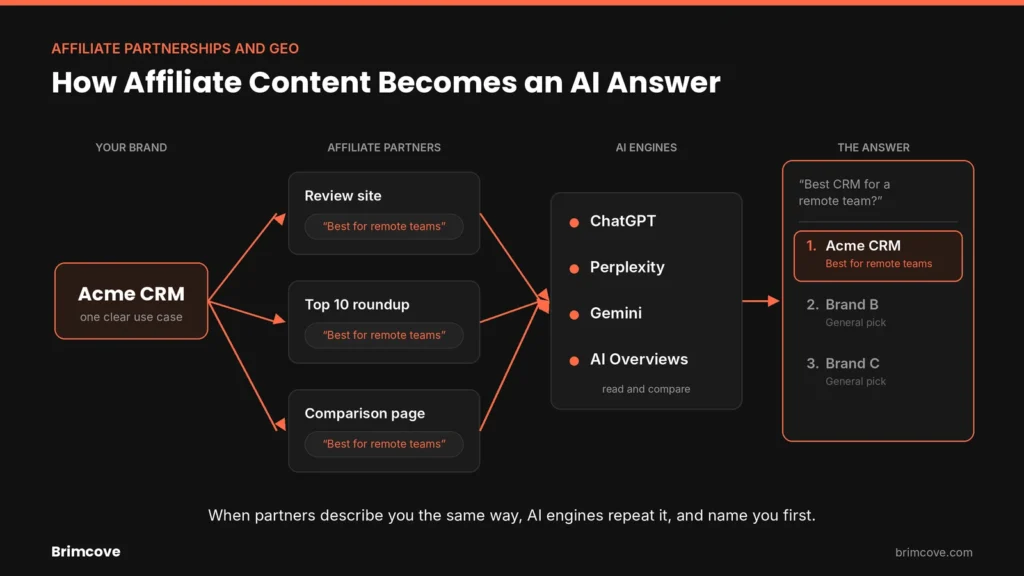
To understand affiliate partnerships and GEO, start with how AI engines read. They don’t read one review and copy it. They pull several sources, look for where those sources agree, and summarize the consensus. When many affiliate partners call you “best for remote teams,” that label repeats in the answer. When partners describe you differently, AI tools give you a vague, diluted description or skip you.
Ranked Lists Get Cited Most
Ranked “best X” lists give AI engines exactly what a buying prompt needs: options, an order, and a reason for each pick. Your position on those lists matters. A brand sitting at #9 with a one-line blurb rarely makes it into a five-item AI answer.
“Best For” Labels Become Co-Citations
Every roundup tags products with a use case, such as “best for startups” or “best budget pick.” AI engines connect your brand to those labels and to the competitors listed beside you. When 10 partners use the same label, the signal compounds. When they use 10 different labels, you own none of them.
Each AI Engine Pulls From Different Sources
Ahrefs looked at the top 50 most-mentioned websites across AI Overviews, ChatGPT, and Perplexity. Only 7 sites appeared in the top 50 for all three. For affiliate partnerships and GEO, that means a partner page that drives citations in Perplexity may barely register in ChatGPT. You need to test prompts in each engine you care about.
Outdated Descriptions Cause Positioning Drift
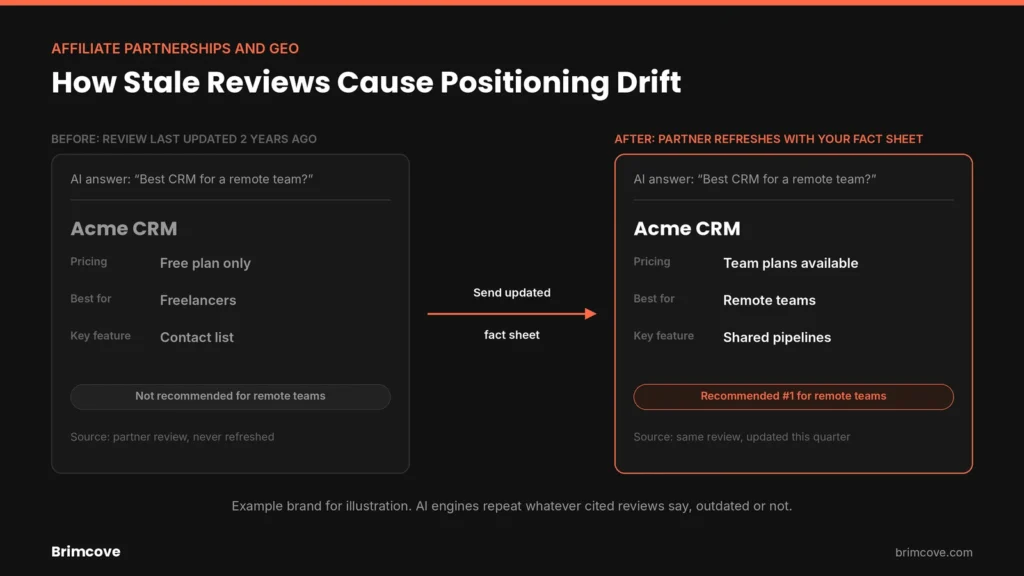
If a partner reviewed you two years ago, AI engines may still repeat your old pricing, old features, or an old target customer. We call this positioning drift. It’s common, and it’s fixable with regular partner updates.
Affiliate Partnerships and GEO: What Makes Publishers Rank Your Brand Higher
Publishers rank brands by expected earnings per visitor, not by personal preference. Their rough formula is commission per sale multiplied by conversion rate. Commission, conversion rate, landing page quality, cookie window, and payout terms all feed that number. Improve any one of them and you give publishers a reason to move you up.
| Lever | What publishers check | Effect on GEO |
|---|---|---|
| Commission rate | Payout per sale or lead versus competitors | Higher earnings per click earn higher list positions |
| Conversion rate | How many clicks turn into sales | Strong converters get featured even at lower rates |
| Landing page | Offer clarity, social proof, page speed | Weak pages lose placement no matter the commission |
| Cookie window | 1-day versus 30-day or longer attribution | Longer windows support long-form reviews, the content AI cites most |
| Payout terms | Fast, reliable payments, few reversals | Trusted programs get recommended more often |
| Partner resources | Screenshots, specs, demo or test accounts | Better resources lead to more accurate, detailed reviews |
Most brands treat affiliate partnerships and GEO as a commission problem alone. That’s a mistake. If a competitor converts twice as well at half your rate, a publisher still earns more by promoting them.
Cutting commissions carries a hidden cost too. When you trim payouts, you can slide down the same roundups AI engines cite. That loss never shows up in your affiliate dashboard. It shows up months later, when your brand is missing from AI answers.
How to Value an Affiliate Listing for AI Visibility
In affiliate partnerships and GEO, you value each listing on two layers: the direct revenue its clicks bring in, and the indirect value of the AI citations the page drives. Add both, subtract the listing cost, and you get a truer net value. Listings that look break-even on referral revenue often turn profitable once AI influence is counted.
Use this formula:
(Direct Revenue + AI Influence Value) − Listing Cost = Net Monthly Value
Here’s a worked example with illustrative numbers. Swap in your own data.
- A SaaS roundup costs you $2,000 a month in flat fees and commissions.
- It drives $1,800 in direct affiliate revenue. On paper, that’s a $200 monthly loss.
- But the page appears as a cited source in 9 of your 25 tracked buying prompts.
- Your GA4 data shows $3,000 a month in pipeline from AI-referred visitors. You conservatively credit 20% of that to this page: $600.
- Net value: $1,800 + $600 − $2,000 = +$400 a month.
The “losing” listing is actually profitable. That’s the affiliate partnerships and GEO case your team needs to bring to finance.
To estimate AI influence value, combine three inputs: how often the page is cited in your prompt set, the page’s organic traffic value in Ahrefs, and your AI-referred revenue in GA4. None of these is perfect alone. Together, they give you a defensible estimate.
Affiliate Partnerships and GEO Audit: 6 Steps
An affiliate partnerships and GEO audit shows which publisher pages AI engines cite in your category, how you appear on them, and where to invest next. You run your top buying prompts, map the cited affiliate URLs, score your placement and description, model each listing’s value, and fix the gaps with partners. Most teams can finish a first pass in a week.
Step 1: Build Your Prompt Set
List 20 to 30 transactional prompts your buyers actually use. Include formats like “best [category] for [use case],” “[your brand] vs [competitor],” and “[competitor] alternatives.” Run each one in ChatGPT, Perplexity, Gemini, and Google AI Mode. Use fresh, logged-out sessions so personal history doesn’t skew results.
Step 2: Map the Cited Affiliate URLs
Log every source URL each engine cites. Then sort the affiliate pages against your partner list into three groups:
- Listed and strong: you appear near the top with an accurate description.
- Listed but weak: you rank low, or the description is wrong or outdated.
- Missing: the page is cited, but your brand isn’t on it.
The missing group is usually your biggest opportunity.
Step 3: Score Your Placement Quality
For each page you’re on, record your list position, your “best for” label, the accuracy of your pricing and features, the page’s last-updated date, and which competitors sit beside you. Then compare your affiliate landing pages with your top three competitors’ pages. Check offer clarity, social proof, and how easy it is to find program details.
Step 4: Check Message Consistency
Pull every “best for” label partners use for you. Pick the one use case you most want to own. Then send partners a short brand fact sheet with current pricing, key features, approved positioning, and fresh screenshots. In affiliate partnerships and GEO, consistency across partners matters more than clever copy.
Step 5: Model Value and Prioritize
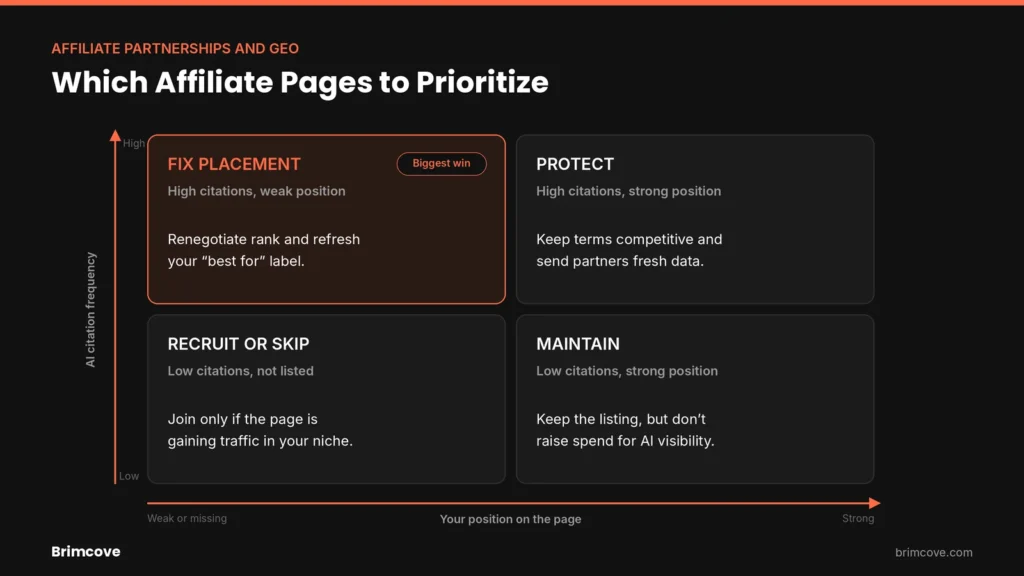
Run the listing value formula for every cited page. Pull organic traffic and traffic value from Ahrefs, add citation frequency from your prompt log, and rank pages by net value. This tells you where to pay more, where to renegotiate, and where to walk away.
Step 6: Act, Then Re-Test
Recruit publishers on the “missing” list. Renegotiate placement on high-value “weak” pages. Ask partners to refresh outdated reviews. Fix any landing page that’s losing conversions. Affiliate partnerships and GEO reward steady upkeep, so re-run your prompt set every month, or at least every quarter, and track how your citations change.
How to Choose Affiliate Partners That AI Engines Trust
For affiliate partnerships and GEO, pick partners whose pages already earn traffic and AI citations in your category, not just partners with big social followings. Look for real organic traffic, solid domain metrics, first-hand product testing, regular updates, and clear disclosure. A niche reviewer that AI engines cite often can be worth more than a large site they ignore.
Use this affiliate partnerships and GEO vetting checklist before you sign a partner or pay for a placement:
- Cited in your prompt set: the strongest signal you can get.
- Real organic traffic: check it in Ahrefs or Semrush. When we vet publishers for client placements, our floor is 1,000+ verified organic visits a month.
- Domain strength: we use DR 30+ as a baseline for most placements.
- First-hand testing: original screenshots, test data, and real pros and cons, not rewritten spec sheets.
- Update cadence: reviews refreshed at least once a year.
- Editorial quality: not a thin roundup, link farm, or AI content mill.
- Niche relevance: the site covers your category, not everything under the sun.
For a deeper breakdown of these checks, see our guide to the most important metrics to check before getting a backlink. The same rules apply to affiliate publishers.
Do Sponsored and Affiliate Links Still Help GEO?
Yes. Google asks publishers to mark affiliate links with rel=”sponsored” or rel=”nofollow,” so those links pass little or no ranking value. Affiliate partnerships and GEO, though, run mostly on mentions and context, not link equity. A clearly disclosed affiliate review that names and describes your brand still feeds AI answers.
A few rules keep your program clean:
- Always qualify affiliate links. Hiding paid links breaks Google’s spam policies and puts both you and your partner at risk. Our guide to sponsored links explains how the attribute works.
- Require clear disclosure. In the US, the FTC expects publishers to disclose affiliate relationships. Disclosure doesn’t hurt AI visibility.
- Pair paid placements with earned ones. Affiliate mentions work best next to editorial coverage you didn’t pay for. Our editorial links guide covers how to earn those.
Affiliate Partnerships vs. Brand Mentions vs. Link Building for GEO
These three channels do different jobs in affiliate partnerships and GEO, and they work best together. Affiliate partnerships win placement on transactional “best X” pages. Brand mentions build your entity signal across editorial content. Link building lifts the organic rankings that AI Overviews often pull from. Brands that rely on only one leave citation gaps.
| Channel | What you get | How you pay | GEO strength | Best for |
|---|---|---|---|---|
| Affiliate partnerships | Placement in reviews, roundups, and comparisons | Commission or flat fee | High for buying prompts | E-commerce, SaaS, fintech |
| Brand mentions | Named mentions in editorial and niche content | Outreach or digital PR | High for category and awareness prompts | Brands building category authority |
| Editorial link building | Contextual dofollow links on relevant sites | Per placement or retainer | Indirect: higher rankings feed AI retrieval | Sites that need organic growth |
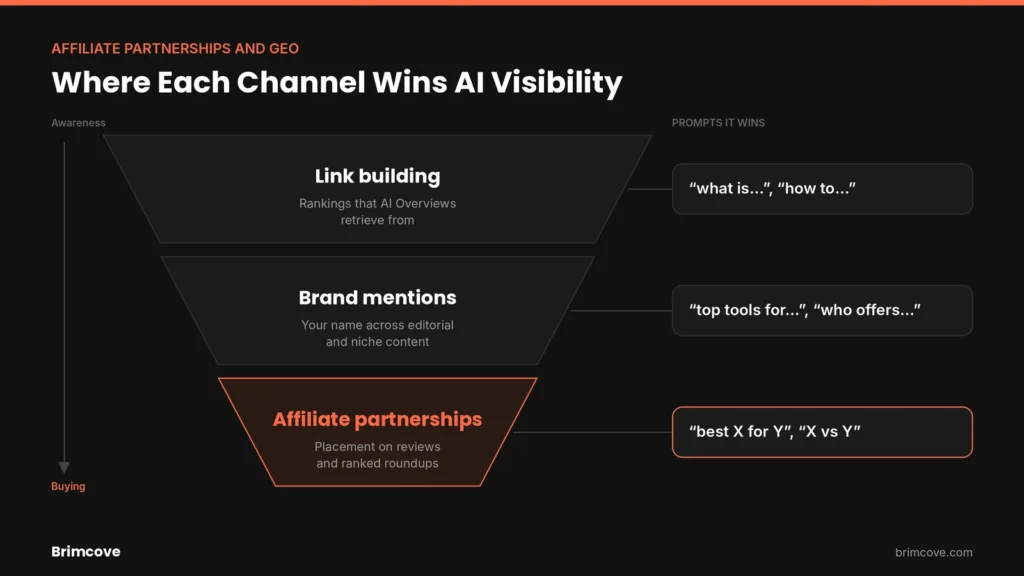
If your affiliate program covers the bottom of the funnel, our brand mentions service fills the rest: manual outreach that gets your brand named on relevant, traffic-verified publications AI engines read. For the bigger picture, read how AI search is reshaping link building strategies.
Common Affiliate GEO Mistakes to Avoid
Most affiliate partnerships and GEO problems come from measuring the program the old way. Teams judge partners on last-click revenue alone, cut commissions without checking which pages AI cites, and let reviews go stale for years. Each of these choices quietly shrinks your presence in AI answers.
Watch for these seven mistakes:
- Cutting commissions blind. Check which partner pages appear in AI answers before you trim any rates.
- Measuring last-click only. Last-click ignores the AI influence a listing carries.
- Letting descriptions go stale. Audit partner copy at least once a year.
- Chasing audience size over citations. A big site AI engines ignore is worth less than a small one they quote.
- Sending traffic to weak landing pages. Poor conversion drops your placement, whatever your commission.
- Mixed “best for” messaging. Pick one use case and brief every partner on it.
- Testing in one engine only. ChatGPT, Perplexity, and AI Overviews cite different sources.
How to Measure Affiliate Partnerships and GEO Results
To measure affiliate partnerships and GEO, track three layers: prompt visibility (how often AI engines name you), source coverage (how many cited affiliate pages include you), and AI referral outcomes in GA4. Review them monthly. Expect some lag, since affiliate page changes can take weeks to appear in AI answers, depending on how often each engine refreshes its sources.
Here’s a simple setup:
- GA4 custom channel group: bucket chatgpt.com, perplexity.ai, gemini.google.com, copilot.microsoft.com, and claude.ai into one “AI referral” channel. By default, many of these visits land in Referral or Direct.
- AI mention tracking: tools like Ahrefs Brand Radar show how often AI engines mention your brand. Our roundup of AI SEO tools covers more options.
- Prompt log: re-run your 20 to 30 prompts monthly and record citations, position, and description.
- Branded search: watch branded queries in Google Search Console. Rising AI visibility often shows up as rising brand searches.
FAQs
What are affiliate partnerships and GEO?
Affiliate partnerships and GEO refer to using commission-based publisher relationships to improve your visibility in AI answers. Affiliate partners create the reviews and “best X” lists that ChatGPT, Perplexity, and Google AI Overviews cite. Better placement and accurate descriptions on those pages lead to more AI recommendations.
Do affiliate links help you appear in ChatGPT?
The link itself carries little weight, since affiliate links are usually marked sponsored or nofollow. What matters is the mention. When cited affiliate pages name your brand, describe it accurately, and rank it well, ChatGPT is more likely to include you in buying answers.
Should I raise commissions to improve AI visibility?
Only after you know which partner pages AI engines cite. Raising rates across the board wastes budget. Raise them selectively on high-influence pages where a better position or a new listing would change your citations.
How long does it take for affiliate changes to show in AI answers?
Affiliate partnerships and GEO results vary by engine. Tools that search the web live, like Perplexity, can reflect an updated review within days or weeks. Answers that draw on training data can take months. Track monthly and judge results over a quarter.
Which affiliate platform is best for GEO?
There’s no single best platform. Choose the one that gives you access to the publishers AI engines cite in your category and shows publisher-level data. B2B SaaS brands often lean on PartnerStack, while consumer brands often use Impact, CJ, or Awin.
Can small brands compete with affiliate partnerships and GEO?
Yes. Small brands rarely win the biggest roundups first, but niche reviewers and specialist blogs are often cited for specific use cases. Own one clear “best for” label, earn placement on the pages AI engines cite for it, and expand from there.
Is GEO different from SEO?
GEO builds on SEO but aims for a different outcome. SEO earns rankings and clicks. GEO earns mentions and recommendations inside AI answers. For affiliate partnerships and GEO, strong SEO still helps, because many AI engines retrieve from pages that already rank well.
Turn Your Affiliate Program Into an AI Visibility Channel
Affiliate partnerships and GEO are no longer separate jobs. Your affiliate program already shapes what AI engines say about your brand. The partners you choose, the commissions you pay, and how consistently partners describe you all feed that signal. Treat affiliate partnerships and GEO as one strategy, audit it every quarter, and back it with earned mentions on the sites AI engines trust.
Want help with affiliate partnerships and GEO, and getting your brand named where AI engines look? Our in-house team runs manual blogger outreach and brand mention campaigns on traffic-verified publications. Book a free strategy call and we’ll show you where your brand is missing from AI answers.
