

Guest posting at the enterprise level is a governed content program, not a bigger order of links. If you run SEO for a large brand, you already know the problem. The tactic works, but the playbook built for small sites breaks the moment legal, brand, procurement and a public backlink profile get involved.
Most advice stops at “pick a good agency” or “check the DR.” That leaves the questions you get asked in budget meetings unanswered. What does a placement really cost? How do you vet 300 sites a year without lowering the bar? Who carries the compliance risk? How do you prove the program moved pipeline?
This guide answers those questions for teams running guest posting as a core enterprise link building channel. You’ll get a vetting rubric with weights, a cost model, a pipeline you can staff, anchor and velocity guardrails, a compliance framework your legal team can sign off on, an attribution method that survives finance review, and a clear way to choose between agency, marketplace and in-house delivery.
01 / DefinitionWhat Is Guest Posting at the Enterprise Level?
Enterprise guest posting is the practice of placing expert-written articles on vetted third-party publications, at volume, under the same governance a large company applies to any public content. The tactic matches small-business guest posting. The difference is the process around it: documented vetting, multi-team approvals, planned anchor and target distribution, disclosure rules and page-level reporting.
Why Enterprise Brands Still Invest in Guest Posting
Guest posting earns its place in an enterprise channel mix for three reasons:
- Authority to specific pages. A contextual link from a relevant publication sends ranking signals to the exact URL you choose, which most other channels can’t do.
- Entity association for AI search. AI assistants build answers from sources they already trust. Repeated, substantive mentions of your brand next to your category terms, on those sources, strengthen the link between the two.
- Audience reach. A good trade publication puts your expertise in front of buyers who never search for you by name.
Six Ways Enterprise Guest Posting Differs From Small-Site Link Building
Each constraint below changes how you plan, price and staff an enterprise guest posting program.
01Approvals run in sequence
Every draft passes through brand. In finance, health, legal and other regulated categories, it passes through legal or compliance too. Program throughput is set by the review queue, not by outreach volume.
02Brand safety is pass or fail
A mid-market brand can tolerate a placement on a site with uneven content. An enterprise brand can’t. Set the bar at the level of your most conservative stakeholder, because that is who will see the screenshot.
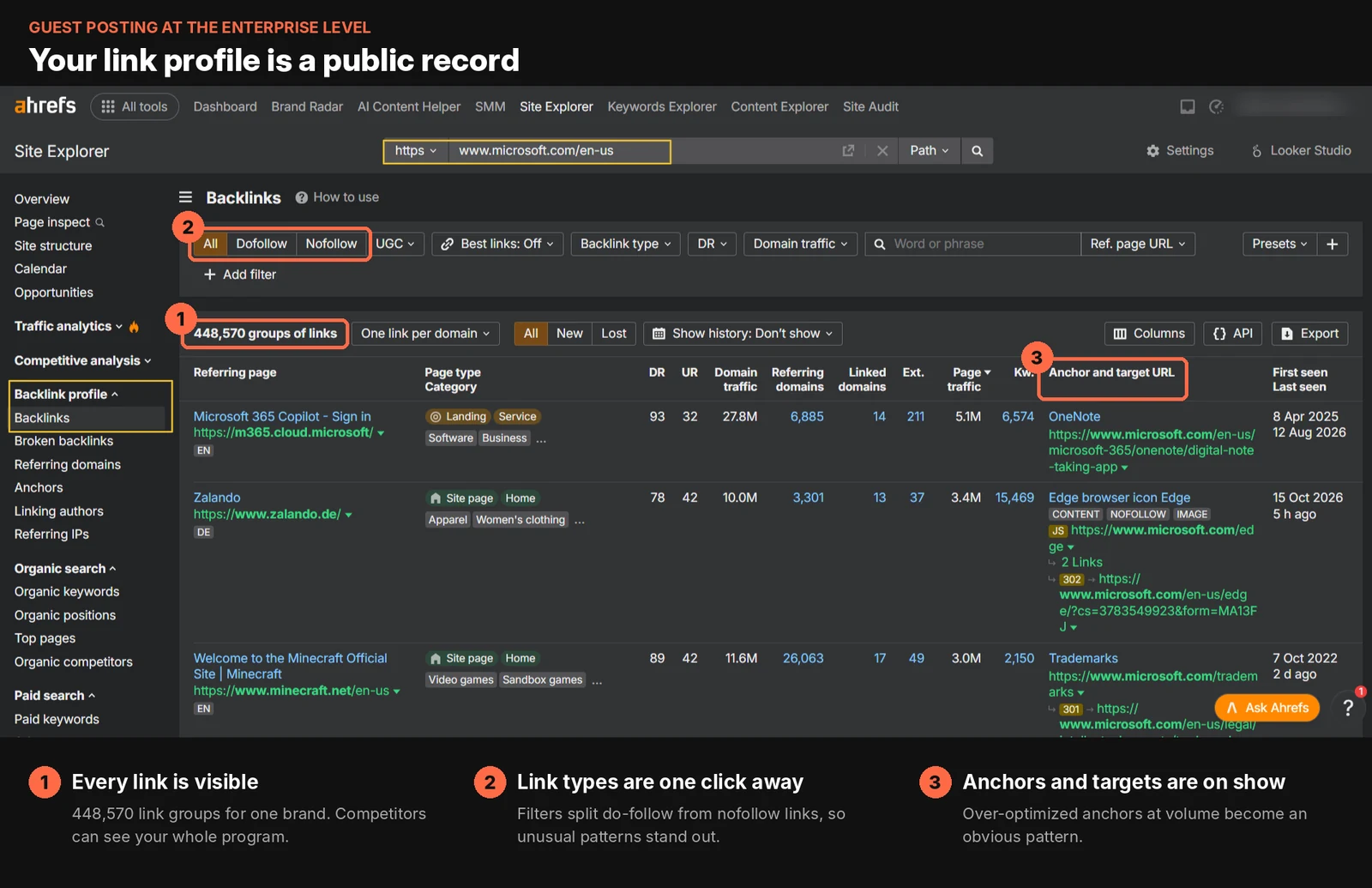
03Your link profile is a public record
Competitors, acquirers and journalists can pull your backlinks in Ahrefs or SEMrush in minutes. Assume every placement will be seen and attributed to you.
04Volume turns a tactic into a footprint
Ten guest posts with similar anchors look like coincidence. Three hundred look like a system. Google’s spam policies name keyword-rich anchor text in guest posts as an example of link spam, and patterns get easier to detect as they grow.
05Many teams touch one article
SEO, content, brand, legal, product marketing and the named author all have a say. Without clear roles, drafts stall in someone’s inbox.
06You sell in more than one market
A US-only link profile for a company that sells in eight countries is an anomaly of its own. Multinational programs need placements across the languages and regions they serve.
The core rule follows from all six: grow the process, never the pattern.
Most enterprise guest posting programs fail because they multiply a method that worked at ten links a month without changing it. For a deeper look at that problem, see our guide on how to scale link building without sacrificing quality.
When Guest Posting Is the Wrong Tool
Guest posting at the enterprise level is one link channel, not the whole strategy. Use something else when:
- The target page has nothing worth citing. Improve the page or build a linkable asset first.
- You need top-tier media coverage fast. Digital PR around a news hook or original data reaches more major outlets.
- A relevant page already ranks for your topic. A link insertion there can be faster. See guest posting vs niche edits.
- Technical or content problems hold your rankings back. Links won’t fix crawl errors, indexing gaps or thin pages.
02 / Vetting and QCHow to Vet Guest Posting Sites and Control Quality at Scale
In enterprise guest posting, vet publications with a written, weighted rubric that scores editorial standards, real audience, topical fit and risk signals, not Domain Rating alone. Then control quality at four checkpoints: before the pitch, before submission, right after publishing and on a recurring audit. A documented process lets someone outside marketing follow every decision.
Domain Rating is a starting filter, not a quality standard. Plenty of DR 70 sites publish anything for a fee. Plenty of DR 45 trade publications have real editors, real subscribers and real influence over your buyers. For guest posting at the enterprise level, you need criteria that hold up in front of a procurement lead who has never opened Ahrefs.
For reference, our own floor at Brimcove is DR 30+, at least 1,000 verified organic visits a month in Ahrefs, confirmed editorial quality, niche relevance and permanent do-follow placement. Enterprise guest posting programs should treat a floor like that as the entry ticket, then score everything above it. Our guides to the metrics to check before getting a backlink and link quality cover the basics in more detail.
10 Guest Post Vetting Checks That Reveal How a Site Operates
- Editorial resistance. Does the publication reject pitches or request rewrites? A site that accepts everything carries no implied endorsement.
- Real audience. Look for signs of readers who arrive outside search: a newsletter, social discussion of its articles, known contributors in the category.
- Topical fit. The site should cover your category every week, not as a one-off made for you.
- Traffic trend, not traffic level. Check the 24-month organic traffic graph. Steady growth is a good sign. A sharp spike followed by a cliff often signals a penalty or bought authority.
- Authority against traffic. High DR with negligible organic traffic means the authority was built, not earned.
- Contributed content density. Count how many of the last 50 posts came from outside contributors. When most of them did, you are looking at a placement service with a masthead.
- Outbound link neighborhood. Review the last 20 to 30 outbound links. Casino, CBD, crypto and essay-writing links put your brand in a neighborhood you can’t defend.
- Indexation. Search
site:for the last ten articles. Unindexed recent posts are an early warning that Google has lost trust in the site. - Author verification. Bylines should belong to real people with traceable careers, not stock-photo personas.
- AI retrieval footprint. Ask ChatGPT, Perplexity and Google’s AI Mode the questions your buyers ask. Note which publications get cited. A placement on a site that assistants already pull from is worth more than one that never appears.
A Weighted Vetting Rubric You Can Hand to Procurement
Score each publication from 1 to 5 on each criterion, multiply by the weight, and set a pass threshold. The weights below are our recommended starting point. Adjust them to your category and risk tolerance, then lock them for the year so scores stay comparable.
| Criterion | Weight | What a 5 looks like | Automatic fail |
|---|---|---|---|
| Editorial standards | 20% | Named editor, rejects or edits pitches | Pay-to-publish price list, no edits |
| Topical fit | 20% | Covers your category weekly | Off-topic or general “write for us” site |
| Audience and traffic trend | 15% | Steady 24-month organic growth, active newsletter | Traffic cliff in the last 6 months |
| Outbound link neighborhood | 15% | Links only to credible, related sources | Links to gambling, pharma spam, essay mills |
| Contributed content density | 10% | Mostly staff-written | Most posts are contributed or sponsored |
| AI retrieval footprint | 10% | Cited by assistants for category questions | Not applicable |
| Disclosure practice | 5% | Labels sponsored content clearly | Hides paid content as editorial |
| Author verification | 5% | Real, traceable contributors | Fake personas |
Any automatic fail removes the site, whatever the total score. This one rule prevents the most common enterprise mistake: approving a high-DR site because its numbers outweigh an obvious red flag.
Tier Publications Before Anyone Pitches
Group approved publications into tiers so effort and budget match value:
Tier 1Trade and business press
Named publications in your category. Low acceptance rates, slow turnaround, the highest value per placement. Pitch on editorial merit only.
Tier 2Established niche sites
Niche publications and respected company blogs with real readers and a real editor. Most of your volume belongs here.
Tier 3Everything else
Sites that passed the floor but scored low. For most enterprise guest posting programs, the right number of Tier 3 placements is zero.
Quality Control at Four Checkpoints
Vetting a site once is not quality control. Things change after the contract is signed, so check at each stage:
- Pre-pitch: The site is scored, tiered and logged. A second reviewer signs off on every Tier 1 and every new domain.
- Pre-submission: The draft passes your editorial checklist: claims sourced, internal style followed, anchor and target match the plan, no extra links added.
- Post-publish, within 48 hours: Confirm the article is live, indexed or submitted for indexing, the link points to the right URL, the anchor and rel attribute match what was agreed, and the publisher didn’t add links or change the copy.
- Recurring audit at 30, 90 and 180 days: Confirm the link still exists unchanged, the page is still indexed and the site’s traffic trend hasn’t collapsed. Use link monitoring alerts in Ahrefs or a backlink monitoring tool so lost links surface on their own.
How to Audit Hundreds of Links Without Re-Checking Everything
- Automate the binary checks. Live, indexed, attribute and anchor can all be monitored by tools. Save human time for judgment calls.
- Sample the judgment checks. Have a second reviewer re-score a random 10% of approved sites each quarter. If their scores drift from the original, retrain or tighten the rubric.
- Keep one shared blocklist. Every rejected or removed domain goes on a list that all vendors and internal teams must check before pitching.
- Write replacement terms into contracts. Agree in advance what happens when a link disappears or a site gets penalized. At Brimcove, every link carries a 6-month replacement guarantee; ask any provider for terms at least that specific.
03 / PricingEnterprise Guest Posting Pricing: What It Costs and Why
There is no single market price for guest posting at the enterprise level, because each placement bundles five separate costs: publisher access, content creation, outreach labor, internal review time and program management. Publication tier, niche, content depth, geography and turnaround move the total most. Ask every provider to break those costs out, and add your own review hours to the budget.
For guest posting at the enterprise level, published price lists cover only part of the market. For reference, Brimcove’s guest posts run from $69 per placement on DR 20+ sites to $389 on DR 70+ sites, and managed programs run from $499 to $5,000 a month. Tier 1 trade press rarely sits on any price list, because those placements are earned by pitching. There, the cost shows up as senior writing time, SME hours and longer cycles rather than a publisher fee.
What You Pay For in Each Placement
| Cost component | What it covers | Where it hides |
|---|---|---|
| Publisher access | Editorial fee or sponsorship fee, where one exists | Bundled into a flat “per link” price |
| Content creation | Research, writing, SME interviews, editing, revisions | Low prices often mean thin or AI-only drafts |
| Outreach labor | Prospecting, vetting, pitching, follow-ups, relationship upkeep | Rarely itemized, but it drives most agency cost |
| Internal review | Brand, legal and SME time spent on each draft | Never on the vendor invoice |
| Program management | Planning, anchor ledger, QC, monitoring, reporting | Often missing from cheap packages |
7 Factors That Drive Guest Posting Cost
- Publication tier and selectivity. The harder a site is to get into, the more labor each placement takes.
- Niche. Finance, health, legal, SaaS and other high-value categories cost more, because competition for editorial space is higher and editors are stricter.
- Content depth. A 1,200-word explainer costs less than a data-backed piece with SME quotes and original analysis.
- Geography and language. Native-language content for non-English markets needs local writers and local publisher relationships.
- Turnaround. Rush timelines limit you to sites that publish quickly, which often means lower editorial standards. Paying more for speed can buy you worse links.
- Placement terms. Permanence, do-follow status, placement in the body rather than the author bio, and replacement guarantees all carry a cost.
- Volume and commitment. Annual commitments usually lower the unit price. They also lock you in, so tie them to quality terms, not just volume.
Guest Posting Pricing Models Compared
| Model | How it works | Best for | Main risk |
|---|---|---|---|
| Per placement | Fixed price per live link, often banded by DR | Testing a vendor, filling specific gaps | Pushes vendors toward easy, cheap sites |
| Monthly retainer | Fixed fee for a planned number of placements plus strategy | Ongoing programs with steady targets | Paying for activity rather than outcomes |
| Hybrid | Base fee for strategy and management plus per-placement fees | Enterprise programs that need both control and flexibility | More complex contracts and invoices |
| Marketplace list price | Self-serve purchase from a publisher catalog | Low-risk Tier 2 fill at known prices | You own all vetting and compliance |
| In-house | Salaries, tools and writer costs | Large, long-term programs with stable volume | Fixed cost even when output drops |
Budget for Internal Review Time
Internal review is the cost most enterprise budgets leave out. Work it out before you sign anything.
An example with assumed inputs: say each draft takes 45 minutes of brand review and 30 minutes of legal review, and you publish 25 articles a month. That adds about 31 hours of internal time every month. Multiply by each reviewer’s loaded hourly cost and add it to the vendor fee for your true cost per placement.
Pricing Red Flags to Watch For
- Price menus that set cost purely by DR band, with no mention of niche or editorial standards
- No list of example publications before payment
- Guaranteed rankings or guaranteed traffic numbers
- “Permanent” links with no written replacement terms
- Prices far below the tier being promised, which usually means a network of sites built to sell links. Our guide to SEO PBN backlinks explains why those placements carry so much risk.
04 / OperationsHow to Build a Repeatable Guest Posting Pipeline Across Many Sites
Build your enterprise guest posting pipeline as eight fixed stages with an owner and a time limit for each, run it from one system of record, and size it backward from your review capacity. Plan placements against a topic map rather than a link quota. Repeatability comes from templates, shared lists and capacity math, not from adding more outreach.
The 8 Stages of an Enterprise Guest Posting Pipeline
- Intake and planning. Agree the quarter’s target pages, topics and anchor budget with SEO, content and product marketing.
- Prospecting. Build the candidate list from competitor backlink gaps, AI citation checks and category publications.
- Vetting and tiering. Score every site with the rubric. Log approvals and rejections.
- Pitching. Send topic pitches matched to each publication’s audience. Track replies and acceptance by tier.
- Briefing. Turn each accepted topic into a brief: angle, outline, SME, target URL, approved anchor and claims to source.
- Drafting and internal review. Writer drafts, SME checks accuracy, brand and legal approve within agreed time limits.
- Publisher edit and publication. Handle the editor’s changes, re-approve material edits, confirm the go-live date.
- Post-live QC and logging. Run the 48-hour check, record the live URL and add the link to monitoring.
Size the Pipeline From Your Review Capacity
The number of pieces you need in progress depends on how many you want to publish and how long each takes from pitch to live. The formula is simple:
An example with assumed inputs: to publish 20 placements a month with a 45-day average cycle, you need about 30 pieces moving at all times. If one in four Tier 2 pitches gets accepted in your category, that means roughly 80 pitches a month to keep those 30 pieces moving.
Then check your reviewers can handle the load. If legal can review ten drafts a week, legal sets your ceiling, not your outreach team. Agree review time limits in writing, such as three business days for brand and five for legal, and track them.
Plan Placements Against a Topic Map, Not a Link Quota
AI assistants answer questions by connecting entities to topics. If your brand keeps appearing in substantive articles about the same few problems, on publications those assistants trust, you build that connection. Our guide on how AI search is reshaping link building strategies covers this shift in more depth.
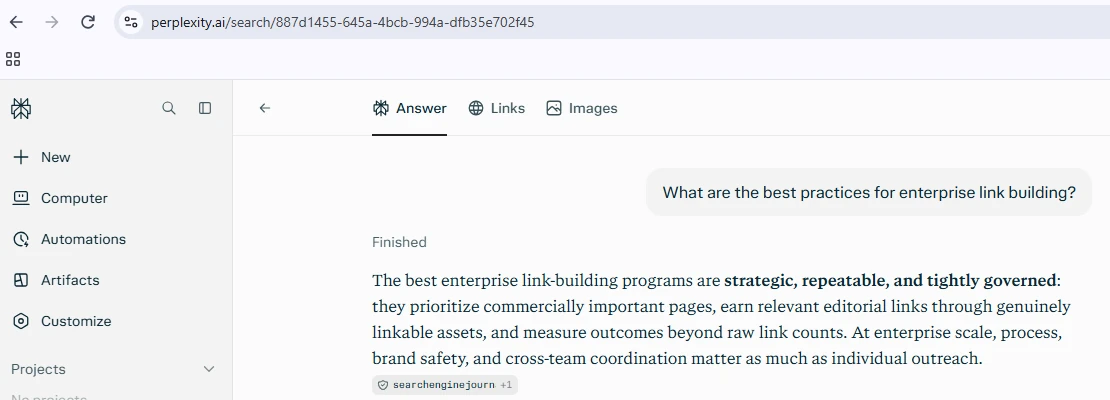
So start each quarter with the five to ten questions you want your brand associated with. Then map placements to them, with several credible publications per question. Fifteen placements concentrated on five topics build a clearer association than thirty spread across thirty unrelated subjects.
Run Everything From One System of Record
A spreadsheet or a ClickUp board works at first. Once you pass a few hundred placements, move to a proper database or CRM. Whatever you use, every placement should carry these fields:
| Field group | Fields to track |
|---|---|
| Publication | Domain, tier, rubric score, reviewer, approval date, editor contact |
| Placement | Article title, author, live URL, publish date, cost, vendor |
| Link | Target URL, anchor text, anchor type, rel attribute, position in the article |
| Compliance | Commercial relationship, disclosure used, approvers and dates |
| Monitoring | Index status, last check date, link status, replacement history |
Templates That Make the Pipeline Repeatable
- Brief template with fixed fields for target URL, anchor, angle and sources
- SME question bank so experts give 20 minutes of input instead of writing drafts
- Pre-approved claims library that legal signs off once, so routine statements skip re-review
- Author bio set with approved versions for each named expert
- Pitch templates by tier, with personalization fields that writers must fill. Our guest post outreach guide covers pitch structure in detail.
What a Publishable Enterprise Guest Article Includes
Editors at strong publications reject generic content. Every article should have:
- One clear point the publication’s readers can use
- First-hand input from a named expert: real examples, lessons and numbers from your own work
- Original data or analysis wherever you have it
- One contextual link to your site, placed where it helps the reader, with no more than two brand links in total
- A source for every claim, and no text reused from anything published elsewhere
- Human editing and fact-checking on any AI-assisted draft before it reaches the editor
Protect Publisher Relationships
In guest posting at the enterprise level, good publications are a limited resource. Set a cap on placements per domain per year, assign one relationship owner per publication, and rotate authors across sites. If several vendors work for you, give them a shared blocklist and a shared claimed-domain list, so two teams never pitch the same editor in the same month.
Coordinate With PR and Communications
Your PR team may already pitch the same editors. Share the publication list with comms, agree who owns each relationship, and route anything touching news, executives or sensitive topics through them. Feed original research and launch news into the guest posting calendar, so placements have something real to say.
05 / RiskHow to Manage Link Velocity and Anchor Text Risk at Scale
In enterprise guest posting, keep branded and URL anchors as the clear majority, make exact-match commercial anchors rare, and spread links across resource, category and brand pages instead of pointing everything at money pages. Pace new links in line with your normal link growth and marketing activity. Track every anchor in one ledger and review the distribution monthly.
In guest posting at the enterprise level, no single link is the risk. The distribution is.
Anchor Text Distribution Guardrails
Don’t copy a universal percentage from a blog post, including this one. Benchmark your own natural profile and the pages ranking in your top three positions in Ahrefs, then keep your program within that range. As a starting point, these are the guardrails we recommend:
| Anchor type | Example | Recommended share of new links |
|---|---|---|
| Branded | “Acme”, “Acme’s research team” | The largest single group |
| Naked URL | acme.com/reports/benchmark | Regular use |
| Natural phrase or partial match | “how procurement teams compare vendors” | Most of the remainder |
| Generic | “this report”, “their guide” | Occasional |
| Exact-match commercial | “enterprise procurement software” | Rare enough to list every instance by hand |
If you can’t name every exact-match anchor in your program from the ledger in under a minute, you have too many. Our guide to anchor text in SEO explains each type in more depth.
Target Page Mix
The instinct is to point every link at product pages. Resist it. Enterprise sites usually have strong internal linking, so authority sent to a well-linked resource page flows to the commercial pages beneath it.
A workable split to start from:
- About half to research, guides and other resource content
- About a third to category or solution pages
- The rest to the homepage, about pages and brand assets
Then adjust by page. If a commercial page sits in positions 4 to 15 for a valuable term, it can justify a larger share for a quarter.
Pace Link Velocity to Real Brand Activity
Link velocity looks natural when it matches what your brand is actually doing. A company that publishes research, runs events and ships product news has a reason to earn coverage at a steady rate.
- Measure your trailing 12-month average of new referring domains per month before the program starts.
- Ramp up over two or three months rather than launching at full volume.
- Avoid sudden multiples of your normal monthly rate that no launch, report or news event explains.
- Time larger pushes to real moments, such as a product launch or an original data study.
- Spread placements across the markets and languages you sell in.
Other Footprints That Give a Program Away
Anchors are the obvious pattern. These are the ones teams forget:
- The same author bylined on dozens of unrelated sites
- Identical author bios and identical link positions in every article
- Templated article structures that repeat across publications
- Links only in author bios rather than in the body
- Many placements on sites that share an owner, theme or hosting setup
Fix these with author rotation, varied bios, briefs that change structure by publication, and an ownership check during vetting.
What to Do When a Placement Goes Bad
At volume, some placements will fail. A site gets deindexed, sold, flooded with spam links or quietly edits your article. Handle it the same way every time:
- Confirm the problem. Check indexing, the traffic trend and the live article before acting.
- Ask the publisher to fix it. Request removal, a corrected link or a rel attribute change, and log the request.
- Use your replacement terms. Claim the replacement or refund your contract allows.
- Disavow sparingly. Google says most sites don’t need the disavow tool. Use it when you have a manual action for unnatural links, or a clear pattern of bad links you can’t get removed.
- Respond to manual actions formally. If Search Console shows one, remove or qualify the links, document every step and file a reconsideration request.
- Close the loop. Add the domain to the blocklist and review how it passed vetting.
06 / ComplianceGuest Posting Compliance: Disclosure, Editorial Standards and Team Roles
Start by classifying every enterprise guest posting placement by its commercial relationship, because that decides the disclosure and link attribute it needs. Then put roles in writing, publish one editorial standards document, and give legal a one-page program summary before launch. Advertising rules hold both the brand and its agencies responsible, so neither side can treat compliance as the other’s job.
This section gives you a working framework, not legal advice. Have your own counsel confirm how these rules apply to your markets and category.
Classify Every Placement: Earned, Sponsored or Paid Link
Most compliance problems in guest posting at the enterprise level start because nobody decided what a placement legally is. Classify each one before it goes live:
| Placement type | What it is | Disclosure to readers | Link attribute Google expects | Enterprise risk |
|---|---|---|---|---|
| Earned contributed article | Editor accepts the piece on merit; no payment for publication | Normal author byline and bio | Standard link | Low |
| Sponsored or paid placement | Money or other value changes hands for publication | Clear “sponsored” or “partner” label | rel=”sponsored” or rel=”nofollow” | Low if labeled; high if hidden |
| Paid link in existing content | Payment to add a link to a live article | Same as sponsored | rel=”sponsored” or rel=”nofollow” | High if the link passes ranking credit |
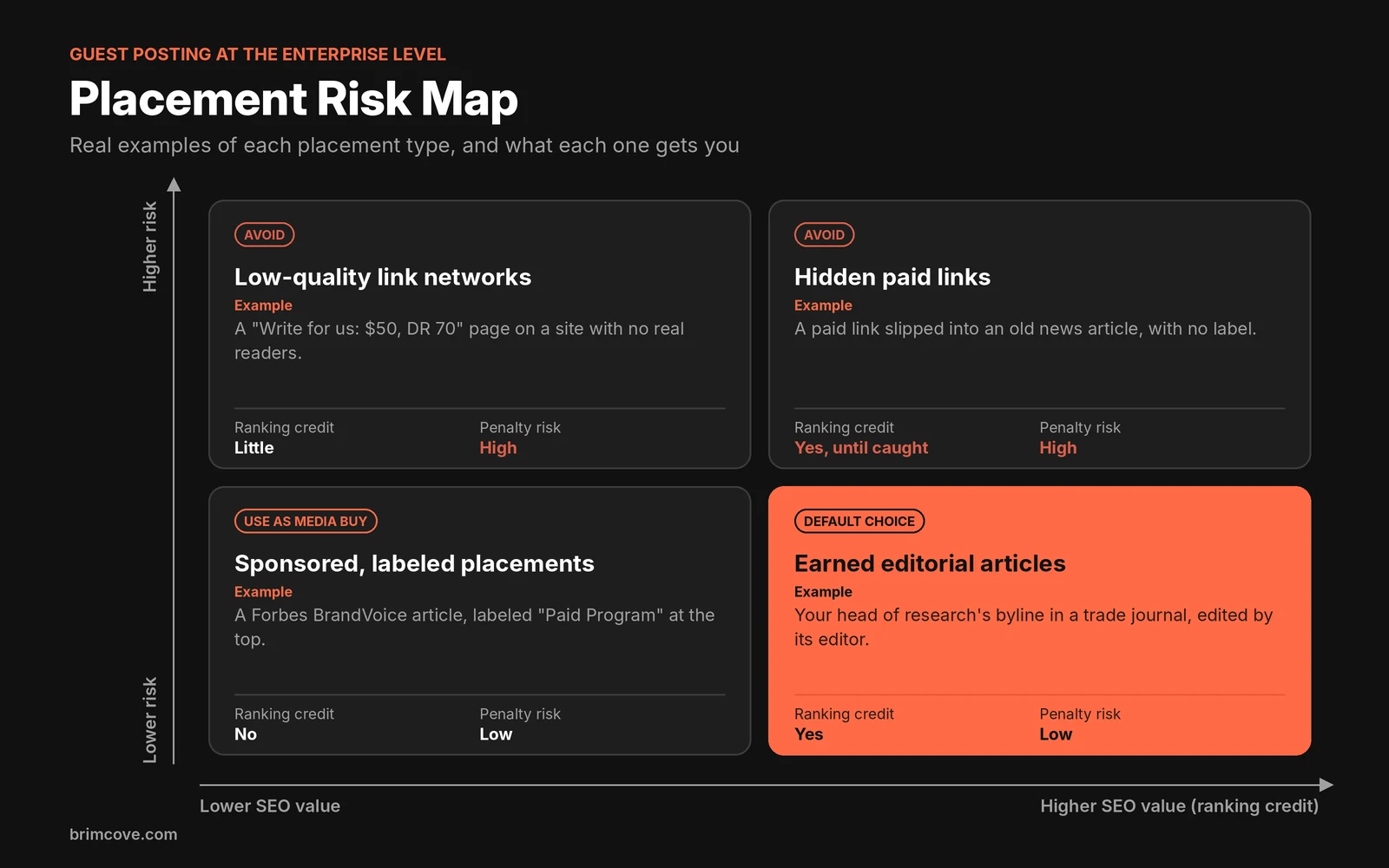
Google’s link spam policies treat links bought to pass ranking credit as a violation. Paid placements that are labeled and qualified still deliver reach, referral traffic and brand exposure, just not ranking credit. Both outcomes are legitimate. Reporting a paid, qualified link as if it were earned authority is not. For background on the attributes, see our guide to sponsored links and Google’s own guidance on qualifying outbound links.
For guest posting at the enterprise level, the cleanest policy is to make earned editorial links the default and treat paid placements as a labeled media buy with its own budget line.
Advertising Disclosure Rules by Market
- United States: The FTC’s Endorsement Guides require clear and conspicuous disclosure of material connections, such as payment, between a brand and the people promoting it. The Guides also expect advertisers to monitor compliance, and they state that agencies and other intermediaries can be liable too.
- United Kingdom: The CAP Code requires marketing to be obviously identifiable as marketing.
- European Union: Consumer protection law bans paid editorial content that isn’t clearly identified as paid.
- Regulated categories: Finance, health, pharma, insurance and legal brands face extra rules on claims, risk warnings and required disclaimers. Route every draft in these categories through compliance, with no exceptions for short pieces.
Assign Team Roles With a RACI Chart
A simple RACI chart prevents drafts from stalling and makes accountability clear when something goes wrong.
| Task | SEO lead | Content lead | Brand | Legal or compliance | Named author or SME | Vendor |
|---|---|---|---|---|---|---|
| Publication approval | Accountable | Consulted | Consulted for Tier 1 | Informed | — | Responsible for vetting |
| Anchor and target choice | Accountable | Informed | — | — | — | Responsible for logging |
| Draft accuracy | Informed | Accountable | — | — | Responsible | Responsible for writing |
| Brand and claims approval | Informed | Responsible | Accountable | Accountable in regulated categories | Consulted | Informed |
| Disclosure and attributes | Accountable | Informed | — | Consulted | — | Responsible |
| Post-live QC | Accountable | Informed | — | — | — | Responsible |
What Your Editorial Standards Document Should Cover
One shared document keeps every writer, vendor and reviewer aligned. Keep it to a few pages and include:
- Voice, terminology and banned claims
- Sourcing rules: which data sources are acceptable and how to cite them
- A pre-approved claims library with the exact wording legal has cleared
- Rules for mentioning competitors, customers and partners
- Author attribution rules: real named experts only, with approved bios
- An AI use policy: where AI drafting is allowed, the human editing and fact-checking required, and how to follow each publisher’s own AI rules
- Disclosure wording for sponsored placements
Give Legal a One-Page Program Summary Before Launch
The summary should answer five questions: which publications you will use, what the commercial relationship is with each, how disclosure is handled, who reviews drafts, and where records are stored. Keep invoices, publisher agreements and draft approvals together for every placement. Answering these questions before launch costs far less than answering them during a complaint or an audit.
07 / MeasurementHow to Measure Guest Posting ROI and Attribute Results
Measure enterprise guest posting at the page level, not the site level. Track rankings, organic traffic and conversions on the exact URLs that received links, compare them with similar pages that didn’t, and put a value on the difference. Report referring domains by tier and AI citation share alongside it, and agree the timeline to impact before the program starts.
Programs for guest posting at the enterprise level often get cut for bad reporting, not bad execution. A raw link count invites one question: why isn’t it higher? Page-level evidence invites a better one: where should we do more?
Use a Test-and-Control Design
- Before launch, pick the target pages and a control group of similar pages with similar rankings, traffic and internal links that will receive no new links.
- Record a baseline for both groups: rankings for their main terms, organic sessions, conversions and existing referring domains.
- Freeze other major changes on both groups where you can, or log every change so you can account for it.
- Compare the two groups monthly. The gap between them is your best estimate of the program’s effect.
This is far stronger evidence than sitewide traffic, which moves for dozens of reasons.
Leading and Lagging Indicators to Track
| Indicator | Type | When it usually moves | What it tells you |
|---|---|---|---|
| Placements live by tier | Leading | Monthly | The pipeline is working |
| New referring domains by tier | Leading | Monthly | Authority is being added to the right places |
| Rankings on target pages | Middle | Often within one to three quarters | Links are being counted |
| AI citation and mention share | Middle | Quarterly | Your brand is joining the sources assistants use |
| Organic sessions on target pages vs control | Lagging | Two to three quarters or longer | Rankings turned into traffic |
| Conversions and pipeline from target pages | Lagging | After traffic moves | The program is creating revenue |
How to Calculate Guest Posting ROI
Use the same formula finance uses for any other channel:
For attributable value, pick one of two methods and stick with it:
- Conversion value: extra organic conversions on target pages compared with control, multiplied by your average value per conversion from your CRM.
- Paid search equivalent: extra organic clicks multiplied by what those clicks would cost in Google Ads. Ahrefs and SEMrush both estimate this as traffic value. It is weaker evidence, but useful before conversions show up.
Total program cost must include internal review time, tools and management, not just vendor invoices.
Track AI Search Visibility With a Fixed Prompt Set
Write 20 to 50 prompts your buyers would plausibly ask. Run them on a fixed schedule in ChatGPT, Perplexity, Gemini and Google’s AI features. Google’s guidance on AI features explains how those features draw on its core search index. Log whether your brand appears, how it is described and which sources are cited next to you. Keep the prompts and method the same every time, because consistency matters more than which tracking tool you pick.
Set Time to Impact in Writing
Tell leadership up front, in writing, to expect two to three quarters before lagging indicators move in most competitive categories. Our guide to link building timelines explains why. Programs get cancelled in month four because nobody said what month four would look like.
What to Report to Leadership
- Referring domains added this quarter, by tier
- Target page movement against control
- Attributable value and ROI to date
- AI citation share on the fixed prompt set
- Risk status: anchor distribution, lost links and replacements
08 / Delivery modelAgency vs Marketplace vs In-House: Choosing an Enterprise Guest Posting Model
For enterprise guest posting, agencies suit programs that need relationships, writing capacity and fast scale. Marketplaces suit low-risk Tier 2 volume when your team can vet every site. In-house suits large, stable programs with strict brand control. Most enterprises end up with a hybrid: strategy and governance in-house, execution split between one or two agencies, with marketplaces used sparingly.
Agency, Marketplace and In-House Compared
| Factor | Agency | Marketplace | In-house team |
|---|---|---|---|
| Speed to start | Weeks | Days | Months to hire and train |
| Publisher relationships | Existing, varies by agency | Catalog only, no relationship | Built slowly from scratch |
| Vetting responsibility | Shared, check their process | Entirely yours | Entirely yours |
| Quality consistency | Depends on the agency’s process | Varies widely by listing | Highest, if staffed well |
| Cost structure | Retainer or per placement | Per placement, visible prices | Fixed salaries and tools |
| Internal effort | Low to medium | High | Highest |
| Scaling up or down | Easy | Easy | Slow |
| Compliance accountability | Shared by contract | Mostly yours | Yours |
| Best fit | Fast, multi-market programs | Filling known Tier 2 gaps | Long-term, high-control programs |
When Each Model Makes Sense
Choose an agency when you need volume within a quarter, write in several languages, or lack people with publisher relationships. Our guide to outsourcing link building covers what to hand over and what to keep.
Use a marketplace when you have a clear list of target publications, the in-house time to vet each listing, and a need for predictable per-unit prices. Treat every listing as unvetted until your rubric says otherwise.
Build in-house when guest posting is a permanent part of your channel mix, volume is stable, and brand or regulatory control outweighs speed.
Run a hybrid in most other cases. Keep strategy, the rubric, the anchor ledger and final approvals in-house. Give execution to vendors who work inside your rules, and measure them against each other on the same scorecard.
12 Questions to Ask Any Guest Posting Provider
Use these questions to compare providers for guest posting at the enterprise level on the same terms.
- Can you show us ten recent placements in our category, with live URLs?
- What is your written vetting process, and can we see a scored example?
- What share of your placements are earned editorial versus paid or sponsored?
- How do you handle disclosure and link attributes on paid placements?
- Who writes the content, and what is your policy on AI drafting?
- How do you plan anchor text and target pages across a whole program?
- Can we approve every publication before you pitch it?
- What happens if a link is removed or a site is penalized?
- What do you report, how often, and can we access raw data?
- How do you prevent pitching sites on our blocklist or sites another vendor already uses?
- Who on your team owns our account, and who actually does the outreach?
- Which costs are fixed, which vary, and what is not included?
Red Flags in Guest Posting Proposals
- Refusing to name any publications before the contract
- A fixed monthly link count with no mention of quality standards
- Guaranteed rankings or guaranteed DR increases
- Anchor text chosen per link, with no program-level plan
- No answer on disclosure or link attributes
- Reports that show only link counts and DR
Contract Terms to Require
Good answers in a pitch meeting mean little unless they are in the contract. Ask for:
- Your approval of every publication before it is pitched
- Ownership and usage rights for every article you pay for
- Replacement or refund terms for lost or penalized links, with a stated time window
- Access to raw placement data with every field in your system of record
- Written responsibility for disclosure and link attributes
- A ban on pitching sites from your blocklist or reusing your content elsewhere
- A notice period and a handover of publisher contacts if you end the contract
09 / Launch planYour First 90 Days: Launching an Enterprise Guest Posting Program
Launch guest posting at the enterprise level in three phases. Spend the first month on baselines and governance, the second on a small pilot, and the third on review and scale-up. A pilot of 10 to 15 placements tests your vetting, approvals and vendors on real work before you commit a full-year budget. It also gives you true cycle times for capacity planning.
Days 1–30Baseline and governance
Audit the current backlink profile and past placements, choose target pages and a control group, agree the rubric, anchor guardrails and RACI, brief legal, shortlist vendors.
Output: baseline report, approved publication list, signed-off governance documents.
Days 31–60Pilot
Run 10 to 15 placements, mostly Tier 2 with a few Tier 1 pitches.
Output: measured cycle time, acceptance rate, review hours and QC failures.
Days 61–90Review and scale
Fix the bottlenecks the pilot exposed, set quarterly volume with the capacity formula, agree longer-term contracts.
Output: quarterly plan, vendor decisions, first leadership report with the agreed timeline.
FAQsGuest Posting at the Enterprise Level: FAQs
What is enterprise guest posting?
Enterprise guest posting is a governed program of expert articles placed on vetted third-party publications for a large brand. It uses documented vetting, multi-team approvals, planned anchor text and page-level reporting, so every placement can be defended to brand, legal and leadership.
How is enterprise guest posting different from regular guest posting?
The tactic is the same, but the process isn’t. Enterprise guest posting programs face sequential approvals, strict brand safety, a public link profile and enough volume to create detectable patterns. That means formal vetting, an anchor ledger, compliance rules and test-and-control reporting.
How do you choose a provider for guest posting at the enterprise level?
Ask for live placements in your category, a written vetting process, a clear disclosure policy and access to raw data. Then put publication approval, content ownership and replacement terms in the contract. Score every shortlisted provider on the same criteria.
Is guest posting still safe for enterprise brands?
Yes, when the placements are earned on editorial merit, the publications pass a strict rubric, and anchors stay natural. The risk comes from paid links passing ranking credit without disclosure, keyword-heavy anchors at volume, and low-quality sites built to sell links.
How many guest posts does an enterprise program need per month?
There is no standard number. Work it out from your target pages, the referring domain gap to the pages outranking you, and your review capacity. Your legal and brand review queue usually sets the ceiling before your budget does.
Should enterprise guest post links be do-follow?
Earned editorial placements usually carry standard links. Paid or sponsored placements should be labeled for readers and qualified with rel=”sponsored” or rel=”nofollow”, in line with Google’s guidance and advertising disclosure rules.
How long does enterprise guest posting take to show results?
Leading indicators, such as live placements and new referring domains, move within weeks. Rankings on target pages often move within one to three quarters. Traffic and revenue usually take two to three quarters or longer in competitive categories.
Does guest posting help with AI search visibility?
It can. AI assistants build answers from sources they already trust. Substantive articles that mention your brand alongside your category topics, on publications those assistants cite, strengthen the association between your brand and those topics.
Next stepYour Next Step: Audit Before You Scale
Guest posting at the enterprise level works when it runs like any other governed channel: clear quality rules, a pipeline sized to your reviewers, planned anchors, written compliance and page-level proof.
Start with one practical move this week. Pull your current backlink profile into Ahrefs, list your top 20 target pages, and score your last 20 placements against the rubric above. That single exercise shows you where your quality bar sits today, where your anchor risk is, and which pages need links most.
If you’d rather have a team run that audit and build the program with you, Brimcove’s guest posting services and managed link building programs are built around the vetting, QC and reporting described in this guide.
