
Enterprise link building is less about finding links and more about keeping a large organization from undoing its own work. A site migration quietly breaks thousands of linked URLs. An outreach inbox on the main brand domain gets flagged as spam. The CFO asks what last year’s link budget returned, and the only answer is a Domain Rating chart.
This enterprise link building guide is built for the people who have to fix that: in-house SEO leads, heads of growth and the marketing directors who sign the budget. You’ll get the operating model, not another list of tactics.
Inside this enterprise link building playbook, you’ll find a page-scoring formula, a link policy template legal can approve once, a compliance checklist that goes beyond Google, an approval workflow with real SLAs, deliverability rules for outreach at volume, a budget model and a 90-day launch plan.
What Is Enterprise Link Building?
Enterprise link building is the practice of earning editorial backlinks for a large organization’s highest-value pages, run as an ongoing program with one owner, one written policy, formal approvals and revenue-linked reporting. The tactics look familiar. What changes is the operating layer: more stakeholders, more properties, more risk and more scrutiny on spend.
Company size alone doesn’t make a program “enterprise.” Use this quick test. If three or more of these are true, you need an enterprise link building operating model, not just a better outreach template:
- You manage more than one domain, country site or acquired brand
- Legal, brand or compliance must sign off on content that carries your name
- Vendors go through procurement, security review or a master service agreement
- You run a standing monthly link target across several sites or regions
- Your link budget sits in a plan someone above marketing approves
- You’ve migrated, merged or rebranded a site in the last three years
- You work in a regulated category such as finance, healthcare, insurance or legal
| Standard link building | Enterprise link building | |
|---|---|---|
| Target pages | 5–20 pages | Hundreds, ranked by a scoring model |
| Decision makers | 1–2 people | SEO, brand, legal, PR, regional leads, procurement |
| Main risk | A wasted link | A brand, legal or penalty problem |
| Vendor setup | Card payment, start Monday | MSA, security questionnaire, approved vendor list |
| Reporting | Links built, DR, rankings | Pipeline, share of voice, cost per outcome |
| Biggest bottleneck | Finding prospects | Approvals and coordination |
Step 1: Build the Business Case and Budget
An enterprise link building business case wins approval when it states the gap in numbers, prices the work from that gap, and shows how risk is controlled. Leaders rarely reject enterprise link building on principle. They reject vague asks with no budget logic, no timeline and no way to check progress.
Keep the case to one page with five parts:
- The gap. For your top commercial pages, compare referring domains against the top three ranking URLs. “Our 25 priority pages average 18 referring domains. The pages outranking them average 41.”
- The value at stake. Use Ahrefs or Semrush traffic value (estimated clicks × keyword CPC) for those keywords. It translates rankings into a number finance already understands: paid media spend.
- The budget. Price it from the gap, not from a round number (formula below).
- The timeline. Set expectations in quarters, not weeks. Report leading indicators monthly while slower ranking and revenue signals build.
- The controls. Name the link policy, the approval path and the reporting cadence. This is what turns a “risky SEO tactic” into a governed enterprise link building program.
A Budget Model You Can Defend
Work backward from the link gap:
Worked example: 25 priority pages with an average gap of 15 referring domains is 375 links. Spread over 12 months, that’s about 31 placements a month. If you assume a blended $250–$350 per vetted placement (swap in your own vendor quotes), the placement line runs $7,750–$10,850 a month. Add your internal costs for one data asset per quarter and the hours of the people who own the program.
For reference, editorial placements through our team run from $69 (DR 20+) to $389 (DR 70+), and a fully managed link building program runs from $499 to $5,000 a month. Enterprise link building programs usually sit at the top of those ranges because they need higher-authority, niche-relevant publishers.
Tip: Present a range, not a single number. A low and high scenario tied to different link velocities gives leadership a real choice instead of a yes-or-no.
Step 2: Decide Which Pages Get Links
In enterprise link building, links should go to pages where authority is the missing ingredient, not to pages someone senior asked about. Score every candidate page on revenue, ranking distance and link gap, then pass it through a readiness gate. Pages that fail the gate get fixed first, because links can’t rescue a weak page.
The Readiness Gate (Pass or Fail)
Before a page enters the queue, it must clear all four checks:
- Indexable, canonical to itself and returning a 200 status
- Matches the search intent of its target keyword (check the current top 5)
- Receives at least 3 contextual internal links from relevant pages
- Has a stable URL with no migration or redesign planned for 6 months
The last check matters more in enterprise link building than anywhere else. Building links to a URL that changes next quarter hands the value to a redirect chain.
The Scoring Model
Score each page that passes from 1 to 5 on three factors:
| Factor | 1 (low) | 5 (high) | Data source |
|---|---|---|---|
| Revenue weight | Informational, no assisted conversions | Direct pipeline or sales page | GA4, CRM |
| Ranking distance | Position 50+ or not ranking | Positions 4–15 | Google Search Console |
| Link gap | Already matches top 3 | Needs 20+ more referring domains | Ahrefs, Semrush |
Multiplying instead of adding means a page that scores 1 on any factor drops to the bottom. That’s intentional. A high-revenue page already sitting at position 1 doesn’t need your budget this quarter.
Sort by score, take the top 20–50 pages, and treat that list as your quarterly target set. Rescore every quarter. When a business unit asks for its page to jump the queue, the answer becomes simple: “Show us the numbers that change its score.”
Use Hubs for Large Page Sets
E-commerce and SaaS sites can’t build links to 8,000 product or feature pages. Build links to category hubs, comparison pages and data assets instead, then pass that authority down with clean internal links. Your link building plan should map which hub feeds which money pages before any outreach starts.
Step 3: Write a Link Policy Legal Can Approve Once
An enterprise link building policy is a short, signed document that sets the rules every team and vendor follows: which sites qualify, which anchors are allowed, what needs disclosure and who approves what. Approved once by legal and brand, it replaces dozens of one-off reviews and keeps a multi-vendor link profile consistent.
Keep it to two or three pages. A regional agency should read it in ten minutes. Here’s the enterprise link building policy structure we use with clients:
| Section | What it states | Example rule |
|---|---|---|
| Scope | Which domains, teams and vendors it covers | All brand domains, all regions, all agencies |
| Site standards | Minimum bar for any linking site | DR 30+, 1,000+ verified organic visits a month, real editorial standards, niche relevance |
| Banned sources | Sites and patterns never used | PBNs, link farms, sites selling links on a public price list, competitor-owned media |
| Anchor rules | Mix and limits per target page | Branded and URL anchors first; exact-match capped at a small share and never repeated across vendors |
| Paid placements | When paid is allowed and how it’s marked | Paid or sponsored content carries rel=”sponsored” and a visible disclosure |
| Content rules | What can be said under the brand name | Only claims from the approved claims library; no unapproved stats, pricing or customer names |
| Approvals | Who signs off on what, and how fast | See the tiered approval workflow in Step 5 |
| Records | What every placement log must capture | URL, target page, anchor, publisher, date, cost, vendor, rel attribute |
| Review cycle | When the policy is updated | Every 6 months or after any Google spam policy change |
Two rules deserve extra attention.
Anchors. Across thousands of links, patterns become visible. If one target page shows the same commercial anchor from five vendors, it looks built, because it was. Our guide to anchor text covers healthy ratios.
Contract links. Partnership, sponsorship and reseller teams sometimes write “must link to us” clauses into agreements. Google’s spam policies treat links required by a contract or terms of service as link schemes unless they’re qualified. Ask legal to remove follow-link requirements from templates, or require rel=”sponsored” or rel=”nofollow” on them.
Step 4: Check Link Building Compliance Before the First Email
Enterprise link building touches five rule sets, not one: Google’s spam policies, advertising disclosure law, email and privacy law, industry-specific claim rules and intellectual property. Most guides stop at Google. Legal teams don’t, so map all five before outreach starts and you’ll avoid the late-stage vetoes that kill campaigns.
This section is a practical enterprise link building compliance checklist, not legal advice. Use it to brief your legal team and get answers in writing.
1. Google’s Spam Policies
- Link schemes. Paid links, excessive link exchanges and links required by contract must carry rel=”sponsored” or rel=”nofollow”. See our explainer on sponsored links.
- Site reputation abuse. Since November 2024, Google treats third-party content published to exploit a host site’s ranking signals as a violation, even when the host is involved in producing it. Two enterprise link building takeaways: don’t buy placements in rented sections of big publishers (coupon hubs, unrelated “partner” verticals), and audit any third-party sections on your own domains.
- Policy circumvention. Moving risky tactics to a subdomain or a new microsite doesn’t isolate the risk. Plan for your whole estate to be judged together.
2. Advertising Disclosure (FTC and Equivalents)
The FTC’s Endorsement Guides, revised in June 2023, require a clear and conspicuous disclosure when a material connection exists between a brand and the person or publisher promoting it. Payment, free products and employment all count. The revision also made clear that advertisers can be liable for deceptive endorsements even when the endorser isn’t.
In practice: any paid placement, gifted product review or employee-written guest post needs a visible disclosure on the page, not just a rel attribute in the code. The UK, EU and other markets have their own versions, so check each region you publish in.
3. Outreach Email and Privacy Law
| Region | Main rules to brief legal on | What it means for outreach |
|---|---|---|
| United States | CAN-SPAM | Accurate sender details, honest subject lines, a physical address and a working opt-out you honor |
| UK and EU | UK GDPR / GDPR, PECR and ePrivacy rules | Document a legitimate interest basis, record where each contact came from, honor objections quickly |
| Canada | CASL | Stricter consent rules; confirm with counsel before cold outreach to Canadian contacts |
Also confirm where your outreach CRM stores contact data and how long you keep it. Procurement will ask.
4. Regulated Claims
Healthcare, finance, insurance and legal brands face extra review on anything published under their name. Build an approved claims library: pre-cleared statistics, product descriptions, boilerplate and disclaimers. Writers pull from it, so most guest content clears review without a fresh legal pass.
5. Data and Intellectual Property
Original research is the strongest asset in enterprise link building, and also the riskiest. Aggregate customer data, set a minimum group size so no individual or client can be identified, and get written sign-off from the data owner. License every image you send to publishers.
Step 5: Build an Approval Workflow That Doesn’t Kill Placements
The fix for slow enterprise link building approvals is to sort content by risk, so only risky pieces get a full review. Low-risk content on pre-approved publishers moves in a day. New claims, executive bylines and data releases get proper legal time. Every tier has a written turnaround target that’s reported alongside link counts.
Editors don’t wait. If a piece sits in review for two weeks, the slot goes to someone else. Here’s a tiered enterprise link building approval model that keeps speed and control:
| Approval tier | What falls in it | Who approves | Target turnaround |
|---|---|---|---|
| Tier A: pre-cleared | Content using only the claims library, on a pre-approved publisher list | SEO program owner | 1 business day |
| Tier B: brand check | New publisher, new topic or a quote from a named employee | SEO owner + brand | 2 business days |
| Tier C: full review | Original data, executive bylines, regulated claims, any paid placement | SEO owner + brand + legal | 5 business days |
Your goal is to move most of your volume into Tier A over time by growing the claims library and the pre-approved publisher list. Faster approvals raise output without adding a single pitch.
Who Does What (RACI)
| Activity | SEO owner | Content | Brand | Legal | Vendor |
|---|---|---|---|---|---|
| Link policy | A/R | C | C | C (signs off) | I |
| Target page list | A/R | I | I | — | I |
| Outreach and pitching | A | I | I | — | R |
| Writing guest content | A | R | C | C (Tier C) | R |
| Final approval | A | — | R (Tier B–C) | R (Tier C) | — |
| Placement log and reporting | A | — | I | I | R |
R = does the work, A = owns the outcome, C = consulted, I = informed.
Your Approval Kit
Prepare these once and share them with every writer and vendor:
- Approved claims library: cleared stats, product lines and disclaimers
- Spokesperson bios: 3–5 named experts with approved bios and headshots
- Pre-approved publisher list: sites already vetted against your policy
- Boilerplate: the company description legal has already signed
- Disclosure templates: wording for paid and sponsored placements
Step 6: Protect the Link Equity You Already Have
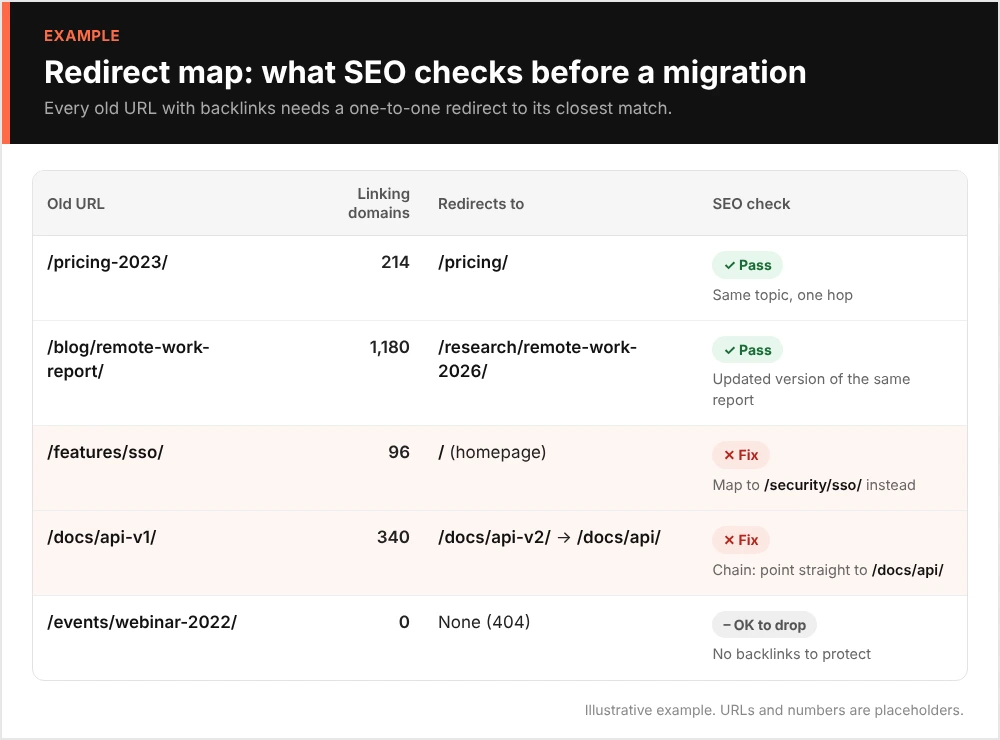
The cheapest wins in enterprise link building are links you already earned and then lost. Migrations, redesigns, rebrands and acquisitions break linked URLs at scale. Before you buy or pitch a single new link, recover what’s leaking and put rules in place so the next release doesn’t leak it again.
In enterprise link building, large sites lose links in four predictable ways:
| Leak | How to find it | Fix |
|---|---|---|
| Linked pages now 404 | Ahrefs Best by Links report, filtered to 404 | 301 each URL to its closest topical match, never all to the homepage |
| Redirect chains after migrations | Screaming Frog crawl of all externally linked URLs | Point each old URL straight to the final destination |
| Acquired or retired domains | Backlink export of every domain you own | Map relevant pages one-to-one; audit for toxic patterns before redirecting |
| Unlinked brand mentions | Brand monitoring for brand, product and exec names | Short, polite request to add the link |
Make SEO a Release Gate
Most link losses happen during launches, not because of bad strategy. Add two items to your engineering and web team’s release checklist:
- Any URL with external backlinks needs a one-to-one redirect in the migration map, approved by SEO.
- SEO checks redirect status and lost referring domains at 7, 30 and 90 days after launch.
Our guide to link reclamation covers the outreach side. For ongoing tracking, a dedicated tool from our list of backlink monitoring tools will alert you when high-value links drop.
Be Careful With Acquired Domains
An acquired brand’s links can be a gift or a liability. Audit its profile before you redirect anything. If it shows paid-link footprints or spam patterns, redirecting it moves that history onto your main domain.
Step 7: Scale Link Building Outreach Without Burning Your Domain
Enterprise link building outreach needs its own sending setup, a shared contact record across every team and vendor, and volume planned from your real conversion rates. Blasting hundreds of emails a day from the main brand domain risks spam filtering for the whole company, including sales and support mail.
Protect the Sending Domain
Since Gmail began enforcing its sender guidelines in November 2025, mail that fails authentication can be rejected outright. Google’s email sender guidelines ask senders to keep their user-reported spam rate below 0.1% and never let it reach 0.3%. Senders above about 5,000 messages a day to Gmail accounts face stricter bulk-sender rules, and that label doesn’t expire.
What that means for enterprise link building outreach:
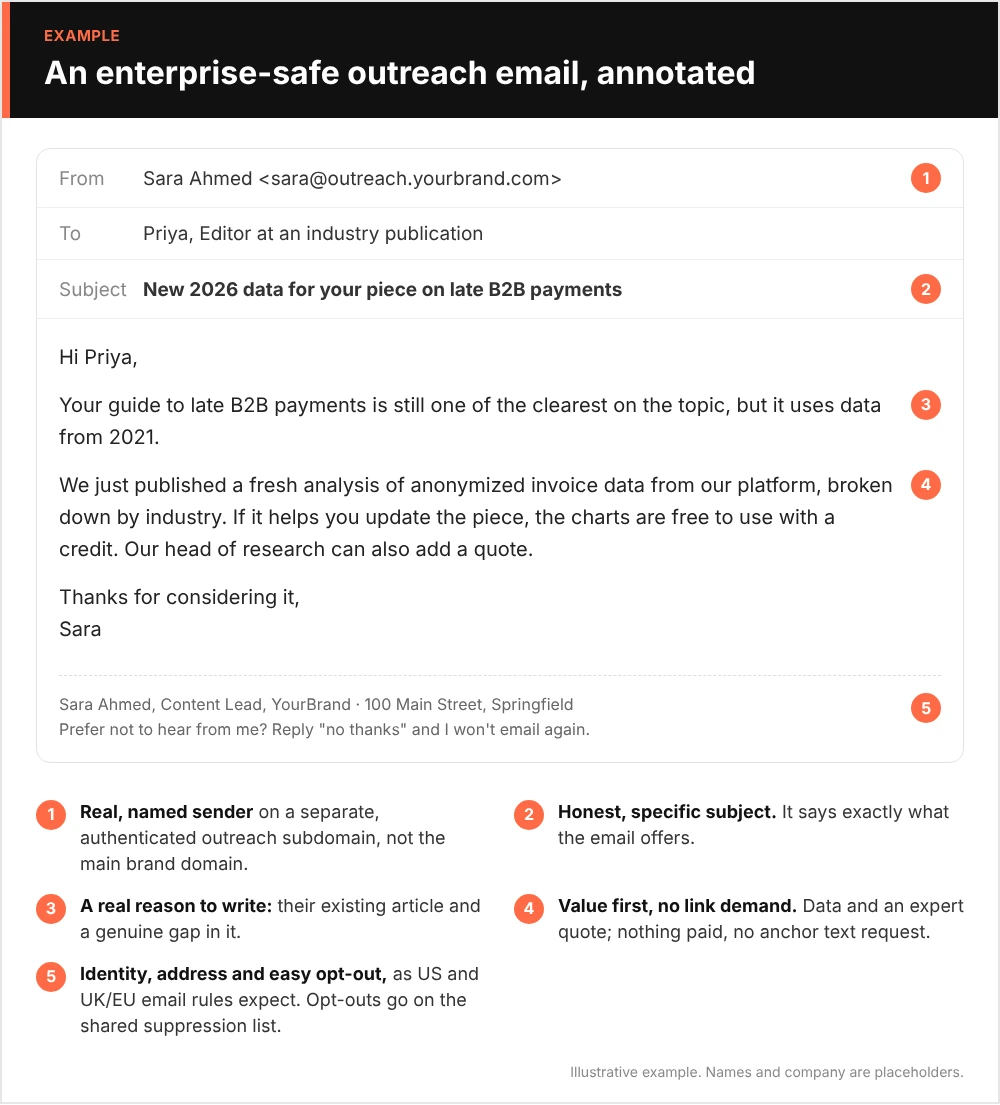
- Separate the stream. Send outreach from a dedicated, authenticated subdomain (SPF, DKIM and DMARC aligned), approved by IT and security. Keep it apart from newsletters and transactional mail.
- Avoid lookalike domains. Registering “brand-team.com” may pass deliverability checks, but security teams and journalists can read it as phishing. Get brand and IT approval first.
- Use real people. Emails should come from named employees or clearly identified agency staff who can be verified on LinkedIn.
- Cap per inbox. Spread volume across several warmed inboxes and keep each to a few dozen personal emails a day.
- Honor every no. One or two follow-ups at most. Any opt-out goes on a global suppression list that every vendor checks.
Plan Volume From Your Own Numbers
Work out how many pitches your enterprise link building program needs, using your last 90 days of data:
Example: for 31 placements a month, with an assumed 10% reply rate and 1 in 3 replies converting (use your own rates), you need about 930 well-targeted pitches. Spread over 21 working days and 6 inboxes, that’s roughly 7 new emails per inbox per day. Better targeting lifts the reply rate and shrinks every number in that chain.
Run One Contact Record for the Whole Company
PR, SEO, partnerships and three agencies may all pitch the same editor in the same week. Fix this with one shared outreach log, checked before every pitch:
- One record per publisher and contact, with owner and last-contact date
- Relationship owners: PR owns tier-one journalists; SEO owns everyone else unless agreed
- A 30-day cool-off after any pitch, across all teams and vendors
- Shared suppression list for opt-outs and “never contact” publishers
For the mechanics of growing output without lowering standards, see how to scale link building without sacrificing quality.
Step 8: Choose Enterprise Link Building Tactics by Speed, Risk and Scale
The right enterprise link building tactic mix balances three things: how fast a tactic produces links, how much review it triggers and how far it scales. Data-led digital PR earns the strongest links but needs full legal review. Mention reclamation and vetted guest content move faster and fill the monthly volume in between.
| Tactic | Best enterprise use | Approval tier | Relative speed | How it scales |
|---|---|---|---|---|
| Original data studies and digital PR | Category authority, news coverage, AI citations | C | Slow | Few, very strong links per study |
| Unlinked mention reclamation | Turning existing press and partner mentions into links | A | Fast | Grows with brand size |
| Expert commentary for journalists | Exec and specialist quotes in trade and national media | B | Medium | Limited by spokesperson time |
| Editorial guest content by named experts | Deep links to hubs and Tier 1 pages | A or B | Medium | High, with a claims library |
| Link insertions in existing articles | Relevant links on already-indexed pages | A | Fast | High, needs strict vetting |
| Partner and integration pages | Links from vendors, resellers and tech partners | B | Medium | Medium; editorial only, no contract links |
| Regional and local publishers | Country sites and local folders | A or B | Medium | Per market |
| Free tools and calculators | Evergreen links to a useful asset | C | Slow | Strong over the long term |
For multi-market brands, regional links matter more in enterprise link building than most teams budget for. A German product page needs coverage from German publishers to back up the targeting your hreflang already declares. Our international link building team handles in-language outreach for this reason.
Every asset you pitch should earn its link on merit. Our guide to linkable assets covers formats that work.
Tactics to Retire
Some tactics still show up in enterprise link building playbooks but rarely pay off now:
- Press release wire distribution for links. Wire links are usually nofollow and syndicated copies add little. Use wires for announcements, not SEO.
- Scholarship and “badge” links. Widely abused and easy for both Google and journalists to spot.
- Bulk directory submissions. Keep only the directories your buyers actually use.
- Rented sections on big publishers. These are exactly what the site reputation abuse policy targets.
Plan for AI Search, Too
AI Overviews, ChatGPT and Perplexity tend to draw on sources that already rank and get cited by others. Links and brand mentions from the publications your buyers read raise the odds your brand appears in those answers. We cover this shift in how AI search is reshaping link building.
Step 9: Choose and Manage Vendors Like a Portfolio
Most enterprise link building programs end up with more than one vendor, so treat them as a portfolio: one policy, one reporting format, one shared publisher log and a scheduled quality audit. Choose vendors with procurement-grade questions about methods, subcontracting and data handling, not just price per link and sample domains.
Questions to Put in Your RFP
| Area | Ask this | A good answer looks like |
|---|---|---|
| Method | How are links acquired, step by step? | Manual outreach to vetted editors; no PBNs, no bulk automation |
| Vetting | What’s your minimum bar for a site? | Named metrics plus human review of traffic trend, content and outbound links |
| Transparency | Will we see every publisher before and after placement? | Full URLs, anchors and dates in a live dashboard |
| Subcontracting | Who actually does the outreach and writing? | In-house team, or named subcontractors disclosed in the contract |
| Policy fit | Will you work to our link policy and approval tiers? | Yes, in writing, including disclosure rules |
| Guarantees | What happens if a link is removed? | A replacement window stated in the contract |
| Data | Where is our contact and campaign data stored? | Clear storage, retention and deletion terms |
| Proof | Can we audit your last 20 placements for any client? | Yes, with live URLs |
At Brimcove, every placement comes with a 6-month replacement guarantee, all outreach is done by our in-house team, and clients get live reporting with every URL. Hold any enterprise link building vendor, us included, to the same standard.
Run the Portfolio
- One reporting template. Target URL, anchor, publisher, date, cost, rel attribute, vendor. Different formats hide duplicates.
- One publisher log. Updated weekly, so two vendors never pitch the same site for the same brand.
- Quarterly sample audit. Pull 20 random placements per vendor and check them against your policy. Our guide to link quality lists what to check.
- Annual re-vetting. Agencies change owners, staff and methods. Re-run the RFP questions every year.
Step 10: Measure Enterprise Link Building ROI
Measure enterprise link building in three layers: program health (are links landing on policy), page impact (did the target pages move) and business outcome (did organic pipeline or revenue grow). Use a holdout group of similar pages to prove links caused the lift, not seasonality or a core update.
Three Layers of Metrics
| Layer | Metrics | Cadence | Audience |
|---|---|---|---|
| Program health | Placements vs plan, % in policy, approval turnaround by tier, cost per placement, spam rate on outreach inboxes | Weekly | SEO team, vendors |
| Page impact | Referring domains to target pages, ranking and clicks for each page’s keywords, share of voice vs named competitors | Monthly | SEO and marketing leads |
| Business outcome | Organic pipeline or revenue from priority pages, traffic value, AI answer citations | Quarterly | CMO, finance |
Prove Causation With a Holdout Group
Leadership’s hardest question about enterprise link building is “Would this page have grown anyway?” Answer it with a simple test:
- Take 20 pages with similar priority scores.
- Build links to 10 of them this quarter. Leave the other 10 untouched.
- Compare clicks and average position for both groups at 30, 60 and 90 days in Google Search Console.
- Report the difference between the groups, not the raw growth of the linked set.
A site-wide core update hits both groups equally, so the gap between them is your best estimate of what links added. Run it every quarter and your enterprise link building program builds a track record finance can trust.
Track AI Visibility
Build a fixed list of 30–50 buyer questions. Each month, check which brands ChatGPT, Perplexity and Google AI Overviews mention or cite for them. Log the result next to your link and mention gains on the same topics.
Set Honest Timelines
Competitive Tier 1 pages move slowest, and approval delays add time on top. Leading indicators move first, so report them while you wait. Our breakdown of link building timelines gives benchmarks by situation.
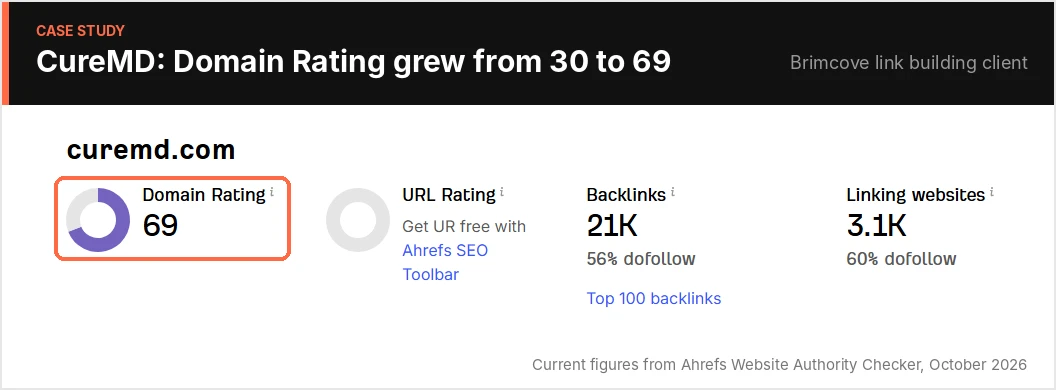
For a sense of what consistent work can do: our healthcare client CureMD grew from 5K to 60K monthly organic traffic and from DR 30 to 67 in six months.
A 90-Day Enterprise Link Building Launch Plan
A new enterprise link building program should spend its first month on foundations, its second on a controlled pilot and its third on scaling what the pilot proved. Most teams skip straight to outreach and then stall in approvals. This order gets the slow parts moving first, so placements flow once outreach starts.
| Weeks | Focus | Deliverables | Owner |
|---|---|---|---|
| 1–2 | Audit and scope | Domain inventory, backlink baseline, lost-link list, competitor gap for top pages | SEO owner |
| 3–4 | Rules and approvals | Link policy signed, approval tiers and SLAs agreed, claims library and spokesperson bios ready | SEO owner, brand, legal |
| 3–4 | Quick wins | 404 and redirect fixes, first unlinked mention requests | SEO, web team |
| 5–6 | Infrastructure | Outreach subdomain authenticated, shared contact log, reporting template, vendor RFP sent | SEO owner, IT |
| 5–8 | Pilot | Outreach to 10 test pages with 10 holdout pages; first data asset in production | SEO, vendor, content |
| 9–10 | Review | Pilot results, approval turnaround, reply and placement rates, cost per placement | SEO owner |
| 11–13 | Scale | Expand to the full quarterly target list; first leadership one-pager; next quarter’s budget request | SEO owner, marketing lead |
By day 90, your enterprise link building program should have a signed policy, a working approval path, a live outreach setup, early placements and your first evidence from the holdout test. That’s a far stronger budget conversation than a link count.
Enterprise Link Building Mistakes to Avoid
The costliest enterprise link building mistakes are organizational, not tactical. Programs stall when no single person owns them, when legal sees content too late, when vendors work blind to each other, or when success is reported as Domain Rating instead of business results. Each one has a simple, structural fix.
- No named owner. “The SEO team” isn’t an owner. Name one person accountable for enterprise link building policy, budget and reporting.
- Bringing legal in at the end. Brief legal during policy writing, not after an editor accepts a draft.
- Reporting DR as the headline. Leadership funds pipeline and share of voice. Put authority metrics in the operational report.
- Building links to unstable URLs. If a redesign is coming, wait or build to the hub that will survive it.
- Letting business units hire their own vendors. Allow it only if they work to the central policy and shared log.
- Sending outreach from the main domain. One spam spike can hurt sales and support email deliverability.
- Treating every page as Tier 1. Spreading budget thin across 500 pages moves none of them.
- Skipping the holdout test. Without a control group, every ranking change is open to debate.
Enterprise Link Building FAQs
How is enterprise link building different from regular link building?
The tactics are mostly the same: digital PR, guest content, link reclamation and outreach. What changes is everything around them. Enterprise link building covers many target pages ranked by a scoring model, several approvers across SEO, brand and legal, vendors that go through procurement, and compliance rules in every region you publish in. Success is reported differently too: leadership expects pipeline and share of voice, not just a count of new links.
How much does enterprise link building cost?
There’s no fixed price, because the cost depends on how many links your priority pages need. Work it out from your link gap: total the extra referring domains your top pages need to match the pages outranking them, divide by the months available, and multiply by your blended cost per vetted placement. Then add the cost of data assets and the time of the people who run the program. Showing leadership a low and a high scenario gives them a clearer choice.
Should enterprises build links in-house or use an agency?
Most enterprise link building programs use a hybrid model. A small internal team owns the link policy, the target page list, approvals and reporting, because those need company knowledge and authority. An agency supplies outreach capacity, publisher relationships and placement volume. Fully in-house works if you can hire and keep a dedicated team. Fully outsourced only works when a strong internal owner holds every vendor to the same policy.
How long does enterprise link building take to work?
Expect early signals first and rankings later. New referring domains, placement rates and approval turnaround show progress within the first few months. Rankings on competitive commercial pages move more slowly, and legal or brand reviews add time on top. That’s why it helps to plan, budget and report in quarters, and to run a holdout test that shows leadership what the links actually changed.
Is buying links safe for enterprise brands?
Paying for a placement stays within Google’s rules only when the link carries rel=”sponsored” or rel=”nofollow” and readers can see the content is paid. Paid links that pass ranking value break Google’s spam policies and can lead to a manual action. In the US, the FTC’s Endorsement Guides also require a clear disclosure when there’s a paid relationship. For most enterprises, editorial links earned through data, expertise and outreach are the safer long-term choice.
Does enterprise link building help with AI search visibility?
It helps indirectly. AI tools such as Google AI Overviews, ChatGPT and Perplexity tend to draw on sources that already rank well and get cited by others. Earning links and brand mentions from the publications your buyers read makes your brand more likely to appear in those answers. To track it, keep a fixed list of buyer questions and check each month which brands the AI tools mention.
Who should own enterprise link building in a large company?
One named person, usually a senior SEO or organic growth lead. They own the link policy, the target page list, the vendor portfolio and reporting to leadership. Content, brand, legal, PR and regional teams all contribute, but accountability stays with one owner. Programs without a single owner tend to stall in approvals and repeat work across teams.
Turn Link Building Into a Program, Not a Project
Enterprise link building works when it runs like any other governed business program: a named owner, a scored target list, one signed policy, tiered approvals, a protected sending setup, a managed vendor portfolio and reporting that proves impact with a control group.
If you want an execution partner that works inside your policy and approval process, our managed link building program is built for exactly that. Every link is placed by our in-house team through manual outreach, logged in live reporting, and backed by a 6-month replacement guarantee.
Book a Free Consultation