
Anchor text in SEO is the clickable text users select to move from one webpage to another. It helps readers understand what they will find after clicking a link and gives search engines additional context about the relationship between linked pages.
For example, in the sentence “Learn more about technical SEO basics,” the words “technical SEO basics” are the anchor text.
When used properly, anchor text can improve navigation, strengthen internal linking, support topical relevance, and help search engines understand your website’s content. However, aggressively repeating exact-match keywords or using misleading anchors can create a poor user experience and an unnatural linking pattern.
This guide explains what anchor text is, why it matters for SEO, the different types of anchor text, how Google interprets links, internal and external linking best practices, common mistakes, anchor text audits, and practical ways to optimize links naturally.
Table of Contents
What Is Anchor Text?
Anchor text is the visible, clickable text used in a hyperlink. A basic HTML link looks like this:
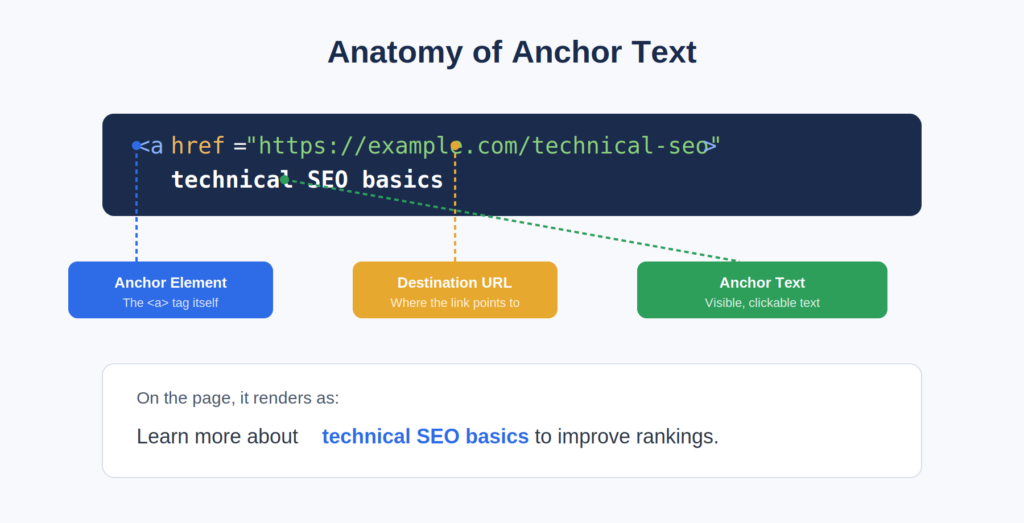
In this example, <a> is the anchor element, href contains the destination URL, and “technical SEO basics” is the anchor text.
On a webpage, users typically see anchor text as a clickable phrase, often distinguished by formatting such as underlining or a different color.
For example:
A strong internal linking strategy helps search engines discover important pages.
The phrase “A strong internal linking strategy” is the anchor text.
Links create connections between webpages. Imagine a website about digital marketing:
Homepage → SEO Guide → Keyword Research Guide → Link Building Guide
The anchor text used between these pages helps users understand the relationship between the topics. Phrases such as “learn SEO basics,” “keyword research guide,” and “link building strategies” are generally more helpful than repeatedly using vague text such as “click here.”
Internal links connect pages on the same website. They can guide users through related topics, help search engines discover content, and support the website’s overall topic structure.
External links point from your website to another website. For example, a page may link to Google’s Search Central documentation using descriptive anchor text such as “Google Search Central documentation.”
Backlinks are links from another website to your website. If a marketing publication links to your SEO guide using a phrase such as “SEO content strategy,” the link may send referral traffic, increase brand exposure, and provide context about your page.
Images can also function as links. When a clickable image has descriptive alt text, that alt text can provide additional context about the image and destination.
Visual suggestion: Create a simple visual showing: “Learn more about [technical SEO basics] to improve your website’s search performance.” Highlight “technical SEO basics” and label it “Anchor text → Destination page.”
Why Anchor Text Is Important for SEO
Anchor text is important because it serves both users and search engines. Users rely on links to navigate the web, while search engines can use links and their surrounding context to better understand how pages relate to one another.
Helps search engines understand linked pages. Descriptive anchor text can provide clues about the subject of a destination page. For example, “local SEO strategies” gives users a clearer idea of what they will find than “learn more.”
Anchor text is only one signal among many. The destination page’s content, surrounding text, website structure, and other SEO factors also influence how search engines understand a page.
- Improves user navigation. Good anchor text sets expectations before a user clicks. “Read our guide to keyword research for beginners” is more informative than “Read more here.”
- Supports topical relevance. Internal links can connect related content and help create a clearer topical structure. An SEO website might connect pages about keyword research, technical SEO, link building, local SEO, and content marketing using relevant contextual links.
- Strengthens internal linking. A well-planned internal linking strategy helps distribute link equity across important pages and creates logical paths through your website.
For example:
Homepage → SEO Services Page → Technical SEO Guide → Technical SEO Audit Checklist
Descriptive anchor text can make these relationships clearer to both users and search engines.
- Supports crawlability. Search engine crawlers discover pages by following links. If an important page has no internal links pointing to it, it may be more difficult to discover through the website’s normal structure.
- Improves user experience. Anchor text should primarily help users. A visitor who sees “How to build links to your website” has a much better understanding of the destination than someone who sees “Click here.”
How Google Uses Anchor Text
Google can use anchor text as one source of information when interpreting links and webpages. However, anchor text is only one part of a much larger system.
Search engines may consider:
- The anchor text itself
- The words surrounding the link
- The content of the destination page
- The source page
- The relationship between the two pages
- The overall website structure
- The quality and context of the link
Relevance and context matter. A page about technical SEO linking to another page using “technical SEO audit” creates a clear topical connection. The surrounding paragraph can provide even more context.
For example:
“Before launching a new website, review your technical SEO checklist to identify crawlability and indexing issues.”
The anchor and the surrounding text work together to explain why the link is relevant.
Google can use both internal and external links to understand websites. Internal links communicate relationships within your own website, while external backlinks can provide information about how other websites reference your content.
Descriptive anchors are generally more useful than vague wording because they tell users what to expect. However, anchor text does not guarantee rankings.
A page may have many links using a particular phrase and still fail to rank if the content is poor, search intent is mismatched, technical problems exist, competition is stronger, or the website lacks overall authority.
Anchor text should support a broader SEO strategy, not replace quality content, technical SEO, or a good user experience.
Types of Anchor Text
Different anchor text types serve different purposes. There is no universal percentage distribution that every website should follow. A natural anchor profile depends on how people actually reference your brand and content.
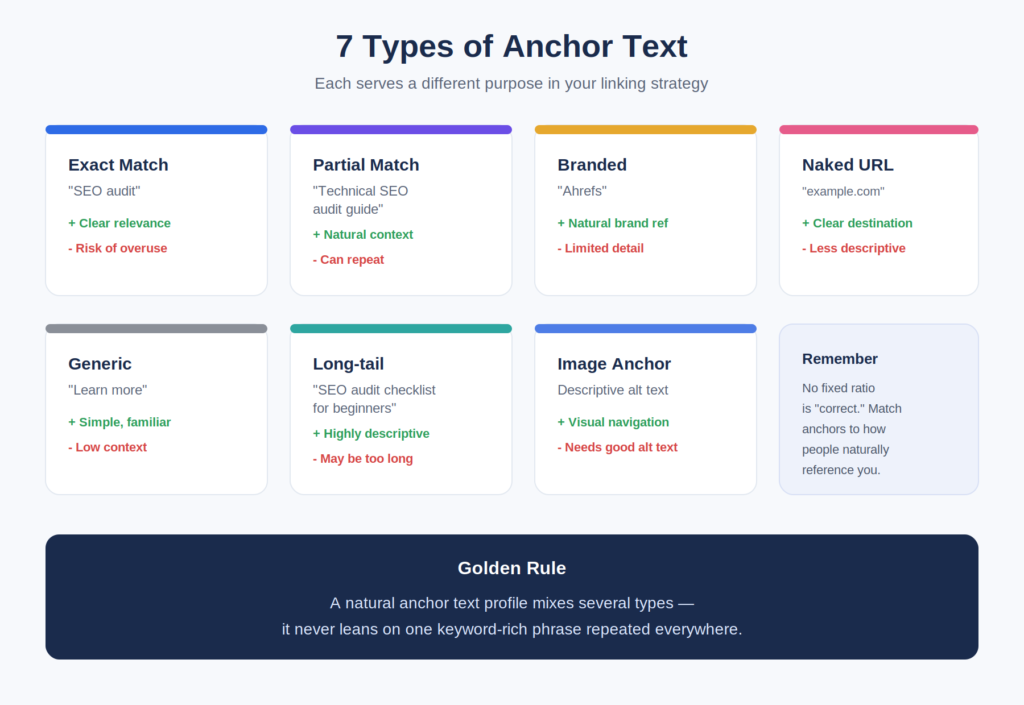
- Exact-match anchor text uses the precise keyword or phrase associated with the destination page. For example, linking to a page about “keyword research” using the anchor “keyword research.” This can be useful for relevant internal links, but repeatedly using exact-match keywords in backlinks can create an unnatural pattern.
- Partial-match anchor text includes part of the target keyword along with additional words, such as “our guide to technical SEO audits.” It often sounds more natural while still providing context.
- Branded anchor text uses a company, product, or website name, such as “Google,” “Ahrefs,” or a business name. Branded anchors are common in press coverage, partnerships, and editorial references.
- Naked URL anchors display the URL itself, such as https://example.com. They are common in citations and resource lists but may be less readable than descriptive phrases.
- Generic anchor text includes phrases such as “click here,” “learn more,” and “read this.” These are not automatically harmful, but they provide little information about the destination.
- Phrase-match and long-tail anchors use natural phrases that describe a topic without exactly matching a primary keyword. Examples include “ways to improve your website’s visibility” or “how small businesses can improve local search visibility.”
- Image anchors occur when an image is clickable. The image’s alt text should describe the image accurately and naturally.
- Related-keyword anchors use connected concepts instead of an exact target keyword. For a page about content marketing, examples might include “content strategy,” “content promotion,” or “SEO content planning.”
- Compound anchors combine a brand name with a descriptive phrase, such as “Ahrefs keyword research tools” or “Google Search Central documentation.”
Internal vs External Anchor Text
Internal and external anchor text have different purposes and levels of control.
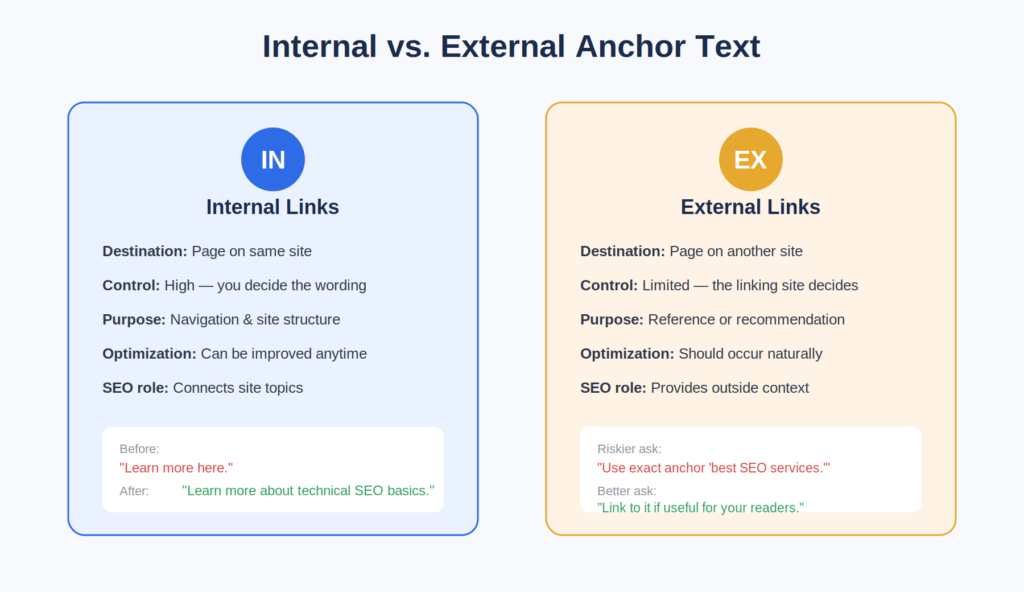
You have direct control over internal links. This makes it possible to review older content and improve unclear anchors.
Before: Learn more here.
After: Learn more about technical SEO basics.
The second version gives users a clearer idea of the destination.
External anchor text is controlled by the website linking to you. A publisher may use your brand name, URL, a descriptive phrase, or a natural sentence. You should not try to force every external link to use a specific keyword.
The goal of link building should be to earn relevant, valuable links rather than manipulate anchor text.
Anchor Text Best Practices
Write naturally. The anchor should fit smoothly into the sentence.
Awkward: “Businesses looking for SEO should use our best SEO services for businesses SEO page.”
Natural: “Businesses can explore our SEO services for small businesses.”
If a keyword does not fit naturally, do not force it.
Match user intent. Ask what users expect to find after clicking. If the destination is a beginner’s guide, “SEO guide for beginners” is more useful than simply “SEO.”
Be descriptive. The anchor should provide enough information to explain the destination.
Instead of: “Read this.”
Use: “Read our guide to keyword research.”
Keep anchors concise. Anchor text does not need to include every possible keyword. “Technical SEO checklist” is usually clearer than “The complete and ultimate technical SEO checklist for absolutely everything beginners and professionals need to know about technical SEO.”
Avoid keyword stuffing. A natural internal linking profile may include branded phrases, descriptive phrases, topic variations, and natural language. Do not force the same keyword into every anchor.
Use varied anchor text. A page about link building might naturally receive anchors such as:
- Link building guide
- How to build backlinks
- Link-building strategies
- Building quality backlinks
- Learn more about link building
Link only when helpful. Do not add a link simply because you want to use a keyword. Ask whether the link genuinely helps the reader.
Prioritize context. The surrounding sentence and paragraph should make the link logical.
Optimize image alt text accurately. Good: alt=”SEO keyword research workflow”.
Poor: alt=”best SEO keyword research tools SEO keyword research SEO”.
Review anchors regularly. As your website grows, look for generic anchors, broken destinations, irrelevant links, repeated wording, and important pages with few internal links.
Anchor Text Mistakes to Avoid
Exact-match overuse.
Using the same keyword repeatedly can create an unnatural linking pattern, especially in backlinks.
Generic anchors everywhere.
“Click here” is not automatically harmful, but relying on it throughout a website creates a poor user experience.
Irrelevant anchor text.
Do not use “best SEO tools” to link to a page that only discusses website hosting.
Misleading links.
If the anchor says “SEO pricing guide,” the destination should genuinely discuss SEO pricing.
Empty or poor image alt text.
Decorative images may appropriately use empty alt text, but linked images should have accurate descriptive information where appropriate.
Overlinking.
Adding too many links can make content difficult to read. Every link should serve a clear purpose.
Linking to low-value pages.
Avoid repeatedly sending users to thin, outdated, duplicate, or unhelpful pages.
Keyword stuffing.
Using multiple keywords unnaturally in one anchor or sentence reduces readability.
Repeating the same anchor sitewide.
Navigation menus may naturally use consistent labels, but repeatedly inserting the same keyword-rich anchor into every article can look forced.
How to Optimize Anchor Text
A practical optimization process starts with the pages that matter most to your business, such as service pages, product pages, pillar content, important guides, and high-converting landing pages.
- Identify the target page. Understand the page’s primary topic and purpose.
- Choose a descriptive anchor. Select wording that accurately tells users what they will find after clicking.
- Review the surrounding context. Make sure the anchor fits naturally into the sentence and paragraph.
- Diversify naturally. Avoid forcing a fixed anchor distribution. Use different wording when the context calls for it.
- Improve internal linking. Find relevant older content that can naturally link to important pages.
- Monitor performance. Review organic traffic, rankings, clicks, engagement, and conversions. Anchor text is only one part of overall SEO performance.
- Update older content. Replace vague anchors, fix broken links, add links to newer content, and improve topical connections.
Anchor Text Decision Framework
Before adding a link, ask:
- What is the destination page about?
- What does the reader need to understand before clicking?
- Does the anchor fit naturally in the sentence?
- Is the link genuinely useful?
- Have I already used the same phrase repeatedly in similar contexts?
If the answer to the third or fourth question is no, rewrite the sentence or reconsider whether the link belongs there.
How to Audit Anchor Text
An anchor text audit examines how your website uses internal links and how other websites link to your domain.
Step 1: Export internal links. Use a crawling tool to collect the source URL, destination URL, anchor text, link status, and link type.
Step 2: Review backlink anchor distribution. Analyze branded anchors, exact-match anchors, partial-match phrases, generic wording, and naked URLs. Do not assume that a specific percentage is automatically good or bad. Context matters.
Step 3: Identify repeated anchors. Find pages that repeatedly use identical keyword-rich anchors and review whether the repetition is natural.
Step 4: Find generic anchors. Look for “click here,” “read more,” and “learn more.” Replace them when clearer wording would improve usability.
Step 5: Check relevance. Confirm that the anchor accurately describes the destination page.
Step 6: Evaluate image alt text. Check linked images for missing, inaccurate, or keyword-stuffed alt text.
Step 7: Prioritize fixes. Start with misleading links, broken links, irrelevant destinations, important pages with weak internal linking, and generic anchors where clearer wording would help.
Anchor Text Audit Checklist
- Important pages have relevant internal links.
- Anchors accurately describe destinations.
- Generic anchors are not overused.
- Broken links are fixed.
- Irrelevant links are removed or updated.
- Linked images have appropriate alt text.
- Anchor text is natural and readable.
- Important pages are not isolated.
- Repeated anchors are reviewed for context.
- Backlink anchor patterns are monitored over time.
Anchor Text for Link Building
Anchor text is important when acquiring backlinks, but it should not be manipulated aggressively.
Editorial backlinks. When a publisher genuinely references your content, they may choose an anchor based on their own writing style. You generally should not demand a specific exact-match anchor.
Guest posts. If you contribute genuinely useful content to a relevant publication, links should fit naturally within the article and help readers access additional information.
Digital PR. Press coverage may use your brand name, company URL, research report title, or a descriptive phrase. The publication usually determines the wording.
Resource pages. These often use descriptive anchors that identify the resource, such as “Beginner’s guide to keyword research.”
Brand mentions. If a website mentions your company without linking, you may be able to request a link where it would genuinely help readers. The resulting anchor may simply be your brand name.
When requesting a link, focus on the value of the resource rather than forcing a specific keyword.
Better:
“If you think this guide would be useful to your readers, feel free to link to it as a reference.”
Riskier:
“Please link to us using the exact anchor text ‘best SEO services.’”
Natural anchor variation is safer and more sustainable.
Anchor Text Examples by Industry
| Industry | Good Anchor | Poor Anchor |
| SaaS | project management software | best project management software cheap |
| eCommerce | women’s running shoes | buy best cheap women’s running shoes online |
| Healthcare | guide to managing diabetes | best diabetes doctor treatment cure |
| Legal | personal injury claim process | best personal injury lawyer |
| Finance | small business budgeting guide | best loans guaranteed approval |
| Local business | Islamabad digital marketing agency | best digital marketing agency Islamabad cheap |
| Blog | beginner’s travel planning guide | travel blog travel tips travel guide |
The good examples describe the destination naturally. The poor examples are often overly promotional, repetitive, keyword-stuffed, or misleading.
Best Tools for Anchor Text Analysis
Google Search Console provides information about top linking websites, top linked pages, and external link data. It is useful because it provides first-party information from Google, although it is not a complete backlink database.
Ahrefs can help analyze backlink anchors, referring domains, competitors, and new or lost links.
Semrush provides backlink audits, anchor text analysis, competitor research, and link-building campaign features.
Moz supports link research, anchor text analysis, and domain comparisons.
Screaming Frog is useful for auditing internal links, anchor text, broken links, and internal linking patterns.
Sitebulb provides visual and technical auditing capabilities, including internal linking analysis and website architecture insights.
Majestic specializes in link intelligence and can help analyze backlink profiles and anchor text patterns.
The Future of Anchor Text
Search engines are increasingly capable of understanding language, entities, and context. This means the future of anchor text is likely to focus less on mechanical keyword repetition and more on meaning.
AI-powered search systems interpret entire passages and relationships between concepts. A link’s context may involve the source page, destination content, surrounding text, and relationship between entities.
For example, phrases such as “SEO audit,” “website SEO analysis,” and “search optimization audit” may have overlapping meanings depending on the context.
Links can also help establish relationships between entities. Repeated connections between a brand, SEO services, digital marketing, and local SEO may contribute to a clearer understanding of the brand’s topical associations.
The most sustainable approach is user-first optimization. If users understand where a link goes, why it is relevant, and what they will find there, the anchor is likely serving its primary purpose.
Frequently Asked Questions
What is anchor text in SEO?
Anchor text is the clickable text within a hyperlink. It helps users understand the destination of a link and provides search engines with additional context about the linked page.
Does anchor text improve rankings?
Anchor text can contribute to how search engines understand the relevance and context of linked pages. However, it is only one of many SEO signals and does not guarantee higher rankings.
What is exact-match anchor text?
Exact-match anchor text uses the exact keyword or phrase associated with the destination page. For example, linking to a page about “keyword research” using the anchor “keyword research.”
What is branded anchor text?
Branded anchor text uses a company, website, or product name as the clickable text. Examples include Google, Ahrefs, or a business name.
What is generic anchor text?
Generic anchor text uses broad phrases such as “click here,” “learn more,” or “read this.” It can be natural in some contexts but often provides little information about the destination.
Is “click here” bad for SEO?
“Click here” is not automatically harmful, but it is less descriptive than an anchor that explains the destination. Use descriptive wording when it helps users understand the link.
How long should anchor text be?
There is no strict character limit. The best anchor text is usually concise enough to read naturally while being descriptive enough to explain the destination.
Can images have anchor text?
Yes. When an image is clickable, its alt text can provide descriptive context about the image and linked destination.
Does anchor text matter for internal links?
Yes. Descriptive internal anchor text can improve navigation, help connect related pages, and support a clearer website structure.
Does anchor text matter for backlinks?
Yes, but website owners generally cannot fully control how external websites link to them. Natural variation is normal and should not be artificially manipulated.
What is over-optimized anchor text?
Over-optimized anchor text typically involves excessive use of keyword-rich or exact-match phrases, particularly in an unnatural backlink pattern.
How many exact-match anchors should I use?
There is no universal ideal percentage. Use exact-match wording when it naturally fits the content and avoid forcing a predetermined distribution.
What is anchor text diversity?
Anchor text diversity refers to the natural variation in the phrases used to link to a page. This may include branded, descriptive, partial-match, URL, and other natural phrases.
How do I audit anchor text?
You can crawl your website to analyze internal anchors and use backlink analysis tools to review external anchor text. Look for irrelevant, misleading, repetitive, or overly optimized anchors.
Which anchor text is best?
The best anchor text is relevant, descriptive, concise, and natural for the sentence. There is no single anchor type that is best for every situation.
Does Google penalize anchor text?
Google can take action against manipulative link schemes, including practices designed to manipulate rankings through unnatural links. Using descriptive anchor text naturally is not a problem.
What tools analyze anchor text?
Google Search Console, Ahrefs, Semrush, Moz, Screaming Frog, Sitebulb, and Majestic can help analyze internal or external anchor text.
How do I improve internal anchor text?
Identify vague anchors, review the destination page, and replace unclear phrases with concise descriptions that accurately explain what users will find after clicking.
What is contextual anchor text?
Contextual anchor text is a link placed naturally within relevant content. The surrounding words and paragraph provide additional meaning about the relationship between the link and the destination.
What are the biggest anchor text mistakes?
Common mistakes include keyword stuffing, excessive exact-match anchors, misleading links, overlinking, irrelevant destinations, repeated sitewide keyword anchors, and ignoring internal linking opportunities.
Anchor Text Optimization Checklist
- Anchor text accurately describes the destination page.
- Links are useful to readers.
- Important pages receive relevant internal links.
- Generic anchors are not overused.
- Exact-match anchors are not forced unnecessarily.
- Anchor text fits naturally within the sentence.
- Surrounding content is relevant to the link.
- Internal links connect related topics.
- Broken links are fixed.
- Misleading links are removed or updated.
- Linked images have appropriate alt text.
- Important pages are not isolated from the rest of the site.
- Repeated anchor patterns are reviewed for naturalness.
- Backlink anchors are monitored over time.
- Link-building outreach does not demand unnatural keyword anchors.
- Content updates include opportunities to improve internal linking.
- Anchor text supports users first and SEO second.
The most effective approach to anchor text in SEO is not to chase a perfect formula. Instead, focus on relevance, clarity, context, and user experience. Use descriptive anchors that help people navigate your website, connect related content logically, and allow external backlinks to develop naturally.
When anchor text is part of a broader strategy that includes high-quality content, strong website architecture, technical SEO, and ethical link building, it can help create a clearer and more useful web experience for both users and search engines.
