
Selling SEO to small businesses can be challenging. Unlike products or paid advertising, SEO usually requires time, consistency, and trust before it produces significant results. Many freelancers, consultants, and agencies struggle to close SEO clients—not because they lack the technical skills, but because they fail to explain how SEO can contribute to a business’s growth.
Small business owners generally do not care about crawl budgets, canonical tags, or metadata unless those technical improvements help them generate more calls, leads, bookings, or sales.
The most effective way to sell SEO is to focus on business outcomes rather than technical tasks. This means understanding a prospect’s goals, identifying missed opportunities, explaining how SEO can solve real business problems, and building trust throughout the sales process.
Whether you’re an SEO freelancer, consultant, agency owner, or digital marketer, this guide explains how to find qualified prospects, conduct effective discovery calls, create persuasive audits and proposals, overcome common objections, price your services, and close more long-term SEO clients.
Table of Contents
Why Small Businesses Need SEO
Many small businesses rely on referrals, repeat customers, or paid advertising. While these channels can be valuable, they may limit growth or require continuous spending. SEO offers another way to attract people who are actively searching for the products or services a business provides.
For example, someone searching for “emergency plumber near me” or “best dentist in Lahore” already has a specific need. If a business does not appear in relevant search results or local map listings, potential customers may choose a competitor instead.
When selling SEO, focus on the problem it solves rather than the work involved.
Local search visibility: A business that appears in Google’s local results, has an optimized website, and maintains positive reviews is more likely to receive calls and enquiries than a competitor with an outdated website and weak online visibility.
Qualified lead generation: Small businesses usually do not need millions of website visitors. They need relevant visitors who are likely to become customers. A local accountant, for example, may only need a few dozen additional qualified leads each month to significantly increase revenue.
Long-term marketing value: Paid advertising can generate immediate traffic, but that traffic generally stops when the budget ends. SEO can create assets—such as optimized service pages and useful content—that continue attracting organic traffic after they are published.
Trust and credibility: A professional website, positive reviews, useful content, and strong search visibility can make a business appear more credible. Customers often research several businesses before making a decision, and a strong online presence can influence which company they choose.
Competing with larger companies: Small businesses do not always need to compete for broad, highly competitive keywords. A local bakery may not need to rank for “cakes” nationally. It can target searches such as “custom wedding cakes in Islamabad” or “birthday cakes near me.” Specific local searches often provide valuable opportunities for smaller businesses.
The key message is simple: SEO helps businesses become visible when potential customers are actively looking for their products or services.
Understand the Small Business Mindset
One of the biggest mistakes SEO professionals make is speaking like SEO experts instead of business advisors.
A small business owner is usually more interested in questions such as:
- How many new customers can this bring?
- How much revenue could it generate?
- How long will it take to see progress?
- What will I receive each month?
- How will we measure success?
This is why every SEO recommendation should be connected to a business outcome.
Instead of saying, “We’ll improve crawlability and optimize internal linking,” explain: “We’ll make it easier for search engines to understand your website and help potential customers find your important services.”
The second explanation is easier to understand because it focuses on value rather than technical terminology.
Rankings are not the final goal. A business can rank first for a keyword that generates little traffic or produces no customers. Meanwhile, ranking third for a high-intent local keyword could generate dozens of enquiries.
During sales conversations, ask questions such as:
- Which products or services generate the most revenue?
- How many enquiries do you currently receive each month?
- Which services would you like to grow?
- Which locations do you want to target?
- How much is an average customer worth?
- Where do most of your customers currently come from?
These questions help you position SEO as a growth strategy rather than simply a way to improve rankings.
Business owners also want measurable results. Depending on the business, success could include more phone calls, contact form submissions, bookings, online purchases, qualified leads, organic traffic, or improved local visibility.
The more clearly you connect SEO activity to these outcomes, the easier it becomes for a prospect to understand its value.
Why Small Businesses Hesitate to Buy SEO
Understanding objections is an important part of selling SEO. A prospect’s hesitation does not always mean they are rejecting your service. Often, they need more information or reassurance.
“I don’t understand SEO.” Technical terms can make SEO seem complicated. Avoid explaining every ranking factor and focus on what the work will achieve. Simple explanations build confidence.
“We tried SEO before.” Some businesses have experienced poor communication, unrealistic promises, low-quality tactics, or a lack of results from previous providers. Ask what happened, what they expected, and what they would like to see done differently. This helps you understand their concerns without criticizing another provider.
“SEO is too expensive.” Do not immediately reduce your price. Instead, discuss the value of a new customer. If an average customer is worth $500 to the business, even a few additional customers may justify the investment.
“SEO takes too long.” Be honest. SEO is not an overnight solution. Explain that progress can be tracked through milestones such as technical improvements, increased visibility, ranking growth, traffic, and leads.
“We already use Google Ads.” SEO and paid advertising can work together. Ads can provide immediate visibility, while SEO builds a long-term source of organic traffic and may gradually reduce dependence on paid acquisition.
“We don’t need SEO.” Do not argue. Show the opportunity. If competitors appear for valuable searches while the prospect does not, explain what potential customers may be missing.
“I don’t want a long-term contract.” Reduce the concern through clear deliverables, regular reporting, measurable KPIs, and transparent communication. Trust increases when clients understand exactly what they are paying for.
The best response to objections is not pressure. It is clarity, honesty, and evidence.
How to Find Small Businesses That Need SEO
The best prospects are not necessarily businesses with no online presence. Often, the strongest opportunities are businesses that already have a website but are underperforming in search.
Google Maps listings: Search for services in a specific location, such as “dentist in Islamabad” or “electrician in Lahore.” Look for businesses with incomplete profiles, few reviews, weak descriptions, poor photos, or limited local visibility.
Businesses ranking beyond page one: A business appearing on page two or three may already have a website and some authority but still have significant opportunities to improve through better content, technical SEO, internal linking, local optimization, or backlinks.
Outdated websites: Slow loading speeds, poor mobile experiences, broken pages, outdated designs, thin content, and missing service pages often indicate SEO opportunities.
Local service businesses: Plumbers, dentists, lawyers, electricians, accountants, roofers, cleaning companies, real estate agencies, auto repair shops, and home renovation companies often benefit from SEO because their customers actively search for these services.
Businesses relying only on paid advertising: Companies that depend entirely on Google Ads or social media advertising may benefit from developing a long-term organic traffic channel.
Competitor gaps: Compare businesses competing in the same market. Look at keyword rankings, service pages, local visibility, reviews, content, and website quality. Specific observations are much more persuasive than generic claims.
Instead of saying, “Your SEO needs improvement,” say: “Three competitors are appearing in the local results for your highest-value service, while your business is not currently visible. This represents an opportunity to improve your local search presence and compete for those customers.”
Specific insights demonstrate expertise and make the sales conversation more relevant.
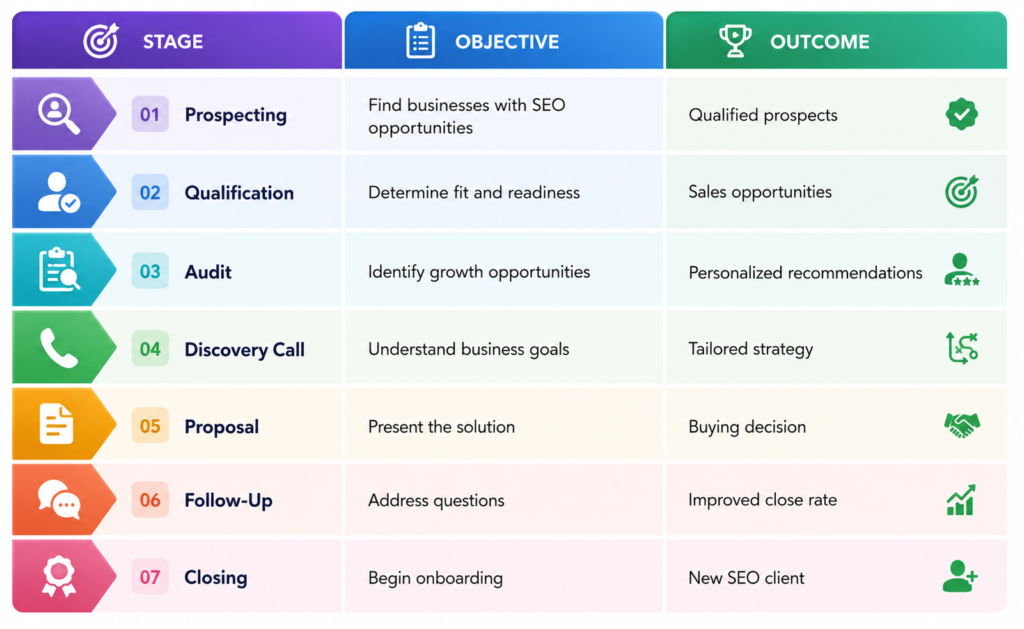
Build a Repeatable SEO Sales Process
A structured process helps you qualify better prospects and avoid wasting time on businesses that are unlikely to become clients.
1. Prospecting: Identify businesses with clear SEO opportunities. Build a focused list instead of contacting hundreds of random companies.
2. Qualification: Determine whether the business has realistic goals, a suitable budget, decision-making authority, and a genuine need for SEO. Not every business is a good fit.
3. Discovery call: Learn about the business, its goals, competitors, current marketing channels, and challenges. Listen more than you speak.
4. SEO audit: Review the website and online presence to identify the most important opportunities. Focus on issues that can affect visibility, traffic, leads, or conversions.
5. Proposal: Present a personalized strategy based on the prospect’s goals and challenges. Explain deliverables, timelines, pricing, and expected outcomes clearly.
6. Follow-up: Many deals are lost simply because the provider does not follow up. A professional message can answer questions and keep the conversation moving.
7. Closing and onboarding: Make the next steps simple. Provide the agreement, invoice, onboarding questionnaire, access requirements, reporting schedule, and kickoff details.
A simple sales funnel looks like this:
How to Conduct an Effective SEO Discovery Call
A discovery call is not a presentation. It is a conversation designed to uncover the business problems SEO may help solve.
Ask open-ended questions such as:
- What services generate the most revenue?
- Where do most of your customers come from?
- Which competitors are performing well?
- What marketing channels have you tried?
- What would you like to achieve over the next 12 months?
- Which locations or services do you want to grow?
- Have you invested in SEO before?
- What is currently preventing growth?
The first problem a prospect mentions may not be the real problem. A business owner may say, “We need better rankings,” but the underlying issue may be declining sales, rising advertising costs, or fewer enquiries.
Listen carefully and ask follow-up questions. Avoid interrupting or immediately presenting your solution. The more you understand the business, the more personalized your recommendations will be.
Before ending the call, summarize what you learned and explain the next steps. For example, you may review the website in more detail, prepare a customized audit, send a proposal, and schedule a follow-up discussion.
Clear next steps make the process feel professional and organized.
How to Present SEO as an Investment
The most important question behind almost every marketing decision is: “Will this help my business make more money?”
Your SEO pitch should answer that question.
Instead of saying, “We’ll optimize your service pages,” explain: “Optimized service pages can help your business appear for searches made by potential customers, increasing the opportunity to generate enquiries and sales.”
You can also use simple ROI examples.
Suppose a local dental clinic receives 400 organic visitors each month. If 5% book an appointment, that represents 20 potential patients. If each patient is worth $300 on average, the potential revenue is $6,000.
This is not a promise of guaranteed results. It is a simple way to show how traffic, conversions, and customer value connect.
SEO can also be compared with paid advertising:
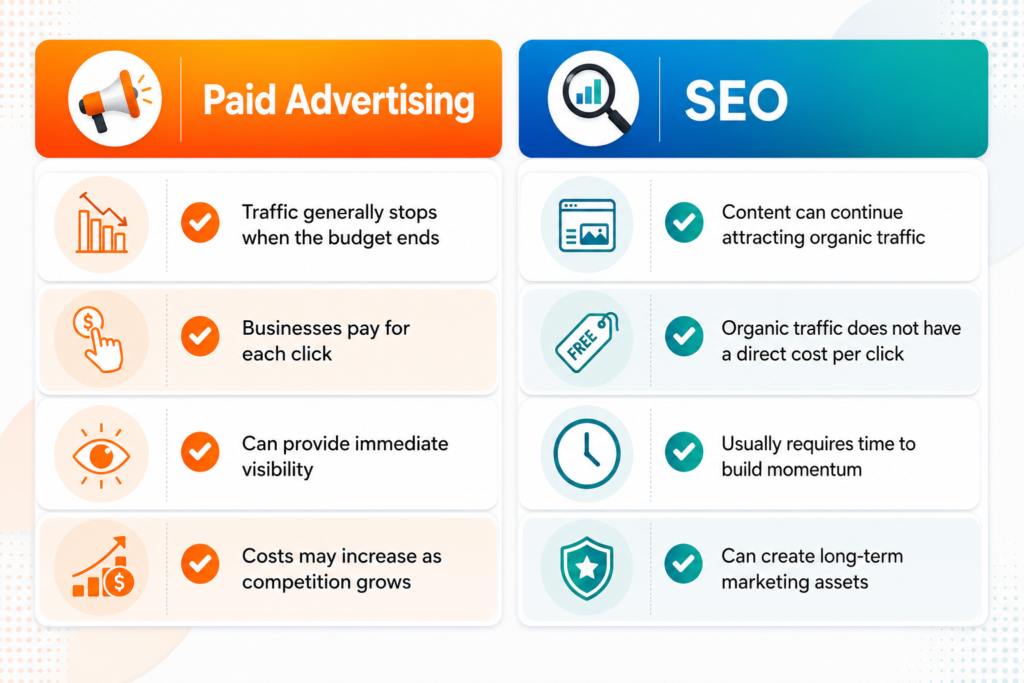
Many businesses benefit from using both channels. Paid advertising can provide immediate results, while SEO builds sustainable organic visibility over time.
Create SEO Audits That Sell
An SEO audit should not be a long list of technical problems. Its purpose is to show the prospect where opportunities exist and explain how addressing them could support business growth.
Review the most important areas:
Website health: Check loading speed, mobile usability, broken pages, security, navigation, and overall user experience.
Technical SEO: Look for missing or duplicate title tags, broken links, indexing problems, redirect issues, and sitemap problems. Focus on the issues that matter most instead of overwhelming the prospect with dozens of minor findings.
Keyword opportunities: Identify valuable services and searches the business is not currently targeting. A cleaning company may rank for its brand name but miss opportunities such as commercial cleaning, carpet cleaning, or end-of-tenancy cleaning.
Competitor performance: Compare the prospect with competitors in areas such as rankings, content, local visibility, reviews, service pages, and website authority.
Local SEO: Review Google Business Profile optimization, categories, reviews, location-based content, and consistency of business information.
Content opportunities: Identify missing service pages, local landing pages, FAQs, guides, and educational content that could attract relevant search traffic.
Always connect the finding to a business opportunity.
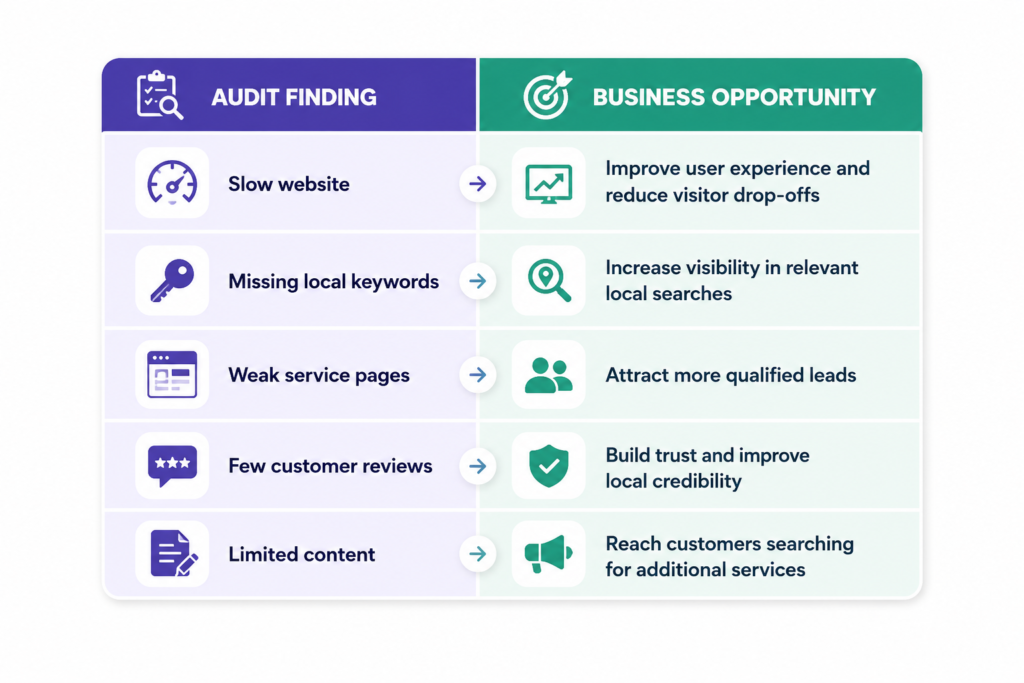
A strong audit does not simply say, “This is wrong.” It explains, “This is the opportunity, and this is how addressing it may help the business.”
How to Price SEO Services for Small Businesses
There is no single pricing model that works for every client. Pricing should reflect the project’s scope, competition, business size, complexity, and expected value.
Monthly retainers are common because SEO requires ongoing work. Services may include keyword research, on-page optimization, content strategy, technical improvements, local SEO, managed link building, and reporting.
One-time audits are useful for businesses that are not ready for an ongoing campaign. A detailed audit can also allow a prospect to experience your expertise before committing to a retainer.
Local SEO packages are suitable for businesses that depend on local customers. These may include Google Business Profile optimization, local keyword targeting, review strategy, citations, and location pages.
Project-based pricing works well for defined projects such as website migrations, technical SEO cleanups, content optimization, or competitor research.
Performance-based pricing can be risky because SEO results depend on many factors outside the provider’s control. If you use this model, define the KPIs and terms clearly.
The most important principle is to avoid competing on price alone. Explain the value of the service and recommend the solution that best matches the client’s goals and resources.
Create Simple SEO Packages
Many SEO packages are too complicated. Business owners do not necessarily want a list of technical tasks. They want to understand what they will receive and how it can help their business.
A simple structure could include:
Starter Package: Designed for businesses beginning SEO. It may include an audit, keyword research, optimization of key pages, Google Business Profile improvements, technical recommendations, and monthly reporting.
Growth Package: Designed for businesses seeking consistent lead generation. It may include everything in the Starter Package, plus content strategy, competitor analysis, internal linking, citation management, and ongoing technical improvements.
Premium Package: Designed for competitive or established businesses. It may include advanced technical SEO, content strategy, link building, digital PR, conversion recommendations, competitor monitoring, and ongoing consulting.
The package should be easy to understand, with clear deliverables and realistic outcomes.
Create SEO Proposals That Convert
A proposal should demonstrate that you understand the client’s business. Avoid sending the same generic document to every prospect.
A strong proposal should include:
Business overview: Summarize the client’s industry, audience, services, target locations, and goals.
Current challenges: Explain the most important SEO problems affecting visibility or growth.
Opportunities: Show what could improve, such as increased local visibility, stronger service pages, more qualified traffic, or better conversion rates.
Recommended strategy: Explain the overall approach, including technical SEO, keyword targeting, content, local SEO, internal linking, or link building.
Deliverables: Clearly explain what the client will receive each month.
Timeline: Set realistic expectations. The first month may focus on audits and technical improvements, while later months may focus on content, authority, rankings, traffic, and lead generation.
Pricing: Present the investment, payment terms, contract details, and optional services clearly.
Case studies: Include relevant examples of previous work whenever possible.
Next steps: Make it easy for the client to move forward with clear onboarding instructions.
The proposal should answer three questions:
- What is the problem?
- What is the opportunity?
- How will your strategy help?
Build Trust Before the Sale
Trust is often the deciding factor when two SEO providers offer similar services.
Share case studies: Explain the client’s original challenge, the strategy used, and the measurable outcome.
Use testimonials and reviews: Feedback about communication, professionalism, and business results can reduce uncertainty.
Build your personal brand: Publish educational content, share useful SEO insights, maintain a professional website, and demonstrate your knowledge consistently.
Provide educational value: Helpful audits, checklists, articles, videos, and practical advice can demonstrate your expertise before a prospect becomes a client.
Be transparent: Avoid guaranteed rankings and unrealistic promises. Honest communication about timelines, challenges, and potential outcomes creates stronger relationships.
The goal is to become a trusted advisor rather than another provider sending generic sales messages.
How to Close More SEO Clients
Closing more clients does not require aggressive sales tactics. It requires consistency and a professional process.
Follow up consistently: Send a thank-you message after the discovery call, deliver the proposal promptly, follow up after a few days, and answer any questions.
Personalize your recommendations: Consider the business’s industry, competition, budget, target audience, and goals.
Use genuine urgency: Seasonal opportunities, upcoming launches, or limited onboarding capacity can create legitimate reasons to make a decision. Avoid fake countdowns or misleading pressure.
Focus on ROI: Keep returning the conversation to qualified leads, sales, customer value, and long-term growth.
Use social proof: Case studies, testimonials, reviews, and performance examples help prospects feel more confident.
Make onboarding simple: Once the client agrees, provide clear instructions for signing the agreement, completing the questionnaire, sharing access, and scheduling the kickoff meeting.
A smooth onboarding process reinforces the professionalism you demonstrated during the sales process.
Common Mistakes SEO Professionals Make
Several mistakes can make SEO more difficult to sell.
Talking too technically: Business owners do not need to understand every SEO concept. Explain how the work supports their goals.
Overpromising results: Avoid guaranteed rankings and unrealistic timelines. SEO depends on competition, website quality, content, authority, and other factors.
Focusing only on rankings: Rankings are useful, but qualified traffic, leads, conversions, and revenue are more important business outcomes.
Poor communication: Regular updates, clear reports, and strategy discussions can become a major competitive advantage.
Sending generic proposals: Personalization demonstrates that you understand the prospect’s business.
Failing to follow up: A prospect may need time to make a decision. Professional persistence can turn an uncertain lead into a client.
A Practical Example of Selling SEO to a Local Business
Imagine a plumbing company serving one metropolitan area. The business depends heavily on referrals and paid advertising but has poor organic visibility.
Its website has outdated service pages, slow loading times, weak local content, and an incomplete Google Business Profile. Competitors appear above it for important searches.
Instead of starting the sales conversation with rankings and backlinks, ask:
- How many enquiries do you receive each month?
- Which services generate the most revenue?
- Which locations would you like to target?
- Where do most new customers currently come from?
- How much do you currently spend on advertising?
The audit may reveal missing location pages, weak internal linking, duplicate title tags, poor mobile performance, and limited local authority.
The proposed strategy could include technical improvements, local keyword optimization, Google Business Profile improvements, new service-area pages, internal linking, content creation, and local link building.
The important part is connecting every recommendation to a business objective. The goal is not simply to improve technical metrics. It is to increase visibility for valuable searches, attract qualified visitors, generate more enquiries, and gradually reduce dependence on paid advertising.
SEO Sales Tools
The right tools can make the sales process more efficient and professional.
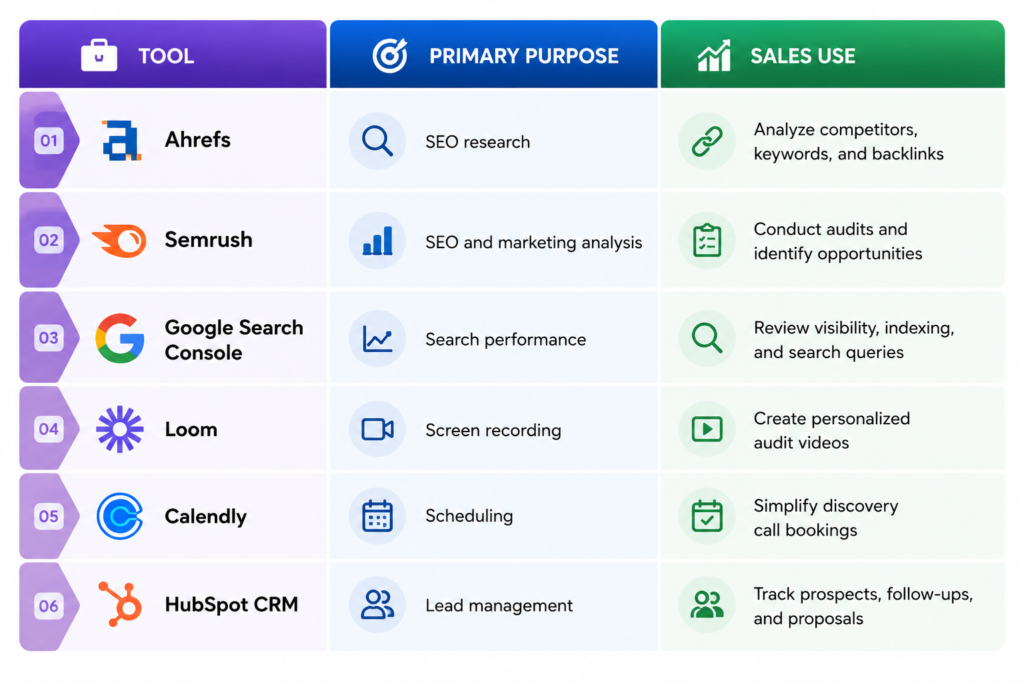
Tools support the sales process, but they do not replace communication, expertise, and a clear understanding of the client’s business.
Frequently Asked Questions
What is the best way to sell SEO services?
Focus on business outcomes. Explain how SEO can help generate qualified leads, improve visibility, increase sales, and support long-term growth.
Why is SEO difficult to sell?
SEO requires time, and many business owners have limited knowledge of how it works or have had poor experiences with previous providers. Trust and clear communication are essential.
How do I convince a small business to buy SEO?
Understand its goals, identify missed opportunities, and explain how SEO can address real business challenges. Keep the conversation simple and relevant.
What should I charge for SEO?
Pricing depends on the scope, competition, business size, and level of service. Common models include audits, monthly retainers, local SEO packages, and project-based pricing.
How long does it take to close an SEO client?
Some prospects decide within days, while others may take several weeks. Clear proposals and consistent follow-ups can help move the process forward.
Should I offer free SEO audits?
A basic audit can demonstrate your expertise and generate leads. However, avoid giving away a complete strategy that would normally require paid consulting.
What industries commonly invest in SEO?
Local service businesses, healthcare providers, law firms, real estate companies, home improvement businesses, ecommerce stores, SaaS companies, and professional service providers commonly use SEO to increase visibility and generate leads.
How do I explain SEO to beginners?
Explain that SEO helps a business appear when potential customers search online for its products or services, making it easier to attract relevant visitors without relying entirely on paid advertising.
Is cold emailing effective for SEO sales?
It can be effective when outreach is personalized. Messages should reference the prospect’s business, identify genuine opportunities, and provide useful insights instead of making generic promises.
How can freelancers get SEO clients?
Freelancers can find clients through referrals, LinkedIn, networking, content marketing, partnerships, local outreach, freelance platforms, and personalized email campaigns.
Conclusion
Learning how to sell SEO to small businesses is about more than understanding search engines. It requires understanding business owners, identifying their challenges, and showing how SEO can contribute to leads, revenue, and long-term growth.
The most successful SEO professionals do not simply sell rankings. They sell solutions.
They take time to understand the client’s goals, identify genuine opportunities, explain their recommendations clearly, set realistic expectations, and maintain trust throughout the relationship.
The most important principles are:
- Focus on business outcomes instead of technical jargon.
- Find qualified prospects with genuine SEO opportunities.
- Use audits and discovery calls to understand the client’s challenges.
- Connect every recommendation to a measurable business outcome.
- Handle objections with honesty and evidence.
- Create personalized proposals and clear service packages.
- Build trust through case studies, testimonials, education, and communication.
- Follow a structured process from prospecting to onboarding.
Whether you’re a freelancer, consultant, or agency owner, a consultative approach will help you attract better prospects, improve your close rate, and build stronger long-term client relationships.
When you focus on delivering genuine value instead of simply trying to sell a service, SEO becomes easier to explain—and much easier for small business owners to see as a worthwhile investment.
