
Most guest post outreach emails get ignored. You spend 20 minutes researching a site, craft what feels like a solid pitch, hit send, and then… crickets. Or a polite “thanks but no thanks” that feels like a brush-off.
The problem isn’t that editors are rude or too busy. It’s that your email looks exactly like the dozens of others they delete every day — generic, self-serving, and zero effort to stand out.
I’ve sent (and received) thousands of these emails over the years. The ones that actually get replies and land guest posts follow a completely different pattern. They feel human. They show real research. And they make it easy for the editor to say yes without feeling like they’re doing you a favor.
This isn’t another article full of robotic templates. I’m going to show you what actually works right now in 2026: why most outreach fails, the psychology that gets responses, the exact 3-step formula I use, real email examples (the bad ones and the ones that land placements), personalization tactics that matter, a solid follow-up system, and a complete daily workflow you can copy.
If you’re tired of guest post outreach feeling like shouting into the void, this guide will change how you approach it.
Table of Contents
Why most guest post outreach fails
Let’s be brutally honest. The average outreach email looks like this:
“Hi, I’d like to write a guest post for your blog. My topic is SEO tips. Let me know if you’re interested.”
That’s not outreach. That’s spam with better spelling.
Editors ignore these because:
- They scream “copy-pasted” from a mile away
- There’s zero personalization or proof that the sender actually read the site
- The writer jumps straight to asking for something without offering value first
- They’ve seen the same message 50 times that week
Result? Your pitch gets deleted in under five seconds. I’ve tested this myself — generic emails get under 5% reply rates. The better versions I’ll show you later regularly hit 25–40% when done right.
The psychology of outreach that gets replies
People reply when your email triggers three simple feelings:
- Relevance — “This message is actually meant for me and my audience.”
- Value — “Accepting this would genuinely help my readers (and maybe me too).”
- Low friction — “Saying yes won’t create extra work or risk for me.”
Short emails win because busy editors don’t have time to read novels. If your message forces them to scroll or think too hard, they’ll delete it. Value-first approaches work because editors are protective of their audience — they only say yes when they believe the content will make their site better, not just give you a backlink.
Here’s the blunt truth: if your email feels like it’s all about you getting a link, it’s dead on arrival. Make it about them and their readers, and your odds improve dramatically.
Before you send outreach (preparation phase)
Never hit send without doing this homework first. Skipping it is the fastest way to waste your time.
- Read at least 3–5 recent articles on their site so you understand tone, topics, and what they’ve already covered.
- Note one specific thing you genuinely liked or learned — this becomes your personalization hook.
- Check their guest post guidelines page (most real blogs have one). Ignoring it screams laziness.
- Qualify the prospect: Does the site get real traffic? Is the audience a good fit for your expertise? Is the domain relevant and not spammy?
This prep takes 5–10 minutes per site but completely changes how your email lands. I only outreach to sites where I can honestly say the piece would improve their content.
The guest post outreach formula
Forget long-winded pitches. The messages that get replies are short, specific, and focused on the recipient.
Use this simple 3-step formula every time:
- Personalized opener — Reference something real from their recent content.
- Value proposition — Explain briefly how your piece helps their audience.
- Soft ask — Low-pressure next step (e.g., “Would you be open to taking a quick look at the outline?”).
Keep the whole email under 5–7 sentences. Short wins.
Real outreach email examples that actually work
Bad example (generic and instantly ignored):
“Hi, I want to write a guest post for your blog. My topic is SEO tips. Let me know if you’re interested.”
Why it fails: Zero personalization, no value shown, immediate ask.
Good cold outreach example:
“Hey [Name], I really enjoyed your recent article on link building in 2026 — especially the part about relevance over quantity.
I’ve been working on a detailed guide about tiered link-building strategies that I think would complement your audience well. Would you be open to taking a quick look at the outline?”
Why it works: Specific reference to their content, clear value for their readers, soft and low-friction ask.
Warm outreach example (after commenting on a post):
“Hey [Name], I left a comment on your post about content clusters last week because your take on internal linking really resonated. I’m working on something similar for [related niche] and thought there might be a natural overlap. Would you be open to a guest contribution?”
Follow-up example (7–10 days later, no reply):
“Hi [Name], just circling back on my note about the tiered link-building guide. No worries if you’re swamped, but I still think it could be a good fit for your readers. Happy to send the full draft if you’re interested.”
Each of these works because they’re short, shows real research, focuses on the recipient’s audience, and makes replying easy.
Personalization strategies that actually matter
Personalization isn’t about stuffing their name in the greeting. It’s about proving you did basic homework.
Effective lines that increase replies:
- “I really liked how you broke down the difference between DR and DA in your last article…”
- “Your point about anchor text diversity in last month’s post stuck with me because…”
- “Saw you featured [specific tool/resource] — I have something that might fit nicely alongside it…”
Even one relevant sentence changes everything. Editors can smell generic pitches from a mile away, especially in 2026 when AI-generated spam is everywhere.
Follow-up strategy (without being annoying)
Most people never follow up. That’s leaving money — and backlinks — on the table.
Timing rules that work:
- First follow-up: 7–10 days after the initial email
- Second (and final) follow-up: Another 10–14 days later
Keep follow-ups short, polite, and add a tiny bit of new context or value. Never send more than two.
Example follow-up:
“Hey [Name], just following up on my note about the tiered link-building guide. Still think it could be a good fit for your readers. No pressure — happy to send the draft if you’re interested.”
This approach respects their time while gently reminding them.
Finding guest post opportunities
Stop relying on “write for us” pages alone — they’re often overcrowded.
Better ways in 2026:
- Google search operators: “your niche + guest post” or “your niche + contribute” or “your niche + guidelines”
- Competitor backlink analysis (see where similar sites have published)
- Manual research in relevant Facebook groups, Slack communities, and industry newsletters
- Commenting on target blogs first to warm up the relationship
Prioritize relevance over domain rating. A smaller, highly targeted site that actually reaches your audience often delivers better long-term value.
Common mistakes that kill outreach
- Sending mass, barely personalized emails
- Pitching without reading the site first
- Asking for the link or publication before offering any value
- Writing overly long emails that feel like sales pitches
- Following up too aggressively or too many times
Fix these, and your response rate will jump.
Advanced tips that move the needle
- Comment thoughtfully on 2–3 of their recent posts before outreach — this turns cold pitches into warm ones.
- Offer a unique angle or original data instead of generic “SEO tips” topics.
- Build relationships first through genuine engagement on social or their comments section.
- Track everything in a simple spreadsheet: site, date sent, status, notes.
Outreach workflow (step-by-step system)
Here’s the exact daily/weekly system useable:
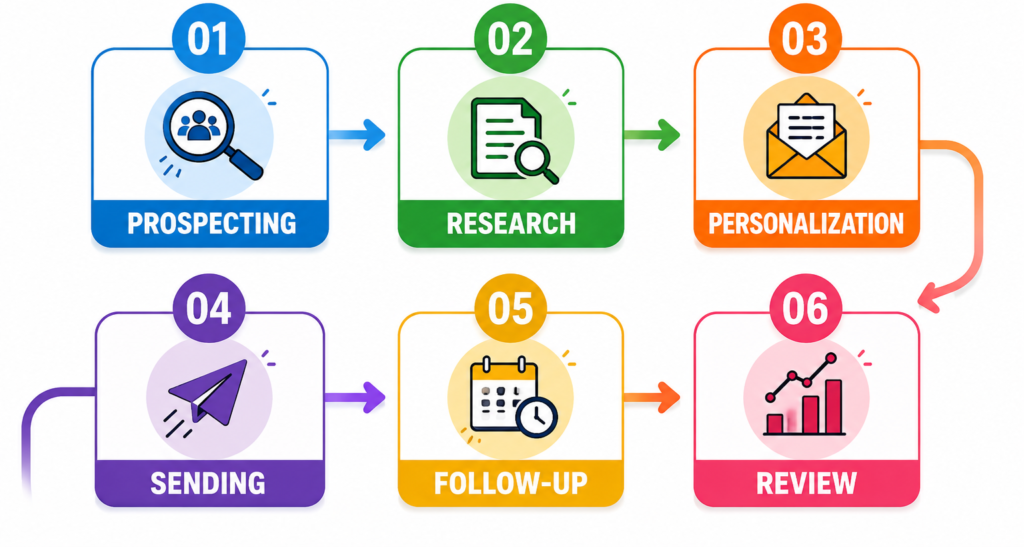
- Find 10–15 relevant sites per week using the methods above.
- Research each one (read 3–5 articles, note personalization hooks).
- Craft a personalized message using the 3-step formula.
- Send and log it in your tracking sheet.
- Follow up once after 7–10 days if no reply.
- Review weekly: What’s getting responses? Adjust topics or approach.
Consistency beats perfection. Ten high-quality personalized pitches per week will outperform 100 generic ones every single time.
Conclusion
Guest post outreach isn’t about volume or fancy templates. It’s about sending better emails — ones that feel human, show real research, and clearly offer value to the recipient and their audience.
Slow down, do the homework, and treat every outreach like a real conversation instead of a numbers game. The replies — and the backlinks — will start coming.
Start today: Pick five relevant sites, read their recent posts, and send one well-researched pitch using the 3-step formula. Track what happens. Tweak and repeat. That’s how you build a guest post outreach system that actually works in 2026.
