
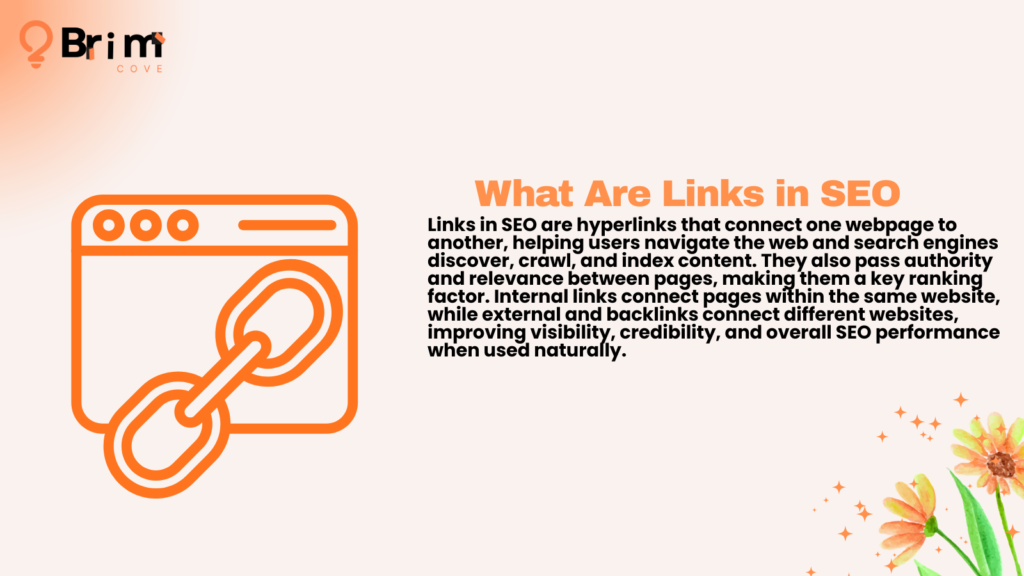
If you’ve started learning SEO, you’ve likely encountered terms such as internal links, backlinks, anchor text, and link building. Although these concepts can seem technical, they all revolve around one basic idea: connecting one webpage to another.
Links help users navigate the internet and help search engines discover, understand, and evaluate webpages. They connect related content, guide visitors toward useful resources, and provide context about how different pages and websites are related.
In this guide, you’ll learn what are links in SEO, how they work, the main types of links, why they matter, how search engines use them, and the best practices for creating a strong linking structure.
Quick Summary
- Internal links connect pages on the same website.
- External links point from your website to another domain.
- Backlinks are links from another website to yours.
- Links help search engines discover pages and understand content relationships.
- Quality and relevance matter more than the number of links.
- A strong SEO link strategy combines useful internal linking with high-quality, natural backlinks.
What Is a Link?
A link, also called a hyperlink, is a clickable connection that takes users from one webpage to another. It can connect two pages on the same website or direct users to a completely different domain.
For example, an article about keyword research might link to a Complete SEO Guide. When a reader clicks that text, they are taken to another webpage. The clickable text is the anchor text, while the page it leads to is the destination URL.
A hyperlink generally includes:
- Destination URL: The webpage the user visits after clicking.
- Anchor text: The visible, clickable words used for the link.
For example:
<a href=”https://example.com/seo-guide”>Complete SEO Guide</a>
Here, “Complete SEO Guide” is the anchor text, and the URL is the destination.
Links are among the basic building blocks of the internet. Without them, users would have difficulty navigating between webpages, and search engines would have a much harder time discovering new content.
Why Are Links Important for SEO?
Links help search engines discover webpages, understand how content is connected, and evaluate signals of relevance and authority. They also improve website navigation and user experience.
Help Search Engines Discover Pages
Search engines use crawlers to explore the web. These crawlers follow links from one page to another to discover new content.
For example:
Homepage → Services Page → Blog → SEO Guide → Technical SEO Article
If an important page has no links pointing to it, it may become difficult for users and search engines to discover. This is why internal linking is an important part of website structure.
Help Search Engines Understand Relationships
Links also provide context about how pages relate to one another.
For example, if several articles about technical SEO link to a detailed guide about website speed, the relationship between those topics becomes clearer. A logical linking structure can help search engines understand your site’s content hierarchy and topical relationships.
Distribute Link Equity
Link equity refers to the value and signals that may flow between pages through links.
For example, a homepage may receive backlinks from external websites. When it links to important service pages or useful guides, internal links help connect those pages within the site’s overall structure.
Link equity is not simply transferred like a fixed amount of authority, but strategic internal linking can help search engines understand which pages are important and how content is connected.
Improve User Experience
Links also make websites easier to use. Instead of forcing visitors to search for related information, relevant links can guide them directly to helpful resources.
A good linking structure helps users:
- Discover related content
- Learn more about a topic
- Navigate a website more easily
- Find supporting information
- Explore relevant products or services
The best links are useful to both users and search engines.
The Main Types of Links in SEO
The three main types of SEO links are internal links, external links, and backlinks.
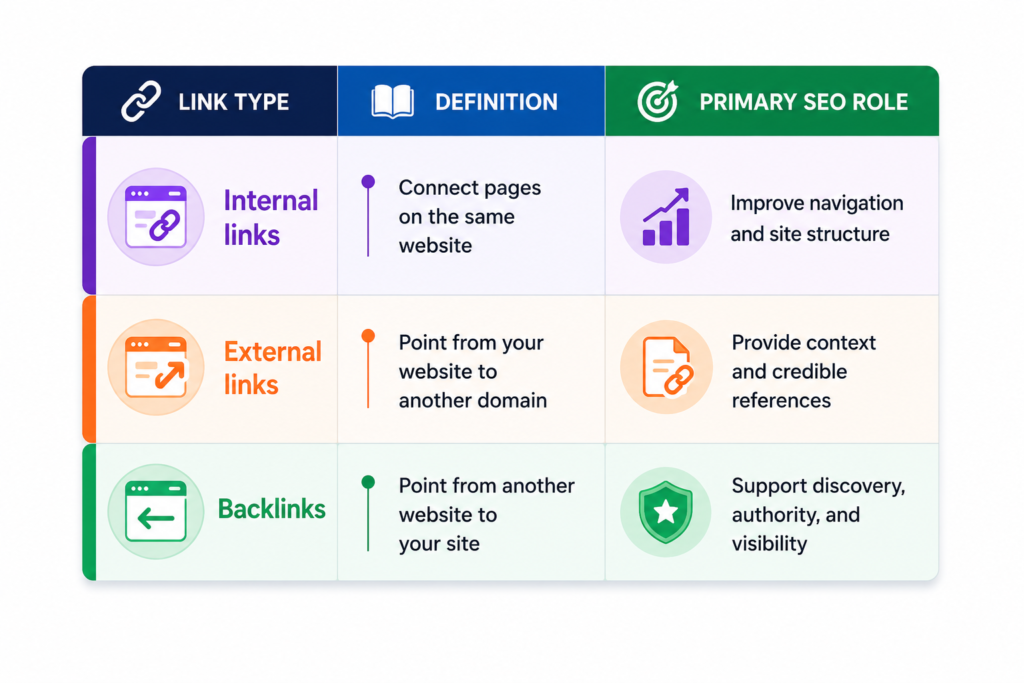
Each type serves a different purpose, and a strong SEO strategy uses them appropriately.
What Are Internal Links?
Internal links connect one page to another page on the same website.
For example, a blog post about keyword research might link to your technical SEO guide, while a service page might link to a relevant case study.
Unlike backlinks, internal links are completely under your control. You decide which pages to connect, where to place links, and what anchor text to use.
Why Internal Links Matter
Improve crawlability: Search engine crawlers can follow internal links to discover important pages.
Support indexing: A well-connected page is generally easier for search engines to discover and understand.
Distribute internal authority: Links can connect stronger pages with newer or less visible pages.
Strengthen topic clusters: A pillar page can link to supporting articles covering related subtopics.
Improve navigation: Visitors can easily find additional information without returning to search results.
For example:
Pillar Page: Complete SEO Guide
→ Keyword Research Guide
→ Technical SEO Guide
→ Link Building Guide
→ On-Page SEO Checklist
→ Local SEO Guide
This structure helps create clear relationships between related content.
Internal Linking Best Practices
Use descriptive anchor text. Instead of generic phrases such as “click here” or “read more,” use text that explains the destination page.
Examples include:
- Technical SEO Checklist
- Beginner’s Keyword Research Guide
- Complete Link Building Guide
Link to relevant pages. Every internal link should provide additional value. Avoid adding links simply to increase the number of links on a page.
Avoid orphan pages. Important pages should have relevant internal links pointing to them. Pages with no meaningful internal links can be difficult for users and search engines to discover.
Maintain a logical site structure. A simple structure might look like:
Home → SEO Services → Technical SEO → Technical SEO Audit Guide
The exact structure will vary by website, but the goal is to create clear and logical connections.
What Are External Links?
External links point from your website to another domain.
For example, an SEO article may link to Google’s official documentation, an industry research report, or another reputable source. These are external links because they direct users away from your website.
External links can improve content quality when they help readers verify information or explore a useful resource.
Benefits of External Links
Support credibility: Linking to reliable sources can help support claims and provide additional context.
Improve user experience: Readers can access valuable information without searching for it themselves.
Provide evidence: Statistics, research, official guidance, and industry data are stronger when supported by relevant sources.
External Linking Best Practices
- Link to trustworthy and relevant websites.
- Use external links when they genuinely help the reader.
- Support statistics and important claims with reliable sources.
- Avoid linking to spammy or irrelevant websites.
- Check important links periodically for broken or outdated destinations.
The goal is not to add as many outbound links as possible. Each link should have a clear purpose.
What Are Backlinks?
A backlink is a link from another website to your website. Backlinks are also called inbound links or incoming links.
For example, if a digital marketing publication links to your SEO guide, your website has earned a backlink from that publication.
Backlinks can help users discover your website and may provide search engines with signals about relevance, authority, and trust.
Why Backlinks Matter
Support website authority: A relevant link from a respected website can act as a valuable recommendation.
Support search visibility: High-quality backlinks can contribute to how search engines evaluate a website and its content. However, backlinks are only one of many ranking signals.
Drive referral traffic: A link from a relevant website can send interested visitors directly to your pages.
Build credibility: Being referenced by respected publications, organizations, or industry websites can increase brand visibility and trust.
A relevant backlink from a respected website is generally more valuable than a large number of links from unrelated or low-quality websites.
Examples of Backlinks
Guest post: You publish a genuinely useful article on another relevant website and include a relevant link where appropriate.
Resource page: A website recommends your guide as a useful resource for its audience.
Industry mention: A blogger references your original research and links to the source.
News coverage: A publication covers your study, product, or announcement and links to your website.
The best backlinks are relevant, useful, and acquired naturally rather than through manipulative schemes.
What Is Anchor Text?
Anchor text is the clickable text within a hyperlink.
For example:
Beginner’s Guide to SEO
is anchor text if it links to an SEO guide.
Descriptive anchor text helps users understand what they can expect after clicking. It can also provide search engines with context about the linked page.
Common Types of Anchor Text
Exact-match anchor: Matches the target keyword exactly.
Example: SEO Link Building Guide
Partial-match anchor: Includes a variation of the target topic.
Example: Guide to effective link-building techniques
Branded anchor: Uses a brand or company name.
Example: Google Search Central
Naked URL: Uses the URL itself as the anchor.
Example: example.com/seo-guide
Generic anchor: Uses phrases such as “click here” or “learn more.”
Generic anchors are common, but they provide less information about the destination page.
A natural backlink profile typically includes a variety of anchor text rather than repeatedly using the same keyword.
Dofollow vs. Nofollow Links
Not all links carry the same attributes or signals.
| Feature | Standard Link | Nofollow Link |
| Default HTML behavior | Standard link | Includes rel=”nofollow” |
| Direct editorial ranking signals | May contribute | Generally not treated as a standard endorsement |
| Referral traffic | Possible | Possible |
| Brand visibility | Possible | Possible |
A “dofollow link” is an informal SEO term for a standard link without a nofollow or other qualifying attribute.
A nofollow link uses:
<a href=”https://example.com” rel=”nofollow”>Example</a>
The nofollow attribute tells search engines that the website owner does not want the link treated as a typical editorial endorsement.
Other important link attributes include:
- rel=”sponsored”: Used for paid advertisements, sponsorships, or other compensated placements.
- rel=”ugc”: Used for links created by users, such as forum posts or comments.
Nofollow links can still generate referral traffic, improve brand visibility, and contribute to a natural link profile.
How Search Engines Use Links
Search engines use links throughout several stages of search.
Crawling
Crawling is the process of discovering webpages. Search engine bots can follow links from known pages to discover other publicly accessible content.
For example:
Homepage → Services → Blog → SEO Guide
If important content is not connected to the rest of a website, it may be harder to discover.
Indexing
After discovering a page, Google analyzes its content and determines whether it should be included in its search index.
Internal links can provide useful context about:
- Which pages are connected
- How topics relate to one another
- Which pages are important within the site’s structure
However, internal links do not guarantee that a page will be indexed.
Ranking
After a page is crawled and potentially indexed, search engines evaluate its relevance and usefulness for different queries.
Links are one of many factors considered alongside content quality, technical SEO, relevance, user experience, and other signals.
Therefore, links alone do not guarantee rankings.
Link Equity Explained
Link equity is a general SEO term used to describe the value and signals that may be associated with links between webpages.
For example, a well-established page may link to another relevant page on the same website. This connection can help search engines understand the relationship between the pages and the importance of the destination within the site’s structure.
The value of a link can vary depending on factors such as:
- Relevance between the linking and destination pages
- Quality and reputation of the linking website
- Context surrounding the link
- Placement of the link
- The purpose of the link
A relevant editorial link within useful content is generally more meaningful than a link placed in an unrelated footer or spammy page.
The objective should not be to collect the highest possible number of links. A stronger approach is to create useful content and build a logical website structure that earns relevant links over time.
How to Build Strong SEO Links
A strong link strategy focuses on relevance, usefulness, and consistency rather than volume.
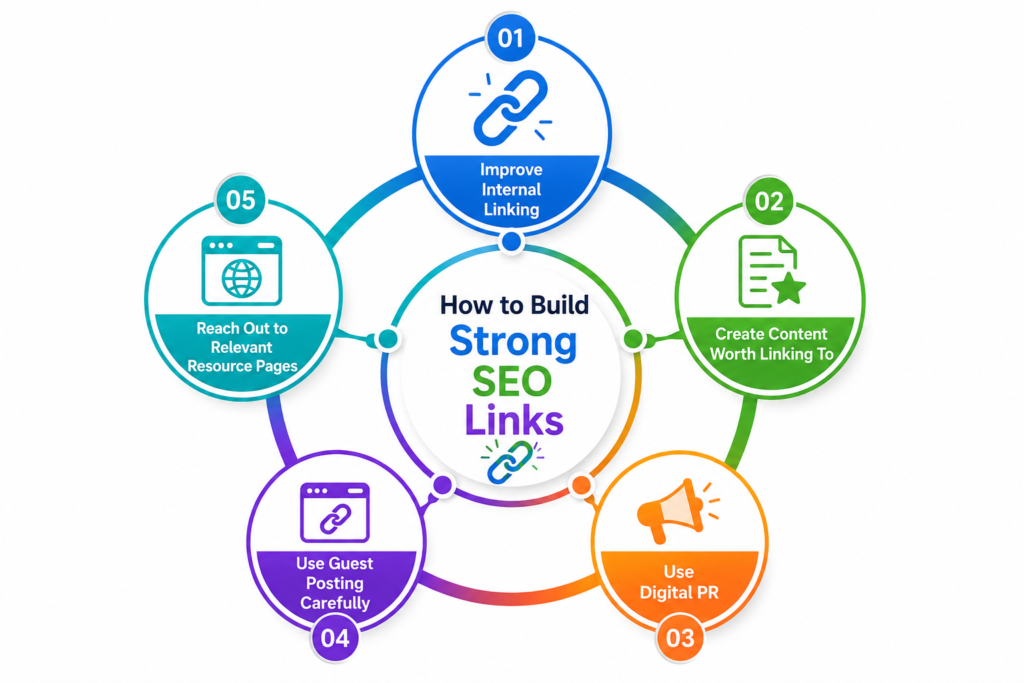
Improve Internal Linking
Because internal links are under your control, they are one of the easiest ways to improve your website’s structure.
When publishing or updating content:
- Link to relevant older articles.
- Connect supporting content to pillar pages.
- Link important service pages from relevant resources.
- Identify and fix orphan pages.
- Add links from authoritative pages to newer relevant content.
Create Content Worth Linking To
The most sustainable backlinks are earned because other websites find your content useful.
Linkable assets may include:
- Original research
- Industry statistics
- Comprehensive guides
- Templates
- Checklists
- Free tools
- Interactive calculators
- Surveys
- Original data
For example, an original industry report may attract links from bloggers, journalists, and other businesses that reference its findings.
Use Digital PR
Digital PR focuses on earning editorial coverage and brand mentions through newsworthy content.
Potential linkable assets include:
- Industry surveys
- Original research
- Market reports
- Expert commentary
- Unique data
- Newsworthy company developments
The focus should be on creating something genuinely valuable or interesting rather than simply requesting a link.
Use Guest Posting Carefully
Guest posting can be useful when it involves creating original, valuable content for a relevant audience.
Prioritize:
- Relevant websites
- Genuine editorial standards
- Useful content
- Natural link placement
Avoid websites that exist primarily to sell links or publish large volumes of unrelated guest posts.
Reach Out to Relevant Resource Pages
Some websites maintain pages that recommend useful tools, guides, or educational resources.
If your content genuinely fills a gap on a relevant resource page, you can contact the website owner and explain why the resource may be useful to their audience.
Quality and relevance should always come before the number of placements.
Common SEO Link-Building Mistakes
Buying Spammy Links
Large packages of cheap backlinks from irrelevant websites, spam directories, or private blog networks may generate short-term activity but pose long-term risks.
A safer approach is to focus on useful content, genuine outreach, digital PR, and relevant editorial opportunities.
Over-Optimizing Anchor Text
Repeatedly using the same exact-match keyword in backlinks can create an unnatural pattern.
A natural profile may include branded anchors, partial-match phrases, descriptive anchors, URLs, and other natural variations.
Ignoring Broken Links
Broken links can create poor user experiences and make navigation more difficult.
Regularly review important internal and external links and update or remove links that no longer lead to useful destinations.
Adding Too Many Unnecessary Links
More links do not automatically make a page better. Excessive linking can distract users and make content difficult to read.
Every link should serve a purpose.
Ignoring Internal Linking
Publishing content without connecting it to related pages can create isolated content and weaken your site’s overall structure.
Whenever you publish a new article, look for relevant older pages that can link to it. Then consider whether the new article should link back to those existing resources.
Linking to Low-Quality Websites
Before linking externally, ask:
- Is the source trustworthy?
- Is it relevant to the topic?
- Does it provide accurate information?
- Would I recommend it to my audience?
If the answer is no, the link may not belong in your content.
SEO Link Best Practices Checklist
Use this checklist when publishing or updating content:
| Checklist Item | Completed |
| Use descriptive anchor text | ☐ |
| Link to relevant internal pages | ☐ |
| Cite trustworthy external sources where appropriate | ☐ |
| Check and fix important broken links | ☐ |
| Connect new content to existing pages | ☐ |
| Avoid manipulative link schemes | ☐ |
| Review orphan pages regularly | ☐ |
| Maintain a logical site structure | ☐ |
| Prioritize relevance over link quantity | ☐ |
| Create content that can naturally earn backlinks | ☐ |
Example of a Strong SEO Link Structure
A simple website structure might look like this:
Homepage
- SEO Services
- On-Page SEO
- Technical SEO
- Local SEO
- Link Building Services
- Blog
- Guide to SEO for Beginners
- What Are Keywords in SEO?
- What Are Links in SEO?
- Technical SEO Checklist
- Link Building Guide
- Contact Page
In this structure, the homepage links to the main sections of the website. Service pages connect with relevant educational content, while blog posts link to related articles and important service pages.
This creates a connected structure that helps users navigate the site and gives search engines clearer context about the relationship between different pages.
Frequently Asked Questions
What are links in SEO?
Links in SEO are clickable connections between webpages. They help users navigate websites and help search engines discover and understand content.
Why are links important for SEO?
Links help search engines discover pages, understand relationships between content, and evaluate signals of relevance and authority. They also improve website navigation.
What is the difference between internal and external links?
Internal links connect pages on the same website. External links point from your website to another domain.
What are backlinks?
Backlinks are links from another website to your website. Relevant, high-quality backlinks can support visibility, authority, and referral traffic.
How many internal links should a page have?
There is no universal number. Add internal links when they are relevant and useful to the reader rather than targeting a specific quantity.
Do backlinks still matter?
Yes. Backlinks remain an important part of SEO, but they are only one ranking signal among many. Quality, relevance, and natural acquisition matter more than simply increasing the number of links.
What is anchor text?
Anchor text is the clickable text within a hyperlink. Descriptive anchor text helps users understand where a link leads.
What is link equity?
Link equity refers to the value and signals associated with links between webpages. Internal linking can help connect important pages and clarify website structure.
What is a nofollow link?
A nofollow link includes the rel=”nofollow” attribute. It tells search engines that the link should not be treated as a standard editorial endorsement.
Can links improve search rankings?
Links can support search visibility, but they do not guarantee rankings. Search engines also evaluate content quality, relevance, technical SEO, user experience, and other signals.
Are paid links allowed?
Paid links intended to manipulate search rankings can violate search engine spam policies. Paid advertisements and sponsored links should use appropriate attributes such as rel=”sponsored” where applicable.
What makes a high-quality backlink?
A high-quality backlink is generally relevant, naturally placed, useful to the audience, and associated with a trustworthy website. Relevance and context are more important than chasing a single metric.
Conclusion
Links are a fundamental part of how the internet works and how search engines discover and understand webpages.
Internal links connect content within your website, external links provide useful references and context, and backlinks can help search engines evaluate signals of relevance, authority, and trust. Anchor text provides additional context, while attributes such as nofollow, sponsored, and ugc help clarify the purpose of different links.
A successful SEO link strategy is not about collecting as many links as possible. Instead, focus on creating a logical internal structure, linking to trustworthy resources, producing valuable content, and earning relevant backlinks naturally.
Start by auditing your current website structure, fixing broken links, connecting related content, improving anchor text, and creating resources that other websites genuinely want to reference. Over time, these practices can help build a more organized, useful, and authoritative website.
