
Triple-comparison pages help buyers pick one of three brands they already know, all on a single URL. Think “Shopify vs WooCommerce vs BigCommerce” or “Notion vs ClickUp vs Asana.” Anyone typing a query like that has done the research and wants a final call.
Most SEO teams stop at two-way “A vs B” posts. That leaves money on the table. Real buyers rarely shortlist exactly two tools, and AI assistants now get long prompts that name three brands in one breath.
This guide gives you our full playbook for triple-comparison pages. You’ll get a scoring system to pick the right trios, a keyword research method, a 9-step page template, the Rank Math settings we use, and the link building that moves these pages into the top 5.
Quick answer: A triple-comparison page compares three competing products against the same buying factors on one page. Build one when a market has three clear leaders and buyers search for them together. Open with a verdict, add a three-column table, give each factor its own section, and keep pricing current.
Need your comparison pages to rank faster? Our managed link building service builds manual, editorial links that push bottom-of-funnel pages into the top 5.
Table of Contents
What Are Triple-Comparison Pages?
Triple-comparison pages are bottom-of-funnel articles that put three rival products side by side and judge them on the same buying factors. They target “brand vs brand vs brand” search queries. A good one ends with a clear recommendation for each type of buyer, so the reader leaves knowing which option to try first.
You may also hear them called three-way comparisons, “A vs B vs C” posts, or trio pages. Here are a few markets where they fit well:
| Market | Example trio | What buyers weigh |
|---|---|---|
| Ecommerce platforms | Shopify vs WooCommerce vs BigCommerce | Fees, hosting, apps, scaling |
| Project management | Notion vs ClickUp vs Asana | Views, automations, team size |
| Video meetings | Zoom vs Google Meet vs Microsoft Teams | Ecosystem, call limits, security |
| Email marketing | Mailchimp vs Kit vs ActiveCampaign | Automation depth, list pricing |
| SEO tools | Ahrefs vs SEMrush vs Ubersuggest | Data depth, budget, ease of use |
The last row is one we built ourselves. Our Ahrefs vs SEMrush vs Ubersuggest comparison helps marketers choose a main SEO toolset by budget and skill level.
Three Types of Triple-Comparison Pages
- Brand-owned: one of the three companies compares itself with its two closest rivals.
- Challenger-owned: a smaller brand reviews the big three, then shows where it fits.
- Neutral: a review site, affiliate, or agency compares all three with no product of its own.
Triple-Comparison Pages vs Two-Way, Alternatives, and Best-Of Pages
Each comparison format answers a different buyer question. Best-of lists help people discover options. Alternatives pages help people leave a tool. Two-way pages settle a head-to-head choice. Triple-comparison pages settle a three-way shortlist, which is often the last step before a free trial or demo request.
| Format | Sample query | Buyer question | Funnel stage | Typical competition |
|---|---|---|---|---|
| Best-of list | best project management software | “What are my options?” | Discovery | Review platforms with very high authority |
| Alternatives page | Asana alternatives | “What else is out there?” | Consideration | Review sites and listicles |
| Two-way page | ClickUp vs Asana | “Which of these two?” | Decision | The two brands themselves |
| Triple-comparison page | Notion vs ClickUp vs Asana | “Which of these three fits me?” | Final decision | Often thin or outdated pages |
The last column is why this format is worth your time. Three-way queries often have weaker competition than the other three formats. Each format also matches a different keyword modifier, so a full comparison program uses all four without overlap.
Why Triple-Comparison Pages Are Worth Building
Triple-comparison pages are worth building because they match how people actually shop: with a shortlist of three. They catch long, multi-brand prompts in AI assistants, target high-converting comparison keywords, and often face weaker competition than best-of lists. For smaller brands, they also open a door into a race led by bigger names.
Buyers Shortlist Three, Not Two
Ask any sales team how many rivals a prospect mentions on a first call. The answer is rarely one. Most buyers bring a short list of two to four names. A two-way page only covers part of that list, so the reader opens more tabs and may never come back.
AI Assistants Get Three-Brand Prompts
People talk to ChatGPT and Perplexity in full sentences. A prompt like “I run a 12-person design agency. Should I pick Notion, ClickUp, or Asana?” is normal there. The assistant needs a source that weighs all three, and a three-way page is the closest match.
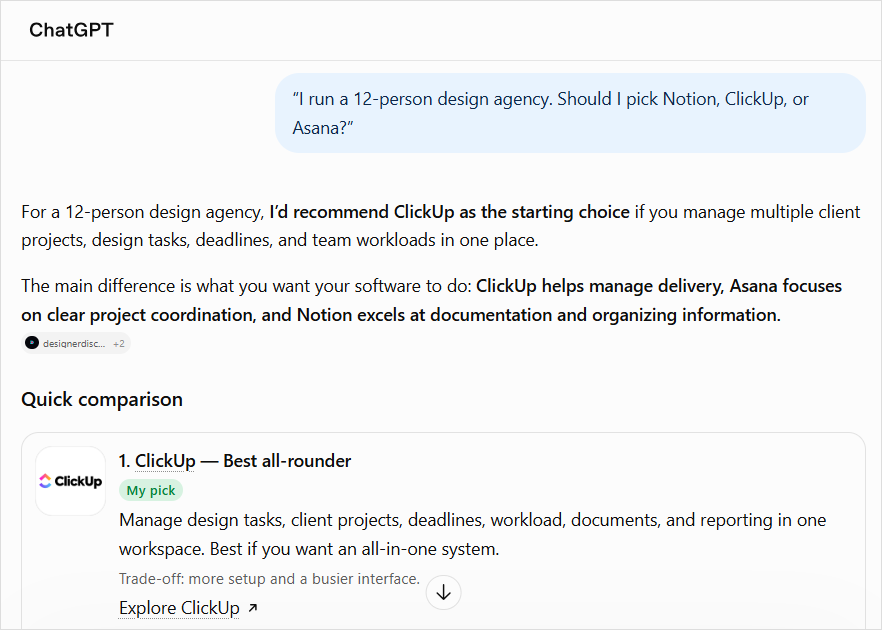
Versus content already earns AI traffic. A Siege Media study of 116 B2B sites found versus pages tracked more closely with AI-referred visits than any other sales-focused page type. Read our take on how AI search is reshaping link building strategies for the link side of this shift.
Comparison Keywords Convert Well
People comparing named brands are close to buying. Grow and Convert reviewed conversion rates across 95 client posts and found comparison and alternatives terms near the top, at over 7.5%. Versus terms came next at over 5%.
So don’t judge these pages by search volume alone. Forty searches a month at a 5% conversion rate is two leads, every month, from one page. That kind of page belongs at the bottom of your SEO funnel.
Less Crowded SERPs
“Best X software” results are packed with review platforms that have huge domain authority. Three-way queries are different. The top results are often thin listicles, old forum threads, or a two-way page that only half answers the question. A well-built page can climb quickly.
A Way In for Challenger Brands
If you’re not one of the big three, a two-way query belongs to the two brands named in it. A three-way query is more open. You can review the big three fairly, then add a short section on where your product fits. Readers still weighing three options are often open to a fourth.
The Trio Fit Score: Which Trios Deserve a Page?
Not every trio deserves its own page. We score each candidate on five factors, from 0 to 2 points each, for a total out of 10. A score of 8 or more means build it now. Five to 7 means build your two-way pages first. Four or less means skip it.
| Factor | 0 points | 1 point | 2 points |
|---|---|---|---|
| Market balance | One brand dominates | Two leaders, one trailing | Three brands share the market |
| Shortlist frequency | Rarely named together | Sometimes named together | Named together in most sales calls or forum threads |
| Combined demand | No volume across any ordering | Volume on one or two orderings | Volume across several orderings and variants |
| SERP gap | Strong three-way pages already rank | Mixed results | Only two-way pages, thin lists, or old threads rank |
| Your edge | You can’t access all three tools | You can test two of them | You can test all three and give a clear verdict |
Example: Say you sell an email marketing tool and keep losing deals to the same three rivals. Prospects name all three on calls (2). Each rival holds a solid share of the market (2). Ahrefs shows volume on two orderings (1). The current top results are two-way posts (2). Your team already has accounts on all three (2). That’s 9 out of 10, so the page goes on this month’s content calendar.
Low numbers in Ahrefs aren’t a deal-breaker. Tools often undercount small queries, and every visitor to these pages is close to a decision.
How to Find Triple-Comparison Keywords
To find triple-comparison keywords, start with the rivals your buyers already name, then check every word order of each trio in Ahrefs or Semrush. Pull three-way queries from Google Search Console with a regex filter, scan Reddit for organic mentions, and test what AI assistants say today. Combine it all in one sheet.
- List your contenders. Pull names from sales call notes, the “lost to” field in your CRM, G2 category pages, and niche subreddits.
- Check all six orderings. Three brands can appear in six orders, from “A vs B vs C” to “C vs B vs A.” Search each one and add the volumes.
- Filter exports for three-way phrasing. Export “vs” keywords for each brand from Ahrefs Keywords Explorer into Google Sheets. Use
=REGEXMATCH(A2, "vs.*vs")to flag rows that name three brands. - Catch other phrasings. Buyers also search “A or B or C,” “A B C comparison,” and “A vs B vs C pricing.” Add these as secondary keywords on one page.
- Mine Search Console. In the Performance report, add a Query filter, pick Custom (regex), and enter
vs.*vs. You’ll see three-way queries you already appear for. - Search Reddit. Run
site:reddit.com "A" "B" "C"in Google. Threads that compare all three prove real demand, even when tools show zero. - Test AI answers. Ask ChatGPT, Perplexity, and Google AI Mode your three-way question. Note which pages they cite. If they cite roundups or two-way posts, the spot is still open.
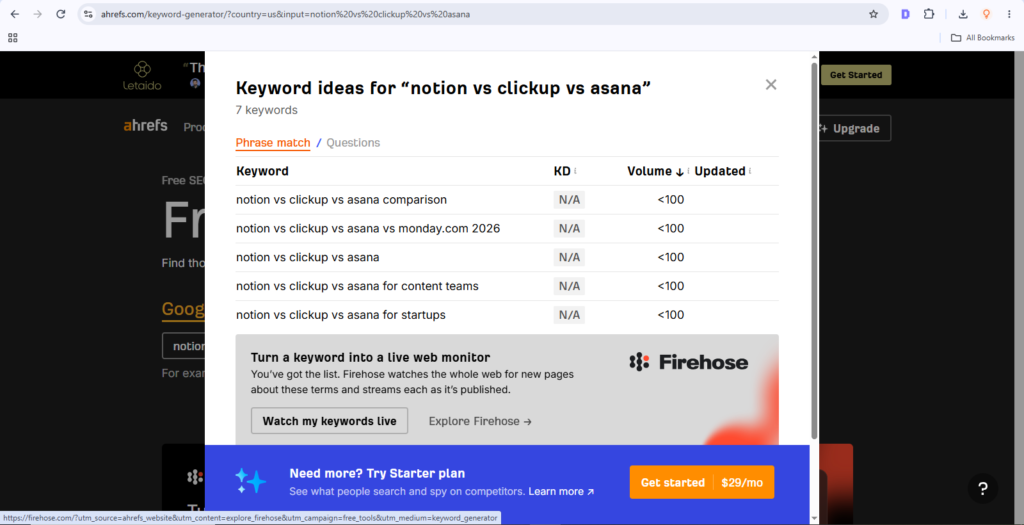
Our keyword research checklist and Ahrefs content gap guide walk through the tool steps in more detail.
How to Build a Triple-Comparison Page in 9 Steps
To build a triple-comparison page, start with a short verdict and an at-a-glance table, then explain how you tested. Follow with pricing at different team sizes, a section per buying factor, switching costs, and best-fit buyer profiles. Close with an honest “none of the three” section, an FAQ, and a CTA.
Step 1: Pick the Format the SERP Rewards
Search your main query and look at the top five results. If blog posts rank, write a long-form article. If landing pages rank, build a hybrid: a short decision block on top and detailed copy below. Grow and Convert notes that long-form posts often rank more easily than short landing pages, especially on newer domains.
Step 2: Open With a Short Verdict
Write three “best for” lines right after the intro, one per brand. For example: “Pick Notion for docs-first teams, ClickUp for feature-heavy workflows, and Asana for cross-team project tracking.” Keep it as live text, not an image, so search engines can read it.
Step 3: Add an At-a-Glance Table
Create one HTML table with a column per brand and six to ten rows. Cover starting price, free plan, key features, ease of use, support, and integrations. Add a “last checked” date under the table so readers know the data is fresh.
Step 4: Explain How You Compared
Say who tested the tools, for how long, and on which plans. Add your own screenshots. This first-hand proof is what Google’s helpful content guidance rewards, and it’s the part competitors can’t copy.
Step 5: Show Pricing at Three Team Sizes
List prices rarely tell the full story. Show what each tool costs for a solo user, a 10-person team, and a 50-person team. Note add-ons and annual-only discounts. This one table often earns more time on page than the rest of the article.
Step 6: Break Down Each Buying Factor
Under an H2 like “Feature-by-Feature Breakdown,” give each factor its own H3, such as “Automations” or “Reporting.” Name all three brands in every H3 section, and end each one with a one-line winner for that factor.
Step 7: Cover Switching and Setup Costs
Most comparison pages skip this, so it sets yours apart. Explain migration effort, contract terms, data export options, and the learning curve for each tool. Buyers moving from one of the three care about this more than any feature list.
Step 8: Match Each Tool to a Buyer Profile
Add a “Who Should Choose Which” section. Match each brand to a team size, budget, skill level, or industry. Then add a short “When none of the three fit” note. If you sell an alternative, this is the honest place to mention it.
Step 9: Finish With an FAQ and a Fair CTA
Answer the side questions buyers ask, like free trials, discounts, and data security. Then add one clear call to action that matches the tone of the page. Readers trust a fair page with a soft CTA far more than a sales pitch dressed up as a review.
How to Get Triple-Comparison Pages Cited in AI Search
AI assistants cite passages that answer a question cleanly on their own. To earn those citations, open every section with a direct answer, name all three brands in full, phrase subheadings as real questions, keep tables in HTML, and date your facts. Brand mentions on trusted sites also help models link your name to the category.
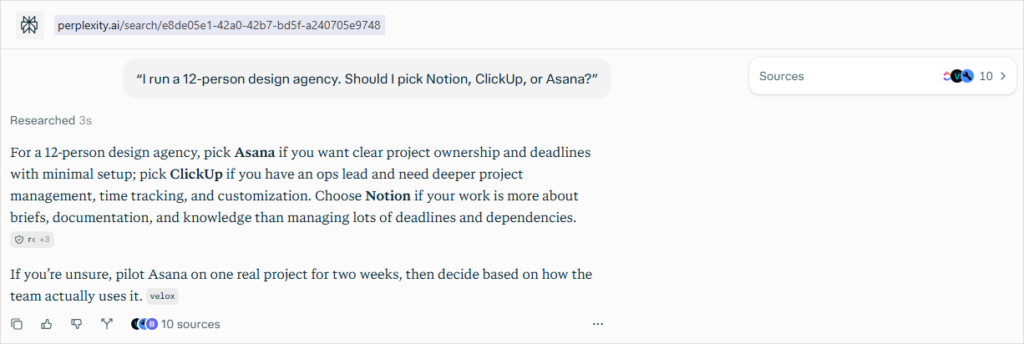
Use these formatting rules on every three-way page:
- Answer first. Start each section with a 40 to 60 word answer that makes sense out of context.
- Repeat full names. Write “ClickUp” instead of “it” or “the second tool.” Models pull passages, not whole pages.
- Use question-style H3s. “Which is cheapest for a 10-person team?” matches how people prompt.
- State a winner per factor. A clear line like “Asana wins on reporting” is easy to quote.
- Date every price. Write “as of October 2026” next to pricing so models trust the figure.
- Keep one canonical page per trio. Several thin versions split the signals models look for.
Pages that follow these rules give AI tools something specific to quote. That’s the core of generative engine optimization (GEO) for comparison content.
Rank Math SEO Checklist for Triple-Comparison Pages
In Rank Math, set the main “A vs B vs C” query as the focus keyword and add two other word orders as secondary keywords. Place the query in the SEO title, meta description, slug, first sentence, and at least one subheading. Aim for about 1% keyword density, then add internal links and nofollow external links.
| Rank Math test | How to pass it on a three-way page | Target |
|---|---|---|
| Focus keyword in SEO title | Start the title with the full query | Under 60 characters |
| Title readability | Add a number, a power word, and a sentiment word | “A vs B vs C: 9 Honest Differences (2026)” |
| Focus keyword in meta description | Use the exact query once, in a natural sentence | 140 to 155 characters |
| Focus keyword in URL | Use only the three brand names | /a-vs-b-vs-c/ |
| Keyword at the start of content | Use the query in your first sentence | First 10% of the content |
| Keyword in subheadings | Use it in one H2 and one H3 | Not in every heading |
| Keyword density | Spread the query across the page | About 1% to 1.5% |
| Image alt text | Add the query to your comparison graphic | At least one image |
| Content length | Cover every factor in depth | 2,500+ words for Rank Math’s full score |
| Internal links | Link to each related two-way page and one service page | 3 to 6 or more |
| External links | Cite official pricing pages and studies | 2 to 4, set to nofollow |
| Table of contents | Place it after the intro | Every page over 1,500 words |
| Short paragraphs | One to three sentences each | Under 120 words |
| Schema | Article + FAQPage | Test in Google’s Rich Results Test |
How to Make External Links Nofollow in Rank Math
Go to Rank Math SEO > General Settings > Links and switch on Nofollow External Links. Every outbound link then gets rel=”nofollow” automatically. To do it for a single link, select the link in the editor and tick the nofollow box.
Rank Math’s content test still gives a point for at least one dofollow external link. If your policy keeps outbound links nofollow, accept that missing point. Our guide to outbound links covers when each option makes sense.
A Quick Note on FAQ Schema
Google now shows FAQ rich results mostly for well-known government and health sites. FAQPage schema still helps search engines and AI tools read your question-and-answer pairs, so keep it. Google’s FAQPage documentation lists the rules.
Internal Linking and Keyword Cannibalization
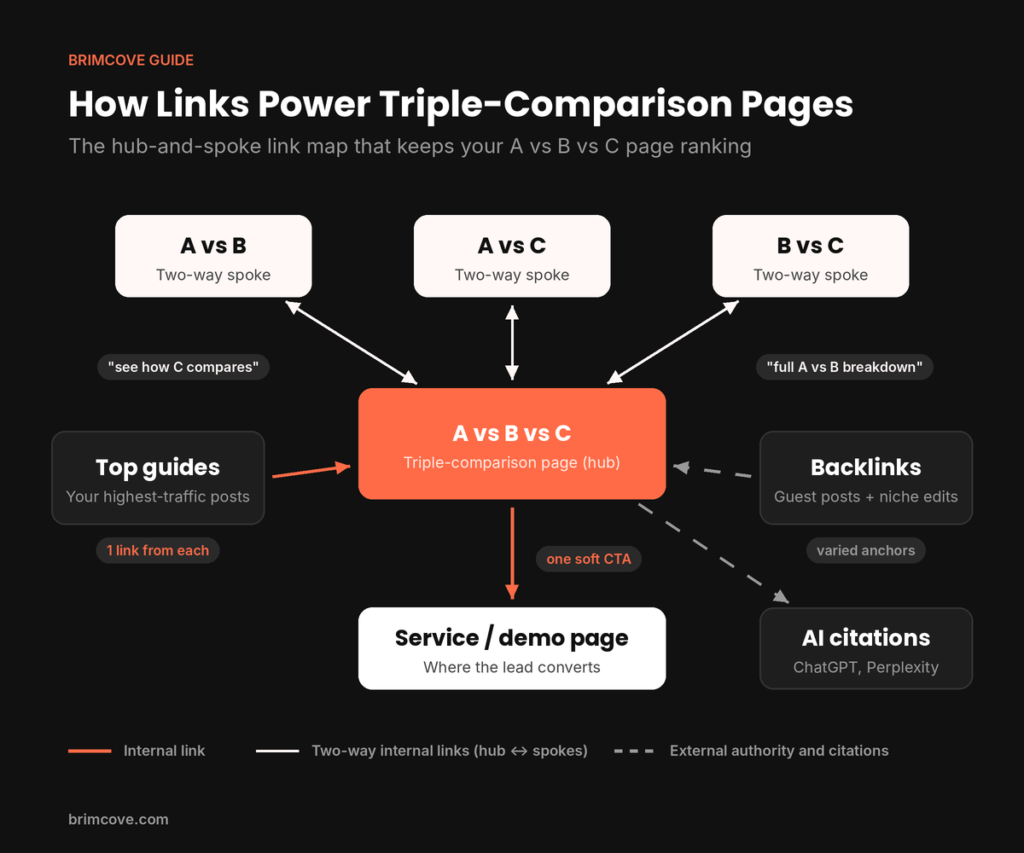
Your three-way page and your two-way pages should support each other, not compete. Give each page its own focus keyword, then connect them in a hub-and-spoke pattern. The trio page is the hub, and each head-to-head post is a spoke. If two URLs keep swapping for one query, merge them.
- Hub: the triple-comparison page (A vs B vs C).
- Spokes: the two-way posts (A vs B, A vs C, B vs C).
- Hub to spoke: use anchors like “full A vs B breakdown.”
- Spoke to hub: use anchors like “see how C compares too.”
Once a month, open each three-way query in Search Console and check the Pages tab. If two of your URLs share impressions and both sit below position 10, combine the best content into the stronger page and 301 redirect the weaker one.
For more on this, see our guides to internal linking for AI and SEO and anchor text in SEO.
How to Build Links to Comparison Pages
Comparison pages almost never attract links naturally, because bloggers rarely cite content that leads to a purchase. To rank them, route internal links from your strongest posts first. Then add a small number of editorial links from niche-relevant sites, and earn brand mentions that help AI tools tie your name to the category.
What works best for triple-comparison pages:
- Internal links from your top posts. Find your highest-traffic guides in GA4 and add one contextual link from each. It costs nothing and works fast.
- Editorial guest posts. A guest post on a respected niche blog can point readers to your comparison as a buying resource.
- Link insertions. A niche edit inside an older article that already ranks for one of the three brands sends relevant authority quickly.
- A quarterly pricing tracker. Publish a small, dated pricing table for all three tools and update it every quarter. Fresh data turns a sales page into a linkable asset.
- Brand mentions. Unlinked mentions on trusted sites help LLMs connect your brand with the category. Our brand mentions service is built for this.
Keep anchor text varied. Mix branded anchors, the full three-way phrase, and plain anchors like “this breakdown.” A low-volume page with mostly exact-match anchors looks unnatural to Google.
Want this handled for you? Our managed link building service places manual, editorial links on traffic-verified sites, and SaaS teams can use our SaaS link building plans.
How to Measure and Update Your Pages
Judge triple-comparison pages by leads, not page views. Track key events in GA4, impressions for three-way queries in Search Console, and how often AI tools cite your page. Then review the page every 90 days, or sooner when one of the three brands changes its pricing, plans, or core features.
- Leads per page. Set demo requests, trial sign-ups, and form fills as key events in GA4.
- Query coverage. Reuse the
vs.*vsregex filter in Search Console to watch every word order. - Rankings. Track the main query and two or three variants in a rank tracking tool.
- AI citations. Keep a sheet of 5 to 10 prompts. Run them monthly in ChatGPT, Perplexity, Gemini, and Google AI Mode, and log which pages get cited.
When you update the page, change the visible “last updated” date and add a one-line note on what changed. Readers notice, and so do search engines.
Common Mistakes to Avoid
The biggest mistakes with triple-comparison pages are picking a trio nobody searches for, hiding the verdict, and turning the page into a one-sided pitch. Stale pricing, image-only tables, and pages that fight your own two-way posts also cost rankings and trust.
- Picking a trio buyers don’t compare. Score it first. No score, no page.
- Copying vendor feature lists. They’re biased and change often. Test the tools yourself.
- Hiding the verdict. Put your recommendation in the first screen.
- Making your brand win every row. Readers stop trusting the page fast.
- Tracking only one word order. You’ll miss demand from the other five.
- Using screenshots for tables. Crawlers and screen readers can’t read them.
- Stuffing brand names. Repeating all three names in every line hurts readability.
- Letting prices go stale. Old numbers cost you trust and rankings.
- Making claims you can’t prove. Back every statement with a source or your own testing.
Get Your Comparison Pages Into the Top 5
Great triple-comparison pages still need authority to rank. Our in-house team builds manual, editorial links on traffic-verified sites, with a 6-month replacement guarantee on every link. We used the same approach to grow CureMD from 5K to 60K monthly traffic and DR 30 to 67 in six months.
Book a free 30-minute strategy call or explore our managed link building service.
FAQs
What is an example of a triple-comparison page?
A page titled “Notion vs ClickUp vs Asana” is a typical example. It compares all three project management tools on pricing, features, ease of use, and integrations, then tells each type of team which tool to pick. Our Ahrefs vs SEMrush vs Ubersuggest post follows the same format for SEO tools.
Are triple-comparison pages good for SEO?
Yes, when the trio is real. Triple-comparison pages target buyers close to a decision, so they tend to convert well. Their keywords often face weaker competition than best-of lists. They also give AI assistants a direct source for three-brand prompts, which two-way posts can’t fully answer.
Is it legal to name competitors on a comparison page?
In most markets, you can name competitors if your claims are accurate, current, and provable, and you don’t suggest they endorse you. Use their names as plain text, not their logos, unless you have permission. Rules differ by country, so check with a lawyer for anything high-risk.
How do you stay fair if your brand is one of the three?
Score every tool on the same criteria, and show where your own product falls short. Link to each brand’s official pricing page as a source. Readers forgive a clear preference far more easily than hidden weaknesses, and a balanced page earns more trust and more AI citations.
Should a triple-comparison page be a blog post or a landing page?
Let the search results decide. If blog posts hold the top spots, write a long-form article. If landing pages rank, build a hybrid page with a short decision block at the top and detailed copy below. Newer, lower-authority sites usually find blog posts easier to rank.
How long should triple-comparison pages be?
Most rank well between 2,000 and 3,000 words. Length should come from depth: a verdict, a comparison table, a section per buying factor, switching costs, buyer profiles, and an FAQ. Check the top three results for your query, cover what they cover, then add what they missed.
How often should you update triple-comparison pages?
Review them every 90 days. Update sooner when any of the three brands changes pricing, plans, or a core feature. Change the visible “last updated” date each time, and add a short note on what changed so readers and search engines can see the page is current.
