
Backlinks aren’t equal. Some come from household-name publications with serious authority. Others work quietly behind the scenes, making your best links even stronger. Some create layers of support that compound your SEO power over months.
That’s tiered link building.
Interest in link-building strategies just hit an all-time high in 2026. The SEO community’s split, though. Some practitioners swear by tiered pyramids. Others see them as gray-area manipulation. The truth? It depends entirely on how you execute.
Tiered link building works on a straightforward idea: build links to your links. Tier 1 links point to your site. Tier 2 links point to Tier 1. Tier 3 links amplify Tier 2. Each layer theoretically strengthens the ones above it, funneling link equity toward your domain.
But—and this is the part most guides skip—Google’s systems now detect these patterns in real time. Not weeks later. Real-time. SpamBrain catches coordinated, manipulative tiering instantly. Poor execution leads to penalties that take months to recover from.
This guide goes deeper than the typical overview. You’ll find real mechanics, current 2026 data, honest risk assessment, and the exact implementation approach that works without inviting penalties.
Table of Contents
What Is Tiered Link Building?
Strip away the jargon. Tiered link building means organizing backlinks in layers. Instead of chasing 50 direct links to your site, you chase 10 really good ones, then build 25-35 links pointing to those 10. The pyramid structure is supposed to multiply your SEO authority.
Here’s the basic model:
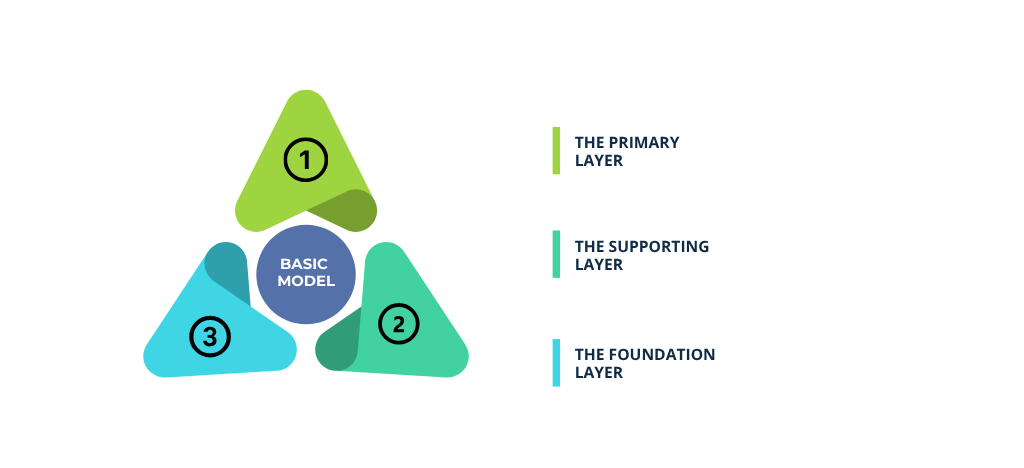
Tier 1 (Primary layer): Direct links to your website from high-authority, relevant sources.
Tier 2 (Supporting layer): Links pointing to your Tier 1 backlinks. These strengthen them.
Tier 3 (Foundation layer): Links pointing to Tier 2 links. Another layer of reinforcement.
Think of it like a pyramid. A strong base holds everything up.
Why This Strategy Became Popular
Cold outreach is expensive and saturated. A high-quality guest post on a DR 60+ site costs $500–$3,000 now. The average email gets an 8.5% response rate. Finding quality linking opportunities requires serious effort.
Tiered link building offered a shortcut: fewer expensive Tier 1 links, more cheaper Tier 2 and Tier 3 links. Build 10 $1,000 links and 40 $100 links. Math says it’s more efficient.
The execution is where things fall apart. Quality at every tier is non-negotiable. Cut corners, and Google flags the entire structure as a scheme.
How Tiered Link Building Works
The mechanics matter because effectiveness depends on link quality at each level. Low-quality tiers tank the strategy.
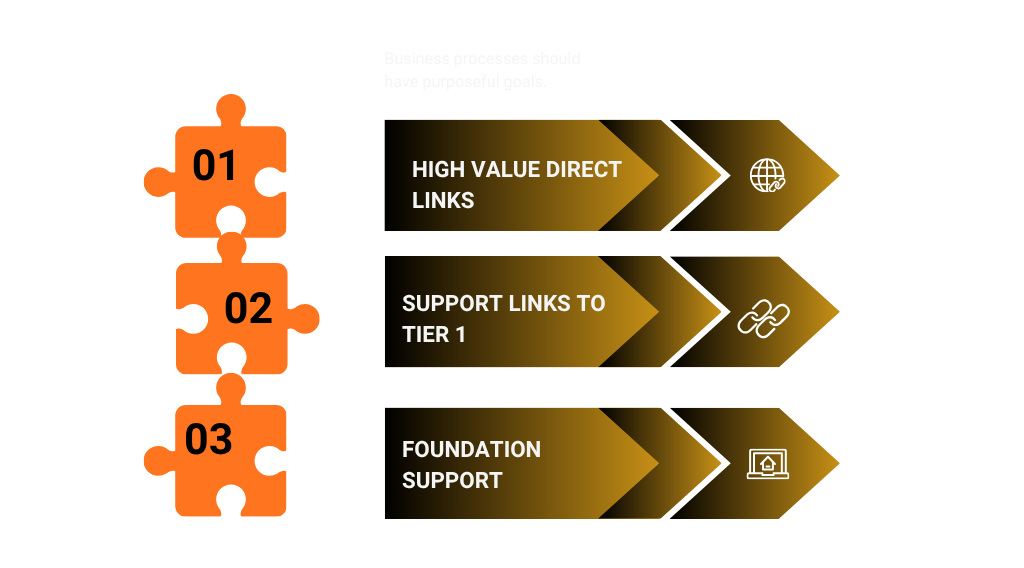
Tier 1: High-Value Direct Links
These points straight to your website. They’re your primary backlinks and carry the most weight in search engines.
Sources include:
– Guest posts on high-authority blogs in your space
– Editorial links from news sites or industry magazines
– Press coverage and brand mentions
– Resource page links on authority sites
– Legitimate collaborations with established brands
Real example: A fitness website publishes a guest post on Healthline (DR 92). The post links back to the site’s workout resource page. That’s Tier 1. Healthline has authority, and the context is relevant to fitness. The link signals trust to Google.
Why it matters: Tier 1 links move the ranking needle. They influence search results more than any other factor. They tell Google’s systems, “trusted websites endorse this site.”
Tier 2: Support Links to Tier 1
These don’t hit your website. They point to your Tier 1 links instead. The goal: make those Tier 1 pages stronger, which indirectly benefits your site.
Tier 2 sources include:
– Blog posts mentioning and linking to your Tier 1 guest posts
– Medium or LinkedIn articles linking to Tier 1 content
– Niche blogs and resource sites linking to your guest post
– Forum discussions pointing to Tier 1 material
– Directory or listing sites pointing to Tier 1 pages
Real scenario: Your Healthline guest post sits there as Tier 1. You then publish a Medium article about fitness trends—and link to that Healthline piece. A niche fitness forum links to your Medium post. These Tier 2 links don’t directly help your site, but they boost Healthline’s page authority, which strengthens the original link back to you.
The catch: Impact is indirect and hard to measure. It’s like building a moat around your castle instead of building the castle walls taller.
Tier 3: Foundation Support
These point to Tier 2 links. Farthest from your site, carrying the least direct authority. But they supposedly add foundation strength.
Tier 3 sources include:
– Social bookmarks on Reddit, Pinterest, Digg
– Forum signatures with links to Tier 2 pages
– Free directory submissions
– Profile links on social platforms
– Blog comments with Tier 2 links
Example: Multiple Reddit bookmarks and Pinterest shares point to your Medium article (the Tier 2 link). The Medium article gains visibility and authority. It then strengthens its link back to Healthline.
Real talk: Tier 3 links are too far down the chain to move rankings directly. They only matter if Tier 2 is solid. Build garbage Tier 3 links, and you’ve wasted time and money.
Does Link Equity Actually Flow Upward?
This is the question nobody answers honestly.
Real answer: Sometimes. Tier 2 and Tier 3 links can improve your Tier 1 pages’ visibility and indexation, which indirectly helps your site. But only if the sources are quality. Low-quality Tier 2 and 3 links provide almost no benefit and risk contaminating your profile.
Here’s what the 2026 data shows: 92.3% of top-100 Google results have at least one backlink. But the top 1%? They have diverse, high-quality profiles built over time—not manipulative pyramids built in weeks. The most effective tiered approaches are those where Tier 2 and 3 emerge naturally through promotion and content distribution.
Real-World Examples of Tiered Link Building
Example 1: SaaS Product Review Site
Goal: Rank “best project management tools for remote teams”
Tier 1 strategy: Secure guest posts on ProductHunt (DR 91) and G2 (DR 90). Each includes one link to the review site’s main article.
Tier 2 strategy:
– Publish a comparison blog post mentioning the G2 review, link to G2
– Share the ProductHunt link in relevant LinkedIn articles and professional communities
– Email 3-4 product blogs asking them to mention the G2 review
Tier 3 strategy (selective):
– Share your blog post on 10-12 relevant Reddit threads
– Add it to Quora answers about project management
– Bookmark it on relevant ProductHunt Collections
Result over 6-8 weeks: Tier 1 pages gain visibility. Tier 2 support pushes them higher. The main review article gets ranking traction.
Example 2: Local Service Business (Riskier Approach)
Goal: Rank “HVAC repair in Denver”
Tier 1: Guest post on Home Advisor (DR 76) plus local news mention.
Tier 2: Links from Medium articles, Web 2.0 sites, small local blogs, niche directories.
Tier 3: Social bookmarks, forum links, low-quality directory submissions. Lots of them.
What goes wrong: If Tier 2 and Tier 3 sources look coordinated and low-quality, SpamBrain flags the whole structure as artificial. No ranking improvement. Possibly a penalty.
The difference between success and failure often comes down to this: Are Tier 2 and 3 links from genuinely relevant sources that naturally mention your content? Or are they from a coordinated outreach campaign designed to game rankings?
Benefits of Tiered Link Building
When quality sources are involved, real advantages exist.
Amplifies Your Best Links
Your strongest links deserve amplification. A DR 80+ guest post that costs $1,500 might rank a page. Support that page with 2-3 quality Tier 2 links, and it ranks higher, drives more traffic, and passes more authority.
Data point from 2025: High-authority guest posts on DR 80+ sites generated 40-50 referring domains when promoted effectively. Without promotion? They stayed invisible.
Cost-Effective Authority
A single DR 90 link costs $500-$3,000. A DR 90 link with three solid Tier 2 links might cost $800-$1,200. You’re getting more SEO work for less per-link cost. ROI improves.
Natural Link Profile Appearance
Real websites get links from many sources over time. Direct links, mentions, shares, and forum discussions. Tiered link building can mimic this natural distribution if done with care. Your profile appears organic, not manipulated.
Lower Risk to Main Site
Low-quality links built to Tier 2 pages instead of to your site mean lower penalty risk. If Google devalues those weak links, your domain stays clean.
Faster Link Indexation
Quality Tier 2 links help ensure your Tier 1 pages get found and indexed quickly. More referring domains correlate with faster discovery.
Risks & Limitations of Tiered Link Building
Most guides gloss over this section. I won’t.
SpamBrain Detection Is Real
Google’s machine learning system detects unnatural linking patterns in real time. October 2025 saw another spam update specifically targeting coordinated schemes. SpamBrain reduced spam by 99% compared to older methods.
What this means: Build 20 links to 5 pages in 2 weeks from clustered sources? SpamBrain flags it. Recovery takes months. Sometimes doesn’t happen at all.
Gray Hat Status
Tiered link building, by definition, sits in a gray zone. It’s not explicitly forbidden, but it’s not white hat either. Google forbids “links meant to manipulate rankings.” Tiered link building’s entire premise is built around manipulating link equity flow.
Industry consensus in 2026: Tiered link building works best when Tier 2 and 3 links come naturally through promotion—not coordinated outreach campaigns.
Longer Results Timeline
A direct Tier 1 link from authority can influence rankings within 2-4 weeks. Tiered structures require link equity to flow up through multiple layers. Real results often take 8-12 weeks. Sometimes, the benefit from Tier 2 and 3 is barely measurable.
You’re asking for patience here. Most people want results faster.
Quality Degradation as You Go Down
Lower tiers mean lower quality, usually. Your Tier 2 links might be decent. Your Tier 3 links? Often mediocre. Weak Tier 3 links add nothing and can drag down profile quality.
Scalability Becomes Painful
Building 5 Tier 1 links is manageable. Building 5 quality Tier 2 links for each Tier 1 link requires significant work. Suddenly, you’re managing 25+ links across multiple tiers. The project management burden grows fast.
Gray Hat Effectiveness Declines Over Time
Tactics that worked in 2023 became devalued in 2025. Large-scale guest posting on “write for us” sites? Dead. Tiered link building could follow the same trajectory.
Safe assumption: Tiered link building works now. Whether it works in 2027 or 2028 is an open question.
Step-by-Step Implementation Strategy
If you decide to go this route, here’s how to do it without inviting penalties.
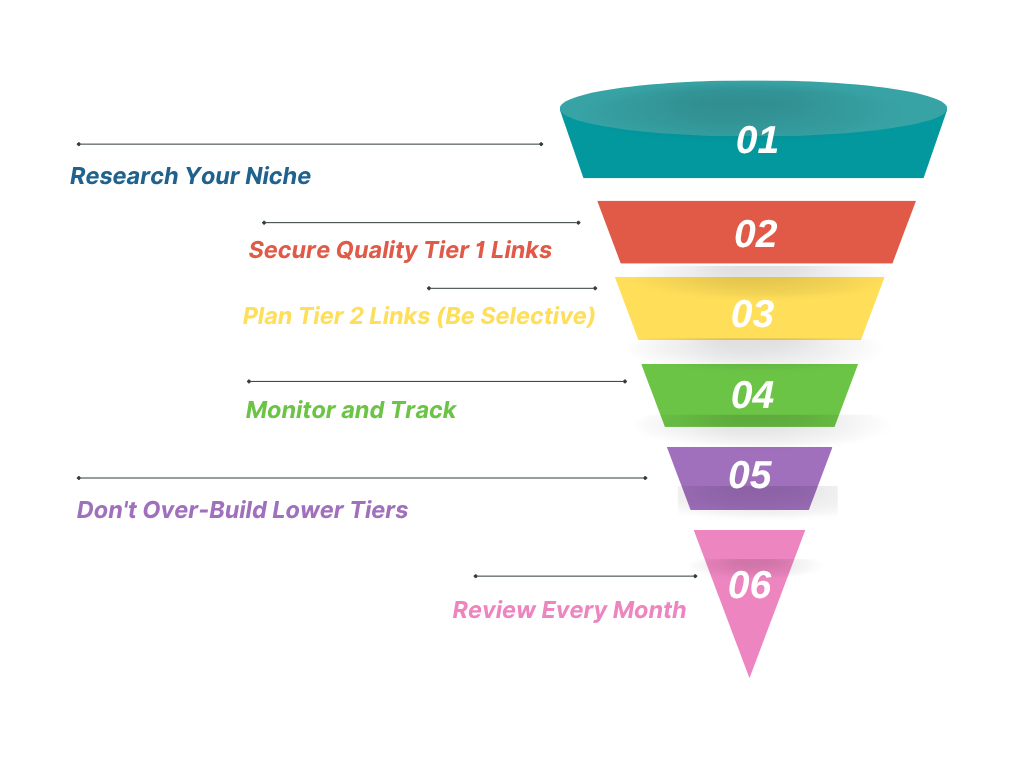
Step 1: Research Your Niche
Identify 8-12 high-authority sites where you want links. Use Ahrefs or SEMrush to check:
– Domain Rating (DR 60+)
– Relevance to your industry
– Actual traffic and reader engagement
– Who else links to them
Don’t chase DR numbers alone. A DR 50 site with 10,000 monthly visitors beats a DR 70 site nobody reads.
Step 2: Secure Quality Tier 1 Links
Use white-hat methods:
– Guest posting (real outreach, not “write for us” farms)
– HARO (Help A Reporter Out) for journalist links
– Broken link building on relevant high-authority sites
– Editorial link insertion on established pages
– Digital PR campaigns with actual journalists
Quality over quantity. Five excellent Tier 1 links beat fifty weak ones. Non-negotiable.
Step 3: Plan Tier 2 Links (Be Selective)
For each Tier 1 link, find 2-4 natural Tier 2 opportunities:
– Write blog posts that mention and link to the Tier 1 content
– Share the Tier 1 link on your own Medium, LinkedIn, or owned properties
– Email 2-3 relevant blogs asking if they’d mention the Tier 1 page
– Add the Tier 1 link to your own resource pages where it fits
Key principle: Tier 2 links should come from real, relevant sources. Not coordinated outreach designed to manipulate.
Step 4: Monitor and Track
Use a spreadsheet or Ahrefs to track:
– Tier 1 placements and dates
– Tier 2 links acquired (if any)
– Ranking movements in target keywords
– Referring to domain growth
Watch for warning signs:
– Sudden ranking drops (possible penalty)
– No change after 8 weeks (tiers not working)
– “Unnatural links” notice from Google (manual action)
Step 5: Don’t Over-Build Lower Tiers
Resist automating or bulk-building Tier 3. Automated link-building tools don’t work anymore. Google flags them instantly. Manual, selective Tier 3 (5-10 links per campaign) from real sources are acceptable. Hundreds of farm links aren’t.
Step 6: Review Every Month
Every 30 days, ask yourself:
– Which Tier 1 links moved the rankings?
– Did Tier 2 links provide measurable benefit?
– Did any tiers trigger spam flags?
Double down on what works. Cut what doesn’t.
Best Practices to Stay Safe
Tiered link building isn’t risky if you follow these rules.
Prioritize Quality Over Quantity
Build 5 high-quality, relevant Tier 1 links backed by 2-3 genuine Tier 2 links each. Not 50 weak links across three tiers.
Maintain Topical Relevance
Every tier should stay relevant to your niche. A fitness site building Tier 2 links from unrelated tech blogs signals manipulation.
Vary Your Anchor Text
Use branded anchors (your company name), partial-match anchors (“tiered link building strategy”), and contextual anchors. Don’t repeat exact-match anchors across tiers. Google flags patterns.
Space Out Acquisition
Build gradually. Instead of acquiring 20 links in two weeks, spread 5 per week over a month. Appears natural. Reduces spam detection risk.
Mix Tiered with Organic Methods
Don’t rely solely on tiered link building. Combine with organic tactics:
– Content marketing that naturally attracts links
– Social media promotion
– Brand mentions and citations
– HARO outreach
– Influencer partnerships
Data from 2025 shows 40.7% of marketers cite content marketing as the top method for passive link acquisition. Mix passive and active methods.
Audit Regularly
Check your backlink profile monthly. Look for:
– Spammy or irrelevant links
– Links from “write for us” farms
– Coordinated linking patterns
– PBN or farm indicators
If something looks wrong, disavow it.
Avoid These Specific Moves
– Don’t build Tier 3 links using automated tools
– Don’t link from PBNs or obvious link farms
– Don’t buy Tier 2 links in bulk from marketplaces
– Don’t use private blog networks
– Don’t create coordinated link-building networks
– Don’t build links to low-quality or AI-generated Tier 1 content
—
Tools & Resources
If you’re implementing this, these help.
Research & Analysis:
– Ahrefs (backlink deep-dives, competitor research)
– SEMrush (link audits, competitive analysis)
– Moz (Domain Authority tracking)
– Google Search Console (free, shows your actual backlinks)
Outreach & Relationship Building:
– Pitchbox (automated outreach)
– Hunter.io (find contact emails)
– LinkedIn Sales Navigator (personalized prospecting)
Tracking & Monitoring:
– Ranktracker (rank tracking for target keywords)
– Backlink Monitor (real-time new backlink alerts)
– Google Analytics (measure traffic impact)
Content & Promotion:
– Medium (distribute Tier 2 content)
– LinkedIn Articles (professional reach)
– BuzzSumo (find shareable content)
Tools make execution easier, but they don’t replace strategy. You still need thoughtful planning.
—
Tier 1 vs. Tier 2 vs. Tier 3: Direct Comparison
—
Should You Use Tiered Link Building in 2026?
It depends.
Use it if:
– You have a solid budget for quality Tier 1 links ($5K+ per month)
– You want to amplify existing high-quality placements
– You’re patient (8-12 weeks for results)
– You can maintain quality across all tiers
– Your niche is moderately competitive
Skip it if:
– You’re using cheap, low-quality Tier 2 and 3 sources
– You want results in 4 weeks
– You’re using automated tools
– Your goal is one or two keywords
– You’re in high-penalty niches (finance, health, legal)
For most businesses, the smarter play: build 10-15 genuinely excellent Tier 1 links through editorial methods. Amplify them naturally through content distribution. Skip Tier 2 and 3 unless they happen organically.
—
Frequently Asked Questions
1. What exactly is tiered link building?
Building multiple layers of backlinks where each layer supports the ones above it. Tier 1 links point to your site. Tier 2 links point to Tier 1. Tier 3 links point to Tier 2. The goal: pass link equity up the chain and amplify your site’s authority.
2. Does tiered link building still work in 2026?
Yes, with conditions. Works when Tier 1 links are genuinely high-quality, and Tier 2 and 3 links come from relevant, legitimate sources. Falls flat when executed as a manipulation scheme with low-quality or coordinated links.
3. How many tiers should I use?
Most effective strategies use 2-3 tiers. Tier 1 and Tier 2 are standard. Tier 3 adds minimal value and increases risk. Beyond Tier 3, benefits drop sharply and penalty risk rises.
4. Do Tier 2 and Tier 3 links pass SEO value?
They pass indirect value. Tier 2 links can improve Tier 1 page authority, which then strengthens their impact on your site. Tier 3 links support Tier 2 but are farther removed. The effect is real but modest, especially with weak sources.
5. What types of websites make good Tier 1 sources?
High-authority (DR 60+), relevant to your niche, with real readership. Best bets: industry publications, established news outlets, respected blogs, review platforms, authority communities (ProductHunt, G2, etc.).
6. Are low-quality Tier 3 links risky?
Very. Large-scale, low-quality Tier 3 link building is a fast path to spam flags. Automated tools are instantly devalued. Use Tier 3 sparingly—5-10 quality links per campaign, not hundreds.
7. How long before I see results?
Tier 1 links typically show ranking impact within 2-4 weeks. Tiered structures take longer—typically 6-12 weeks—because link equity flows through multiple layers. Sometimes, Tier 2 and 3 benefits are barely measurable.
8. Can tiered link building get my site penalized?
Yes. Build hundreds of low-quality links, use automated tools, or create obvious schemes, and Google’s SpamBrain flags it. Penalties range from link devaluation to site-wide ranking drops. Recovery takes months or longer.
9. How does tiered link building compare to traditional link building?
Traditional link building focuses on acquiring quality links directly to your site. Tiered diverts some resources to supporting existing links. Traditional is safer with clearer ROI. Tiered adds complexity but can amplify expensive, high-quality Tier 1 links.
10. Should I automate Tier 3 link building?
No. Automated tools don’t work in 2026. They’re instantly flagged as spam. Manual, selective Tier 3 from real sources is acceptable. Automated bulk building is not.
11. How does Google’s SpamBrain detect tiered link schemes?
It analyzes:
– Linking patterns (coordinated, rapid acquisition)
– Source quality (clusters of weak or farm sites)
– Relevance (links from unrelated niches)
– Anchor text patterns (repeated exact-match anchors)
– Network clustering (linked via shared hosting or ownership)
Suspicious patterns get flagged instantly.
12. Can I combine tiered link building with other SEO tactics?
Absolutely. Combine with content marketing, on-page SEO, technical SEO, and UX improvements. Link building is one signal among many. A well-rounded SEO approach always wins.
13. What’s the difference between tiered link building and a link wheel?
Link wheel: an older, more aggressive strategy where links form circular patterns (Site A → B → C → A). Tiered: a hierarchical pyramid where each tier supports the one above. Tiered is less obvious and lower-risk.
14. How much should tiered link building cost?
Depends on the scope. A modest campaign (5 Tier 1 + 10 Tier 2 + 5 Tier 3) costs $3K-$8K. An aggressive campaign (15 Tier 1 + 30 Tier 2 + 20 Tier 3) costs $15K-$30K. Tier 1 is expensive. Tier 2 and 3 are cheaper but should still maintain quality.
15. Should I disavow Tier 2 and Tier 3 links if they’re not working?
Only if they’re actively harming your profile. Low-quality links usually just get devalued, not penalized. If you’ve built thousands of spammy Tier 2 or 3 links, disavowal helps. Otherwise, leave them alone.
16. What’s the relationship between tiered link building and E-E-A-T?
E-E-A-T (Experience, Expertise, Authority, Trustworthiness) is Google’s quality framework. Tiered link building can support authority by acquiring links from trusted, relevant sources. But it doesn’t demonstrate experience or trustworthiness if executed through manipulation. Quality, relevant Tier 1 links support E-E-A-T. Low-quality Tier 2 and 3 links don’t.
—
Conclusion
Tiered link building is a legitimate strategy for amplifying high-quality backlinks. It’s not a shortcut. It’s not a silver bullet. Most successful implementations focus on securing world-class Tier 1 links, then supporting them through genuine Tier 2 promotion and selective Tier 3 help.
What you need to know:
1. Tier 1 is everything. Invest in quality. One link from a genuine authority beats ten links from weak sources.
2. Tier 2 amplifies, not creates. Strong Tier 1 links get stronger with Tier 2 support. Weak Tier 1 links stay weak no matter what you do to Tier 2.
3. Tier 3 is optional. Most strategies skip it. The risk-reward isn’t worth it unless you have spare resources.
4. Quality compounds over time. Unlike black hat tactics (temporary gains, high penalty risk), quality tiered link building creates sustainable, long-term ranking improvements.
5. Google is actively watching. SpamBrain detects schemes faster than ever. Coordinated, rapid, low-quality link building triggers penalties. Slow, selective, quality-focused building works.
The best play in 2026 isn’t building a perfect pyramid. It’s securing the fewest highest-quality Tier 1 links possible, amplifying them through legitimate Tier 2 methods, and then getting back to what actually moves rankings: creating valuable content and building genuine relationships in your industry.
That’s sustainable. That’s safe. That works long-term.
