

If you’re working out how to choose a link building agency, check five things before you sign: how they win links, what a typical placement looks like, what you get to approve, what the price covers, and how you’ll know it worked. A link building agency that shows all five in writing is worth a pilot. One that can’t is a risk to your budget and your domain.
This guide is for marketing managers and founders hiring for the first time or re-evaluating a current vendor. We run link building campaigns for clients ourselves, so we’ve sat on both sides of the sales call. Where a criterion would also rule us out, we kept it in.
Key takeaways
- Judge a link building agency on live sample links you audit yourself, not on DR screenshots or client logos.
- Walk away from ranking guarantees, hidden site networks, and very low prices per link.
- Get the method, approval rights, replacement policy, and exit terms written into the contract.
- Start with a short pilot, and measure delivery first and rankings later.
What Does a Good Link Building Agency Actually Do?
A good link building agency earns links from real websites your buyers read, pointing to pages that deserve them. The work covers strategy, prospect research, content, outreach, quality control, and reporting. The links are the output. The judgment about where links should and shouldn’t come from is what you’re paying for.
In practice, that work breaks into five jobs:
- Strategy: choosing which money pages and supporting content need links, and why.
- Vetting: checking every prospect site at page level, not just by a domain score.
- Content and outreach: writing content an editor would accept even without your link.
- Quality control: rejecting weak sites and explaining why.
- Reporting: showing every live link, where it points, and what it cost.
If a link building agency skips strategy and vetting, you’re not buying link building services. You’re buying from a list.
The Three Types of Link Building Services
Not every company selling link building services works the same way. Knowing the model tells you how much control you’ll have and where the risk sits.
| Provider type | What you get | Your control | Best for | Main risk |
|---|---|---|---|---|
| Link marketplace or site list | Pick sites from a catalog, pay per placement | High on site choice, low on quality | Teams with time to vet every site | Sites that sell to anyone, in any niche |
| Managed link building agency | Strategy, outreach, content, and reporting handled for you | Medium to high, if approval rights are in the contract | Teams without in-house link builders | Paying for volume when you need relevance |
| Digital PR agency | Campaigns built to earn news and media coverage | Low on specific placements | Brands with stories, data, or expert voices | Unpredictable link counts and higher cost |
Choose the model first, then compare link building agencies within it. Comparing a digital PR quote to a marketplace price list tells you nothing useful.
When Hiring a Link Building Agency Makes Sense
Choosing to hire a link building agency makes sense when your site already deserves links but isn’t earning them fast enough. That means indexable pages, content worth citing, and competitors outranking you with stronger link profiles. It doesn’t make sense when the real problem is technical, thin content, or no budget for at least six months of work.
Hold off if your pages aren’t indexed, your content is thinner than what ranks, or you need leads this month. Links amplify pages that already deserve to rank. They rarely rescue pages that don’t. If you’re still weighing in-house against outsourced, our guide to outsourcing link building covers that decision.
8 Red Flags of a Risky Link Building Agency
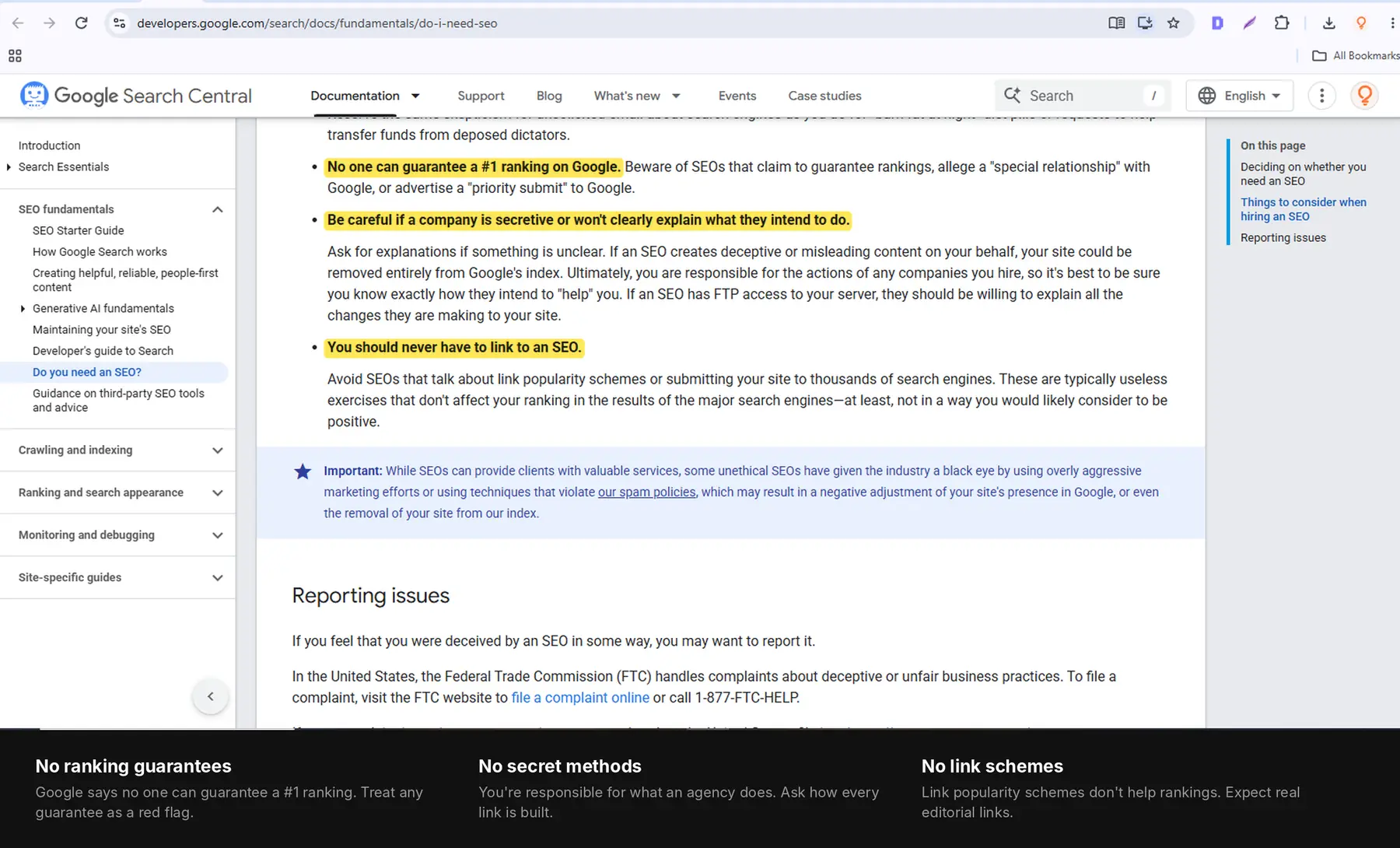
The clearest red flags are promises nobody can keep and details nobody will share. Ranking guarantees, hidden site networks, high link counts at low prices, and reports that list domains without context all point to the same problem: the agency is selling volume, and you carry the risk if it goes wrong.
| Red flag | Why it matters |
|---|---|
| Guaranteed rankings or guaranteed positions | No agency controls Google. Google’s own hiring guide states that no one can guarantee a #1 ranking, and tells you to find someone else if an SEO promises first place. |
| A “private network” they won’t name | Undisclosed networks are often PBNs. They work until they’re detected, then they become a liability. |
| Large link counts at very low prices | Real outreach takes hours per link. A low flat price usually means sites that publish anything for a fee. Google’s spam policies name automated link creation and low-value content made to carry links as link spam. |
| High DR for a suspiciously low price | Ahrefs says DR is purely link-based. It ignores search traffic and doesn’t filter spam, so low-quality links can push it up. A DR 70 site with little organic traffic is a warning, not a bargain. |
| Instant inventory in every niche | A ready list of thousands of sites suggests the same pages are sold to every client, relevant or not. |
| Exact-match anchor quotas | Google’s spam policies list optimized anchor text in guest posts and articles as an example of link spam. It’s also one of the easiest patterns to spot. |
| Long lock-in with no pilot | A confident agency lets you test the work before a long commitment. |
| Vague answers about publisher payments | Google allows paid links marked rel=”sponsored” or nofollow, but treats paid links that pass ranking credit as link spam. If they won’t say what publishers receive, you can’t judge your risk. |
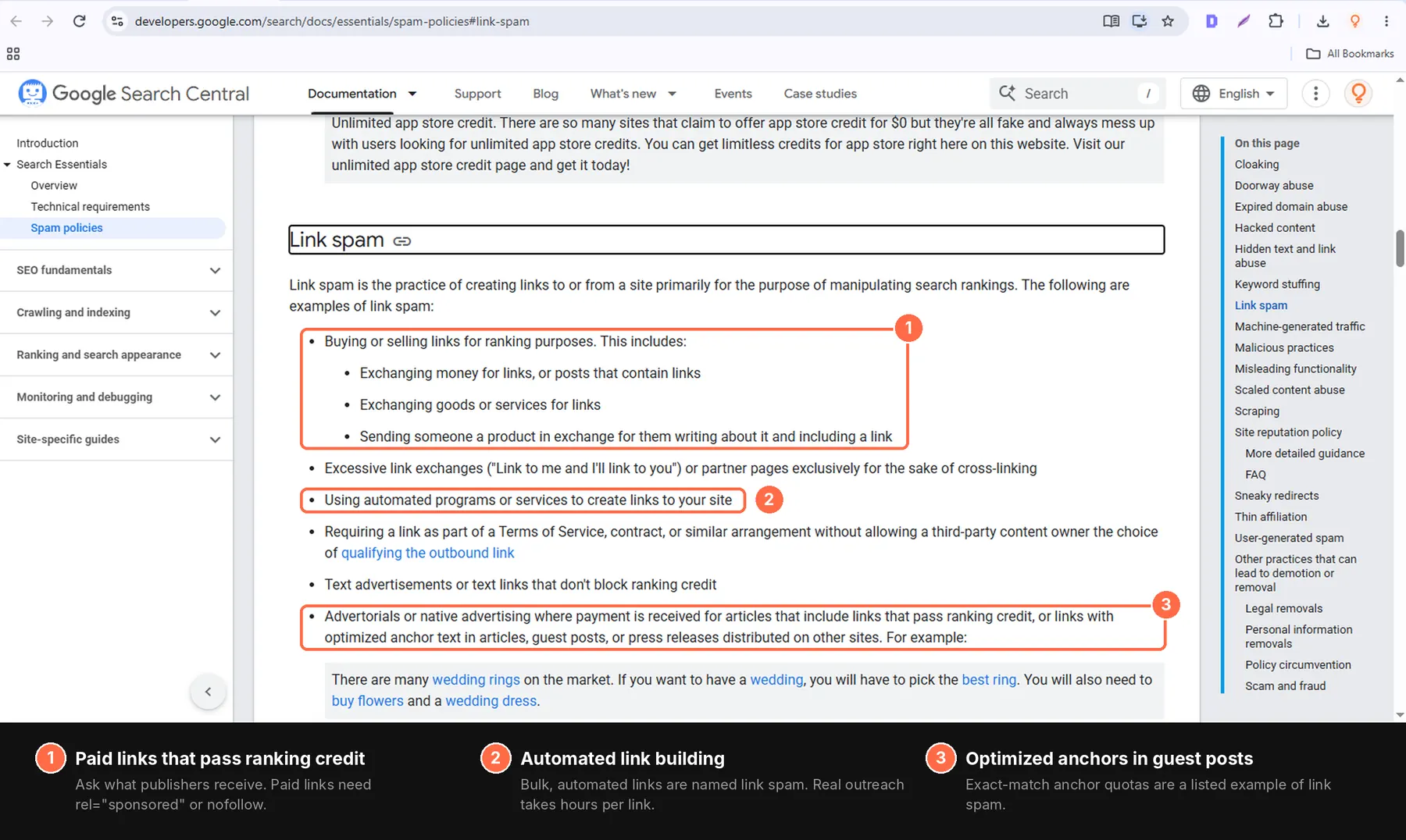
These flags cost money even without a penalty. Since its December 2022 link spam update, Google says its SpamBrain system detects sites that buy links and sites built to pass them, then neutralizes those links so any credit they passed is lost. A cheap link from a link-selling site may simply be worth nothing. One flag alone doesn’t always disqualify a vendor, but two or three together should.
8 Questions to Ask a Link Building Agency Before You Sign
Ask questions that force evidence, not adjectives. A good link building agency answers with examples, documents, and specific rules. Get the important answers in writing. Google’s guide to hiring an SEO warns against any provider that is secretive or won’t clearly explain its plan, and reminds site owners that they are responsible for the actions of the companies they hire.
| Question | A good answer sounds like | Walk away if |
|---|---|---|
| Can you show me five links you built in the last 90 days, in a niche close to mine? | Live URLs you can open, with context on why each site fit. | They only show logos, screenshots, or DR charts. |
| What was the last site you rejected, and why? | A specific reason: unrelated outbound links, falling traffic, poor content. | They can’t recall rejecting anything. |
| Which of our pages would you build links to first? | Named pages, with reasoning based on rankings, intent, and competitor gaps. | “Your homepage” or “wherever the publisher allows.” |
| Do publishers receive payment, and how do you handle it? | A straight answer about fees and how link attributes are handled. | They dodge the question or call it “proprietary.” |
| Can I approve each site and the content before publication? | Yes, with a clear approval step and timeline. | No inspection rights on a per-link contract. |
| What will the monthly report show? | Linking URL, target URL, anchor, attribute, date, cost, and status. | A count of links and a DR average. |
| What do I keep if I cancel? | A full export of links, content, and campaign records. | Access ends when billing ends. |
| What result would make you tell us to stop? | An honest answer about when links aren’t the bottleneck. | Every problem is solved by more links. |
How to Evaluate Link Building Methods and Their Risk
Evaluate methodology by asking how each link gets made, step by step, and matching the answer to the link types they sell. Guest posts, niche edits, digital PR, and resource page outreach all carry different levels of control, cost, and risk. A credible agency explains which method suits which page and why.
| Method | How it works | What to check |
|---|---|---|
| Guest posts | Original articles published on relevant sites, with a contextual link | Content quality, site relevance, how many guest posts the site runs |
| Niche edits (link insertions) | A link added to an existing, already-indexed article | The article’s topic match and traffic, and that the link fits the sentence |
| Digital PR | Data, stories, or expert commentary pitched to journalists | Past coverage quality, not just the number of links |
| Resource and broken link outreach | Getting listed on curated resource pages or replacing dead links | That the resource page is maintained and visited |
| Brand mentions | Getting your brand cited in relevant content | Context and accuracy of the mention, especially for AI search visibility |
Ask the agency to walk you through one recent link from start to finish: how they found the site, why they approved it, what they pitched, and what the publisher received. If the story is clear and repeatable, the method is real. The two formats you’ll be quoted most are guest posts and niche edits, and our guest posting vs niche edits breakdown compares their cost, speed, and risk.
Should a Link Building Agency Promise AI Search Visibility?
No. A link building agency can’t promise AI citations any more than it can promise rankings. Google’s spam policies now treat attempts to manipulate generative AI responses in Search as spam, and Google’s hiring guide tells you to check that any AEO or GEO advice matches its own guidance on optimizing for generative AI.
AI answers draw on the same open web where links and mentions live, so credible coverage still helps. Ask two things. Are brand mentions earned in real editorial content on sites your buyers trust? And how will the agency track your presence in AI Overviews, ChatGPT, or Perplexity? Treat that tracking as a trend to watch, not a guaranteed deliverable.
How to Audit a Sample Link Yourself in 10 Minutes
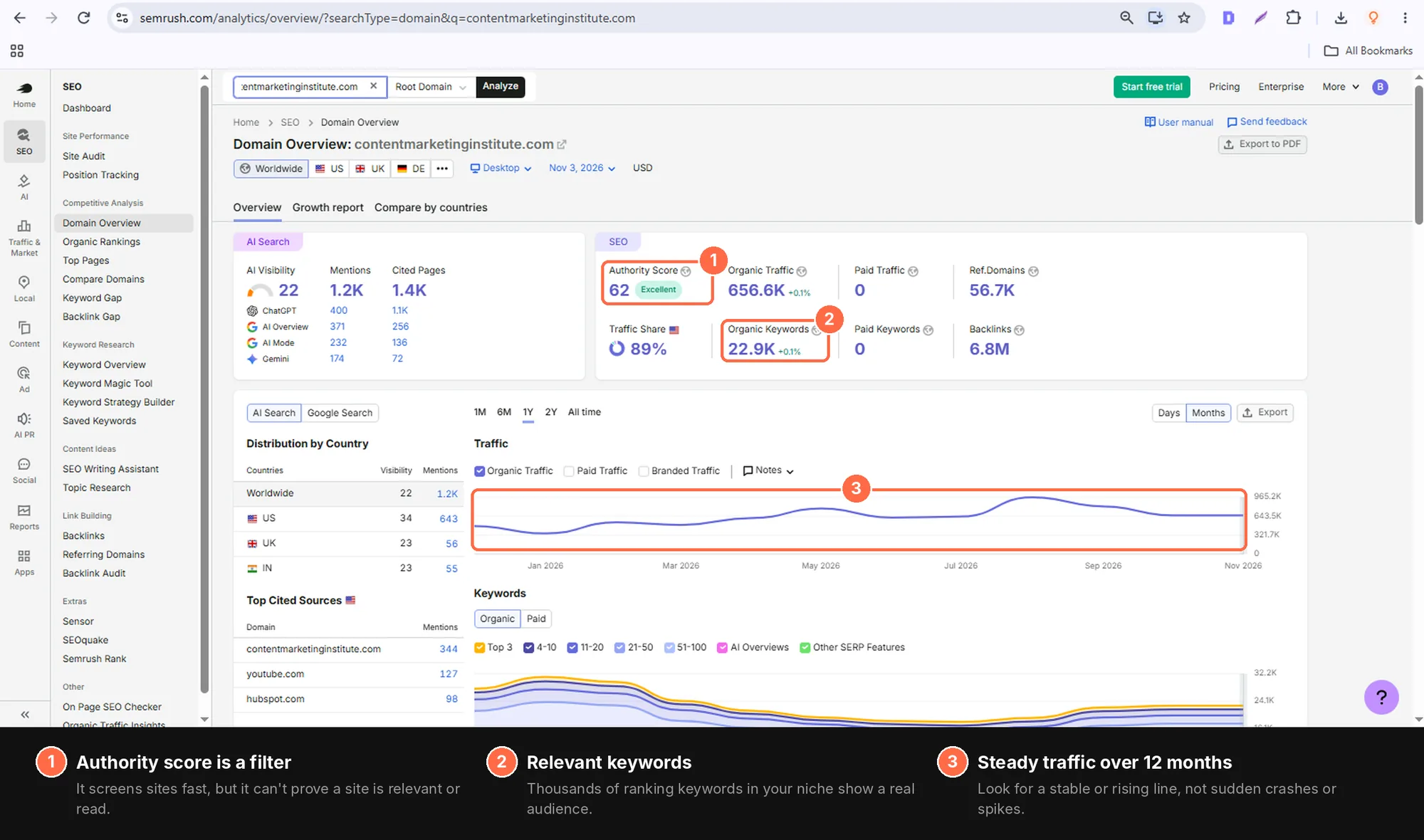
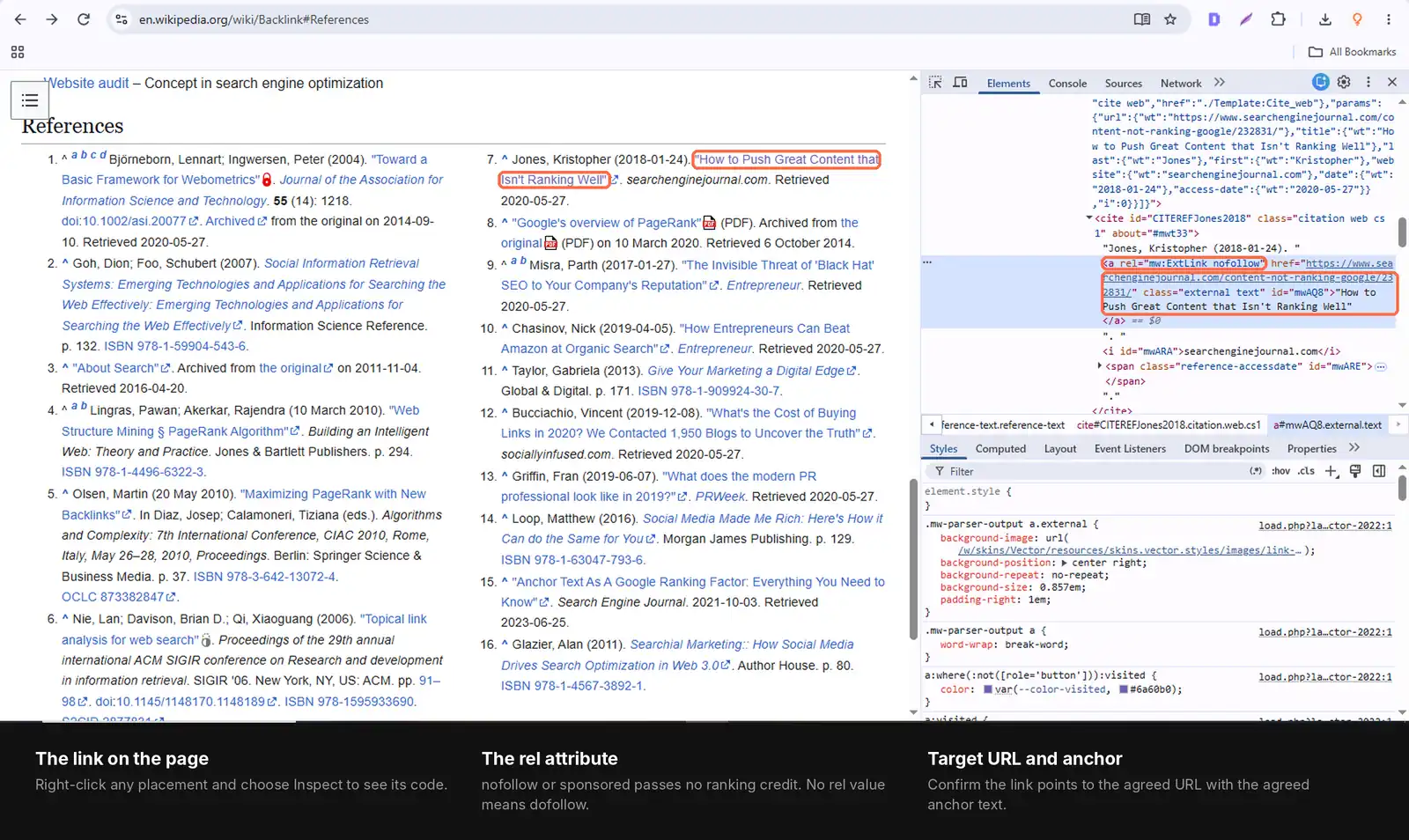
You don’t have to take a link building agency’s word on backlink quality. Open a sample link and run this 10-minute check, first on the agency’s samples before you sign and later on a sample of your own links:
- Read the page as a buyer would. If the articles exist only to hold links, so does the site.
- Check the organic traffic trend in Ahrefs or Semrush. Look for steady traffic from relevant keywords and countries, not sudden crashes or spikes.
- Scan what else the site links to. Casino, loan, and CBD links across unrelated posts usually mean the site sells to anyone.
- Look for sponsored-post footprints. A “write for us” page is fine. A price list or several guest posts a day is not.
- Check placement context. The link should sit in the body of a relevant article, not in an author bio or footer.
- Confirm the technical basics: the rel attribute, indexing, the agreed URL, and the agreed anchor.
For a deeper breakdown of each signal, see our guides to link quality and the metrics to check before getting a backlink.
Treat Metrics as Filters, Not Proof
Domain Rating and Domain Authority help you screen sites fast, but they don’t prove a site is relevant, read, or editorially sound. Ahrefs, which created DR, says it ignores search traffic and that large amounts of low-quality backlinks can raise it. Google adds that third-party SEO tools have no access to its internal ranking data. Metrics can disqualify a site, but they can’t qualify one alone. If a vendor quotes DA instead, our guide to Domain Authority vs Domain Rating explains the difference.
Our own floor is DR 30+ and 1,000+ verified monthly organic traffic in Ahrefs, plus niche relevance and an editorial review. Ask any vendor for its written minimums, then ask what happens to sites that pass the numbers but fail the review.
Free download: The 47-Point Guest Post Vetting Checklist
Score every site an agency proposes on traffic, relevance, editorial quality, and link-selling footprints, in one spreadsheet.
How to Judge Link Building Pricing in 2026
Judge pricing by the cost of each accepted, live, and retained link, not the headline price. A cheap quote that delivers irrelevant links costs more than a higher quote that delivers links you’d keep.
| Pricing model | How it works | What to watch |
|---|---|---|
| Per link | A fixed price per placement, often tiered by site metrics | Pricing tied only to DR rewards inflated metrics |
| Monthly retainer | A set fee for ongoing strategy, outreach, and a target number of links | What happens if the target isn’t met that month |
| Campaign or project | A fixed fee for a defined campaign, common in digital PR | Unclear link counts and success definitions |
| Performance-based | Payment tied to rankings or traffic | Incentives to use risky tactics for fast movement |
Three principles hold across every model:
- Know what the price covers: strategy, content, outreach, publisher fees, revisions, and reporting should all be listed.
- Pay on publication: for per-link work, pay when a link is live on an approved page, not when outreach starts.
- Compare link building packages like for like: match site standards, link types, and replacement terms before comparing prices.
For a benchmark, Editorial.Link’s 2026 survey of 518 SEO professionals put the average acceptable price for one high-quality link at $508.95, and the monthly budget for high-difficulty niches at $8,406. A link building agency ran it, and it measures what SEOs consider acceptable rather than what they paid. Still, a “DR 70 link for $20” offer sits so far below that range that it only works if the site sells to everyone.
For reference, our guest posts run from $69 (DR 20+) to $389 (DR 70+), and managed campaigns start at $499 a month. Digital PR links usually cost more, which pulls survey averages up.
11 Contract Terms to Get in Writing Before You Pay
A good contract turns an agency’s sales promises into terms you can enforce. If something mattered on the sales call, it belongs in the statement of work. Check that yours covers each of these:
- Deliverable: a link counts when it’s live, indexed, on an approved site, and pointing to the agreed URL.
- Approval rights: you see the site, topic, anchor, and target page first.
- Site standards: written minimums for traffic, relevance, and editorial quality.
- Link attributes: how follow, nofollow, and sponsored links are handled and priced.
- Replacement policy: coverage period, what counts as lost, and turnaround. Ours is six months.
- Billing: when you’re charged and what happens to fees for undelivered links.
- Ownership: you keep the content, link records, and reports after cancellation.
- Subcontracting: disclosure if outreach or writing is outsourced.
- Competitor conflicts: how they handle your direct competitors.
- Exit terms: notice period, fees, and work in progress.
- Pilot option: a short first term before any long commitment.
How to Run a Link Building Pilot Before You Commit
A pilot is a short paid test, usually one to two months, that checks a link building agency’s process before you sign a longer deal. Keep it small, use the standards you’d apply at full scale, and end with a written pass-or-fail review. Judge the process, not rankings.
- Use one brief: the same target pages, exclusions, approval rules, and reporting fields for every shortlisted agency.
- Limit the scope: two to four target pages and a budget you could lose without hurting the quarter.
- Approve every site: run the 10-minute audit on each proposal and reject freely. How the agency handles rejections is part of the test.
- Verify every live link: URL, anchor, attribute, placement context, and indexing.
- Score it: rate the pilot on the scorecard below, then scale, adjust, or stop.
Two months is too short for rankings to mean much. What a pilot can prove is if the agency delivers what it promised and accepts your standards without pushback. To see what a full campaign looks like afterward, read our link building case study.
How to Measure Link Building Results After You Hire
Measure link building in three layers: delivery, search performance, and business outcomes. Delivery shows in month one, search movement usually takes several months, and business results take longest. Before work starts, save a baseline for each target page: rankings, Search Console impressions and clicks, referring domains, and conversions.
| Layer | What to track | When it becomes meaningful |
|---|---|---|
| Delivery | Links live, on approved sites, with correct anchors and targets, still live after 90 days | From month one |
| Search | Rankings and impressions for target queries, referring domains vs. competitors | Usually months three to six |
| Business | Organic leads, sign-ups, or revenue from target pages, plus referral traffic | Usually month six onward |
Timelines vary with competition and site history, and our guide to link building timelines explains why. In one campaign we ran, CureMD grew from about 5K to 60K monthly organic visits and from DR 30 to DR 67 in six months. That’s one result, not a promise.
Keep your own link record. Agency dashboards end with the contract, and Search Console’s Links report shows only a sample of your links. A backlink monitoring tool checked monthly catches lost links early. By month six, if links are live and relevant but nothing has moved, the bottleneck may be content or competition, and a good agency will say so. If links vanish or land on sites you didn’t approve, the problem is the agency.
How to Re-Evaluate Your Current Link Building Agency
To re-evaluate a current link building agency, pull every link it built in the last six months and audit a random sample, not the examples it picks. Count how many are still live, followed, and pointing at the right page, then compare target-page results against your baseline. If the agency can’t produce a full list quickly, that’s your first finding.
Ask the vetting questions again, since processes and staff change. If you switch, request a full export before giving notice. Don’t rush to disavow old links: disavowing is for clear spam patterns or a manual action, not for links that are simply weaker than you’d like.
How to Choose a Link Building Agency With a Weighted Scorecard
The fairest way to choose a link building agency is to score every shortlisted vendor on the same criteria. Score each agency from 1 to 5 on each row, multiply by the weight, and add the totals. The scorecard keeps a confident sales call from outweighing weak evidence.
| Criterion | Weight | What earns a 5 | Agency A | Agency B | Agency C |
|---|---|---|---|---|---|
| Sample link quality | 25% | Recent live links pass the 10-minute check | |||
| Transparency of method | 15% | Clear, repeatable process; publisher payments disclosed | |||
| Strategy fit | 15% | Named target pages with reasoning | |||
| Approval and control | 10% | Site and content approval before publication | |||
| Pricing clarity | 10% | Every cost listed; pay on publication | |||
| Contract terms | 10% | Replacement policy, data export, pilot option | |||
| Reporting | 10% | Page-level records you keep | |||
| Communication | 5% | Fast, specific answers; a named point of contact |
Common Mistakes When Hiring a Link Building Agency
Most bad agency hires come from a handful of repeat mistakes. Each one is easy to avoid once you know to look for it:
- Buying on price per link. Low prices usually mean low standards.
- Approving sites on DR alone. A high score with no real traffic is a red flag.
- Sending every link to the homepage. Money pages and your best content need links too.
- Ignoring anchor text. Heavy keyword anchors are an easy pattern to detect.
- Skipping the baseline and the pilot. Without them, you can’t tell what changed or what you paid for.
- Expecting rankings in 30 days. Judge the early months on delivery.
FAQs About Choosing a Link Building Agency
How do you choose a link building agency?
Ask for recent live links in a niche close to yours and audit them yourself. Then confirm the agency’s method, approval rights, pricing breakdown, replacement policy, and exit terms in writing. Start with a one- or two-month pilot, and score every vendor on the same criteria before committing.
How much does a link building agency cost?
Link building costs depend on the pricing model, your niche, and site standards. Per-link pricing usually rises with site quality, while retainers cover ongoing strategy and outreach. Compare quotes by the cost per live, retained link on an approved site, not the headline price.
Are paid links against Google’s guidelines?
Google’s spam policies list buying or selling links for ranking purposes as link spam. The same page says paid links are fine when marked rel=”sponsored” or nofollow, because buying links for advertising is a normal part of the web. Ask any agency what publishers receive and how attributes are handled. Relevance, natural anchors, and sites with real audiences reduce risk. That’s what white hat link building looks like in practice.
Can a bad link building agency get my site penalized?
Yes. Google says sites that violate its spam policies may rank lower or disappear from results, through automated systems or a manual action. More often, Google’s systems simply neutralize the bad links, so the budget is wasted even when the site isn’t punished. Vetting sample links and keeping approval rights is the best protection.
What’s the difference between a link building agency and an SEO agency?
A link building agency focuses on earning links and mentions from other sites. A full SEO agency also covers technical SEO, content, and on-page work. If your site has technical or content gaps, fix those first or hire a partner that covers both.
Should I build links in-house or hire a link building agency?
Build in-house if someone on your team has the time to research, pitch, and follow up every week, and you have content worth linking to. Hire an agency when that capacity is missing or you need to move faster than one person can. Many teams do both: in-house for relationships and PR, an agency for steady outreach.
The Bottom Line on Choosing a Link Building Agency
Knowing how to choose a link building agency comes down to evidence over promises. Audit live samples, get the method and money flow in writing, start with a pilot, and judge results in layers. An agency that welcomes that scrutiny is usually the one worth hiring.
If you’d like to test us against this guide, our managed link building team will walk you through recent placements and how we vet every site.
