
Ecommerce link building is the work of earning backlinks to an online store so its category and product pages rank for buying-intent searches. It is harder than link building for a blog, because nobody wants to cite a product page for a $24 phone case.
This guide shows you how to do it anyway. You’ll get 15 ecommerce link building tactics grouped into five approaches: product-led outreach, digital PR, resource and guest-post links, broken link building, and supplier and community links. Each one comes with a store example and a realistic idea of what to expect.
You’ll also learn which pages should receive your links, how to measure ecommerce link building results, how to plug the link equity your store already leaks, and which risky tactics to avoid. The guide ends with a 7-day plan you can start on Monday.
Table of Contents
What Is Ecommerce Link Building?
Ecommerce link building is the process of earning links from other websites to an online store, with the goal of ranking category and product pages for commercial searches. Because product pages rarely attract links on their own, stores earn links to linkable pages first, then pass that authority to money pages through internal links.
Three things make link building for ecommerce harder than for other sites:
- Product pages give writers no reason to cite them. A blogger links to a source that proves a point. A product page sells, so it rarely proves anything.
- Store URLs are unstable. Products sell out, get discontinued and get replaced. Every deleted URL with backlinks is authority thrown away.
- Most “natural” store links carry no ranking value. Affiliate links, influencer links and marketplace listings are usually tagged nofollow or sponsored.
The working model for ecommerce link building is a relay. You earn links to assets people want to cite, such as buying guides, tools, data and partner listings. Then your internal links carry that authority to the category and product pages that make money.
Why Ecommerce Link Building Matters in 2026
Ecommerce link building still decides which stores win competitive category searches, because most stores in a niche have similar product pages, prices and schema. Links also shape which brands AI shopping answers name, since those systems lean on sources that trusted sites already cite. A store without links competes on ad spend alone.
Here is what earned ecommerce backlinks do for a store:
- They lift category pages. Category pages target the highest-value searches, like “women’s trail running shoes.” They are also the pages most stores starve of authority.
- They put your brand in AI answers. When ChatGPT, Perplexity or Google AI Overviews list “best” products, they draw on roundups, reviews and editorial pages. Earning brand mentions on those pages is how you get in.
- They send buyers, not just rankings. A link in a gift guide or on a stockist page sends visitors who already want to buy.
- They lower your paid dependence. Organic category traffic keeps coming after a campaign budget runs out.
Stores that win treat ecommerce link building as an asset that compounds. Stores that lose run a 60-day push, see no change, and stop right before it starts working.
Where to Point Your Ecommerce Links: Choosing Target Pages
Point most of your ecommerce links at category pages and linkable content, not at the homepage or individual products. Category pages target the biggest commercial searches and survive product changes. Content assets attract links naturally and pass authority down. Product pages deserve links only when the product is a stable hero item.
| Page type | Link value | Lifespan risk | Best tactics | Anchor text to use |
|---|---|---|---|---|
| Category / collection pages | Highest: target head commercial terms | Low | Roundups, stockist pages, guest posts, niche edits | Partial match (“trail running shoes for women”) and branded |
| Buying guides and content hubs | High: earn links passively, pass equity to categories | Very low | Resource pages, broken links, digital PR | Topic phrases and branded |
| Tools (size finder, calculator) | High: get embedded and cited | Very low | Resource pages, blogger outreach | Tool name |
| Hero product pages | Medium: good for branded product searches | Medium | Reviews, product seeding, gift guides | Product name |
| Homepage | Low for rankings: brand signal only | None | Partner directories, sponsorships, press | Brand name, naked URL |
| Seasonal / promo pages | Medium, if the URL is permanent | High if the URL changes yearly | Deal sites, discount communities | Offer name |
Two rules make this framework work:
- Every content asset links down to its category. A trail shoe buying guide should link to the trail shoe category in its first screen, with a descriptive anchor.
- Keep exact-match anchors rare. Keep most anchors branded, naked or descriptive. Our guide to anchor text mix covers the ratios.
Fix Link Leaks Before You Start Ecommerce Link Building
Most established stores already have backlinks pointing at pages that return 404 errors, redirect to the homepage, or split across duplicate URLs. Recovering that equity costs nothing and often moves rankings faster than new links. Audit and fix these leaks before your ecommerce link building outreach begins.
Start every ecommerce link building audit in Ahrefs: Site Explorer, then Best by links, then filter the HTTP code to 404 and 3XX. Sort by referring domains. Every row is a link you earned and are wasting.
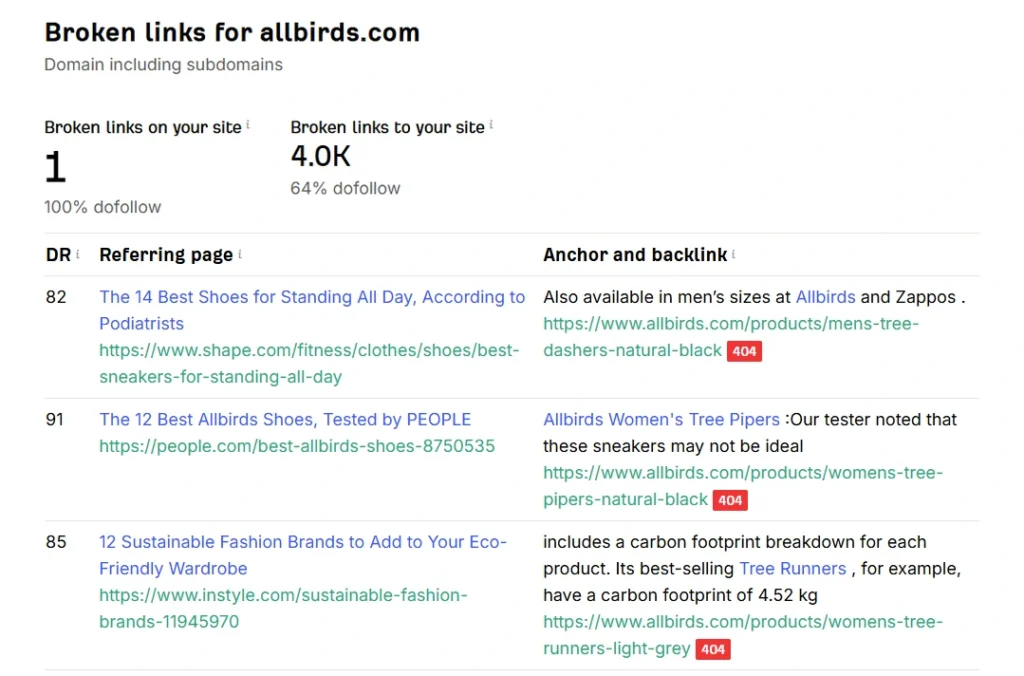
1. Discontinued products. Redirect each dead product URL that has backlinks to its closest replacement, or to the parent category if there is none. Never send them all to the homepage: Google often treats those redirects as soft 404s, so the links stop counting. If the old page still gets search traffic, keep it live with a “no longer available” note and links to alternatives. Even big brands get this wrong. Roundups on People (DR 91), InStyle (DR 85) and Shape (DR 82) still link to Allbirds product pages that were discontinued and now return 404 errors. Each one is an editorial link the store already earned and is now wasting.
2. Out-of-stock pages. Never delete or 404 a temporarily sold-out product. Keep the page live, show a restock date or an email alert, and link to similar items.
3. Year-stamped seasonal URLs. /black-friday-2025/ loses its links when you build /black-friday-2026/. Use one permanent URL like /black-friday/ and update the page each year.
4. Duplicate product URLs. On many Shopify themes, a product loads at both /products/item and /collections/category/products/item. Bloggers copy whichever URL they land on. Check that both canonicalize to /products/item, and point your internal links at that version.
5. Filter and tracking URLs. Links to ?color=blue or ?utm_source= versions split authority. Make sure filtered and tracked URLs canonicalize to the clean category or product URL.
6. Migration gaps. If you moved platforms, say from WooCommerce to Shopify, crawl the old URL list from your backlink tool. Any old URL with links and no redirect is a leak.
Ecommerce Link Building Strategies: 15 Tactics by Approach
The ecommerce link building strategies below fall into five approaches. Product-led outreach and supplier links use relationships you already have and land fastest. Digital PR and broken link building take weeks. Resource and guest-post links scale over months. Start with the fast approaches, then layer in the slower ones once early links are landing.
Product-Led Outreach for Ecommerce Link Building
Product-led outreach uses the products themselves as the reason to link: samples, photos, reviews and roundup inclusion. It suits stores with distinctive products and works best when you pitch the writers who already cover your category.
1. Get into best-of roundups and gift guides
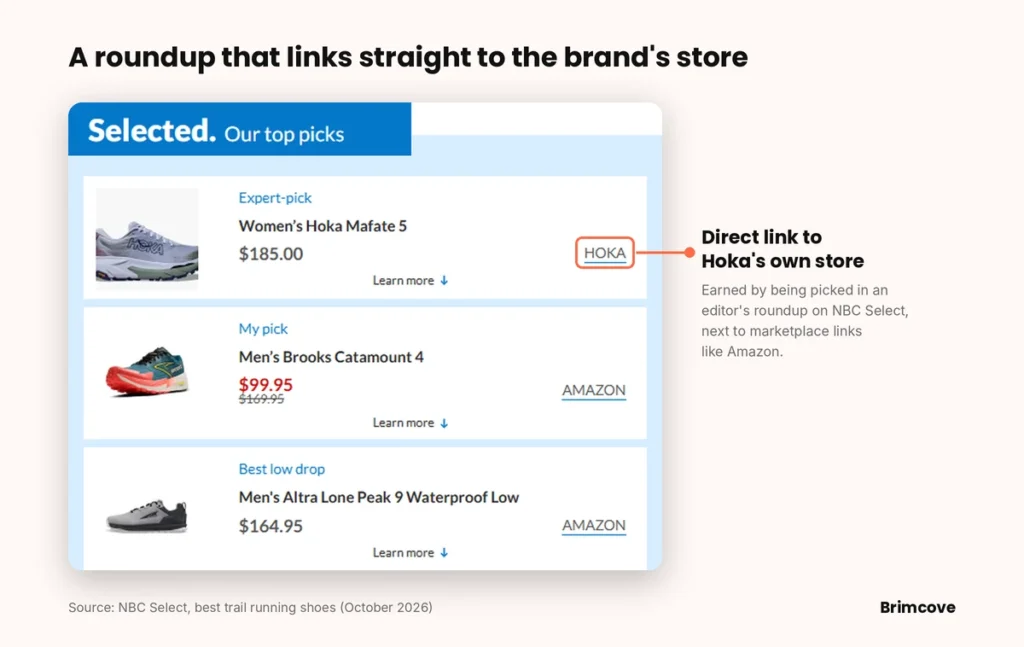
For ecommerce link building, roundups like “best standing desks” or “gifts for coffee lovers” are where buyers and AI answer engines look for product picks. Being on them matters even when the link is an affiliate link.NBC Select’s trail running shoe roundup is a good example: Hoka’s Mafate 5 links straight to Hoka’s own store, while other picks link to Amazon.
Search “best [product] 2026” and “[niche] gift guide” and list every page on the first two results pages. Email each author with what makes your product different, the price, a high-resolution image and a sample offer. Ask to be added to existing roundups too, since writers refresh them every year. Pitch holiday gift guides by late summer, when editors start building them. If you need this done at scale, our blogger outreach team runs these pitches for stores.
Example: A small-batch hot sauce brand pitches “gifts for foodies” authors with a three-bottle sampler and one line on what makes each sauce different.
Realistic expectations: Most pitches get no reply. Expect a small share of authors to request samples and fewer still to add you, often with an affiliate or nofollow link. The payoff is buyer traffic and AI answer visibility more than raw link equity.
2. Seed products with creators, the compliant way
Product seeding still has a place in ecommerce link building, but Google asks reviewers to disclose free products and tag those links nofollow or sponsored. Treat seeding as a mention and review engine, not a dofollow link source.
Example: A cycling apparel store sends rain jackets to five cycling bloggers before winter, with no conditions beyond an honest review.
Realistic expectations: Expect disclosed, nofollow links and social posts. The value comes later: reviews feed AI shopping answers and branded searches, and any unprompted mention in a creator’s future “best of” list is an earned editorial link.
3. Reverse image search your product photos
Reverse image search is an underused ecommerce link building tactic. Bloggers, Pinterest accounts, resellers and listicles reuse store product photos constantly, usually with no credit. Run your 20 most-used product and lifestyle images through Google Lens and TinEye. For every page using a photo without a link, ask for an image credit link to the matching product or category page.
Example: A furniture store finds its lifestyle photo of an oak dining table on three interior design blogs and asks each one to credit the image with a link to the dining tables category.
Realistic expectations: Reply rates are higher than cold outreach because you own the photo. Expect a handful of links from your first audit, then a slow trickle as you repeat it each quarter.
4. Reclaim unlinked brand and product mentions
Sites that already wrote about you are the easiest yes in ecommerce link building. Search your brand name and your best-selling product names in Ahrefs Content Explorer, exclude your own domain, and use the “highlight unlinked” option. Set Google Alerts for the same terms, then send a two-line email asking for the link.
Example: Set an alert for a product name like “Allbirds Tree Runner”, and Google Alerts surfaces reviews on sites like RunRepeat and MindBodyGreen. Open each one and check whether the product name links to the store. If it doesn’t, email the editor and ask them to add the link.
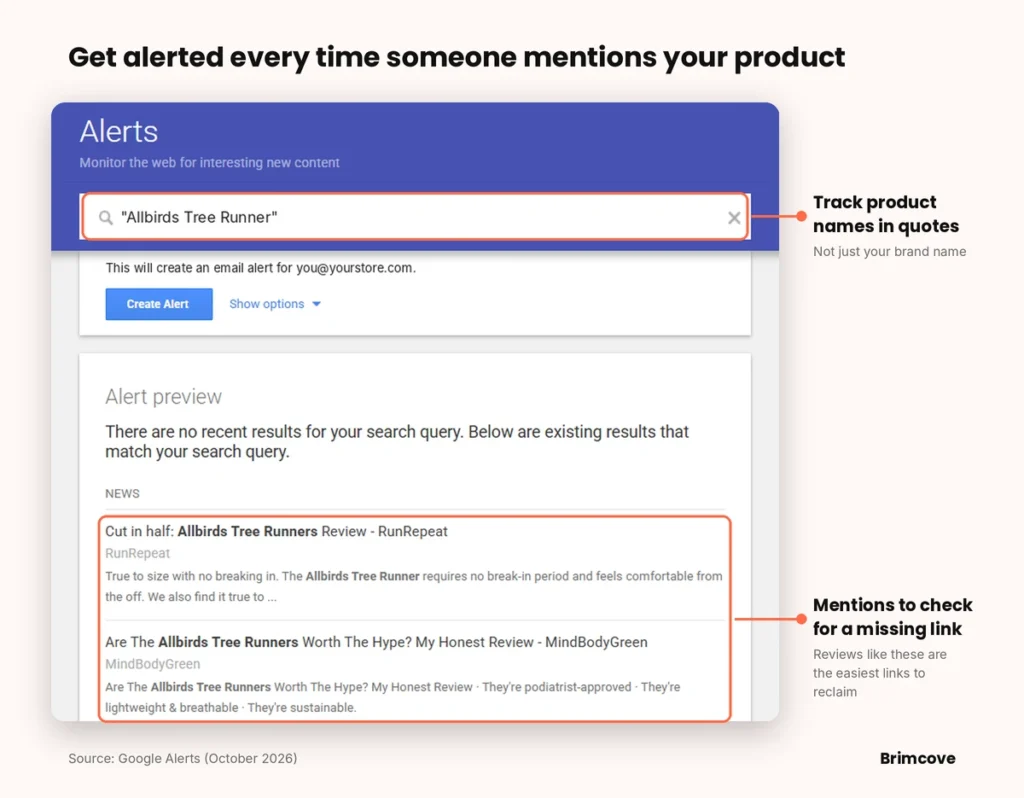
Realistic expectations: This is the highest conversion rate in link building for ecommerce, because the writer already chose to mention you. Volume depends on brand awareness: newer stores find few mentions. Our link reclamation guide includes email templates.
Digital PR for Ecommerce Brands
Digital PR is the highest-ceiling form of ecommerce link building. It earns links from news sites and trade publications by giving journalists something worth covering: data, expert commentary or a newsworthy program. It produces the strongest ecommerce backlinks, but it needs a real story, not a product announcement.
5. Publish data only your store has
For ecommerce link building, your order data is a story no competitor can copy. Think about which sizes sell out first, which regions buy what, which products get returned and why, or how buying shifts by season. Package one finding as a short report with a single chart, then pitch it to trade publications and regional press. Share aggregated numbers only, never customer-level data.
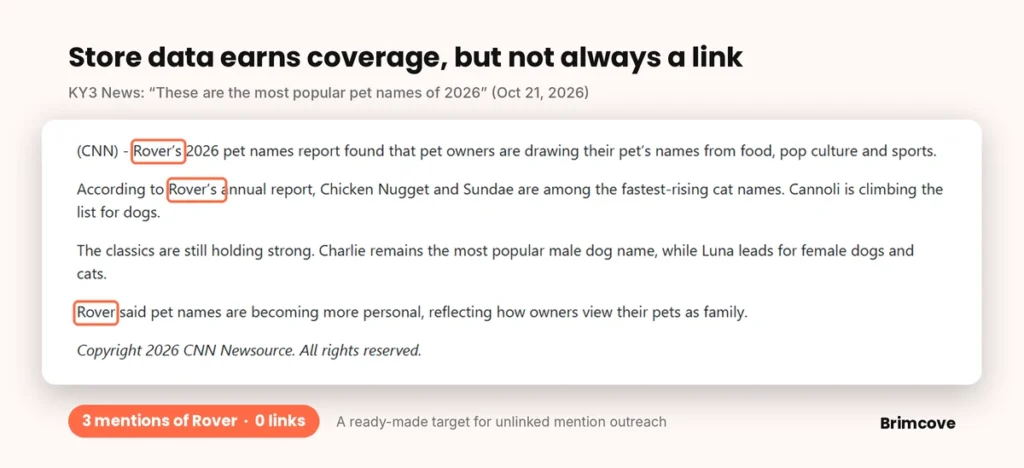
Example: Rover publishes the year’s most popular pet names every October, and news sites across the US cover it. KY3’s story names Rover three times without linking to it, which makes it an easy reclamation target for tactic 4.
Realistic expectations: Most data stories get little pickup. One that lands can earn links from several outlets in a single news cycle. Plan two or three attempts a year rather than betting on one.
6. Answer journalist requests with store data
Journalists post requests for expert sources every day on platforms like Qwoted and Featured. Stores have an edge because they can answer with real sales behaviour, not opinions. Filter requests for your category, reply within a few hours, and lead with one specific number.
Example: A shoe store answers a reporter writing about wide-fit footwear with how its returns changed after adding a fit quiz.
Realistic expectations: Expect a low hit rate. Plan on many replies for each published quote, and accept that some quotes appear without a link. Our HARO alternatives roundup lists the platforms worth joining.
7. Launch programs worth covering
Student, military, teacher and healthcare worker discounts earn links from university pages, community sites and discount directories. So do recycling, repair and trade-in programs. Give each program its own permanent URL with clear eligibility rules, then email the communities that serve that audience.
Example: An outdoor gear store launches a repair program for worn jackets and pitches it to hiking clubs and sustainability blogs.
Realistic expectations: Links arrive slowly but last for years, since a permanent program page stays relevant. Expect discount directories to link first and editorial coverage to depend on how distinctive the program is.
Resource and Guest-Post Link Building for Online Stores
Resource and guest-post link building earns links to useful content: guides, tools and articles placed on niche sites. It is the most scalable approach to ecommerce link building, because one strong asset can earn links for years and guest posts can be planned month by month.
8. Build buying guides that link to categories
A buying guide is the bridge between what people link to and what you sell. Writers cite a guide on choosing mattress firmness, then the guide links down to your mattress category. Make guides worth citing with comparison tables, real specs, your own photos and notes from testing products in-house. Our guide to linkable assets covers formats that earn links on their own.
Example: REI’s trail-running shoe buying guide explains cushioning, heel-to-toe drop and lug patterns. Its cushion section links straight to REI’s minimal, moderate and maximum cushion shoe categories.
Realistic expectations: Guides are a slow but durable ecommerce link building asset and rarely earn links in their first month. Expect links to build over three to six months once the guide ranks and you promote it through resource outreach.
9. Create tools and fit finders
Tools get embedded and cited because they solve a problem in seconds. A jewellery store can offer a printable ring sizer, a paint store a coverage calculator, and an HVAC parts store a room BTU calculator. Build one tool tied to your biggest category, then pitch it to bloggers who write about that problem.
Example: A paint store builds a “how much paint do I need” calculator and pitches it to home improvement bloggers who write room makeover posts.
Realistic expectations: A good tool can keep earning links passively for years, but it costs more to build than an article. Validate demand first by checking that people search for the problem it solves.
10. Pitch resource pages
Resource pages are a steady ecommerce link building source: many blogs, schools and associations keep pages of useful links for their readers. Search strings like “[topic] intitle:resources” or “[topic] useful links” to find them, then pitch your guide or tool, not your store. Our resource page link building guide walks through the full process.
Example: A gardening store pitches its seed-starting calendar to community garden associations that list growing resources.
Realistic expectations: Conversion is modest and depends on how well your asset fits the page. Personal, specific pitches convert far better than templates.
11. Place vetted guest posts and niche edits
In competitive categories, earned tactics alone rarely keep pace with stores that have years of links. Editorial guest posts and niche edits on real niche sites close that gap, as long as vetting is strict:
- 1,000+ monthly organic visitors, verified in Ahrefs, with a stable or rising trend
- DR 30 or higher, but relevance ranks above DR
- Topically related to your products or your buyers
- Link sits inside editorial body copy, not a footer, sidebar or author bio
- Permanent, dofollow placement
- No “write for us, any topic” footprint or pages full of unrelated outbound links
Example: A baby products store places a guide on safe sleep setups on a parenting blog with real readership, linking to its crib category.
Realistic expectations: This is the most predictable ecommerce link building tactic for volume and timing, with placements live within weeks. Ranking impact still depends on site quality and relevance. Our list of metrics to check before getting a backlink goes deeper.
Broken Link Building for Ecommerce Sites
Broken link building finds links pointing to dead pages and offers your live page as the replacement. It is a reliable ecommerce link building tactic for stores because competitors constantly discontinue products and leave linked 404 pages behind.
12. Replace competitors’ dead product pages
Put a competitor into Ahrefs Site Explorer, open Best by links, and filter for 404 pages. Check what each page sold using the Wayback Machine. Then email the linking sites: their link is broken, and your equivalent category page is live. Point these links at a category page where possible, since categories outlast single products.
Example: A camping store finds a competitor’s discontinued tent page still linked from six camping blogs, and offers its tent category as the working replacement.
Realistic expectations: Replies beat most cold ecommerce link building outreach because you are fixing a problem for the editor. Expect a minority of sites to swap the link, and some to remove it without adding yours.
13. Fix broken links on niche resource pages
Resource pages decay too. Run niche resource pages through a broken link checker such as the Check My Links browser extension or Ahrefs, and note any dead links on topics your guides or tools cover.
Example: A home brewing store finds a dead link to a defunct hydrometer guide on a homebrew club’s resource page and offers its own hydrometer guide.
Realistic expectations: Each page yields only one or two opportunities, so this is a steady side tactic, not a volume engine. It pairs well with tactic 10.
Supplier, Manufacturer and Community Links
Supplier, manufacturer and community links come from businesses and groups you already work with. They are unique to ecommerce, need no cold outreach, and often land within days, which makes them the best starting point for ecommerce link building at most stores.
14. Get listed by suppliers, manufacturers and stockists
- If you make your own products, retailers that stock you often run brand pages or “brands we carry” lists. Ask your account contact to add a link.
- If you resell other brands, many brands publish “where to buy” or “authorized retailers” pages. Ask each brand rep to list your store.
- If you use suppliers, fabric mills, packaging makers and ingredient suppliers often showcase customers. Offer a short testimonial in exchange for a listing.
Example: An independent bike shop that stocks four brands asks each brand rep to add it to the brand’s dealer locator page.
Realistic expectations: These are the quickest wins in ecommerce link building, because they are warm asks and most get answered. Many stores find several of these links within the first two weeks, often from strong domains.
15. Join partner directories and sponsor communities
Shopify app developers, theme makers, payment providers, 3PLs and review platforms publish customer showcases. Local clubs, school teams and charity events link to their sponsors. Pick partners and communities your buyers actually care about.
Example: A running store writes a short case study for its inventory app’s customer showcase and sponsors a local running club at the entry tier.
Realistic expectations: Partner case studies take a few weeks to publish. Sponsorship links are near-certain once you pay, so confirm the sponsor page includes a link first.
Ecommerce Link Building Tactics Compared
The fastest ecommerce link building tactics use existing relationships: unlinked mentions, image credits, stockist pages and partner directories often land within two weeks at almost no cost. Content assets and data stories take months to pay off but keep earning links without new outreach. Use the table to match tactics to your time and budget.
| Tactic | Approach | Typical time to first link | Effort | Best target page |
|---|---|---|---|---|
| 1. Roundups and gift guides | Product-led | 2 to 8 weeks | Medium | Product, category |
| 2. Product seeding | Product-led | 2 to 6 weeks | Medium | Product (mentions) |
| 3. Image credits | Product-led | Days | Low | Product, category |
| 4. Unlinked mentions | Product-led | Days | Low | Homepage, product |
| 5. First-party data | Digital PR | 1 to 3 months | High | Report page |
| 6. Journalist requests | Digital PR | 2 to 8 weeks | Medium | Homepage, guide |
| 7. Program pages | Digital PR | 2 to 6 weeks | Low | Program page |
| 8. Buying guides | Resource / guest post | 2 to 6 months | High | Guide, then category |
| 9. Tools and fit finders | Resource / guest post | 2 to 6 months | High | Tool, then category |
| 10. Resource pages | Resource / guest post | 2 to 6 weeks | Medium | Guide, tool |
| 11. Guest posts and niche edits | Resource / guest post | 1 to 4 weeks | Low if outsourced | Category, guide |
| 12. Competitor dead pages | Broken link | 2 to 6 weeks | Medium | Category |
| 13. Broken resource links | Broken link | 2 to 6 weeks | Medium | Guide, tool |
| 14. Supplier and stockist links | Supplier / community | 1 to 2 weeks | Low | Homepage, category |
| 15. Partners and sponsorships | Supplier / community | 1 to 4 weeks | Low | Homepage |
Timings are typical ranges from practice, not guarantees. A store with little brand recognition should expect the slower end.
How to Measure Ecommerce Link Building Results
Measure ecommerce link building at the page level, not the domain level. Track new referring domains to your target pages, their average position in Google Search Console, and the organic revenue those pages bring in GA4. Domain Rating can climb while category revenue stays flat, so treat DR as a side metric only.
| Metric | Where to find it | What good looks like |
|---|---|---|
| Referring domains to each target page | Ahrefs or Semrush, filtered by URL | Steady monthly growth, no sudden spikes |
| Average position for target pages | Google Search Console, Pages report | Positions 5 to 20 moving toward the top 5 |
| Organic revenue by landing page | GA4, landing page report filtered to organic | Rising revenue on target categories |
| Branded search impressions | Google Search Console, brand queries | Growth after roundups, PR and seeding |
| AI answer mentions | Manual checks in ChatGPT, Perplexity and Google AI Overviews | Your brand named for your top “best [product]” prompts |
Record a baseline before your first ecommerce link building campaign starts, then review monthly. Most new links take weeks to be crawled and counted, and ranking movement usually shows over three to six months. Our guide to link building timelines breaks down each stage.
Risky Ecommerce Link Building Tactics That Lead to Penalties
The riskiest ecommerce link building tactics are the ones that look manufactured: private blog networks, link farms, bulk directory blasts, sitewide footer links and formal link swaps. Google’s spam policies target links placed to manipulate rankings, and a manual action can drop category pages out of search until you clean up.
Avoid these ecommerce link building shortcuts:
- Private blog networks and link farms. Sites built only to sell links, with no real readers, are the clearest spam signal.
- Bulk directory and profile submissions. Hundreds of low-quality directory or forum profile links in a week look automated.
- Sitewide footer and sidebar links. A “powered by” or partner link on every page of another site rarely looks editorial.
- Formal link exchanges. “You link to me, I link to you” deals are a pattern Google watches for. A supplier listing you because you are a customer is fine.
- Undisclosed paid reviews. Free products or payments given for reviews need disclosure and a nofollow or sponsored tag.
- Exact-match anchor overload. A profile full of “buy cheap running shoes” anchors looks bought.
- Link velocity spikes. Dozens of links arriving in days after months of nothing invites scrutiny.
If you inherit a bad profile, audit it in Ahrefs or Semrush, ask for removal where you can, and use Google’s disavow tool only for clearly spammy links you cannot remove.
When to Outsource Ecommerce Link Building
Outsource ecommerce link building when your target categories need more links than your team can earn in-house, or when nobody owns outreach week to week. Keep warm tactics like supplier links in-house, since partners know you. Hand off prospecting, vetting and placement, where a specialist team moves faster and protects your link profile.
Signs it’s time to bring in help:
- Your target categories sit on page two and competitors have several times your referring domains.
- Outreach happens in bursts, then stops for months.
- Nobody on the team can vet a site for real traffic and relevance.
- You run multiple stores or regions and need links in more than one market.
At Brimcove, our managed link building service handles this end to end. Every placement is manual, every site is vetted for real organic traffic and niche relevance, and every link carries a 6-month replacement guarantee. Managed ecommerce link building plans start at $499 a month. See how we approach online stores in our ecommerce SEO case study.
Your Next Step: Start Ecommerce Link Building This Week
The best next step is a 7-day ecommerce link building sprint: fix leaks, pick target pages and send your warmest asks before anything else. Recovered links and warm contacts produce results while slower tactics are still being built. By day seven you should have a leak report, five target categories and 30 to 50 outreach emails sent.
- Day 1: Audit leaks. Export 404 and redirected pages with backlinks from Ahrefs. Map each one to a replacement or parent category and hand the redirect list to your developer.
- Day 2: Pick target pages. Choose five category pages sitting in positions 5 to 20 in Google Search Console. These are your link targets for the next quarter.
- Day 3: Reclaim mentions and images. Run brand, product and reverse image searches. Send a short credit request for every unlinked mention.
- Day 4: Email your partners. List every supplier, retailer, brand and software tool you work with. Send one warm email per partner asking for a listing or case study.
- Day 5: Build the roundup list. Find 30 best-of articles and gift guides for your top categories. Pitch the 10 most relevant with a sample offer.
- Day 6: Mine competitors. Pull your top two competitors’ broken pages and referring domains. Add sites that link to both competitors but not to you to your prospect list.
- Day 7: Plan one asset. Pick one buying guide, tool or data story tied to your top category. Brief it so it ships within 30 days.
After week one, keep a weekly rhythm of outreach, mention checks and progress on your content asset. Consistent ecommerce link building beats bursts every time. If you’d rather hand off the outreach, book a free consultation with our team.
FAQs About Ecommerce Link Building
How do you build backlinks for an ecommerce website?
Start with links you can recover: fix 404 pages that have backlinks and claim unlinked brand mentions. Then ask suppliers, retailers and software partners for listings. Add roundup outreach, digital PR and one strong buying guide or tool, and send most links to category pages.
What is the best ecommerce link building strategy for a new store?
Supplier, manufacturer and partner links come first, because they are warm asks that land fast. Add roundup outreach and one buying guide next. Save data-led digital PR until you have enough order data to tell a real story.
Can you build links directly to product pages?
Yes, but only for stable hero products. Most product pages change or disappear, so their links are at risk. Build links to category pages and guides, then use internal links to pass authority to products.
How many backlinks does an ecommerce store need?
There is no fixed number. Check the referring domains of the pages ranking in the top five for your target category term. That count, filtered for relevant sites, is your ecommerce link building benchmark.
How long does ecommerce link building take to work?
Quick wins like reclaimed mentions can land in days. Ranking movement for category pages usually shows over three to six months of steady work, and keeps building after that.
Do affiliate and influencer links help ecommerce SEO?
They rarely pass direct ranking value, since most are tagged sponsored or nofollow. They still drive sales, build branded searches and help your brand appear in AI shopping answers.
How much does ecommerce link building cost?
Many ecommerce link building tactics in this guide cost only time. Outsourced editorial placements cost $69 to $389 per guest post at Brimcove, depending on site authority. Managed programs run from $499 to $5,000 a month.
Is it safe to pay for links to an online store?
Google’s spam policies target links placed purely to manipulate rankings. Risk drops when placements sit on real sites with real traffic, relevant topics and genuine editorial content. Link farms and private blog networks remain unsafe at any price.
