
Your CFO wants one number: what did AI search return on the money you spent? Most teams can’t answer that yet. They track rankings and clicks, while buyers ask ChatGPT, Gemini and Perplexity for a shortlist and never see a results page.
GEO ROI measurement fixes that gap. It ties AI visibility (mentions, citations and share of voice) to AI referral traffic, then to leads and revenue. In this guide, you’ll get the exact KPIs, a GA4 setup you can copy, a full ROI formula with a worked example, and a reporting cadence leadership will accept.
We built this from the way we measure brand mention and link campaigns at Brimcove. No vanity metrics and no made-up multipliers.
Key takeaways
- GEO ROI = (AI-sourced revenue + discounted AI-influenced revenue − GEO cost) ÷ GEO cost × 100.
- Track four layers: visibility, traffic, engagement and revenue. Skip one and the chain breaks.
- GA4 undercounts AI visits. Pair it with prompt tracking and self-reported attribution.
- Third-party pages (reviews, roundups, editorial features) drive most AI citations on buying queries, so measure them like paid placements.
- Expect visibility gains in 4 to 8 weeks and revenue proof in 3 to 6 months.
Want AI tools to recommend your brand? Our brand mention service earns citations on the sites ChatGPT, Gemini and Perplexity already trust.
Table of Contents
What Is GEO ROI Measurement?
GEO ROI measurement is the process of linking your generative engine optimization spend to business results. It tracks how often AI tools mention and cite your brand, how many visits those answers send, how those visitors convert, and how much revenue follows. The output is one ratio: return per dollar invested.
GEO (generative engine optimization) is the work of getting your brand named and cited inside AI answers. That covers ChatGPT, Gemini, Perplexity, Claude, Copilot and Google AI Overviews.
ROI is the familiar part. The hard part is the chain in between. A buyer can read an AI answer, remember your name, and search for you on Google two days later. No referral tag survives that trip. Good GEO ROI measurement captures both the direct clicks and that indirect pull.
GEO ROI vs SEO ROI
| Factor | SEO ROI | GEO ROI |
|---|---|---|
| Main visibility signal | Keyword rank (1–10) | Mention rate, citation rate, share of voice |
| Click data | Google Search Console | GA4 referrals (partial) |
| Impression data | GSC impressions | Prompt tracking (sampled) |
| Typical attribution | Last click, organic channel | Referral + branded lift + self-reported |
| Volume | High | Low, but higher intent |
| Result stability | Fairly stable | Answers vary per run and per platform |
Why GEO ROI Is Harder to Measure (and Why It’s Worth It)
GEO ROI is harder to measure because AI answers often create zero clicks, many AI visits arrive with no referrer, and answers change from one run to the next. It’s worth the effort because the traffic that does arrive converts far better than standard organic visits, so a small volume can carry real revenue.
Here’s what makes it tricky:
- Low volume. Ahrefs tracked 74,752 websites and found AI chatbots sent just 0.28% of total web traffic in March 2026.
- Zero-click answers. Many buyers read the AI answer and act without clicking. Your influence is real but invisible in analytics.
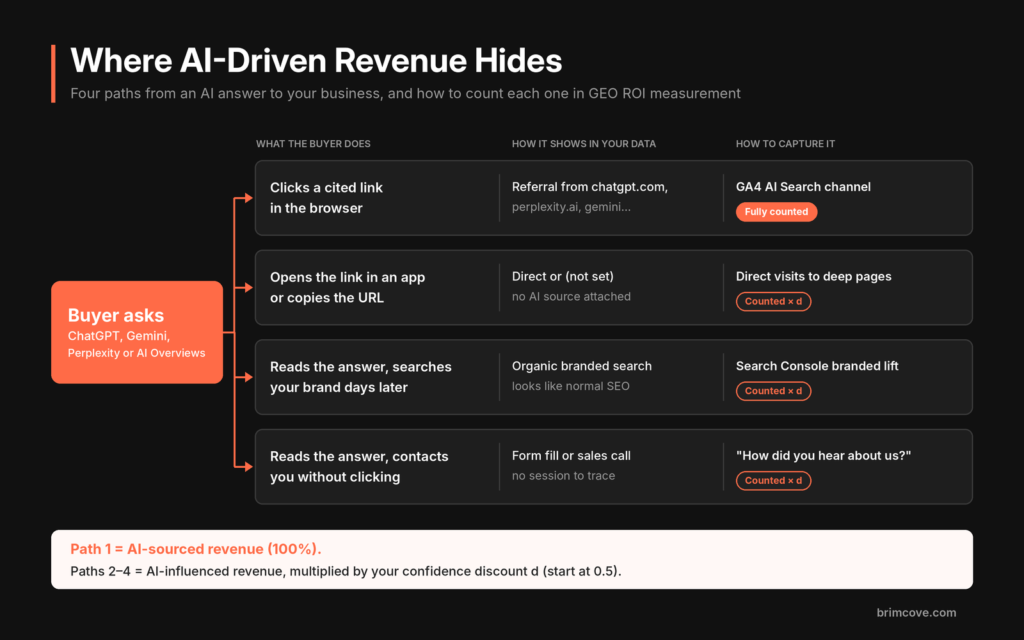
- Lost referrers. App users, copy-pasted links and some browsers strip the source. Those visits land in Direct.
- Unstable outputs. Ask the same prompt twice and you can get two different brand lists. One manual check proves nothing.
- Third-party influence. On buying queries, AI tools lean on review sites, roundups and editorial pages, not just your own site. Siege Media’s analysis of 1,000 transactional prompts found that 52.5% of the 40 most-cited domains were affiliate or sponsorship sites.
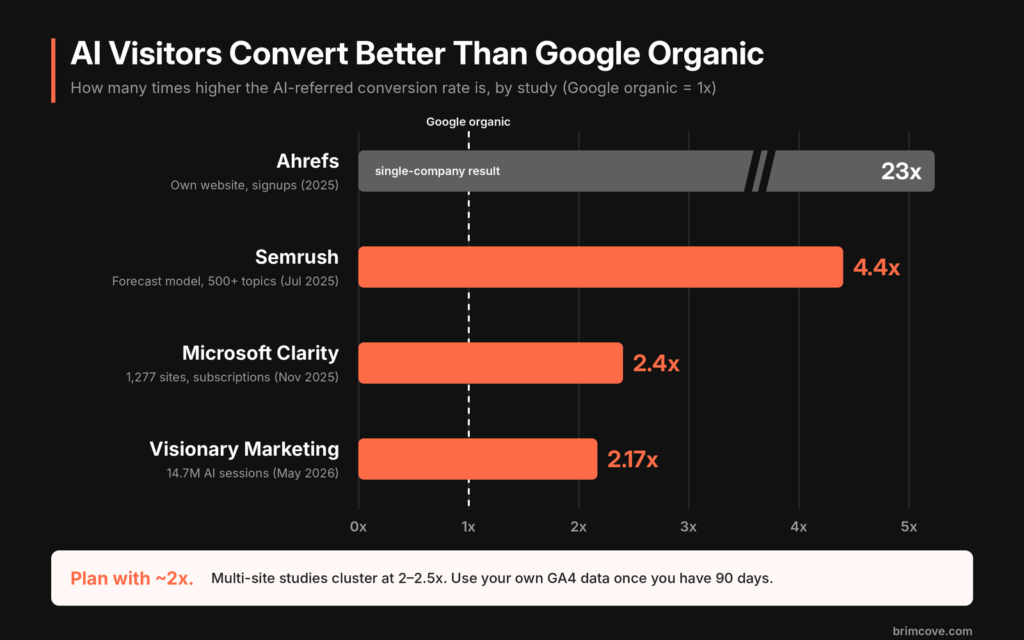
Now the upside. Ahrefs reported that AI search visitors made up 0.5% of its traffic but drove 12.1% of its signups. Semrush puts AI-referred conversion at about 4.4 times standard organic. Other studies land lower, from roughly 1.2x to 5x, depending on industry and how a conversion is defined.
So plan with the conservative number, not the headline. Even at 2x, a few hundred AI visits can outperform thousands of top-of-funnel organic clicks. That’s the case for measuring it properly, and for understanding how AI search is reshaping link building.
The 4-Layer GEO Measurement Framework
The best way to measure GEO is in four connected layers: visibility (are AI tools naming you?), traffic (are those answers sending visits?), engagement (do those visitors act?) and revenue (does it turn into pipeline and sales?). Each layer feeds the next, and ROI only holds up when all four are tracked.
| Layer | Question it answers | Core metrics | Where the data lives |
|---|---|---|---|
| 1. Visibility | Are AI tools naming and citing us? | Mention rate, citation rate, share of voice, sentiment, position | Prompt tracker or manual prompt log |
| 2. Traffic | Are AI answers sending visits? | AI referral sessions, AI landing pages, branded search lift | GA4, Google Search Console |
| 3. Engagement | Are those visitors interested? | Engagement rate, pages per session, time on site | GA4 |
| 4. Revenue | Is it turning into money? | AI-sourced leads, conversion rate, pipeline, revenue | GA4 key events + CRM |
Layers 1 and 2 are leading indicators. They move first, usually within weeks. Layers 3 and 4 are lagging indicators. They prove the business case, but they need months of data.
A common mistake is reporting only Layer 1. A rising mention rate looks great on a slide, but leadership will ask what it earned. Always show the full chain.
9 GEO KPIs That Actually Prove ROI
The GEO KPIs that matter most are AI mention rate, AI citation rate, AI share of voice, first-mention rate, sentiment and positioning accuracy, AI referral sessions, AI conversion rate, branded search lift and AI-sourced revenue. The first five show visibility. The last four connect that visibility to money.
| # | KPI | Formula | Track it with | Review |
|---|---|---|---|---|
| 1 | AI mention rate | Prompts where your brand is named ÷ total prompts tracked × 100 | Prompt tracker or manual log | Weekly |
| 2 | AI citation rate | Prompts where your URL is cited as a source ÷ total prompts × 100 | Prompt tracker | Weekly |
| 3 | AI share of voice | Your mentions ÷ all brand mentions across your prompt set × 100 | Prompt tracker with competitor set | Every 2 weeks |
| 4 | First-mention rate | Answers where you’re named first ÷ answers that name you × 100 | Prompt tracker | Monthly |
| 5 | Sentiment and positioning accuracy | Share of answers that describe you positively and with the right “best for” use case | Manual review of answers | Monthly |
| 6 | AI referral sessions | Sessions from AI sources in GA4 | GA4 custom channel | Weekly |
| 7 | AI conversion rate | AI key events ÷ AI sessions × 100 | GA4 | Monthly |
| 8 | Branded search lift | Branded impressions now vs. your pre-GEO baseline | Google Search Console | Monthly |
| 9 | AI-sourced revenue | Revenue from AI-referred and AI-reported deals | CRM + GA4 | Monthly / quarterly |
How to Read the Gaps Between KPIs
The gaps between KPIs tell you what to fix next:
- High mention rate, low citation rate. AI tools know your brand, but they don’t trust your pages as a source. Build stronger reference content and earn mentions on cited third-party sites.
- High citation rate, low referral sessions. You’re cited, but buried. Check your position in the answer and the page the AI links to.
- High referral sessions, low conversion rate. The AI is sending the wrong intent, or your landing page doesn’t match what the answer promised.
- Low share of voice, decent mention rate. You show up, but competitors show up more. Look at which sources name them and not you.
Build Your Prompt Set First
Every visibility KPI depends on the prompts you track. Start with 30 to 50 prompts across three groups:
- Category prompts: “best [category] for [audience]”, “top [category] tools”.
- Comparison prompts: “[your brand] vs [competitor]”, “[competitor] alternatives”.
- Problem prompts: “how do I fix [pain point]”, “fastest way to [job]”.
Run each prompt on ChatGPT, Gemini, Perplexity and Google AI Overviews. Run it more than once, since answers vary. Keep the set fixed for at least a quarter so your trend lines mean something.
How to Track AI Referral Traffic in GA4 (Step by Step)
To track AI referral traffic in GA4, create a custom channel group with a source rule that matches AI domains like chatgpt.com, perplexity.ai, gemini.google.com and claude.ai. Place that channel above Referral, mark your key events, and compare AI sessions with organic in an Exploration. Setup takes about 15 minutes.
GA4 now ships a default AI Assistants channel for some platforms, but coverage is uneven. Perplexity and Claude visits can still land in plain Referral. A custom channel gives you one clean bucket you control.
Step 1: Check What You Already Have
Open Reports → Acquisition → Traffic acquisition. Set the dimension to Session source / medium and search for “chatgpt”, “perplexity”, “gemini”, “claude” and “copilot”. If rows appear, AI traffic is already reaching you.
Step 2: Create the AI Search Channel
Go to Admin → Data display → Channel groups → Create new channel group. Copy the default group, then add a channel named AI Search with this condition:
- Dimension: Source
- Match type: matches regex
- Value:
.*(chatgpt\.com|chat\.openai\.com|openai\.com|perplexity\.ai|claude\.ai|gemini\.google\.com|copilot\.microsoft\.com|edgeservices\.bing\.com|deepseek\.com|grok\.com|meta\.ai|you\.com).*
GA4 regex is case-sensitive, so keep the domains lowercase.
Step 3: Move It Above Referral
GA4 assigns each session to the first channel it matches. If Referral sits above AI Search, chatgpt.com visits get filed under Referral and your new channel shows zero. Drag AI Search above Referral. Google’s custom channel groups guide covers the reorder steps.
Step 4: Don’t Filter by Medium
Skip any “medium = referral” condition. A large share of ChatGPT clicks arrive as chatgpt.com / (none) or (not set). Mo Agency estimates that’s 30 to 40% of visible ChatGPT traffic. A medium filter throws it away.
Step 5: Mark Key Events and Build the Comparison
Make sure your form fills, demo bookings, signups or purchases are marked as key events. Then build an Exploration with Session custom channel group as the dimension and sessions, engagement rate, key events and revenue as metrics. Add a second tab with Landing page filtered to AI Search, so you can see which pages AI tools send people to.
Step 6: Catch the Traffic GA4 Misses
GA4 gives you a floor, not the full number. Close the gap three ways:
- Add a “How did you hear about us?” field to every lead form, with ChatGPT, Perplexity, Gemini, Google AI Overviews and “Other AI tool” as options. Self-reported answers catch zero-click buyers.
- Watch Direct traffic to deep pages. People rarely type a long blog URL from memory. A rise in direct visits to pages that AI tools cite is a strong hint of hidden AI traffic.
- Track branded search in GSC. Save a 90-day baseline before GEO work starts. Branded impressions above that baseline are a fair proxy for AI-driven awareness.
The GEO ROI Formula (With a Worked Example)
The GEO ROI formula is: (AI-sourced revenue + discounted AI-influenced revenue − total GEO cost) ÷ total GEO cost × 100. AI-sourced revenue comes from tracked AI referrals. AI-influenced revenue comes from self-reported and branded-search signals, cut by a confidence discount so you never overclaim.
GEO ROI (%) = [AI-sourced revenue + (AI-influenced revenue × d) − GEO cost] ÷ GEO cost × 100
- AI-sourced revenue: revenue from customers whose first or converting session came from the AI Search channel.
- AI-influenced revenue: revenue from customers who said an AI tool sent them, but who aren’t already counted above.
- d (confidence discount): usually 0.3 to 0.6. Start at 0.5 and adjust after a few quarters of data.
- GEO cost: everything you spent, including content updates, third-party mentions and placements, tools and team hours.
Worked Example (Hypothetical Numbers)
A B2B software company runs GEO for one quarter. Here’s the math.
| Line | Calculation | Value |
|---|---|---|
| GEO cost (quarter) | Content $3,600 + third-party mentions $4,500 + tracking tool $900 | $9,000 |
| AI referral sessions | From GA4 AI Search channel | 1,800 |
| AI leads | 1,800 × 5% conversion rate | 90 |
| AI-sourced customers | 90 × 10% close rate | 9 |
| AI-sourced revenue | 9 × $1,500 first-year value | $13,500 |
| AI-influenced customers | Picked “ChatGPT” or “Perplexity” on the form, not in the AI channel | 10 |
| AI-influenced revenue (discounted) | 10 × $1,500 × 0.5 | $7,500 |
| Total GEO return | $13,500 + $7,500 | $21,000 |
| GEO ROI | ($21,000 − $9,000) ÷ $9,000 × 100 | 133% |
Two rules keep this number credible:
- Dedupe. A customer counted as AI-sourced can’t also be counted as AI-influenced.
- Report a range. Show ROI with d = 0 (sourced only), d = 0.5 and d = 1. In this example, that’s 50%, 133% and 217%. Finance trusts a range more than one bold number.
For long sales cycles, swap first-year value for pipeline value and report “pipeline ROI” until deals close.
How to Measure the ROI of Third-Party Mentions
To measure the ROI of third-party mentions, list the pages AI tools cite for your buying prompts, check where you appear on each, and value every placement by its direct referral revenue plus its share of AI-driven revenue. Then compare that total with what the placement costs you in commissions, fees or outreach time.
This matters because AI answers on buying queries lean heavily on other people’s pages. Siege Media found that third-party sources make up 80 to 95% of AI citations at the bottom of the funnel. Roundups, affiliate reviews, editorial features, comparison pages and forum threads all count.
Step 1: Map the Source URLs
Run your 20 to 30 highest-intent prompts on ChatGPT, Gemini and Perplexity. Log every URL each answer cites. Then sort them into three lists:
- Listed and strong: you appear near the top with an accurate description.
- Listed but weak: you’re buried, outdated or described for the wrong use case.
- Missing: the page is cited, but you’re not on it.
The “missing” list is your biggest opportunity. These pages already shape AI answers in your category.
Step 2: Audit Placement Quality
For every page you’re on, note your position, the “best for” label the author gives you, and how both have changed over the last 12 months. Compare that with your top three competitors on the same page.
Consistency matters more than clever copy. If one roundup calls you “best for agencies” and another calls you “best for beginners”, AI tools get mixed signals and may tie you to neither. Pick the use case you want to own and ask partners to use the same language.
Step 3: Value Each Placement
Use this formula for each URL:
Net placement value = Direct referral value + (URL citation share × AI revenue) − Placement cost
- Direct referral value: revenue from visitors who clicked through from that page (GA4 referral data).
- URL citation share: that page’s share of all AI citations across your prompt set. If it’s cited 12 times out of 200 logged citations, its share is 6%.
- AI revenue: your AI-sourced plus discounted AI-influenced revenue for the period.
- Placement cost: commissions, sponsorship fees or outreach cost.
A listing that looks break-even on clicks alone often turns clearly positive once its AI share is added. That’s the data you need to justify paying more for a placement, or to drop one that no AI tool cites.
Step 4: Fix the Inputs Partners Care About
Affiliate publishers rank brands by what they earn: commission rate × conversion rate. Low commissions, short cookie windows (24 hours vs. 30 days) and weak landing pages all push you down the roundup, and so down the AI answer.
Editorial pages work on relevance and authority. Earned editorial links and mentions on trusted, traffic-verified sites are the same sources AI tools pull from. That’s why we run brand mention and managed link building campaigns against a cited-source list, not a generic domain list.
Step 5: Share It in Revenue Terms
Take the gap list and the placement values to your affiliate, PR or partnerships team. Show which cited pages you’re missing and what closing those gaps is worth. A dollar figure moves budget faster than a visibility score.
GEO ROI Measurement Tools: Free and Paid Stack
You can start GEO ROI measurement for free with GA4, Google Search Console, a CRM field and a prompt spreadsheet. Paid AI visibility tools such as Ahrefs Brand Radar, Semrush’s AI toolkit, Profound and Peec AI save time by running prompts at scale and tracking competitors, but they measure visibility, not revenue.
| Tool | Layer | What it does for GEO ROI | Cost |
|---|---|---|---|
| Prompt spreadsheet | Visibility | Logs prompts, platforms, brands named, URLs cited, position | Free |
| Google Analytics 4 | Traffic, engagement, revenue | AI Search channel, landing pages, key events | Free |
| Google Search Console | Traffic | Branded impression and click trends | Free |
| CRM (HubSpot, Pipedrive etc.) | Revenue | “How did you hear about us?” field, deal value | Usually in your plan |
| Ahrefs Brand Radar | Visibility | Brand mentions and cited pages across AI answers | Paid |
| Semrush AI toolkit | Visibility | AI visibility and share of voice vs competitors | Paid |
| Profound / Peec AI | Visibility | Large prompt sets, multi-platform tracking, sentiment | Paid |
A simple rule: buy a visibility tool once your manual prompt log passes about 50 prompts, or once you track more than three competitors. Before that, a spreadsheet works fine.
No tool closes the loop to revenue by itself. You still need GA4 and your CRM for that. For more options, see our list of AI SEO tools and our roundup of rank tracking tools, several of which now report AI visibility.
Template: The Manual Prompt Log
| Date | Prompt | Platform | Brands named (in order) | Your position | URLs cited | Your description | Sentiment |
|---|---|---|---|---|---|---|---|
| 2026-10-20 | best link building service for SaaS | ChatGPT | Brand A, Brand B, You | 3 | site1.com/roundup, site2.com/review | “good for SaaS startups” | Positive |
Log one row per prompt, per platform, per run. Your five visibility KPIs come straight from this sheet. GA4 and your CRM supply the other four.
How Long Does GEO Take to Show ROI?
Most brands see early visibility changes, like new mentions and citations, within 4 to 8 weeks of GEO work. Measurable AI referral traffic usually follows in 2 to 4 months. Clear revenue proof typically takes 3 to 6 months, and longer for B2B deals with long sales cycles. Third-party mentions often move faster than on-site content.
| Phase | Timing | What to expect | What to report |
|---|---|---|---|
| Baseline | Weeks 0–2 | Prompt set built, GA4 channel live, branded search baseline saved | Starting KPIs |
| Early signals | Weeks 4–8 | First new mentions and citations, often on Perplexity and AI Overviews | Mention rate, citation rate |
| Traffic | Months 2–4 | AI referral sessions climb, landing page patterns appear | AI sessions, engagement |
| Revenue | Months 3–6+ | AI leads and deals show in the CRM, ROI becomes stable | AI-sourced revenue, ROI range |
These ranges reflect typical campaign patterns, not a guarantee. Two factors speed things up: an existing base of trusted mentions, and content that already ranks well in Google. AI tools that browse the web, like Perplexity and Google AI Overviews, tend to reflect fresh sources faster than answers built mostly from training data.
Don’t judge GEO on month one. Set a 90-day checkpoint for visibility and a 6-month checkpoint for ROI.
How to Report GEO ROI to Leadership
Report GEO ROI on three rhythms: a weekly visibility check for the team, a monthly scorecard that links visibility to traffic and leads, and a quarterly ROI review for leadership with revenue, cost and an ROI range. Lead with business numbers, then show the visibility trends that explain them.
| Cadence | Audience | What to include |
|---|---|---|
| Weekly | SEO / content team | Mention rate, citation rate, new cited URLs, lost citations |
| Monthly | Marketing lead | Share of voice vs competitors, AI sessions, AI conversion rate, branded search lift, top AI landing pages |
| Quarterly | CEO / CFO | AI-sourced revenue, discounted AI-influenced revenue, total GEO cost, ROI range, next quarter’s priorities |
The One-Page Scorecard
Keep the leadership report to one page, in this order:
- Headline result: “GEO returned $21,000 on $9,000 spent this quarter (ROI 50% to 217%, base case 133%).”
- Revenue chain: AI sessions → leads → customers → revenue, with quarter-on-quarter change.
- Visibility trend: share of voice vs your top three competitors.
- Wins: new high-value pages that now cite you.
- Gaps and asks: missing cited sources and the budget to close them.
Show AI traffic as its own line next to organic, paid and referral. Small session counts look less odd when leadership can see the conversion rate beside them.
7 GEO ROI Measurement Mistakes to Avoid
The most common GEO ROI measurement mistakes are relying on one-off prompt checks, trusting GA4’s default channels, reporting visibility without revenue, planning with headline conversion multipliers, double-counting customers, ignoring third-party sources and changing the prompt set mid-quarter. Each one either hides real value or inflates it.
- Running each prompt once. AI answers vary. Run every prompt several times per platform and record the share of runs that name you.
- Trusting default GA4 channels. Without a custom AI channel placed above Referral, AI visits scatter across Referral, Direct and Unassigned.
- Stopping at visibility. A mention rate is a leading signal, not a result. Always connect it to sessions, leads and revenue.
- Planning with the biggest multiplier. A 23x conversion stat from one company won’t hold for yours. Use your own AI conversion rate once you have 90 days of data.
- Double-counting. One customer, one bucket. Dedupe AI-sourced and AI-influenced revenue before you add them.
- Only measuring your own site. On buying prompts, the pages AI tools cite are often roundups and reviews. Skip those and you miss most of the picture.
- Moving the goalposts. Changing prompts every month breaks your trend lines. Lock the core set for a quarter and add new prompts as a separate group.
One more on the content side: AI tools find and trust pages more easily when your site structure is clear. Our guide to internal linking for AI and SEO shows how to help crawlers and LLMs reach your best pages.
Start Measuring GEO ROI This Week
You don’t need a big budget to start. This week, build your 30-prompt set, add the AI Search channel in GA4, save your branded search baseline and add an AI option to your lead form. In 90 days, you’ll have real numbers instead of guesses.
Your quick-start checklist:
- [ ] Build a 30–50 prompt set (category, comparison, problem)
- [ ] Log baseline mention rate, citation rate and share of voice
- [ ] Create the AI Search channel in GA4 and move it above Referral
- [ ] Mark key events and build the AI vs organic Exploration
- [ ] Save a 90-day branded search baseline in Search Console
- [ ] Add an AI option to your “How did you hear about us?” field
- [ ] Map the third-party URLs AI tools cite in your category
- [ ] Book a 90-day visibility review and a 6-month ROI review
Then put budget where the data points: the third-party pages AI tools already cite in your category.
Want more AI answers to name your brand? Our in-house team earns mentions on the traffic-verified sites ChatGPT, Gemini and Perplexity cite, with fully manual outreach and live reporting. Explore our brand mention service or book a free strategy call.
GEO ROI Measurement FAQs
What is GEO ROI measurement in simple terms?
GEO ROI measurement shows how much money you get back from the work you put into AI search visibility. You track three things in order. First, how often tools like ChatGPT, Gemini and Perplexity name or cite your brand. Next, how many visits and leads those answers send. Last, how much revenue those leads produce. Divide the net return by what you spent, and you have your GEO ROI.
What is a good ROI for GEO?
There’s no agreed industry benchmark yet, because most brands only started tracking AI traffic in the last year or two. A practical bar is a positive ROI within 6 months using only tracked AI-sourced revenue (d = 0 in the formula above). If you only reach break-even after adding self-reported, AI-influenced revenue, the channel is still likely working. Your attribution just needs tightening before you scale spend.
Can GA4 track ChatGPT and Perplexity traffic?
Yes, but only part of it. When someone clicks a link inside a ChatGPT or Perplexity answer in a web browser, the visit usually arrives with a referrer like chatgpt.com or perplexity.ai, and GA4 records it. GA4’s default AI Assistants channel doesn’t cover every platform, so build a custom AI Search channel with a source regex and place it above Referral. Treat the result as a minimum count, not the full total.
Why does my AI traffic show up as Direct in GA4?
Some AI visits lose their referrer before they reach your site. Mobile apps, desktop apps, copied links and some privacy-focused browsers strip the source, so GA4 files the visit as Direct. A useful clue is a rise in direct visits to long, deep URLs like blog posts or comparison pages. Very few people type those from memory. If the pages AI tools cite are also the ones gaining direct traffic, hidden AI visits are the likely cause.
What’s the difference between an AI mention and an AI citation?
A mention is when an AI answer names your brand, for example “Brand X is a popular option for SaaS teams.” A citation is when the answer links to one of your pages as a source. You can have a high mention rate and a low citation rate. That usually means AI tools know your brand from third-party pages but don’t see your own content as a trusted reference. Mentions build awareness. Citations send clicks.
How do I calculate AI share of voice?
Pick a fixed set of prompts and a fixed list of competitors. Run every prompt on each AI platform you track, and count how many times each brand is named. Then divide your mentions by the total mentions of all tracked brands and multiply by 100. For example, if your prompts return 400 brand mentions in total and 60 are yours, your AI share of voice is 15%. Recalculate every two weeks with the same prompts and competitor list.
How many prompts should I track, and how often?
Start with 30 to 50 prompts split across three groups: category prompts (“best X for Y”), comparison prompts (“X vs Y”, “X alternatives”) and problem prompts (“how do I fix Z”). Run each one on at least three platforms, several times each, because answers change between runs. Check visibility weekly, but judge trends monthly. Keep the core set locked for a full quarter so your numbers stay comparable.
How do I measure GEO without paid tools?
You can cover all four measurement layers for free:
- Visibility: a spreadsheet that logs prompts, platforms, brands named, your position and the URLs cited.
- Traffic: a custom AI Search channel in GA4.
- Engagement and conversions: GA4 key events and an Exploration comparing AI with organic.
- Revenue and zero-click influence: a “How did you hear about us?” field in your forms and CRM, plus branded search trends in Search Console.
Paid tools mainly save time once your prompt set grows past about 50 prompts.
How long does GEO take to show ROI?
Visibility usually moves first. New mentions and citations often appear within 4 to 8 weeks, especially on platforms that browse the web live, like Perplexity and Google AI Overviews. AI referral traffic tends to build over 2 to 4 months. Revenue proof typically needs 3 to 6 months, and longer for B2B companies with long sales cycles. Set a 90-day checkpoint for visibility and a 6-month checkpoint for ROI rather than judging the first month.
Do backlinks and brand mentions improve GEO ROI?
Yes, when they’re on the right pages. AI tools that search the web lean on sources that are already trusted and widely referenced, such as editorial roundups, review sites and industry publications. A mention on a page that AI tools already cite for your buying prompts can lift your mention rate, citation rate and share of voice at once. A link on a random site nobody cites does far less. Always build your outreach list from the URLs AI answers actually use.
Is GEO ROI measured differently for B2B and e-commerce?
The formula is the same, but the revenue inputs differ. E-commerce brands can usually tie AI sessions straight to orders and revenue in GA4 within weeks. B2B brands have longer cycles, so they should track AI-sourced leads and pipeline value first, then switch to closed revenue once deals land. B2B teams also get more value from the self-reported “How did you hear about us?” field, because buyers often research in AI tools long before they fill in a form.
How do I prove GEO ROI to a CFO who only trusts last-click data?
Lead with the number they already trust: revenue from sessions tracked in the GA4 AI Search channel. That’s last-click proof on its own. Then show self-reported AI revenue as a separate, discounted line, and present ROI as a range (sourced only, base case, full credit). Finance teams accept a conservative floor with a clearly labeled upside far more readily than one large, blended figure.
Should I cut SEO budget to fund GEO?
Usually not. Much of what earns AI visibility, like strong content, clean site structure and trusted mentions and links, also drives Google rankings. Google AI Overviews also pull from pages that already rank well. Most brands get better results by adding GEO measurement and third-party mention work on top of SEO, then shifting budget gradually once their own AI conversion data proves the case.
