
You spent hours writing a great blog post or product page. You optimized the title, added images, and made sure the content is helpful. Then you hit publish… and almost nobody clicks through from Google.
One of the most common reasons is a weak or missing meta description. This small piece of text appears right below your page title in search results and can make or break whether someone clicks on your link.
In this complete guide, you’ll learn exactly what a meta description is, why it matters for SEO and click-through rates, the ideal length in 2026, and a simple step-by-step process to write compelling meta descriptions that actually get clicks. You’ll also see many real good and bad examples so you can avoid common mistakes and start writing better ones immediately.
Whether you’re a complete beginner, blogger, content writer, or small business owner, this guide will give you the practical knowledge and templates you need to create meta descriptions that stand out and drive more traffic to your site.
Table of Contents
What is a meta description?
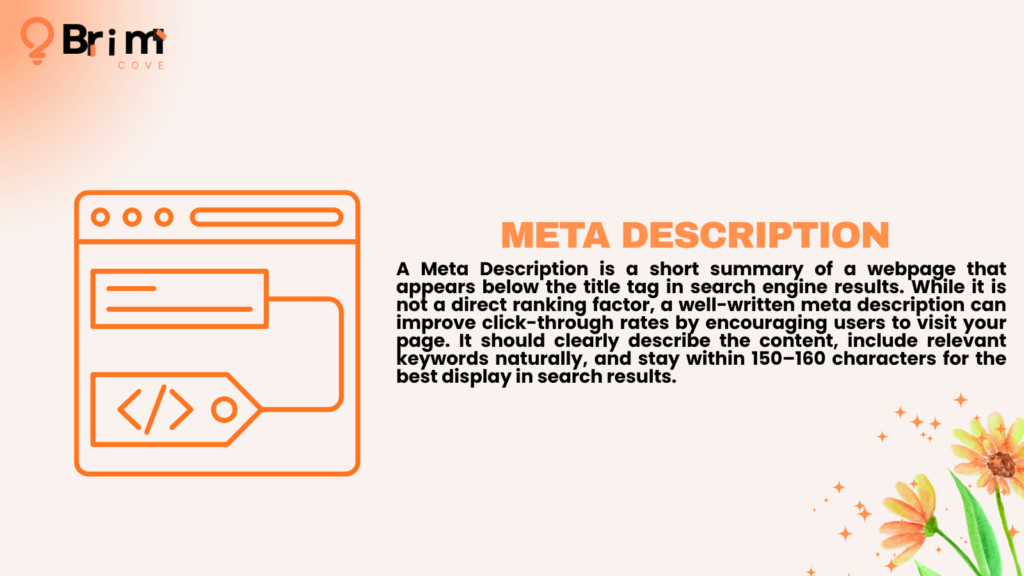
A meta description is a summary of a webpage that appears in search engine results pages (SERPs) below the title tag.
It’s the 1–2 line snippet of text that gives searchers a quick idea of what the page is about before they click. Think of it as a mini advertisement for your content that helps convince people your page is worth visiting.
Here’s a simple example you might see in Google:
Title: Low Cost SEO Guide 2026
Meta Description: Learn how to rank on Google without spending thousands. Step-by-step low-cost SEO strategies, tools under $50, and a complete action plan for beginners and small businesses.
When someone searches for “low cost SEO,” they see your title and this description. If it sounds useful, relevant, and promising, they’re much more likely to click your result instead of the ones above or below it.
Meta descriptions don’t directly affect rankings like title tags or content quality do, but they have a big indirect impact through click-through rate (CTR). When more people click your result, Google sees it as a positive signal that your page satisfies the search query, which can help your rankings improve over time.
Writing your own meta description gives you control. If you leave it blank, Google will automatically pull text from your page content. Sometimes this works fine, but it often results in awkward, incomplete, or less persuasive snippets that don’t encourage clicks.
Where do meta descriptions appear?
Meta descriptions show up in Google, Bing, and other search engines right under the blue clickable title link.
On desktop computers, they usually display about 150–160 characters before getting cut off. On mobile devices, the visible length can be slightly different because of smaller screens, but the general recommendation stays the same.
You can see your meta description in action by searching for your own page or using free preview tools. If you don’t write one, Google often chooses a snippet from the first paragraph or another part of your content. This automatic choice is not always the best representation of your page, which is why taking the time to craft a good meta description is worth the effort.
In 2026, with more searches happening on mobile, making sure your meta description displays well on both desktop and phones has become even more important for getting clicks.
Why meta descriptions matter for SEO
Even though meta descriptions are not a direct ranking factor, they are still very important for several practical reasons.
First, they strongly influence click-through rate (CTR). A compelling, benefit-focused description can increase clicks by 5–20% or more compared to a generic or missing one. Higher CTR tells Google that searchers find your page relevant and useful.
Second, they help set clear expectations for visitors. When the meta description accurately describes what’s on the page, people are less likely to bounce back to the search results quickly. Lower bounce rates and longer time on page are positive signals that can support better rankings over time.
Third, meta descriptions give you one more opportunity to include your primary keyword naturally and speak directly to the searcher’s needs or pain points. This helps match user intent more effectively.
In competitive niches where many pages rank for the same terms, a strong meta description can be the deciding factor that makes someone choose your result over a competitor’s.
For bloggers and small business owners, improving meta descriptions is one of the quickest and cheapest ways to get more traffic from the same rankings.
Ideal meta description length
In 2026, the recommended meta description length is still around 150–160 characters (including spaces).
Google can display up to about 920 pixels on desktop, which typically translates to 150–160 characters. On mobile devices, the visible length is often a bit shorter due to screen size, but the same target works well across devices.
If your meta description is too long, Google will cut it off with an ellipsis (…), and it may look incomplete or less professional. If it’s too short, it might not give enough information to persuade someone to click.
Best practice for beginners: Aim for 140–155 characters. This gives you a safe buffer so the full description displays cleanly on both desktop and mobile. Always preview how it looks using Google Search Console or free SERP preview tools before publishing.
Remember that character count includes spaces. Write your description, count the characters, and trim or expand as needed until it feels natural and compelling within the ideal range.
How to write a perfect meta description (step-by-step)
Here’s a simple, repeatable 5-step process that works for any page:
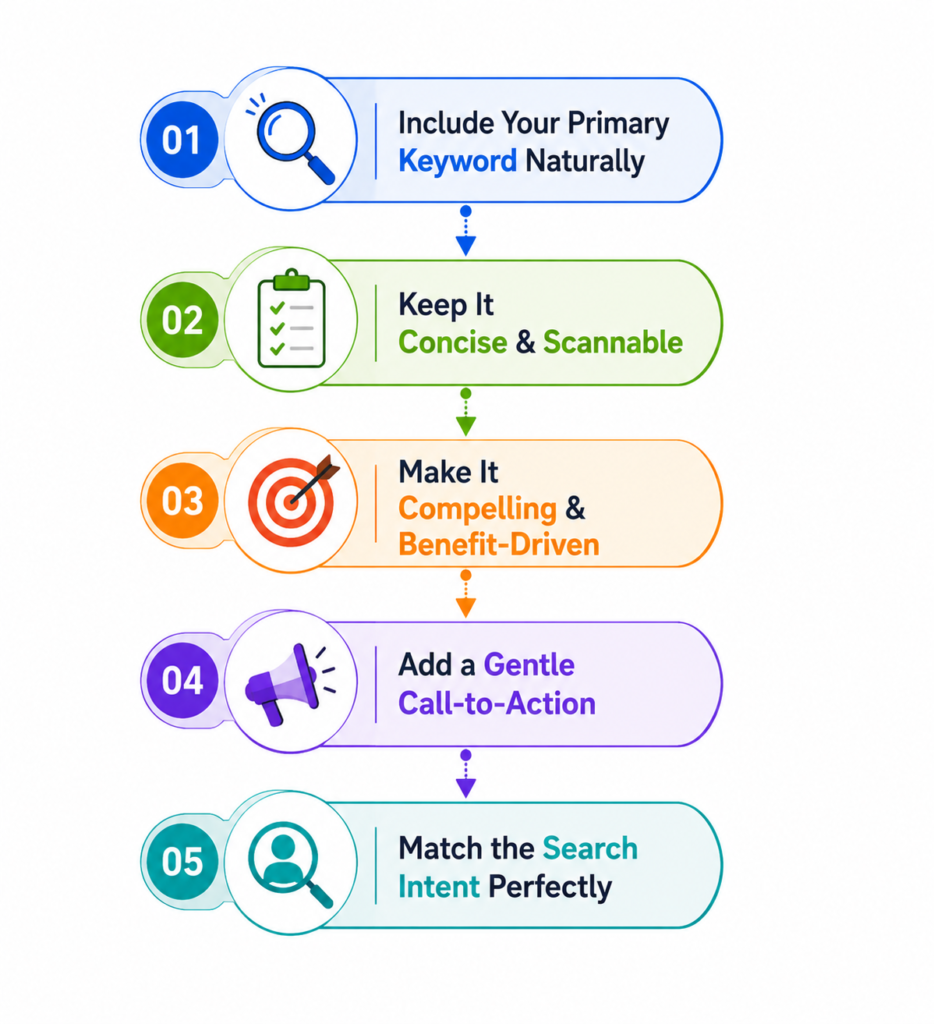
- Include your primary keyword naturally. Place the main search term near the beginning so it stands out and matches what the user typed. This helps both searchers and Google quickly understand the topic.
- Keep it concise and scannable. Use short sentences. Avoid long, complicated wording. Focus on one clear benefit or promise that directly addresses the searcher’s need.
- Make it compelling and benefit-driven. Speak directly to the reader using “you” language. Highlight what they will gain — whether it’s learning something new, solving a problem, or finding the best option.
- Add a gentle call-to-action. Encourage the click with soft action words like “learn how,” “discover,” “get the complete guide,” “compare the best options,” or “find out more.”
- Match the search intent perfectly. If the query is informational, focus on education and clarity. If it’s commercial or transactional, emphasize benefits, solutions, or next steps.
Putting it all together, here’s a strong meta description example for the keyword “meta description”:
“Learn what a meta description is, the ideal length in 2026, and how to write compelling ones that boost CTR. Step-by-step guide with real good and bad examples for beginners and bloggers.”
This version includes the keyword early, promises clear value, feels actionable, and stays within the recommended length.
Meta description examples (good vs bad)
Let’s look at several real-world examples so you can see exactly what works and what doesn’t.
Good example 1 – Informational page:
“Discover what a search query is with simple explanations, real examples, and how it affects your SEO strategy. Perfect beginner-friendly guide updated for 2026.”
Why it works: Clear, includes the main idea, sets expectations, and sounds helpful without being salesy.
Good example 2 – Commercial page:
“Find the best budget CRM for small businesses under $50 per month. Honest reviews, feature comparisons, pricing details, and real user feedback to help you choose the right tool.”
Why it works: Speaks directly to buyer intent, highlights benefits, includes numbers for specificity, and encourages action.
Good example 3 – How-to guide:
“Learn how to write perfect meta descriptions that get more clicks. Step-by-step process, ideal length, good vs bad examples, and pro tips to improve your CTR in 2026.”
Why it works: Promises a clear process, includes benefits (more clicks), and matches the informational intent.
Bad example 1:
“This page explains everything about meta descriptions and why they are important for SEO and rankings. Click here to read more about meta tags and search engine optimization techniques used by professionals.”
Why it fails: Boring, keyword-stuffed, no real benefit, and the “click here” feels outdated.
Bad example 2:
“Meta description is an HTML tag. It appears in the SERP below the title. Write a good meta description for better CTR and SEO results. Buy our SEO services now for expert help.”
Why it fails: Sounds salesy and pushy, awkward wording, and tries to sell instead of helping.
Bad example 3 (too vague):
“Welcome to our website. We have many articles about SEO and digital marketing. Please read our latest post about meta descriptions.”
Why it fails: Too generic, doesn’t highlight any unique value or benefit.
Study these examples carefully. The good ones focus on the reader’s needs and benefits. The bad ones focus on the writer or try too hard to sell.
Common meta description mistakes
Here are the most common mistakes that hurt click-through rates and should be avoided:
- Making them too long (over 160 characters) so Google cuts them off with an ellipsis, and they look incomplete.
- Keyword stuffing by repeating the main keyword unnaturally multiple times.
- Writing duplicate meta descriptions for many different pages on the same site.
- Being too vague or generic (“Welcome to our site” or “Read our latest article”).
- Focusing only on keywords instead of benefits, solutions, or what the reader will gain.
- Forgetting to update meta descriptions when the page content changes significantly.
- Using the same meta description across similar pages instead of making each one unique.
Fixing even a few of these mistakes on your most important pages can lead to noticeable improvements in clicks.
Do meta descriptions affect rankings?
Meta descriptions are not a direct ranking factor. Google has confirmed this multiple times over the years.
However, they have a significant indirect impact because they influence click-through rate (CTR). When more people click on your result from the search page, Google interprets this as a sign that your page is relevant and useful for that query. Over time, strong CTR can contribute to better rankings.
So while a great meta description won’t magically push your page to position #1 tomorrow, it is an important part of a complete SEO strategy that supports long-term growth through better user signals.
Google is rewriting meta descriptions
You will sometimes notice that Google ignores your carefully written meta description and creates its own version instead.
This happens when Google’s algorithm believes another part of your page (often a paragraph or sentence) better matches the exact words the user searched for. It is especially common with popular or highly competitive keywords.
To reduce the chance of Google rewriting your meta description:
- Make sure your meta description is highly relevant to the main content of the page.
- Include the primary keyword naturally near the beginning.
- Write unique, compelling copy that accurately and concisely summarizes the entire page.
- Avoid keyword stuffing or overly promotional language.
Even if Google rewrites it occasionally, a well-written meta description still increases your chances of Google choosing a good snippet or using yours more often.
Best practices for meta descriptions
Follow these practical best practices to create consistently strong meta descriptions:
- Write a unique meta description for every important page on your site.
- Use active voice and speak directly to the reader with “you” language.
- Highlight the main benefit or solution your page offers right away.
- Include your primary keyword early in the description, but don’t force it unnaturally.
- Add a subtle call-to-action when it fits the tone naturally.
- Test different versions and monitor performance in Google Search Console over time.
For bloggers and small business owners, spending just 5–10 minutes writing or improving a meta description for each new post or important page is one of the highest-return SEO activities you can do. It requires almost no budget but can deliver real increases in traffic.
Pro tips to make your meta descriptions stand out
Here are some advanced yet simple pro tips to take your meta descriptions to the next level:
- Use emotional triggers or specific numbers when they fit naturally (“Save 40% time”, “5 Easy Steps”, “Beginner-Friendly Guide”).
- Focus on the reader’s pain point and clearly explain how your page solves it.
- Always preview how your meta description looks on both desktop and mobile before publishing.
- Update older pages with stronger meta descriptions as you improve or expand the content.
- Combine your meta description with a compelling title tag — the two work together as a powerful team to attract clicks.
- Experiment with different tones (helpful, urgent, curious) and track which ones get the best click-through rates for your audience.
Small, consistent improvements to your meta descriptions can lead to noticeable increases in organic clicks and traffic over time without any extra cost.
Frequently asked questions
What is a meta description?
A meta description is a short HTML tag that provides a summary of a webpage. It appears in search results below the title and helps users decide whether to click through to your page.
What is the ideal length for a meta description?
Aim for 150–160 characters (including spaces). This length displays cleanly on both desktop and mobile in 2026 without being cut off.
Do meta descriptions affect rankings?
Not directly as a ranking factor. However, they strongly influence click-through rate, which can indirectly affect rankings through improved user behavior signals.
Why does Google rewrite meta descriptions?
Google rewrites them when it believes another part of your page better matches the user’s specific search query. Writing highly relevant, unique, and compelling meta descriptions reduces how often this happens.
Conclusion
A well-written meta description is one of the simplest yet most effective ways to improve your search visibility and attract more clicks from Google. While it doesn’t directly rank your page higher, it plays a big role in whether people actually visit your site after seeing it in the search results.
Remember the most important points from this guide: keep your meta descriptions between 150–160 characters, include your primary keyword naturally near the beginning, focus on benefits and user intent rather than just keywords, and always write unique descriptions for your important pages.
Take action right now. Open your most visited pages or your most recent blog posts and spend 10–15 minutes improving their meta descriptions using the step-by-step process and examples in this guide. You will likely start seeing better click-through rates within a few weeks.
Mastering meta descriptions is a small skill that delivers outsized results for bloggers, content writers, and small business owners. Use it consistently, test what works for your audience, and watch your organic traffic grow.
Start writing better meta descriptions today — your future clicks and visitors will thank you for the extra effort.
