
Many SEO professionals still consider private blog networks when they need faster control over their backlink profile. The promise is attractive: build your own sites, place precisely targeted links, and watch rankings climb without depending on unpredictable editorial outreach. Yet in 2026, Google’s SpamBrain and ongoing link spam updates have made this approach far riskier than it was even a few years ago.
SEO PBN Backlinks refer to links that come from a collection of websites you control — a private blog network. While they can sometimes deliver short-term ranking boosts, they also carry substantial risks of algorithmic penalties, de-indexing, and long-term damage to your main site’s authority.
This complete guide breaks everything down in detail. You’ll learn the exact mechanics of how private blog network backlinks work, the potential benefits, the very real dangers in today’s search landscape, practical steps for building a lower-risk network if you choose to proceed, common mistakes that get networks detected, and a comprehensive FAQ section addressing the questions most people ask in 2026. By the end, you’ll have a clear picture of whether PBNs fit your strategy and how to approach them responsibly — or why safer alternatives might serve you better.
Table of Contents
What are PBN backlinks?
PBN backlinks are links that originate from sites within a private blog network (PBN) — a group of websites fully owned and controlled by the same person or team. The primary purpose is to pass link equity and ranking power to a main “money site” through strategic dofollow links.
Unlike naturally earned backlinks that come from genuine editorial mentions or resource recommendations, PBN links are intentionally created. Most networks start with expired domains that already carry some historical authority. These domains are revived with new content, and links are placed pointing back to the target pages on the money site.
The tactic became especially popular after Google’s Penguin updates cracked down on large-scale link schemes. SEOs realized they could regain some control by building their own networks instead of relying on third-party directories or low-quality guest posts. In theory, a well-managed PBN mimics the natural web by appearing as independent blogs that happen to link to your content.
In practice, the line between helpful internal linking and manipulative link schemes has blurred. Google now uses advanced machine learning via SpamBrain to detect unnatural patterns at scale. What once flew under the radar in 2018–2020 often triggers flags today if the network lacks sufficient diversity or maintenance.
How SEO PBN Backlinks work
The process of creating and using SEO PBN Backlinks follows a structured but labor-intensive workflow.
It begins with domain research. You search for expired or aged domains that have decent historical metrics — reasonable Domain Rating or Authority scores, a clean or recoverable backlink profile, and preferably some topical relevance to your niche. Tools like Ahrefs, SEMrush, or specialized expired domain marketplaces help evaluate these factors.
Once suitable domains are acquired, the next step is technical setup. This includes registering the domains (often with privacy protection), choosing diverse hosting providers to avoid shared IP footprints, and configuring DNS settings. Many experienced builders use VPS or dedicated servers spread across different geographic locations and providers.
Content creation comes next — and this is where many networks fail. Thin, duplicated, or obviously AI-generated articles get flagged quickly. Successful operators invest time (or budget) in original, well-written posts that make each site feel like a legitimate blog. Regular publishing schedules, varied authors (or at least varied writing styles), and natural internal linking within the PBN help strengthen the illusion of independence.
Finally, the actual link placement happens. Links are inserted contextually within relevant articles, surrounded by helpful text rather than dropped into sidebars or footers. Anchor text is varied — a mix of branded, naked URLs, and partial-match phrases — to avoid over-optimization signals.
Throughout the lifecycle, ongoing maintenance is critical: updating content, monitoring for de-indexing, refreshing outdated pages, and watching for any cross-site footprints that could link the network together in Google’s eyes.
Benefits of using SEO PBN Backlinks
When executed with extreme care, some operators still report tangible advantages from private blog network backlinks.
Full control stands out as the biggest draw. You decide exactly which pages receive links, what anchor text is used, and when the links appear. This level of precision is impossible with purely organic outreach.
Speed is another factor. Instead of waiting months for editorial links to materialize, a functioning PBN can deliver new links within days or weeks of setup. In competitive niches where natural link acquisition moves slowly, this acceleration can provide a competitive edge — at least temporarily.
Targeted authority flow is also appealing. You can build topical relevance by choosing expired domains from related industries and crafting content that naturally supports your money site’s keywords.
Some advanced users employ tiered link building, where PBN sites link to intermediate “tier 2” pages that then pass cleaner signals upward. When combined with strong on-page optimization and quality content on the money site, this layered approach has helped certain projects see ranking improvements that would have taken much longer through white-hat methods alone.
However, these benefits are rarely sustainable without constant vigilance and diversification.
Risks and Considerations
The risks of SEO PBN Backlinks have grown significantly by 2026. Google’s SpamBrain system has become remarkably effective at identifying network-level patterns. It analyzes hosting similarities, content fingerprints, link velocity, anchor text distributions, and even behavioral signals across seemingly unrelated sites.
When a network is detected, consequences can be severe. Individual PBN sites may lose rankings or disappear from the index entirely. Worse, the links can stop passing any value — or in some cases trigger negative signals that drag down the money site’s performance. Recovery often involves disavowing large batches of links through Google Search Console, which itself can delay progress for months.
Real-world examples from recent updates show entire campaigns collapsing after a single spam-focused core update. Sites that relied heavily on PBNs for their backlink profile frequently experience sharp visibility drops that prove difficult to reverse without rebuilding authority through legitimate channels.
Additional practical risks include high ongoing costs (domain renewals, hosting, content writers, monitoring tools), the potential for scams when purchasing pre-built networks, and the ethical/reputational damage that comes with using tactics that violate Google’s webmaster guidelines. For agencies or consultants, discovery by clients can destroy trust instantly.
Even “safe” small networks require constant maintenance. One neglected site with outdated content or a shared plugin footprint can compromise the entire structure.
How to build a safe PBN for SEO
If you still decide to explore a private blog network, minimizing risk becomes the top priority. Here is a detailed, expanded step-by-step approach based on current best practices in 2026.
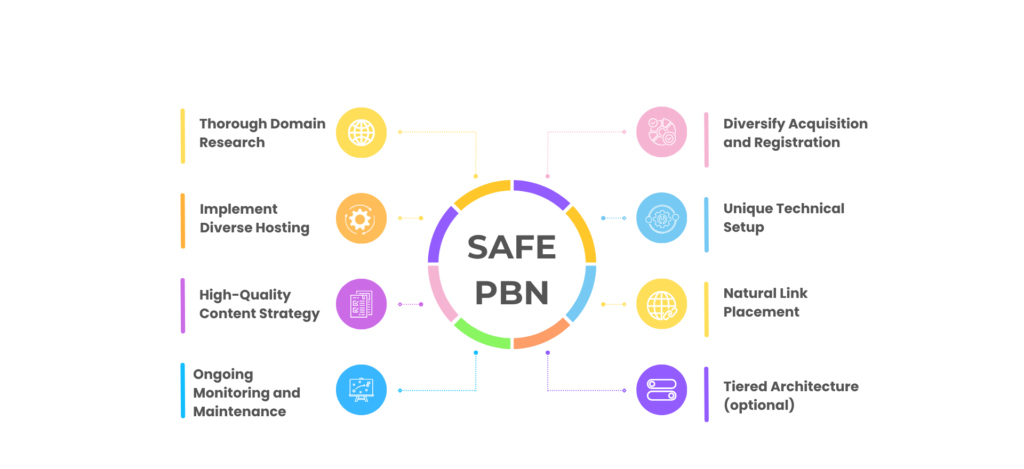
- Thorough domain research — Use multiple tools to evaluate expired domains. Look for clean history via Wayback Machine, natural backlink profiles, and low spam scores. Prioritize domains with some topical relevance but avoid anything previously penalized.
- Diversify acquisition and registration — Buy domains from different marketplaces and registrars. Enable full privacy protection and avoid using the same payment method or account for multiple purchases.
- Implement diverse hosting — Never host more than one or two sites on the same provider or IP range. Mix shared hosting, VPS, and dedicated servers across different countries and companies. Use unique nameservers where possible.
- Unique technical setup — Install different themes, plugins, and even CMS versions where feasible. Customize footers, contact pages, and about sections to avoid identical patterns.
- High-quality content strategy — Write or commission original articles that provide real value. Maintain a realistic publishing schedule — not too aggressive. Include images, internal links, and occasional external links to legitimate sources.
- Natural link placement — Insert links only when they genuinely enhance the reader experience. Vary anchor text heavily. Mix dofollow and nofollow where appropriate. Avoid site-wide or footer links.
- Ongoing monitoring and maintenance — Regularly check indexing status, backlink profiles, and search visibility of each PBN site. Update content every 4–8 weeks. Be prepared to drop any site that starts showing warning signs.
- Tiered architecture (optional) — Use the strongest PBN sites to link to mid-tier supporting pages rather than directly to the money site. This adds another layer of separation.
Even with all these precautions, remember that no PBN is 100% safe. Treat it as a high-risk supplemental tactic rather than a foundation.
Common Mistakes to Avoid
Many PBN failures stem from easily preventable errors:
- Placing too many sites on the same hosting provider or IP block.
- Using identical or very similar WordPress themes and plugins across the network.
- Publishing low-effort, duplicate, or heavily templated content.
- Over-optimizing anchor text with exact-match keywords on multiple sites.
- Linking too aggressively or too soon after launching new domains.
- Neglecting regular content updates and technical maintenance.
- Buying cheap pre-made PBNs without full transparency or audit capability.
- Ignoring footprint checks such as reverse IP lookups or content similarity scans.
Any single one of these mistakes can create a detectable pattern that leads to devaluation or penalties.
FAQs
What are PBN backlinks?
PBN backlinks are links originating from websites that belong to a private blog network you control. The network is typically built using expired or aged domains that are revived with new content. The goal is to pass link equity and ranking signals to your primary money site in a more controlled way than waiting for natural links. In 2026, this tactic sits firmly in the gray area of SEO because it attempts to manipulate Google’s link-based ranking signals.
Are PBNs safe in 2026?
Most experts consider them unsafe for long-term use. Google’s SpamBrain algorithm has advanced significantly and now identifies network patterns more effectively than ever. While extremely small, highly diversified networks managed by experienced operators may still provide temporary value in some niches, the majority of PBN users eventually face devaluation or penalties. White-hat strategies generally deliver more stable, penalty-resistant results over time.
Can PBNs hurt my website?
Yes, they absolutely can. When Google detects a manipulative network, the links often stop passing value and can sometimes trigger negative ranking signals on the target site. In severe cases, manual actions or broad algorithmic demotions affect the money site directly. Recovery requires significant time and effort, including disavowing links and rebuilding authority through legitimate means. Many businesses have lost months or years of SEO progress after relying too heavily on PBNs.
How to choose domains for PBNs?
Focus on expired domains with clean or recoverable histories, natural backlink profiles, and some topical relevance. Use tools like Ahrefs, SEMrush, and Wayback Machine to review past content and avoid any domains with previous penalties or spam associations. Look for domains that appear to have been legitimate blogs or businesses in their previous life rather than obvious spam sites. Diversify across different niches and acquisition sources to reduce footprint risk.
How much does building a PBN cost in 2026?
Expect significant investment. Individual high-quality expired domains can range from $20 to several hundred dollars each. Add hosting fees (ideally varied providers), original content creation, theme customization, ongoing maintenance, and monitoring tools. A modest 8–12 site network can easily cost $1,000–$4,000 in the first year, plus monthly upkeep. Cheaper pre-made networks often end up costing more due to higher detection rates and cleanup efforts.
What is a PBN footprint, and how do I avoid it?
A footprint is any repeatable pattern that reveals multiple sites belong to the same operator. Common examples include shared hosting IPs, identical themes or plugins, similar content structures, overlapping analytics codes, or unnatural linking patterns. Avoid footprints by using completely different hosting providers, unique designs and writing styles, varied publishing schedules, and natural link distribution. Regular self-audits with reverse IP tools and content similarity checkers are essential.
Do PBN backlinks still work in 2026?
Some still deliver short-term results, particularly in lower-competition niches or when used very conservatively within a tiered structure. However, their effectiveness has decreased as detection technology has improved. Many operators report diminishing returns and increasing volatility. The most sustainable ranking improvements in 2026 come from combining any PBN activity with strong on-page optimization and genuine content value.
What tools do people use for PBN management?
Popular options include Ahrefs and SEMrush for domain research and ongoing monitoring, various hosting control panels for diversification, content creation tools (or professional writers), and custom spreadsheets or project management systems for tracking updates and links. Some advanced users also employ VPNs, different browser profiles, or virtual assistants to reduce central management footprints.
Are there better alternatives to PBN link building?
Yes — many. Focus on creating exceptional content that naturally attracts links, running digital PR campaigns, outreach to resource pages, broken link building, and guest posting on reputable sites. Building topical authority through consistent, helpful content remains the most reliable long-term strategy. Tiered link building using high-quality supporting assets (instead of PBNs) can achieve a similar distribution of authority with far lower risk.
How does Google detect PBNs?
Through a combination of SpamBrain machine learning and other systems that look for network-level signals: hosting similarities, content fingerprints, unusual link velocity, anchor text patterns, and behavioral data. Google also employs human quality raters who can flag suspicious sites during manual reviews. Sudden clusters of links from sites that share technical or content characteristics often trigger deeper investigation.
Should beginners use SEO PBN Backlinks?
Generally not recommended. Beginners usually lack the experience needed to build and maintain networks without leaving obvious footprints. Mistakes at this stage can damage a new site’s reputation before it has a chance to establish natural authority. It’s wiser to master on-page SEO, content strategy, and white-hat link acquisition first before experimenting with higher-risk tactics.
Can I buy ready-made PBN links or networks?
Technically, yes, but it carries even higher risk. Many sellers offer low-quality or already-compromised networks. Without full access to history and setup details, you inherit someone else’s footprint and potential penalties. Auditing pre-made networks thoroughly is difficult and time-consuming. Most experienced SEOs strongly advise building your own if you decide to use PBNs at all.
How often should I update content in a PBN?
Aim for regular updates — at minimum once every 4–8 weeks per site to keep them looking active and natural. Fresh, valuable content helps maintain any existing authority and reduces the likelihood of de-indexing. Treat each PBN site as if it were a real independent blog rather than a disposable link farm.
What happens if my PBN gets penalized?
The affected sites typically lose visibility or get removed from the index. Links from them cease to pass meaningful value and may even contribute to negative signals on your target pages. Recovery involves disavowing the problematic links via Google Search Console, removing or noindexing compromised sites, and focusing heavily on natural link building to rebuild trust. The process can take many months and is never guaranteed.
Is tiered link building with PBNs safer?
It can reduce direct exposure to the money site by having PBNs link only to intermediate supporting pages. However, if the entire structure is detected, the risk can still propagate upward. Many modern SEOs prefer fully white-hat tiered approaches using quality guest posts, resource links, or internal content hubs instead of relying on PBNs.
Are there any legitimate uses for private blog networks?
Yes, but they look very different from manipulative PBNs. Large publishers or brands sometimes maintain networks of related sites for content distribution and internal linking to serve real audiences. These networks focus on providing value and follow Google’s guidelines. The version designed solely to artificially boost a single money site’s rankings remains against the spirit and rules of search engines.
Conclusion
SEO PBN Backlinks continue to tempt marketers who want more control over their link profiles and faster results. While some carefully constructed, small-scale networks may still provide short-term value in 2026, the risks have never been higher due to advanced detection systems like SpamBrain.
The most successful long-term SEO strategies focus on creating genuinely helpful content, earning natural editorial links, and building real topical authority. These approaches deliver sustainable growth without the constant fear of penalties or devaluation.
If you do choose to experiment with a private blog network, treat it as a high-risk supplemental tactic rather than a core strategy. Document everything, monitor obsessively, diversify heavily, and always maintain parallel white-hat efforts. Ultimately, Google rewards sites that provide clear value to users — not the ones trying hardest to manipulate the system.
Build for the long term. Invest in quality content and natural link acquisition. Your rankings — and your peace of mind — will be far more stable as a result.
