
Picture this. It’s early April 2026, and your site just took a 35% traffic hit after the March core update finished rolling out. One week earlier,r you were sitting pretty in the top three for your main money keyword. Now you’re staring at page two, wondering what changed. You’re not alone. Data shows 79.5% of top-three positions shifted during that update — the highest volatility in recent memory.
Here’s what most people miss. Google ranking factors aren’t a secret list you can game. They’re a system that keeps getting smarter at spotting pages that actually help real people. The sites that gained ground had strong E-E-A-T signals, original insights, fast loading times, and backlinks that felt earned. The ones that dropped relied on thin content, generic AI drafts, or spammy links.
This isn’t theory. I’ve watched dozens of sites recover (and a few climb higher) by focusing on the signals that matter right now. In this guide, we’ll break down every major category of Google ranking factors, what the March 2026 update changed, and exactly what you can do this week to protect and improve your visibility. No filler. Just the stuff that moves the needle in 2026.
Table of Contents
What are Google ranking factors?
Google ranking factors are the hundreds of signals the algorithm uses to decide the order of search results. Google has never published an official list, but we know from patents, patent leaks, quality rater guidelines, and real-world testing that there are well over 200 of them.
The big four categories still dominate: content relevance and quality, technical performance, backlinks, and user experience signals. Yet the weighting inside those categories keeps shifting. After the March 2026 core update, pages with firsthand experience and original data started outperforming generic listicles by a noticeable margin.
Think of it like a job interview. Google isn’t just checking if you have the right keywords on your résumé. It’s asking: Does this page actually solve the searcher’s problem better than the other ten results? Is the author someone who has walked the walk? Does the page load fast enough that people don’t bounce back to the results page?
The March update made the evaluation stricter. Aggregator sites and thin affiliate pages lost big. Brands and publishers who publish original research or detailed case studies gain. That’s why understanding how Google ranks websites in 2026 matters more than ever — it’s no longer enough to check boxes. You have to build something that feels genuinely useful.
Why ranking factors matter for SEO
Ignore the signals, and you’re gambling with your traffic. One core update can wipe out months of work in a single week.
Look at the numbers from March 2026. Almost 80% of the top-three URLs changed position. In the top ten, over 90% moved. Sites with original data saw average visibility jumps of around 22%. Thin or templated content dropped 30-50% in many cases.
That volatility isn’t random. Google is getting better at measuring real user satisfaction, and it rewards pages that keep people reading, clicking internal links, and coming back. The payoff when you get it right is steady traffic that survives future updates, lower bounce rates, and higher conversion numbers.
Here’s the practical side. Once you align with current Google ranking signals, your SEO stops feeling like constant firefighting. You spend less time chasing every algorithm tweak and more time creating content that ranks because it deserves to.
Top content-related Google ranking factors
Content remains the heaviest category — roughly 35% of the overall weighting in most analyses. But 2026 content has to clear a higher bar than it did even a year ago.
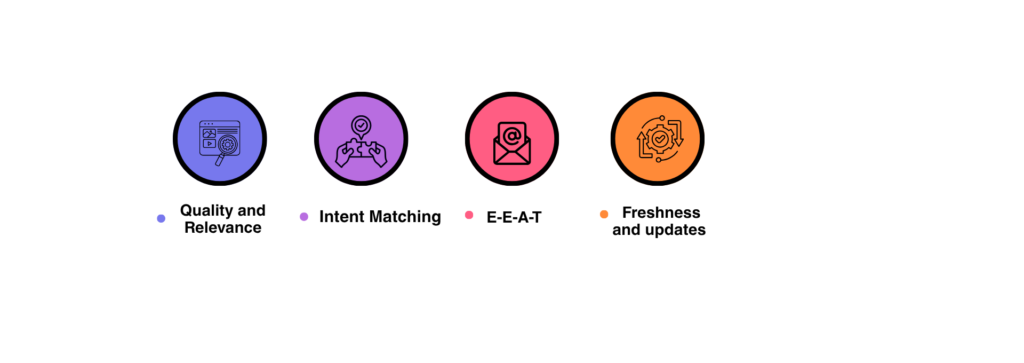
Quality and relevance still sit at the top. Google wants pages that cover a topic completely without forcing readers to jump to another site for missing details.
Intent matching decides everything. Someone searching “best noise-cancelling headphones under 200” doesn’t want a 3,000-word history of audio tech. They want clear comparison tables, real-world testing notes, and honest pros/cons. Pages that nail the exact reason for the search climb fast.
E-E-A-T (Experience, Expertise, Authoritativeness, Trustworthiness) gained even more importance after the March update. Google now looks for proof you’ve actually done what you’re writing about. That could mean author bios with real credentials, original photos from your testing process, or data you collected yourself. A finance blog that only summarizes other articles gets buried. One that shares its own portfolio performance data and lessons learned rises.
Freshness and updates still count, but not in the way most people think. You don’t have to rewrite everything monthly. A targeted refresh — new stats, updated screenshots, or a new section based on recent user feedback — often does the job.
Say you run a SaaS review site. Last year, your “best project management tools” page ranked well with a simple list. After the March update, it dropped. You added real usage screenshots from your team, updated pricing from 2026 contracts, and included a short case study from a client who switched tools. Traffic recovered in three weeks and passed its previous high.
Critical technical SEO ranking factors
Even great content fails if the page feels slow or broken. Technical signals are now a confirmed ranking factor through page experience.
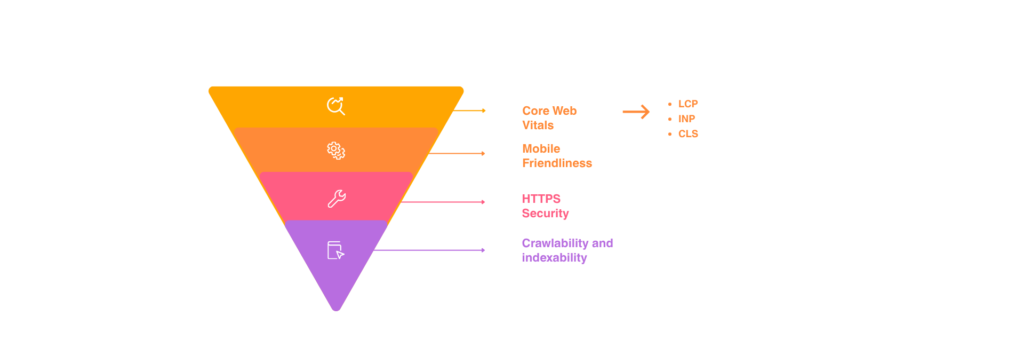
Core Web Vitals remain the main yardstick. In 202,6 the good thresholds are:
- LCP (Largest Contentful Paint) under 2.5 seconds
- INP (Interaction to Next Paint) under 200 milliseconds
- CLS (Cumulative Layout Shift) under 0.1
Many sites saw ranking drops because they were still targeting the old, lower numbers.
Mobile friendliness is non-negotiable. Google has been mobile-first for years, but the algorithm now penalizes even small mobile issues more aggressively.
HTTPS security is basic hygiene. Users (and Google) simply don’t trust non-secure sites.
Crawlability and indexability can quietly kill rankings. Bloated sitemaps, duplicate content tags, or JavaScript that hides important elements can keep your best pages out of the index.
Fix these first, and everything else you do gets amplified. A client of mine spent two days compressing images and lazy-loading videos. Their LCP dropped from 4.2 seconds to 1.8. Organic traffic to those pages jumped 28% within a month.
On-page SEO ranking factors
On-page elements help Google understand what your page is about and how well it’s structured for humans.
Title tags and headings should clearly describe the page and include your main keyword naturally. Over-optimization still looks spammy and hurts more than it helps.
Content structure matters. Short paragraphs, descriptive subheads, and logical flow keep readers engaged longer, which improves behavioral signals.
Schema markup gives Google extra context. FAQ schema, HowTo schema, or Product schema can trigger rich results and lift click-through rates.
Image optimization is low-hanging fruit. Use descriptive alt text that includes relevant keywords naturally, modern WebP formats, and proper file names.
Internal linking also helps. When you link related pages with natural anchor text, you pass authority and help Google see your topical authority.
Backlink ranking factors
Backlinks are still one of the strongest Google ranking signals, but the March 2026 spam update made quality matter even more.
Quality over quantity is the rule. Ten contextual links from authoritative sites in your niche beat hundreds of low-quality directory links.
Anchor text optimization should feel natural. A mix of branded, naked URLs, and varied phrases looks authentic.
Contextual placement adds weight. A link dropped naturally inside a relevant paragraph carries more trust than one in a footer or sidebar.
One example: a marketing agency built a detailed case study showing how they increased a client’s organic traffic 180% in six months. They didn’t ask for links. Respected industry blogs read it, referenced the data in their own posts, and linked naturally. Those links helped the agency’s own site climb for competitive terms.
User experience and behavioral signals
Google watches how people actually use your pages.
Bounce rate, dwell time, scroll depth, and click-through rate all feed into the algorithm. If users leave quickly or don’t engage, rankings suffer.
Site navigation needs to be obvious. Clear menus, logical categories, and helpful internal links keep visitors exploring.
Accessibility improvements — proper heading structure, color contrast, keyboard navigation — help both users and Google’s evaluation.
Local and entity-based ranking signals
For location-based searches, proximity, Google Business Profile activity, and review signals remain powerful. Even for non-local sites, entity signals (how clearly Google understands your brand and topics) have grown.
Consistent NAP data, high-quality reviews, and clear entity mentions across the web strengthen overall authority.
Emerging ranking trends in 2026
Semantic search and entity understanding are more advanced. Google now connects topics across your entire site, rewarding topical depth.
AI-generated content without human oversight got hit hard in the March update. Pages that read like they were written by someone with real experience are winning.
User satisfaction signals — scroll depth, return visits, time on page — carry a heavier weight. The algorithm is better than ever at spotting genuinely helpful pages.
Common SEO mistakes to avoid
- Chasing exact keyword density instead of real intent
- Publishing thin or fully AI-generated content without editing
- Ignoring Core Web Vitals until rankings already drop
- Building low-quality backlinks just to increase numbers
- Never updating older pages, even when the data goes stale
- Poor mobile experience that frustrates users
- Missing author signals or clear E-E-A-T proof
- Overusing pop-ups that hurt engagement metrics
Any one of these can trigger a visibility loss after a core update.
Actionable checklist: improve your rankings
Run this audit on your five most important pages this week:
- Confirm the page fully matches current search intent — read the top three results and note what they cover that you don’t.
- Add or strengthen your author bio with real credentials and a short “why I wrote this” note.
- Test Core Web Vitals and fix anything in the yellow or red zone.
- Refresh at least three statistics or examples with 2026 data.
- Check internal links — make sure they point to related, high-value pages.
- Add relevant schema markup.
- Optimize every image with descriptive alt text.
- Have a colleague read the page and flag anything unclear or generic.
Do these steps consistently, and your rankings become far more stable.
Frequently asked questions
What are the Google ranking factors?
They are the signals Google uses to evaluate and order search results. The biggest ones in 2026 are content quality and relevance, E-E-A-T signals, technical performance (especially Core Web Vitals), backlinks from trusted sites, and how real users interact with the page. There are over 200 signals total, but these categories drive most of the movement.
Which ranking factors are most important in 2026?
Content that demonstrates real experience and fully satisfies search intent sits at the top. Core Web Vitals, relevant backlinks, and strong E-E-A-T signals follow closely. No single factor dominates, but weakness in any of these areas can cause noticeable ranking drops, especially after core updates.
How do backlinks influence Google rankings?
High-quality, contextually relevant backlinks from authoritative sites still pass strong trust signals. Quantity alone does very little now. One relevant link from a respected site in your niche can outweigh dozens of weak ones, especially after the March 2026 spam update cleaned up low-quality link networks.
Does page speed affect SEO?
Yes. Core Web Vitals are a confirmed ranking factor. Pages that load slowly or feel unresponsive lose positions, particularly on mobile, where most searches happen.
Are keywords still a ranking factor?
They help Google understand the topic, but exact density is far less important than natural usage and how well the content matches intent. Over-optimization now looks spammy and can hurt rankings.
What is E-E-A-T, and why does it matter?
Experience, Expertise, Authoritativeness, and Trustworthiness. Google uses these signals to judge whether a page comes from a credible source with real-world knowledge. After the March 2026 update, it carries more weight than ever, especially for topics that affect health, finance, or major decisions.
How often should I update content?
Focus on meaningful updates rather than a rigid calendar. Adding fresh data, new examples, or fixing outdated sections every 6–12 months keeps the page relevant without unnecessary work. Small, targeted refreshes often recover or improve rankings faster than full rewrites.
Do mobile factors impact rankings?
Absolutely. Mobile-first indexing is the default, and a poor mobile experience directly affects Core Web Vitals scores and user behavior signals that Google tracks.
How to improve user experience for SEO?
Make navigation obvious, keep pages fast, use clear headings and short paragraphs, and remove anything that interrupts reading. Reduce intrusive pop-ups and make sure forms and buttons work smoothly on every device.
Can technical SEO affect visibility?
Yes. Even perfect content won’t rank if Google can’t crawl or index it properly or if the page feels sluggish. Technical issues can silently keep your best pages out of the results entirely.
How does the March 2026 core update affect my strategy?
It rewarded original, experience-backed content and punished thin or synthetic material. Focus on adding unique insights, improving technical performance, and building genuine authority rather than chasing volume.
Conclusion
Google ranking factors in 2026 reward pages that feel helpful, trustworthy, fast, and written by people who actually know the topic. The March core update proved that original experience and strong technical foundations beat generic content every single time.
Start with the checklist above. Pick your five most important pages, run the audit today, and fix what you find. You’ll see steadier rankings within weeks, and your site will be far better prepared for whatever Google throws at it next.
Open Search Console right now, pull your top-performing pages, and run a quick Core Web Vitals check. Small, consistent improvements add up faster than most people realize.
