

A technical SEO agency fixes the parts of your website that search engines and AI crawlers struggle with: crawling, indexing, speed, rendering, and site structure. It doesn’t start with blog posts or backlinks. It makes sure the pages you already have can be found and ranked.
We see the same pattern often. A brand publishes strong content and earns good links, yet rankings stall. Then a crawl shows half the site is blocked, duplicated, or buried five clicks deep.
This guide covers what a technical SEO agency does, what a real audit includes, what it costs, and how to hire one without paying for a 200-page PDF nobody reads.
Table of Contents
What a Technical SEO Agency Actually Does (Beyond Running a Crawl)
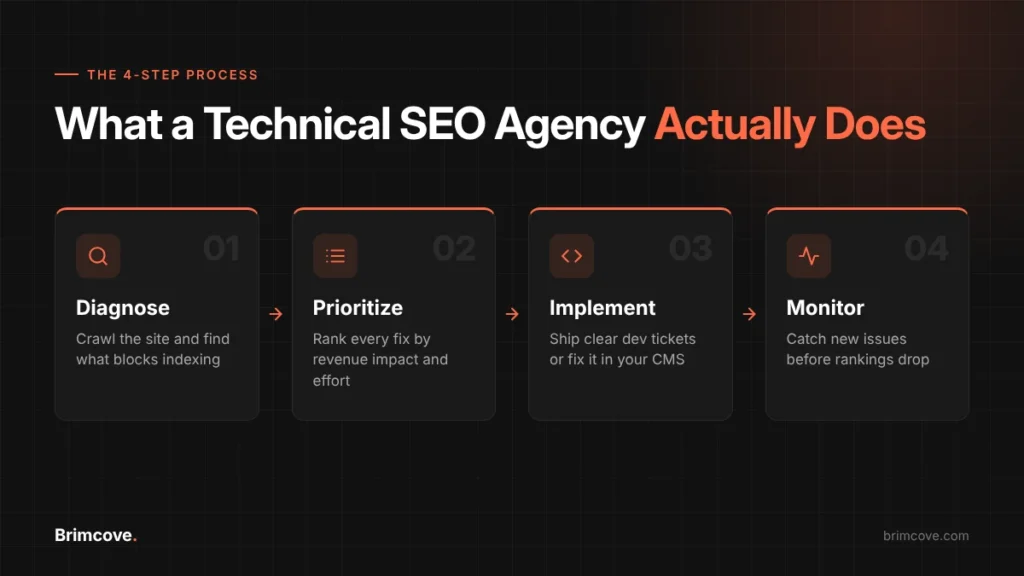
A technical SEO agency diagnoses and fixes the infrastructure problems that stop search engines from crawling, rendering, and indexing your site. The work has four parts: find the issues, rank them by business impact, get them fixed with your developers, and monitor so they don’t return after the next update.
Anyone can run Screaming Frog and export a list of errors. The value is in what happens after the crawl.
Diagnose: find what’s actually broken
The technical SEO agency crawls your site, pulls Google Search Console data, and checks how Googlebot renders your pages. The output is a short list of problems on pages you care about, not 4,000 warnings.
Prioritize: sort by impact, not by count
A missing alt tag and a noindex tag on your pricing page both show up as “issues.” Only one costs you revenue. Good agencies rank fixes by traffic potential, effort, and risk.
Implement: work with your developers
Most fixes need code changes. A Strong technical SEO agencies write tickets with the URL, the problem, the fix, and how to test it. Some make the changes directly in your CMS.
Monitor: stop problems from coming back
A new plugin adds duplicate tags. A redesign drops redirects. Ongoing monitoring catches these before they drag down the ranking factors you’ve worked to build.
Technical SEO Agency vs. Full-Service SEO Agency vs. Freelancer
A technical SEO agency goes deep on site infrastructure. A full-service SEO agency covers technical, content, and links under one roof. A freelancer is cheaper and faster to start but limited in capacity. Pick based on site size, dev support, and how much of your growth problem is technical.
| Technical SEO agency | Full-service SEO agency | Freelancer | |
| Best for | Large or JavaScript-heavy sites | Brands needing technical, content, and links together | Small sites with a few clear problems |
| Technical depth | Very high | Medium to high | Varies by person |
| Content and links | Usually not included | Included | Rarely included |
| Migration capacity | High | High | Low |
| Typical risk | Great audit, weak follow-through | Technical work gets less attention | Single point of failure |
If your site has 50 pages on a clean WordPress theme, a full-service team or skilled freelancer will cover it. If you run 50,000 product pages or sites in six languages, a dedicated technical team pays for itself.
7 Signs Your Site Has Outgrown DIY Technical SEO
You need a technical SEO agency when traffic drops without a clear reason, pages stop getting indexed, or a migration is coming. Other signs include failing page speed, JavaScript content Google can’t see, and a Search Console report full of errors your team hasn’t had time to fix.
- Traffic is sliding and nobody knows why. No algorithm update, no lost links. That often points to crawl or indexing problems.
- “Crawled, currently not indexed” keeps growing. Google visits your pages and chooses not to keep them.
- A migration or redesign is coming. This is where the biggest traffic losses happen. Get help before launch.
- Your site runs on heavy JavaScript. React and Vue sites often ship content crawlers see late or not at all.
- Core Web Vitals fail on key templates. Slow product pages hurt rankings and conversions.
- Filters create thousands of URLs. Faceted navigation wastes crawl budget on near-duplicates.
- SEO tickets keep slipping to “next sprint.” Clear, prioritized tickets are easier to approve and ship.
Inside a Real Technical SEO Audit: The 9 Layers That Matter
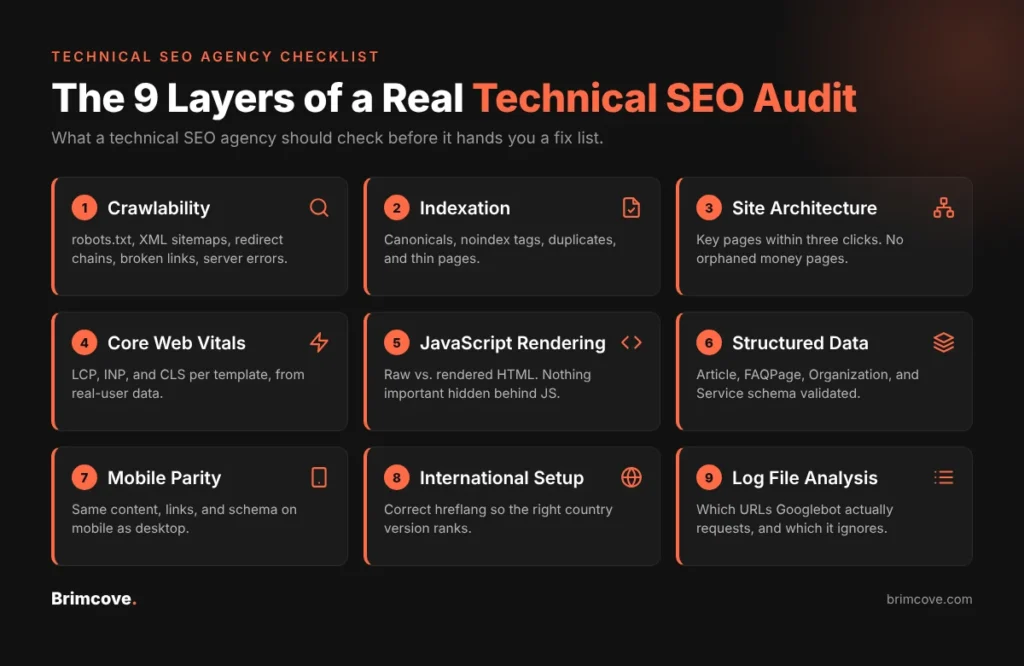
A real technical SEO audit checks nine layers: crawlability, indexation, site architecture, page speed, JavaScript rendering, structured data, mobile parity, international setup, and server logs. Each finding should point to a specific URL or template, explain the business impact, and come with a fix your developers can ship.
1. Crawlability
This covers robots.txt, XML sitemaps, redirect chains, broken links, and server errors. The audit should also confirm internal links arecrawlable links, not JavaScript click events bots can’t follow.
2. Indexation
The agency compares what you want indexed with what Google actually indexed. It checks canonicals, noindex tags, duplicates, and thin pages. The goal: every valuable page in, every low-value page out.
3. Site architecture and internal linking
Key pages should sit within three clicks of the homepage. The audit shows which money pages need more internal links and which pages are orphaned.
4. Page speed and Core Web Vitals
LCP, INP, and CLS should be reported per template, using real-user data from Search Console, not a single lab test.
5. JavaScript rendering
The technical SEO agency compares raw HTML with rendered HTML. Anything missing from the raw version risks slow or partial indexing.
6. Structured data
Article, Product, FAQPage, Organization, and Service schema should be valid in Google’s Rich Results Test.
7. Mobile parity
Google indexes your mobile site. If mobile pages hide content, links, or schema that desktop shows, you lose rankings.
8. International setup
Multi-language sites need correct hreflang tags. Errors cause the wrong country version to rank.
9. Log file analysis
Server logs show which URLs Googlebot actually requests. It’s the only way to see if bots waste time on parameter URLs while new pages go unvisited.
What this looks like on a real site
We ran this process on our own site. Screaming Frog flagged <head> and <body> errors caused by full HTML wrappers inside page-builder widgets. The same crawl surfaced duplicate title tags, canonical problems on key service pages, and 4xx errors from stale URLs.
None of these were visible on the front end. All were fixed within days once we knew where to look.
What Working With a Technical SEO Agency Looks Like, Month by Month
Most engagements follow the same arc: access and discovery in week one, a prioritized audit by week four, fixes rolled out over months two and three, and measurable crawl and indexing gains by months four to six. Ranking gains follow once Google recrawls the fixed pages.
- Week 1: Access. Search Console, analytics, CMS, and ideally server logs. Expect questions about past migrations and top revenue pages.
- Weeks 2–4: Audit. Findings ranked by impact and effort, with a walkthrough call.
- Month 2: Quick wins. Redirects, robots.txt errors, canonicals, and sitemaps. Low effort, often high impact.
- Month 3: Bigger builds. Speed, rendering, architecture, and schema work inside your sprint cycle.
- Months 4–6: Measure and monitor. Indexed pages, crawl stats, and Core Web Vitals improve. Alerts catch regressions.
One honest note: technical fixes remove blockers. They don’t create demand. A page with weak content and no backlinks won’t hit position one because its canonical tag is fixed.
Technical SEO Agency Pricing: Where the Money Actually Goes
Technical SEO agencies usually charge for a one-time audit, a monthly retainer, or a project like a migration. Price depends on site size, platform complexity, and how much implementation the agency handles versus handing tickets to your developers. The ranges below are approximate, based on common market quotes.
| Pricing model | What you get | Approximate range (USD) |
| One-time audit | Crawl, prioritized fix list, walkthrough | $1,500 – $10,000+ |
| Monthly retainer | Audit, ongoing fixes, monitoring, reporting | $1,000 – $7,500+ per month |
| Migration project | URL mapping, redirects, launch QA, monitoring | $3,000 – $25,000+ |
| Hourly consulting | Reviews and dev support on demand | $100 – $300 per hour |
Price climbs with page count, JavaScript frameworks, extra languages, and hands-on implementation. At the other end, a $200 technical SEO agency audit is almost always a tool export with a logo on it. Our guide on choosing an SEO package for a small business shows what each price tier usually includes.
10 Questions That Separate a Real Technical SEO Agency From a Report Mill
Vet a technical SEO agency by asking how they prioritize, who does the work, and how they prove results. Strong agencies answer with specific examples, name their tools, and explain how they work with developers. Weak ones talk about “200-point checklists” without showing outcomes.
- “Show me a technical fix that moved traffic.” Look for a specific fix and a before-and-after Search Console number.
- “How do you decide what to fix first?” The answer should mention revenue and effort, not just “errors before warnings.”
- “Do you analyze server logs?” If not, they’re guessing how Google crawls you.
- “How do you test JavaScript rendering?” Expect raw vs. rendered HTML and URL Inspection.
- “Can I see a sample dev ticket?” Vague tickets don’t get shipped.
- “Do you implement or only recommend?” Both are fine. Know what you’re paying for.
- “What tools do you use?” Screaming Frog, Sitebulb, Ahrefs, SEMrush, Search Console, and a log analyzer.
- “How do you run migrations?” URL mapping, staging redirect tests, and post-launch monitoring.
- “What do you report monthly?” Indexed pages, crawl stats, Core Web Vitals, and traffic to fixed templates.
- “Who works on my account?” Meet them. Seniors often sell and juniors deliver.
Red Flags That Should End the Sales Call
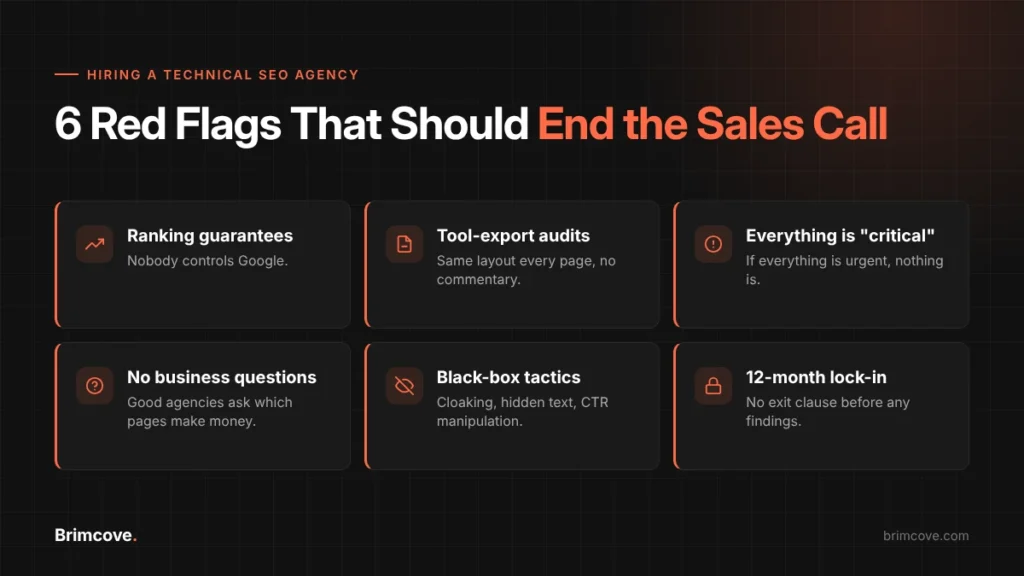
Walk away from any technical SEO agency that guarantees rankings, won’t explain its process, or sells an audit that looks like an unedited tool export. Other warning signs include no plan to work with your developers and pressure to sign a long contract before any findings are shared.
- Ranking guarantees. Nobody controls Google.
- The audit is a tool export. Same layout on every page, no commentary.
- Every issue is “critical.” If everything is urgent, nothing is.
- No questions about your business. Good agencies ask which pages make money first.
- Black-box tactics. Cloaking, hidden text, or CTR manipulation means leave, fast.
- Twelve-month lock-in with no exit clause. Confident agencies let the work speak.
Technical SEO for AI Search: The Checklist Item Most Agencies Skip
AI search tools like Google AI Overviews, ChatGPT, and Perplexity need to crawl and read your pages before they can cite them. A modern technical SEO agency checks that AI crawlers aren’t blocked, key content loads without JavaScript, and structured data clearly describes who you are and what you offer.
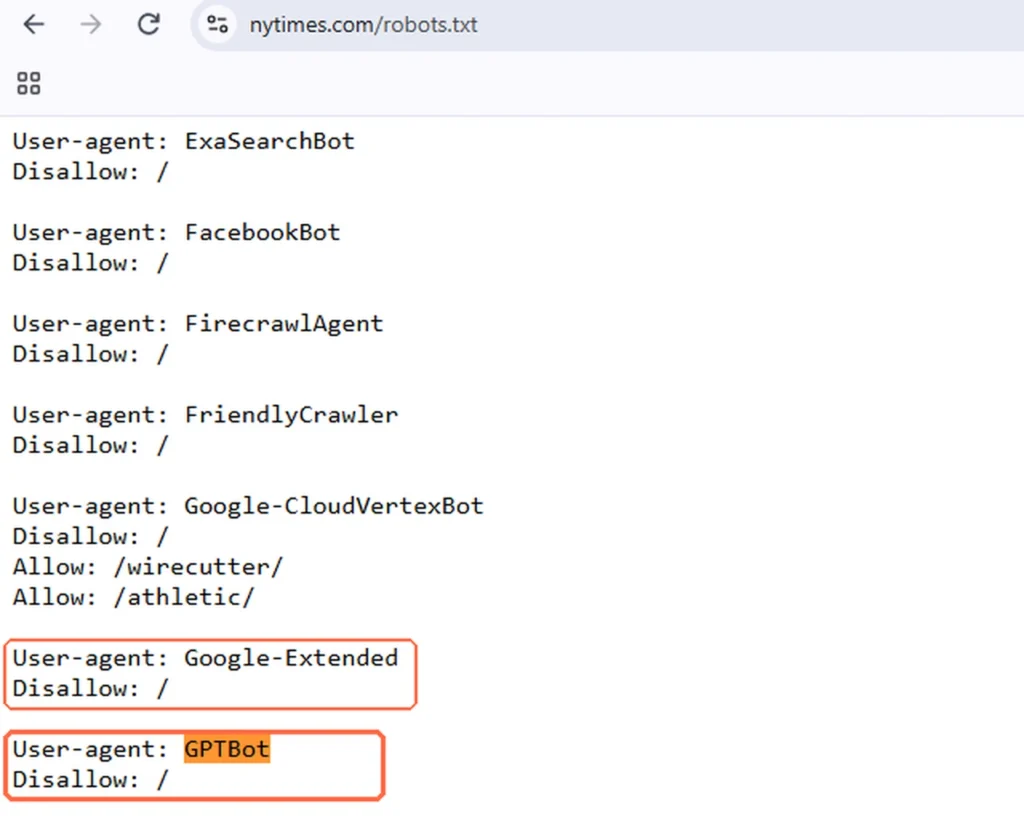
- Check which AI crawlers you allow. Look in robots.txt for GPTBot, OAI-SearchBot, PerplexityBot, ClaudeBot, and Google-Extended. Security plugins and CDNs often block them by accident. Blocking should be a business decision, not a default.
- Serve key content in raw HTML. Many AI crawlers don’t render JavaScript the way Googlebot does.
- Make your entity clear. Organization, Service, and FAQPage schema connect your brand to what you do.
- Structure answers so they’re easy to lift. Direct answers under clear headings get quoted more accurately.
More on this shift in our guide to how AI search is reshaping link building strategies.
When a Technical Fix Won’t Move Rankings (and What Will)
Technical SEO removes the blockers that stop Google from ranking your pages. It can’t make a page more relevant or trusted than competitors. If your site is already crawlable, indexed, and fast, the gap is usually content quality or authority, and backlinks close the authority gap.
| Symptom | Likely cause | What fixes it |
| Pages missing from Google’s index | Technical | Crawl, canonical, and indexing fixes |
| Traffic crashed after a redesign | Technical | Redirect and migration recovery |
| Pages indexed but stuck on page 2–3 | Authority | Relevant, editorial backlinks |
| Thinner competitor pages outrank you | Authority | Link building and digital PR |
| Pages rank but get few clicks | Content | Better titles, meta descriptions, and intent match |
That’s why we run technical, content, and link building as one program at Brimcove. Our in-house team fixes crawl and indexing issues first, then builds authority with manual, editorial placements. A clean site with weak links stalls. Strong links pointing at a broken site get wasted.
If your technical house is in order, managed link building is usually the next lever. Not sure which problem you have? Book a free consultation and we’ll review your Search Console data with you.
Technical SEO Agency FAQs
What does a technical SEO agency do?
It finds and fixes site problems that stop search engines from crawling, rendering, and indexing your pages, including crawl errors, duplicates, slow speed, JavaScript rendering, schema, and migrations. Most also monitor your site so new issues get caught early.
How much does a technical SEO agency cost?
A one-time audit typically runs about $1,500 to $10,000+, depending on site size. Monthly retainers often range from about $1,000 to $7,500+. Migrations cost more because of the planning and QA involved.
How long does technical SEO take to show results?
Quick fixes like redirects can show impact within weeks of Google recrawling the pages. Larger speed or architecture changes usually take three to six months to show clear gains.
Is technical SEO a one-time job?
The audit can be, but sites change constantly. New plugins, redesigns, and content updates introduce new issues, so most growing sites benefit from ongoing monitoring.
Can I do technical SEO myself?
Yes, for small sites. Search Console and Screaming Frog cover the basics. Large sites, JavaScript builds, and migrations usually need specialist experience.
What’s the difference between technical SEO and on-page SEO?
Technical SEO covers infrastructure: crawling, indexing, speed, and rendering. On-page SEO covers page content, like titles, headings, and meta tags. You need both.
Do I need a technical SEO agency for a site migration?
For any migration that changes URLs, domains, or CMS platforms, yes. An agency maps old URLs to new ones, tests redirects before launch, and monitors indexing afterward.
Does technical SEO agency help with AI search visibility?
Yes. AI tools can only cite pages they can access and read. A technical agency makes sure AI crawlers aren’t blocked and key content isn’t hidden behind JavaScript.
