
A SaaS PPC agency plans, runs, and optimizes paid ads for software companies, and judges its work by trials, demos, pipeline, and payback rather than clicks. Plenty of agencies can build a Google Ads account. Far fewer can tell you what a paying customer costs you, or why your cheapest keyword is quietly your most expensive one.
This guide is for founders, heads of marketing, and growth leads deciding if a SaaS PPC agency makes sense. It covers what these agencies do, the metrics that matter, what they cost, how to choose one, and the red flags to watch for.
What is a SaaS PPC agency?
A SaaS PPC agency is a paid media partner that works mainly with software companies. It runs campaigns on Google Ads, Microsoft Ads, LinkedIn, Meta, and review sites, and ties every decision to subscription metrics: trial starts, demo requests, qualified pipeline, customer acquisition cost, and payback.
How it differs from a general PPC agency
A generalist optimizes for the conversion it sees in the ad platform. For a SaaS company, that is usually a signup or form fill, and that is where the generalist’s view ends.
| Area | General PPC agency | SaaS PPC agency |
|---|---|---|
| Success metric | Clicks, CPA, ROAS | Cost per SQL, pipeline, CAC, payback |
| Conversion tracked | Form fill or signup | Signup through activation, SQL, and closed-won |
| Data source | Ad platform and analytics | Ad platform joined with CRM and product data |
| Keyword strategy | Volume and CPC | Buyer intent, competitor and alternative terms |
| Funnel length | One session to a few days | Weeks to months, several stakeholders |
| Offer | Discount or quote | Free trial, freemium, demo, interactive tour |
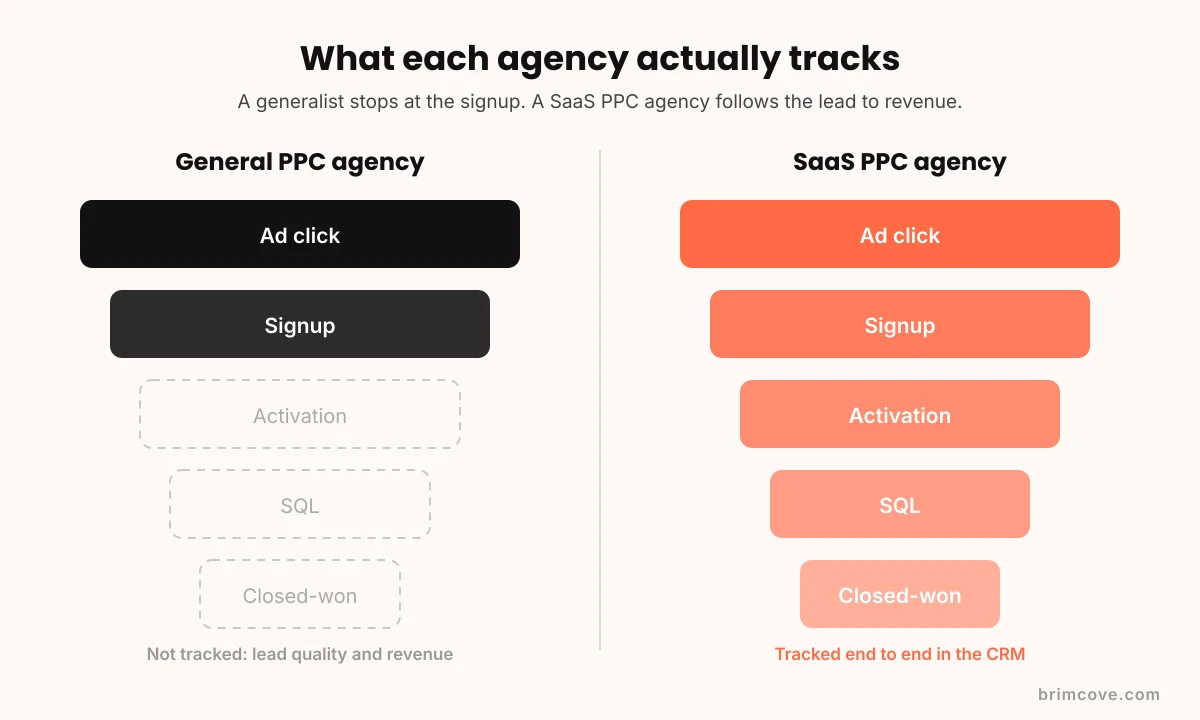
Here is why that matters. A generalist sees two campaigns at $80 per signup and calls them equal. A specialist checks the CRM and finds one produces signups that never activate, while the other converts to paid at 30%. Same CPA, very different business result.
Why hire a specialist (and when not to)
A SaaS PPC agency makes sense when paid media is a serious channel, roughly $10,000 or more a month, your sales cycle runs longer than one session, and nobody in-house can connect ad spend to closed revenue. Below about $5,000 a month, a freelancer or a trained in-house marketer is usually the better buy.
What you actually get
- Pattern knowledge. A SaaS PPC agency running 20 or 30 accounts has already tested competitor campaigns, demo versus trial offers, and LinkedIn lead forms. You buy those lessons instead of paying for them with your own budget.
- Less waste from day one. Software keywords attract people looking for free tools, templates, jobs, and login pages. A specialist excludes them before launch, not after four months of spend.
- Range. One senior hire rarely covers search, LinkedIn, landing page testing, and analytics engineering. A SaaS PPC agency brings all of it, often for less than one experienced paid media manager.
When a SaaS PPC agency is the wrong move
- No working conversion path. If trial-to-paid is unknown or demo show rates are poor, more traffic just exposes the leak faster.
- You can’t share data. Agencies need CRM access, product data, and sales feedback. Without them, expect generic results.
- Paid media is your core engine at large scale. Past roughly $150,000 a month, an in-house team often pays for itself. Many companies end up hybrid: an in-house lead owns targets and data, and the agency owns execution.
How a SaaS PPC agency works
Most engagements follow the same arc: audit, strategy, tracking, build, launch, then a weekly optimization loop. Expect directional signals in month one, reliable cost per SQL or trial data by month three, and payback data once your first customer cohorts mature.
- Audit (weeks 1 to 2). The SaaS PPC agency reviews your ad accounts, analytics, CRM, pricing, and sales process. A good audit names specific waste, such as search terms with spend and zero pipeline.
- Strategy. You agree on the north-star metric, target CAC, and budget split by channel and funnel stage.
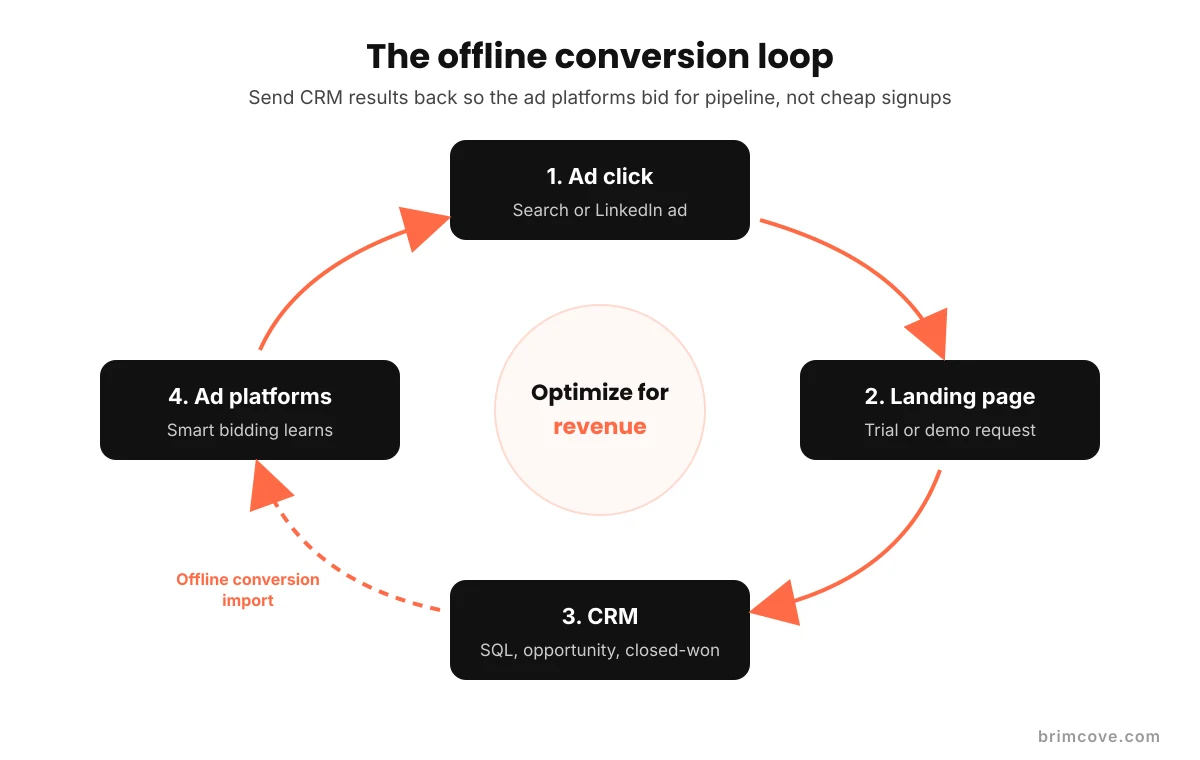
- Tracking. Before new spend, the agency makes sure lead source data reaches your CRM and qualified leads flow back to the ad platforms.
- Keyword and audience research. Keywords are grouped by intent, not volume:
- Brand: your own name, protected cheaply.
- Competitor and alternative: “[competitor] alternative”, “[competitor] vs”.
- High-intent category: “SOC 2 compliance software”.
- Problem-based: “how to automate invoice approvals”, usually better for content offers than trials.
- Ads and landing pages. Copy and pages match the searcher’s stage, not your homepage.
- Launch and learning. Budgets start controlled until the platforms have enough conversion data for smart bidding.
- Optimization. Weekly search term and bid work, monthly pipeline reviews with sales, and a quarterly reset against CAC and payback targets.
Core services a SaaS PPC agency provides
A full-service SaaS PPC agency covers paid search, paid social, review-site ads, retargeting, landing pages, and conversion tracking. Smaller shops may cover only search and LinkedIn, so check which services the retainer includes and which are billed as extras.
Paid search
Google Ads is where high-intent buyers show up and usually the first channel to scale. Microsoft Ads deserves its own line for B2B, since it reaches office desktop users, often at lower CPCs.
Competitor and alternative campaigns
Searchers typing “[competitor] alternative” are already in market and often unhappy. These campaigns need honest comparison pages, a switching offer such as free migration, and copy that respects each platform’s trademark rules.
Paid social
Google captures demand that already exists. LinkedIn creates demand and reaches named accounts by job title, seniority, and company size. Its clicks are expensive, so a SaaS PPC agency uses it for account-based campaigns and retargeting rather than cold trial offers. Meta and Reddit can work for product-led tools with broad or developer audiences.
Review sites and retargeting
Paid placements on G2 and Capterra catch buyers comparing vendors. Retargeting goes past “you visited our site”: pricing page visitors, trial users who haven’t activated, demo no-shows, and closed-lost deals each get a different message.
Landing pages
Ad results are capped by the page the click lands on. A SaaS PPC agency builds or briefs one page per competitor, use case, or persona, and test offers like demo versus trial. Ask who builds the pages. It is the most common gap in proposals.
Conversion tracking and attribution
This is what separates a SaaS PPC agency from a generalist:
- Separate conversion actions for signup, activation, SQL, and closed-won, each with its own value.
- Source data captured on every form and passed into HubSpot, Salesforce, or your CRM.
- Offline conversion imports, so Google and LinkedIn bid toward pipeline instead of signups.
- Reporting that shows pipeline and revenue by campaign, under an attribution model everyone agrees on.
SaaS PPC in 2026: what changed
Google’s paid search is now heavily automated. AI Max for Search is replacing Dynamic Search Ads, Performance Max keeps expanding, and ads are appearing inside AI-driven search results. Automation rewards accounts that feed it pipeline data and punishes accounts that optimize to raw form fills.
AI Max for Search. It is a setting inside a normal Search campaign that matches ads to queries beyond your keyword list, writes copy variations, and can send clicks to other pages on your site. According to Google Ads Help, AI Max is the evolution of Dynamic Search Ads, and Google has said DSA campaigns will be upgraded to AI Max automatically starting in February 2027. For SaaS it behaves like broad match: useful with clean pipeline signals, wasteful with signup-only conversions. A good SaaS PPC agency enables it selectively and restrict which pages it can use.
Performance Max. It runs across Search, YouTube, Display, and Gmail from one campaign. For B2B SaaS it works best as a bounded add-on to Search, mainly for remarketing, with brand exclusions so it can’t take credit for people already searching your name.
Ads in AI search. Google is testing ad formats inside AI-powered results, and buyers increasingly research software through AI answers first. Sharp positioning and strong first-party data matter more as a result.
Automation raises the bar on keyword strategy rather than replacing it, because your keyword lists and negatives now act as guardrails. Our keyword research checklist covers the intent-mapping basics that still apply.
SaaS PPC metrics that matter
The metrics that decide if SaaS PPC is working are CAC, trial-to-paid (or demo-to-close) rate, CAC payback, LTV to CAC, and pipeline per dollar. CTR and CPC are diagnostics. They explain why a business metric moved, but they are never the goal.
CAC
Include the agency fee. CAC quoted on media spend alone flatters the channel.
Trial-to-paid and demo-to-close
This rate turns PPC leads into revenue, and it varies with trial design. First Page Sage’s benchmarks put opt-in trials (no card) at about 18% trial-to-paid, opt-out trials (card required) near 49%, and freemium in the low single digits. Sales-led teams track the chain from demo booked to closed-won. A campaign that doubles signups but halves this rate has produced nothing.
CAC payback period
The 2026 Aleph × Benchmarkit report put the median B2B SaaS payback at 16 months for 2025, down from 18 months in 2024. Under 12 months is widely treated as strong. Paid channels need a shorter payback than your blended number, because they stop producing the moment spend stops.
LTV to CAC and pipeline per dollar
Aim for LTV to CAC of 3:1 or better, and treat it as a ceiling on what you can pay per customer. Sales-led companies with long cycles should also track pipeline per dollar and cost per SQL, the earliest reliable signals.
A worked example
A product-led tool earns $150 per account per month at 80% gross margin. It spends $20,000 a month on search at a $10 CPC and pays a $3,000 agency fee.
| Step | Baseline | After landing page fix |
|---|---|---|
| Clicks | 2,000 | 2,000 |
| Visit-to-trial rate | 4% | 5% |
| Trials | 80 | 100 |
| Trial-to-paid rate | 18% | 18% |
| New customers | 14.4 | 18 |
| Paid CAC (incl. fee) | $1,597 | $1,278 |
| Payback at $120 gross profit/month | 13.3 months | 10.6 months |
One percentage point on the landing page cut payback by almost three months without a single bid change. That is the lens a SaaS PPC agency should bring to every lever.
SaaS PPC agency pricing
Most SaaS PPC agencies charge 10% to 20% of monthly ad spend, or a flat retainer of roughly $1,500 to $10,000 a month depending on scope. Ad spend is billed on top and paid directly to the platforms. Many agencies also set a monthly minimum and a one-time onboarding fee.
| Model | How it works | The catch |
|---|---|---|
| Percentage of spend | A share of monthly media, often tiered down as spend grows | The agency earns more when you spend more, not when you spend better |
| Flat retainer | Fixed fee for a defined scope | Scope creep, and the fee may not flex if spend jumps |
| Hybrid | Base retainer plus a smaller percentage above a threshold | Harder to compare across proposals |
| Performance-based | Fee per SQL or customer, or a revenue share | Rewards lead volume over quality and invites attribution disputes |
Compare flat and percentage fees by dividing the retainer by the rate. A $3,500 retainer against a 12% fee breaks even at about $29,200 of monthly spend. Below that, the percentage is cheaper. Better still, ask each SaaS PPC agency for the all-in monthly cost at today’s budget, double it, and half of it. That exposes minimums, tier jumps, and extras.
What drives cost:
- Number of channels and products, regions, or languages.
- Creative and landing page production, often billed per asset.
- Tracking setup, such as CRM integration and offline conversions, often a one-time project.
- Team seniority and contract length.
Add all three cost lines (media, fees, and setup) to your CAC. And treat pricing far below market with suspicion: it usually means template campaigns and junior account managers.
How to choose the right SaaS PPC agency
Choose on four things: SaaS results you can verify in business metrics, a clear plan for tracking pipeline, the actual people who will run your account, and terms that reward efficient growth. Get your own house in order first, so your SaaS PPC agency spends its first months on growth instead of setup.
Prepare before you talk to agencies
- Unit economics: revenue per account, gross margin, current CAC, and the payback you can afford.
- Funnel rates: visit-to-signup, trial-to-paid or demo-to-close, and sales cycle length.
- ICP and exclusions: company size, industries, roles, regions, and who you never want to pay for.
- Ad, analytics, and tag manager accounts owned by your company, with admin access you can grant.
- One internal owner who can approve budgets, copy, and offers within days.
What to look for
- A track record at your stage and motion. An agency that scales $49 self-serve plans may struggle with a $60,000 ACV enterprise product. Ask for two or three clients like you.
- Case studies with business metrics. Look for cost per SQL, pipeline, CAC, or payback before and after. Lower CPC alone proves nothing.
- Tracking competence. They should explain, unprompted, how CRM data will flow back to the ad platforms.
- The real team. Meet the strategist and specialist who will work on your account, and ask how many other accounts they run.
- Fair terms. You own every account. A short initial term or a 30-day exit after the first 90 days signals confidence.
Questions to ask on the sales call
- What will you optimize toward in month one, three, and six?
- What does your first 90 days look like, week by week?
- How do you set guardrails on AI Max and Performance Max?
- Who builds landing pages, and how many tests do you run per month?
- What’s included in the fee, and what costs extra?
- What would make you recommend we spend less?
The last question is the most revealing. A good partner answers with examples. A weak one changes the subject. To compare finalists, score each from 1 to 5 on SaaS fit, proof, tracking depth, team seniority, and terms, with SaaS fit and tracking weighted double.
Common mistakes and red flags
The costliest SaaS PPC mistakes come from optimizing to the wrong conversion and judging results on the wrong timeline. The biggest agency red flags are vanity reporting, guaranteed results, and a senior pitch followed by a junior handoff.
Mistakes SaaS companies make
- Bidding toward signups. Smart bidding finds the cheapest signups it can, often students, competitors, and free-tool hunters. Bid toward activation, SQLs, or opportunities.
- Leaving broad match unchecked. Without strong conversion signals and negative lists, broad match spends on loosely related queries.
- Blending brand and non-brand. Large brand budgets inflate reported results and hide weak non-brand performance. Report them separately.
- Judging in two weeks, or two years. Allow 60 to 90 days of learning, then hold your SaaS PPC agency to clear targets.
- Withholding sales feedback. If sales never says which leads were junk, the agency can’t fix targeting.
SaaS PPC agency red flags
- Reports built on impressions, clicks, and CTR, with no pipeline view.
- Ads run in the agency’s own accounts, or admin access refused.
- Guaranteed ROAS or lead numbers before they have seen your data.
- No questions about your CRM, ACV, or trial-to-paid rate during the pitch.
- Long lock-in contracts with no performance exit.
- Account managers handling 20 or more clients.
- Monthly pushes for more budget without better CAC or payback.
FAQs about SaaS PPC agencies
Should a SaaS company invest in PPC or SEO first?
PPC buys demand you can measure within weeks. SEO builds demand you own, and it compounds over months. Most SaaS companies run both: PPC to test messaging and capture high-intent searches now, SEO to lower blended CAC over time. Our SaaS SEO checklist covers the organic side.
Can PPC data help other channels?
Yes. Search term reports show the exact words buyers use, which feeds landing pages, sales scripts, and content. Many SaaS teams use paid search to test which topics convert before investing in SaaS link building and organic content around them.
Can we take PPC in-house after working with a SaaS PPC agency?
Yes, and a good agency makes that easy. Because you own the accounts, the structure, history, and conversion setup stay with you. Ask for documentation of campaign logic and negative lists as part of any exit.
Does a SaaS PPC agency write ad creative for LinkedIn and Meta?
Most write copy and brief or produce static creative. Video and complex design are often extra, so confirm it in the scope before signing.
The bottom line
A good SaaS PPC agency earns its fee by connecting ad spend to revenue: clean tracking, intent-matched pages, honest reporting, and the discipline to cut spend that doesn’t pay back. Shortlist a SaaS PPC agency with real SaaS proof, ask the hard questions above, and judge the winner by CAC and payback, not clicks.
