
How does link building help SEO? It is one of the most common questions website owners, marketers, and business leaders ask when trying to improve their search visibility.
Link building is the process of earning hyperlinks from other websites to your own. These links, commonly called backlinks, help search engines discover content and evaluate relationships, relevance, and authority across the web. Although Google’s ranking systems consider many signals, high-quality backlinks remain an important part of how search engines assess the credibility and importance of web pages.
Modern link building is not about collecting as many links as possible. A few relevant, editorially placed backlinks from trusted websites can be more valuable than hundreds of low-quality links.
This guide explains how link building supports SEO, how search engines evaluate backlinks, which strategies work today, how to avoid risky tactics, and how to measure the results of a sustainable link-building campaign.
Quick summary: Link building can support SEO by helping search engines discover pages, strengthening authority and relevance signals, increasing referral traffic, improving brand visibility, and supporting long-term search visibility. However, backlinks work best alongside high-quality content, technical SEO, internal linking, and a positive user experience.
Table of Contents
What Is Link Building?
Link building is the process of acquiring hyperlinks from other websites that point to pages on your own website. These links help users discover content while allowing search engines to crawl websites and understand relationships between pages.
When a reputable website links to your content, it may indicate that your page provides useful information. Search engines evaluate this signal alongside content quality, technical SEO, user experience, relevance, and other ranking factors.
Understanding Different Types of Links
| Link Type | Description | Example |
| Internal links | Connect pages within the same website | A blog post linking to a service page |
| External links | Point from your website to another domain | Citing an official research study |
| Backlinks | Point from another website to your website | An industry blog referencing your guide |
Internal links improve navigation, help search engines discover pages, and distribute importance throughout your website. External links provide supporting references and can strengthen credibility when they point to trustworthy sources. Backlinks are links earned from other websites and remain an important off-page SEO signal.
How Backlinks Work
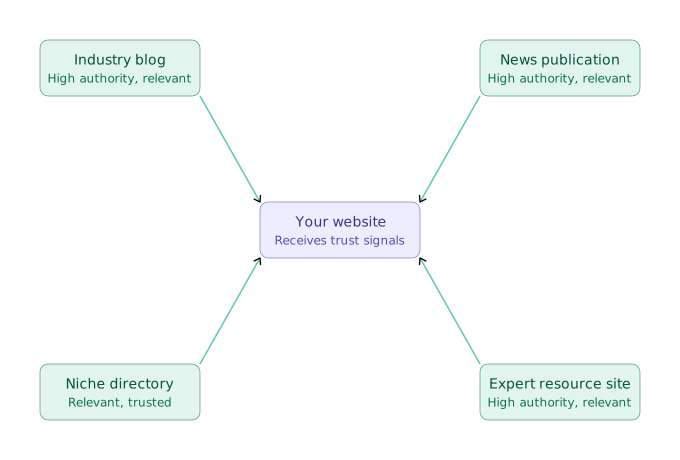
Think of a quality backlink as a recommendation. If an established marketing publication links to your SEO guide because it provides useful information, search engines may interpret that link as a signal that your content deserves attention.
When multiple reputable websites independently reference the same page, your website may build greater authority within that subject area.
How Does Link Building Help SEO?
Link building supports SEO in several ways beyond simply improving rankings. High-quality backlinks can strengthen authority, help search engines discover content, increase referral traffic, improve brand visibility, and reinforce your reputation within a specific industry.
Improves Search Visibility
Backlinks remain an important ranking signal because they can indicate that other websites consider your content valuable. Google’s ranking systems have evolved significantly, but links still help search engines evaluate the importance and relationships of web pages.
For example, if two websites publish similarly useful articles on the same topic, the page supported by stronger, more relevant backlinks may have a competitive advantage. However, backlinks alone do not guarantee rankings.
Builds Website and Topical Authority
Authority develops gradually through valuable content and relevant references from other websites. When respected sources repeatedly mention your content, it can strengthen your reputation within a specific subject area.
Topical relevance matters. For example, a cybersecurity website is more likely to benefit from links from technology publications, security organizations, and relevant industry websites than from unrelated sources.
Helps Search Engines Discover Pages
Search engine crawlers follow links across the web to discover content. A backlink to a newly published article can help search engines find that page, particularly when a website is new, large, or has recently published important product and service pages.
Internal links also play an important role by connecting pages within your own website.
Increases Organic and Referral Traffic
A strong backlink can generate traffic directly from the linking website. For example, a SaaS company featured in an established marketing publication may receive visitors who click through to learn more.
Backlinks can also support organic visibility. If a page earns relevant links and performs well across other SEO areas, it may become more competitive for related search queries.
Improves Brand Visibility and Credibility
Being featured on respected blogs, industry publications, podcasts, and news websites exposes your brand to new audiences. These mentions can increase brand recognition, encourage branded searches, and create additional opportunities for natural backlinks.
Editorial links from reputable publications, professional organizations, universities, industry websites, and established businesses can also reinforce a brand’s credibility.
Important: E-E-A-T—Experience, Expertise, Authoritativeness, and Trustworthiness—is not a single ranking factor that backlinks directly increase. However, credible mentions, expert contributions, research citations, and reputable editorial coverage can support the broader signals associated with a trustworthy online presence.
How Google Evaluates Backlinks
Google does not treat every backlink equally. The value and meaning of a link depend on its context, relevance, source, placement, and the overall quality of the linking website.
Relevance
Topical relevance is one of the most important considerations when evaluating a backlink.
A link from an SEO publication to a keyword research guide is highly relevant. A link from an unrelated website to the same guide may have little contextual value unless there is a legitimate connection between the topics.
The closer the relationship between the linking page, linking website, and destination page, the more meaningful the link is likely to be.
Authority and Trust
The quality and trustworthiness of the linking website also matter. A respected publication with strong editorial standards is generally more valuable than a low-quality website created primarily to publish links.
Third-party metrics such as Domain Authority from Moz and Domain Rating from Ahrefs can help with comparison and prospecting, but they are not official Google ranking factors.
Editorial Placement
Editorial links are included naturally because a publisher believes the linked resource is useful or relevant.
Examples include:
- References within articles
- News coverage
- Research citations
- Expert interviews
- Resource page recommendations
A link placed naturally within useful content generally provides more context than a link placed solely for promotional purposes.
Anchor Text
Anchor text is the clickable text used in a hyperlink. Descriptive anchor text can help users understand where a link leads and provide search engines with additional context.
| Anchor Type | Example | General Use |
| Exact match | SEO audit | Use naturally and sparingly |
| Partial match | Complete SEO audit guide | Useful and natural |
| Branded | Company Name | Common and recommended |
| Naked URL | example.com | Natural variation |
| Generic | Read more | Acceptable in moderation |
A healthy backlink profile usually contains a natural mix of anchor text. Repeatedly using the same exact-match keyword across many backlinks can make a link profile appear manipulative.
Link Context
Search engines can evaluate the surrounding content, not just the hyperlink itself. A backlink placed within a relevant, informative article provides more context than a link hidden in a footer, sidebar, or unrelated section.
The topic of the page, nearby text, section headings, content quality, and usefulness of the link can all contribute to its context.
Dofollow and Nofollow Links
| Attribute | Dofollow | Nofollow |
| Can pass ranking signals | Generally yes | May not pass the same signals |
| Can influence visibility | Directly | Potentially indirectly |
| Can generate referral traffic | Yes | Yes |
| Can increase brand visibility | Yes | Yes |
A standard link without a qualifying attribute is commonly referred to as a “dofollow” link. A nofollow link uses rel=”nofollow” and tells search engines that the publisher does not want the link treated as a typical editorial endorsement.
Nofollow links can still generate referral traffic, increase brand visibility, and contribute to a natural backlink profile.
Natural Growth and Link Diversity
A natural backlink profile may contain links from different relevant sources, including blogs, news websites, industry publications, resource pages, podcasts, professional organizations, and business directories.
A diverse link profile generally appears more natural than one built entirely through a single method. Consistent, genuine interest in your content is also more sustainable than sudden artificial spikes in link acquisition.
Spam Detection
Search engines work to identify manipulative link-building practices. Links from link farms, spam directories, private blog networks, automatically generated websites, hacked websites, and paid schemes designed to manipulate rankings can create unnecessary risk.
The safest approach is to earn links through useful content, legitimate promotion, digital PR, and genuine professional relationships.
Why Quality Matters More Than Quantity
Modern link building is not a numbers game. A few relevant, authoritative backlinks can be more valuable than hundreds of low-quality links.
| High-Quality Backlinks | Low-Quality Backlinks |
| Relevant to your niche | Unrelated to your topic |
| Editorially earned | Paid or manipulated |
| From trusted websites | From spam websites |
| Can drive referral traffic | Little or no real traffic |
| Support topical relevance | Provide little contextual value |
| Natural anchor text | Over-optimized anchors |
The goal is not to acquire the largest number of links. It is to earn links that make sense for users and naturally support your website’s reputation and visibility.
Best Link-Building Strategies That Work
The best strategy depends on your industry, audience, resources, and business goals. Most successful campaigns combine valuable content with targeted promotion and relationship building.
Digital PR
Digital PR involves creating newsworthy content that journalists, bloggers, and publications want to reference.
Examples include:
- Original industry surveys
- Data reports
- Market research
- Trend analysis
- Expert commentary
The strongest digital PR campaigns create a story or resource worth covering rather than simply asking journalists to add a backlink.
Guest Posting
Guest posting involves creating valuable content for another relevant website. The focus should be educating the publication’s audience, not using articles solely to acquire links.
Prioritize websites with:
- Genuine audiences
- Strong editorial standards
- Topical relevance
- Useful, original content
Avoid websites created primarily to sell large volumes of guest post links.
We place guest posts on DR 30–70 sites with real traffic. Manual outreach, in-house content, 6-month guarantee.
See Guest Post Packages ›Resource Page Outreach
Many websites maintain collections of useful resources for their audiences. If you have published a genuinely helpful guide, checklist, tool, template, or research report, you can contact relevant website owners and suggest it as a potential addition.
The resource should genuinely improve the page rather than simply serve as an excuse to request a link.
Broken Link Building
Broken link building involves finding dead links on relevant websites and suggesting a useful replacement.
The process is simple:
- Find broken external links on relevant pages.
- Identify or create a resource that genuinely matches the missing content.
- Contact the website owner.
- Explain the issue and suggest your page as a possible replacement.
This approach can work because you are helping the website owner improve their content.
Original Research and Statistics
Original data often attracts backlinks because publishers prefer citing unique information.
Potential assets include:
- Industry reports
- Customer surveys
- Benchmark studies
- Market analysis
- Internal business data
Statistics pages can also become long-term link-building assets when they are regularly updated and based on reliable sources.
Linkable Assets
A linkable asset is a resource designed to provide enough value that other websites want to reference it.
Examples include:
- Ultimate guides
- Calculators
- Templates
- Interactive tools
- Checklists
- Frameworks
- Original research
A well-designed linkable asset can continue attracting backlinks long after publication.
Expert Contributions and Podcasts
Expert roundups, podcast appearances, interviews, and journalist requests can increase visibility and create legitimate opportunities for mentions and backlinks.
The key is relevance. Contributing to a podcast or publication simply because it offers a link is less sustainable than building relationships with platforms that serve your target audience.
Strategic Partnerships
Partnerships with complementary businesses can create natural opportunities for links and exposure.
Examples include:
- Joint webinars
- Co-authored research
- Industry events
- Partner directories
- Integration pages
- Collaborative case studies
These opportunities work best when both businesses provide genuine value to their audiences.
Local Citations and Industry Directories
For local businesses, reputable local and industry directories can support visibility. Maintain accurate business information, including your name, address, phone number, website, and category.
Avoid submitting your website to hundreds of low-quality directories. Focus on platforms with real users, relevance, editorial standards, or genuine local value.
Link-Building Mistakes to Avoid
Buying Links to Manipulate Rankings
Purchasing backlinks specifically to manipulate rankings can violate search engine spam policies. A better approach is to invest in valuable content, digital PR, and genuine relationships.
Using Spammy Directories
Avoid directories that accept every submission, contain thousands of unrelated websites, or exist primarily to sell links. Use reputable local and industry-specific directories instead.
Using Private Blog Networks
Private Blog Networks, or PBNs, are networks of websites created or controlled primarily to manipulate link authority. They can create short-term opportunities but carry significant long-term risk.
Participating in Link Farms
Link farms are networks or pages created primarily for exchanging or selling links. They often contain thin content, excessive outbound links, and little value for users.
Over-Optimizing Anchor Text
Repeatedly using the same keyword as anchor text across many backlinks can appear unnatural. Use a natural mix of branded, URL, partial-match, descriptive, and occasional exact-match anchors.
Building Irrelevant Backlinks
A cybersecurity publication linking to a cybersecurity guide is contextually relevant. A gardening website linking to enterprise accounting software is unlikely to provide meaningful value.
Prioritize websites with similar topics, audiences, or legitimate business relationships.
Automating Outreach Without Personalization
Sending thousands of identical emails rarely creates meaningful relationships. Research prospects and explain why your resource is relevant to their specific page or audience.
Creating Content That Is Not Worth Linking To
Even the best outreach campaign cannot compensate for weak content.
Before promoting a page, ask:
Would someone voluntarily reference this page in their own content?
If the answer is no, improve the resource before investing heavily in outreach.
Common Mistakes and Better Alternatives
| Mistake | Why It Is a Problem | Better Approach |
| Buying backlinks | Can violate spam policies | Earn editorial links |
| Spam directory submissions | Low-quality signals | Use reputable directories |
| Private Blog Networks | High SEO risk | Build genuine relationships |
| Link farms | Little long-term value | Target relevant websites |
| Exact-match anchor overuse | Can appear manipulative | Diversify anchor text |
| Irrelevant backlinks | Weak topical relevance | Target relevant sources |
| Mass guest posting | Reduces content quality | Publish on trusted websites |
| Automated outreach | Low response rates | Personalize communication |
| Thin content | Difficult to earn links | Create useful resources |
| Quantity-first mindset | Unsustainable | Prioritize quality |
How Long Does Link Building Take?
Link building is a long-term SEO investment rather than a quick ranking tactic. Some backlinks can generate referral traffic immediately, while meaningful changes in organic visibility may take longer.
Results depend on:
- Website age and authority
- Industry competition
- Content quality
- Technical SEO
- Keyword difficulty
- Topical authority
- Quality and relevance of earned backlinks
| Timeframe | What You May See |
| 1 month | Outreach begins, initial backlinks, possible referral traffic |
| 3 months | More referring domains and gradual ranking changes |
| 6 months | Potential growth in organic traffic and search visibility |
| 12 months | A stronger backlink profile and more sustainable SEO growth |
These are general expectations, not guarantees. Search performance depends on the entire SEO strategy, including content, technical optimization, internal linking, and search intent.
How to Measure Link-Building Success
Backlink count alone does not show whether a campaign is successful. Measure links alongside traffic, rankings, visibility, and business outcomes.
Referring domains: Track the number and quality of unique websites linking to your site.
Organic traffic: Monitor traffic growth to pages supported by link-building campaigns, while remembering that content and technical SEO also influence performance.
Keyword rankings: Look for broader keyword visibility, movement into higher positions, and growth across related search terms.
Referral traffic: A backlink that sends qualified visitors can provide significant value even if it has limited direct ranking impact.
Conversions: Track leads, purchases, demo requests, newsletter sign-ups, phone calls, and other meaningful business actions.
Brand mentions: Growing mentions can reveal increasing brand awareness and opportunities to reclaim unlinked references.
Link acquisition rate: Monitor whether you are consistently earning relevant links and referring domains over time.
Link-Building KPI Dashboard
| KPI | Why It Matters | Tracking Frequency |
| Referring domains | Measures backlink diversity | Monthly |
| New backlinks | Tracks campaign progress | Monthly |
| Organic traffic | Shows search growth | Monthly |
| Keyword rankings | Measures visibility | Weekly or monthly |
| Referral traffic | Evaluates link value | Monthly |
| Brand mentions | Measures visibility | Monthly |
| Conversions | Connects SEO to business results | Monthly |
Link Quality Checklist
Before celebrating a new backlink, ask:
- Is the linking website relevant to my industry?
- Does the page appear to have a genuine audience?
- Is the link placed naturally?
- Is the surrounding content high quality?
- Does the link provide value to readers?
- Is the anchor text natural?
- Would I still want this link if search engines did not exist?
The more questions you can answer positively, the more likely the backlink is to support a healthy SEO strategy.
The 47-Point Guest Post Vetting Checklist
The exact criteria we run every publisher through before accepting a placement. Stop wasting money on sites that won’t move your rankings.
- DR and organic traffic minimums by niche
- Red flags that disqualify a site instantly
- How we verify editorial quality vs. link farms
- Anchor text and link placement rules we enforce
Used by 200+ agency teams to vet guest post suppliers.
Best Tools for Link Building
| Tool | Best Used For | Free Access |
| Google Search Console | Search performance and link data | Yes |
| Ahrefs | Backlink analysis and competitor research | Limited |
| Semrush | Backlink research and broader SEO analysis | Limited |
| Moz | Link analysis and authority metrics | Limited |
| Majestic | Backlink intelligence | Limited |
| BuzzSumo | Content and publisher research | Limited |
| Hunter | Finding professional email addresses | Limited |
| Pitchbox | Managing outreach campaigns | No |
| Google Alerts | Monitoring brand mentions | Yes |
Google Search Console helps website owners monitor search performance and link data for their own websites.
Ahrefs and Semrush are useful for backlink research, competitor analysis, referring domain analysis, and prospecting. Moz provides link analysis and third-party authority metrics, while Majestic specializes in backlink intelligence.
BuzzSumo can help identify popular content and influential publishers. Hunter supports contact research, Pitchbox helps manage outreach campaigns, and Google Alerts can monitor brand mentions and potential link reclamation opportunities.
The Future of Link Building
The future of link building is increasingly focused on trust, context, expertise, and relationships rather than link volume.
AI-powered search: As search experiences evolve, original research, expert content, reliable sources, and strong topical coverage will remain important for visibility.
Brand authority: Strong brands naturally attract more mentions and links. Expert commentary, podcasts, events, research, and valuable content can help strengthen brand recognition.
Digital PR: Surveys, reports, trend studies, interactive tools, and expert insights can earn editorial coverage while building broader brand awareness.
Entity SEO: Search engines increasingly understand people, companies, products, organizations, and other entities. Consistent information across authoritative sources can help clarify a brand’s identity and expertise.
Topical authority: Websites that comprehensively cover related topics can build stronger expertise than websites publishing disconnected articles.
Relationship-based outreach: Modern outreach is moving away from mass emailing and toward long-term relationships with journalists, editors, experts, publishers, and industry partners.
The central question is no longer simply:
How can I build more links?
Instead, ask:
How can I create something people genuinely want to reference?
Frequently Asked Questions
What is link building in SEO?
Link building is the process of earning backlinks from other websites to improve a website’s authority, visibility, and search performance.
Does link building still help SEO?
Yes. High-quality backlinks remain an important SEO signal, although they work best alongside excellent content, technical SEO, internal linking, and a positive user experience.
Are backlinks still a ranking factor?
Yes. Links help search engines discover pages and evaluate relationships, relevance, and authority. Quality and relevance matter more than simply increasing the total number of links.
How many backlinks do I need?
There is no universal number. The quality, relevance, and authority of backlinks are more important than the total quantity.
Can you rank without backlinks?
Yes. Websites can rank for low-competition keywords with excellent content and strong technical SEO. Competitive queries often require stronger authority and relevant backlinks.
What makes a good backlink?
A good backlink generally comes from a reputable and relevant website, is placed naturally within useful content, and provides genuine value or context for readers.
How long does link building take?
Some campaigns begin generating referral traffic within weeks, while meaningful SEO improvements may take several months. Competitive industries may require longer.
What is the difference between link building and backlinks?
Backlinks are the actual links pointing to your website. Link building is the process of earning or acquiring those backlinks.
Are nofollow links valuable?
Yes. Nofollow links can generate referral traffic, increase brand awareness, support discovery, and contribute to a natural backlink profile.
What are toxic backlinks?
The term generally refers to links from spammy, manipulative, or extremely low-quality websites. Search engines may ignore many poor-quality links, but deliberately building manipulative links can create risks.
Does guest posting still work?
Yes, when guest content is original, relevant, useful, and published on a quality website. It should not be used as a mass link-placement tactic.
What is digital PR?
Digital PR is the practice of earning media coverage and editorial mentions by creating newsworthy content, original research, expert commentary, data, or compelling stories.
Is buying backlinks safe?
Buying backlinks specifically to manipulate search rankings can violate search engine spam policies. Paid advertising or sponsorship links should be handled using appropriate link attributes.
How can beginners build backlinks?
Beginners can create valuable resources, build industry relationships, contribute to relevant publications, promote original research, participate genuinely in professional communities, and pursue targeted outreach.
Which industries benefit most from link building?
Almost any industry competing for organic visibility can benefit, including SaaS, eCommerce, healthcare, finance, education, real estate, legal services, technology, and local businesses.
Get editorial links from real sites — done for you.
We handle outreach, content, and placement on DR 30–70 sites with genuine traffic. Every link is permanent and backed by a 6-month replacement guarantee.
Conclusion
Understanding how link building helps SEO is essential for anyone trying to improve long-term search visibility. High-quality backlinks can help search engines discover pages, evaluate relevance and authority, increase referral traffic, and improve brand visibility.
However, successful link building is no longer about collecting as many links as possible. Modern SEO rewards relevant, editorial backlinks earned through valuable content, digital PR, strong relationships, and genuine expertise.
If you’re getting started, audit your existing backlink profile, identify content worth promoting, and focus on one or two sustainable strategies. Consistent effort, valuable content, and a user-first approach will outperform shortcuts and manipulative tactics over time.
Treat link building as an ongoing investment—not a one-time task—and combine it with strong content, technical SEO, internal linking, and a positive user experience to build sustainable search visibility.
