
Traditional guest posting remains a useful link-building strategy, but publishing another standard article is becoming increasingly competitive. Editors receive countless pitches, making it harder for ordinary guest posts to stand out.
That is where Guestographics come in.
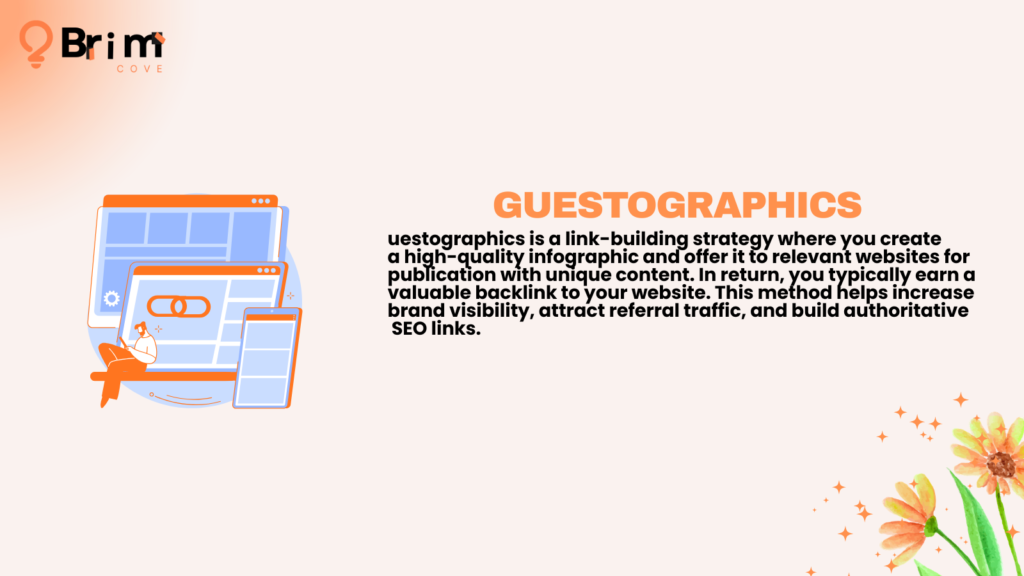
Guestographics combine infographics with guest posting and targeted outreach. Instead of offering only a written article, you create a valuable visual resource that helps publishers explain complex information to their audiences.
A well-planned Guestographic can earn relevant backlinks, increase referral traffic, improve brand visibility, and support your broader SEO strategy. However, success depends on more than creating an attractive graphic. You need the right topic, reliable research, strong design, a useful supporting page, and personalized outreach.
In this guide, you will learn what Guestographics are, how Guestographic link building works, how to create an effective infographic, how to find relevant websites, how to pitch publishers, which mistakes to avoid, and how to measure campaign performance.
Table of Contents
What Are Guestographics?
Guestographics are a visual link-building strategy that combines an infographic with content promotion and targeted outreach.
The process typically involves:
- Researching a relevant topic.
- Creating an original infographic.
- Publishing the infographic with supporting content on your website.
- Finding relevant publishers and websites.
- Promoting the resource through personalized outreach.
- Earning placements, mentions, and backlinks.
For example, a digital marketing company could create an infographic titled “The 2026 SEO Content Promotion Checklist.” The visual might summarize the process using statistics, charts, and practical steps.
The company then publishes the infographic on its website with a detailed article explaining the topic. It reaches out to SEO blogs, marketing publications, and business websites that have published similar content.
A publisher may then feature the infographic in a relevant article and link back to the original resource.
This is the basic idea behind Guestographic link building.
The term Guestographic is commonly associated with combining guest posting and infographics. However, modern campaigns can take different forms. A publisher may:
- Embed the full infographic
- Publish a shortened version
- Use the infographic’s data in a new article
- Feature the visual with an introduction
- Reference the research behind the infographic
The key principle is simple: the infographic must provide genuine value to the publisher’s audience.
Example: You create an infographic explaining the stages of an SEO audit. A marketing website features it in an article about website optimization and links to your detailed guide for readers who want more information.
Unlike traditional guest posts, Guestographics use visual storytelling as the primary content asset. Design, data, charts, and concise explanations make the resource easier to understand and potentially easier to share.
How Guestographics Work
A successful Guestographic campaign follows a repeatable process:
1. Research a relevant topic. Choose a subject your target audience actively cares about. The topic should contain data, steps, comparisons, or information that can be communicated visually.
2. Create the infographic. Organize your research into a clear visual format using charts, icons, statistics, timelines, or step-by-step explanations.
3. Publish supporting content. Create a detailed article on your website that explains the infographic in greater depth. This page becomes the main destination for backlinks.
4. Find relevant websites. Identify blogs, publishers, businesses, and industry websites whose audiences would benefit from the resource.
5. Send personalized outreach. Explain why the infographic is relevant to a specific article or audience.
6. Earn placements and backlinks. Publishers may feature, embed, or reference the infographic.
7. Track performance. Monitor backlinks, referring domains, referral traffic, organic visibility, social shares, and response rates.
Suggested visual:
Topic Research → Data Collection → Infographic Design → Supporting Article → Prospect Research → Outreach → Placement → Performance Tracking
This workflow makes Guestographics easier to manage and repeat.
Why Guestographics Are Effective for SEO
Guestographics can support SEO by combining content marketing, visual communication, outreach, and link acquisition.
The infographic itself does not automatically improve rankings. The SEO value comes from the quality of the resource and the websites that choose to reference it.
Relevant backlinks: A publisher that links to your original infographic or supporting article can create a valuable backlink opportunity. Context and relevance matter more than simply collecting links.
Referral traffic: A placement on a website with an interested audience can send qualified visitors directly to your site.
Brand visibility: Your business can reach audiences that may not have discovered it through search alone. Repeated exposure across relevant publications can strengthen brand recognition.
More content shares: Visual content can be shared through social media, newsletters, presentations, and blogs. Increased visibility can create additional opportunities for natural mentions and links.
Natural link acquisition: A useful Guestographic gives publishers a genuine reason to reference your website instead of simply asking them to add a backlink.
Topical authority: Consistently creating useful visual resources around a subject can support your website’s broader content strategy. For example, an SEO company might publish Guestographics about technical SEO, content marketing, link building, and search trends.
Guestographics vs. Guest Posting
| Factor | Guestographics | Traditional Guest Posting |
| Content type | Infographic with supporting content | Written article |
| Main asset | Visual resource | Blog post |
| Time required | Research, design, and outreach | Research, writing, and outreach |
| Outreach | Pitches a visual asset | Pitches an article or topic |
| Engagement | Strong visual appeal | Depends on writing quality |
| Scalability | One asset may earn multiple placements | Often requires separate articles |
| Best for | Data, processes, statistics, comparisons | Detailed explanations and opinions |
Guestographics do not replace traditional guest posting. They can complement it.
For example, a brand might publish regular guest articles while creating one high-quality infographic every quarter to support a broader content and link-building campaign.
How to Create an Effective Guestographic
The quality of your infographic determines how easy it is to promote. Attractive design cannot compensate for a weak topic or unreliable information.
Choose the right topic
Good Guestographic topics often include:
- Industry statistics
- Trends
- Step-by-step processes
- Checklists
- Comparisons
- Timelines
- Frameworks
- Research findings
- How-to guides
Evergreen topics can continue attracting links over time. A visual guide to the website SEO audit process, for example, may remain useful for years.
Trending topics can generate faster attention when connected to current industry discussions, such as AI adoption in digital marketing.
Keyword research can help identify subjects people are searching for, but search volume should not be your only consideration. Choose a topic with enough substance to communicate visually and a clear audience need.
Collect reliable data
Data gives an infographic credibility. Depending on the subject, useful sources may include:
- Government websites
- Academic research
- Industry reports
- Professional organizations
- Original surveys
- Reputable research institutions
- Official company data
Record the source of important statistics before designing the infographic. Your research sheet can include:
- Statistic or claim
- Original source
- Publication date
- URL
- Context
- How the information will be used
If you conduct original research, explain your methodology clearly.
Follow practical design principles
The goal of an infographic is to make information easier to understand.
- Use a clear visual hierarchy.
- Choose readable typography.
- Use charts only when they improve understanding.
- Use icons to separate concepts.
- Maintain consistent branding.
- Design for mobile screens.
- Keep text concise.
- Use whitespace to avoid clutter.
A good infographic should be easy to scan. Readers should understand the main message without having to read blocks of tiny text.
Create a supporting blog post
Do not publish only an image.
Create a dedicated page that explains the topic in greater detail. The supporting article can:
- Explain key takeaways
- Add context to statistics
- Include research methodology
- Provide examples
- Answer related questions
- Link to relevant resources
This page becomes the primary destination for outreach and backlinks.
For example, an infographic titled “10 Steps to Build a Content Marketing Strategy” can be supported by a detailed guide explaining each step. Publishers may then link to the full resource rather than only an image file.
How to Find Websites for Guestographic Outreach
The best prospects are relevant websites with audiences that would genuinely benefit from your content. Do not focus only on high authority metrics.
Use Google search operators
Try searches such as:
- “infographic” + “digital marketing”
- “SEO statistics” + infographic
- “marketing resources” + SEO
- intitle:infographic + “link building”
- inurl:resources + “content marketing”
- “submit an infographic” + marketing
You can also search for websites that have already published infographics because they may be more receptive to visual content.
Analyze competitor backlinks
Tools such as Ahrefs and Semrush can help you examine competitor backlink profiles. Look for:
- Infographic placements
- Resource pages
- Industry blogs
- Data studies
- Roundups
- Publisher partnerships
- Content references
Do not copy a competitor’s infographic. Use its backlink profile to discover potential publishers, then create something more useful, current, original, or visually effective.
Research industry blogs
Evaluate potential websites based on:
- Topical relevance
- Audience quality
- Content standards
- Organic visibility
- Recent publishing activity
- Existing visual content
- Editorial fit
A smaller website with a highly relevant audience may be more valuable than a large but unrelated publication.
How to Pitch Guestographics
Guestographic outreach should focus on the publisher’s audience rather than your desire for a backlink.
A strong pitch answers three questions:
Why are you contacting this publisher? Mention a specific article, topic, or section of their website.
Why is your resource relevant? Explain what the infographic covers and how it could help their readers.
What action are you requesting? Make the next step simple. Ask whether they would be interested in reviewing the resource or discussing a possible feature.
Outreach Email Template
Subject: Infographic idea for [Website Name]
Hi [First Name],
I was reading your article about [specific topic] and found the section about [specific detail] particularly useful.
We recently created an infographic about [topic] that summarizes [key information or benefit] in a visual format.
I thought it could be relevant to your readers because [specific reason].
You can view it here: [URL]
If you think it would be useful for your audience, I would be happy to discuss a possible way to feature it on your website.
Best,
[Your Name]
Follow-Up Template
Subject: Re: Infographic idea for [Website Name]
Hi [First Name],
Just following up on my previous email about the [topic] infographic.
I thought it might be a useful visual resource for your article about [specific topic]. No problem if it is not a fit—I simply wanted to make sure my previous message did not get buried.
Best,
[Your Name]
Keep follow-ups polite and brief. If a publisher does not respond after reasonable attempts, move on.
Best Outreach Tips
Contact the right person. Editors, content managers, marketing managers, and website owners may be more appropriate contacts than generic inboxes.
Personalize every email. Mention the publisher’s content and explain why your resource fits.
Focus on audience value. Explain how the infographic can simplify a topic, add useful data, or improve the reader experience.
Include a preview. A small image preview can help the recipient understand the asset quickly.
Keep emails short. Your goal is to create interest, not explain every detail of your research.
Do not demand a backlink. Let the value of your resource support the conversation.
Track outreach. Record the website, contact person, date contacted, follow-up date, response, and outcome.
Common Guestographic Mistakes
Poor design: Cluttered layouts, tiny text, and inconsistent fonts make information difficult to understand.
Low-quality data: Unverified or outdated statistics can damage your credibility.
Generic outreach: Identical emails make campaigns feel automated and reduce response rates.
Irrelevant websites: A link from an unrelated website may provide little value to your audience.
Keyword stuffing: Do not force exact-match keywords into infographic text, outreach emails, or anchor text.
Copyrighted graphics: Use original, licensed, or properly permitted visual assets.
Weak landing pages: A page with only an image provides little context for visitors or publishers.
No promotion plan: Even an excellent infographic may remain invisible without outreach and promotion.
Too much information: A longer infographic is not automatically better. Remove anything that does not support the main message.
Tools for Creating Guestographics
Canva: Best for beginners and marketers who need templates and quick drag-and-drop design.
Adobe Illustrator: Ideal for professional designers who need detailed control over vector graphics and complex layouts.
Figma: Useful for collaborative teams that need to review, edit, and comment on designs together.
Piktochart: Designed for infographics, reports, and data visualization.
Venngage: Useful for businesses and marketing teams that want infographic templates and visual communication tools.
The best tool is the one that helps you create an accurate, readable, and professional resource.
How to Measure Guestographic Success
Backlinks are important, but they are not the only performance metric.
Track:
- Backlinks earned: Links pointing to your infographic or supporting article
- Referring domains: The number of unique websites linking to the resource
- Referral traffic: Visitors generated by placements
- Organic traffic: Search traffic to the supporting page
- Keyword rankings: Visibility for relevant search terms
- Social shares: How often the resource is shared
- Outreach response rate: Positive responses compared with emails sent
- Placement quality: Relevance, editorial quality, and audience value
Five highly relevant placements that send qualified traffic may be more valuable than 50 low-quality links.
The goal should be to create useful resources and earn relevant editorial coverage, not manufacture links at scale.
Guestographics Best Practices
Follow these principles when planning a campaign:
- Choose a topic your audience genuinely cares about.
- Use original research whenever possible.
- Verify and cite important statistics.
- Prioritize readability over decoration.
- Design for mobile users.
- Use consistent branding.
- Publish supporting content on your website.
- Target relevant publishers.
- Personalize every outreach email.
- Focus on audience value rather than link count.
- Avoid mass automated outreach.
- Track placements and referral traffic.
- Update evergreen infographics when important data changes.
- Repurpose successful visuals into social posts, newsletters, and supporting articles.
The strongest Guestographics strategy combines content quality with relationship building. The infographic starts the conversation, but relevance and value determine whether publishers want to share it.
Real-World Guestographic Ideas
Almost any industry can use visual link building when information can be communicated clearly.
Ideas include:
- SEO statistics: Search trends, content marketing statistics, or link-building data
- Link-building trends: Campaign workflows, strategies, or industry benchmarks
- Local SEO checklist: Business profiles, citations, reviews, and local content
- AI in digital marketing: AI use cases in content, analytics, automation, and customer service
- E-commerce growth: Shopping trends, customer behavior, and conversion data
- Social media statistics: Platform usage, engagement, and content performance
- Website launch checklist: Design, content, analytics, technical SEO, and promotion
- Content marketing workflow: How research becomes a published and promoted asset
The best topic depends on your audience, available data, and the publishers you want to reach.
Frequently Asked Questions
What is a Guestographic?
A Guestographic is a link-building approach that uses an infographic as the primary content asset. A brand creates a useful visual resource, publishes supporting content, and promotes it to relevant publishers that may feature or reference it.
Are Guestographics still effective?
Yes. Guestographics can still work when the content is original, useful, visually clear, and promoted to relevant websites. Their success depends on resource quality and outreach relevance.
Do Guestographics improve SEO?
Guestographics can support SEO by helping websites earn relevant backlinks, referral traffic, brand visibility, and content mentions. However, no single link-building tactic guarantees higher rankings.
How many backlinks can one Guestographic generate?
There is no fixed number. A campaign may earn a few highly relevant links or attract references from many websites. Results depend on the topic, research quality, promotion, and audience interest.
What is the difference between an infographic and a Guestographic?
An infographic is a visual presentation of information. A Guestographic is a link-building strategy that uses an infographic as the main asset and promotes it through targeted outreach.
Do I need design skills to create a Guestographic?
No. Tools such as Canva, Piktochart, and Venngage can help beginners create professional visuals. Basic knowledge of hierarchy, spacing, contrast, and readability is still useful.
Which industries benefit most from Guestographics?
Industries with statistics, research, processes, or educational content often benefit. These include marketing, SEO, technology, finance, e-commerce, education, real estate, and many others.
Can AI help create Guestographics?
AI can help brainstorm topics, organize information, and create outlines. However, research must be independently verified, and the final design should be reviewed for accuracy, originality, and quality.
Should I publish an infographic without supporting content?
You can, but a supporting article usually creates a stronger resource. Written content adds context, answers related questions, and gives publishers a more useful page to reference.
Are infographic backlinks valuable?
They can be valuable when they come from relevant, trustworthy websites and are placed naturally within useful content. The quality and context of the referring website matter more than the number of links.
Conclusion
Guestographics combine visual content, data, outreach, and link building into one practical SEO strategy.
The process is straightforward: choose a valuable topic, research it carefully, create a useful infographic, publish supporting content, find relevant websites, and conduct personalized outreach.
The most successful campaigns do not treat infographics as shortcuts to backlinks. They create resources that publishers genuinely want to share because they make information easier to understand and more useful to their audiences.
Focus on:
- Original research
- Accurate information
- Strong visual design
- Relevant publishers
- Personalized outreach
- Useful landing pages
- Consistent performance tracking
If you want to scale visual link building without managing every part of the process yourself, BrimCove provides Guest Posting Services and Link Building Services designed around targeted outreach and relevant editorial placements.
A well-executed Guestographic can become more than a single backlink asset. It can attract referral traffic, strengthen brand visibility, support content promotion, and create valuable relationships with publishers in your industry.
Start with one useful visual resource, promote it to the right audience, measure what works, and improve your strategy with every campaign.
Recommended visuals:
- Guestographic workflow diagram
- Guest Posting vs. Guestographics comparison table
- Guestographic outreach funnel
- Infographic design checklist
- Guestographic outreach process
- Example Guestographic mockup
