
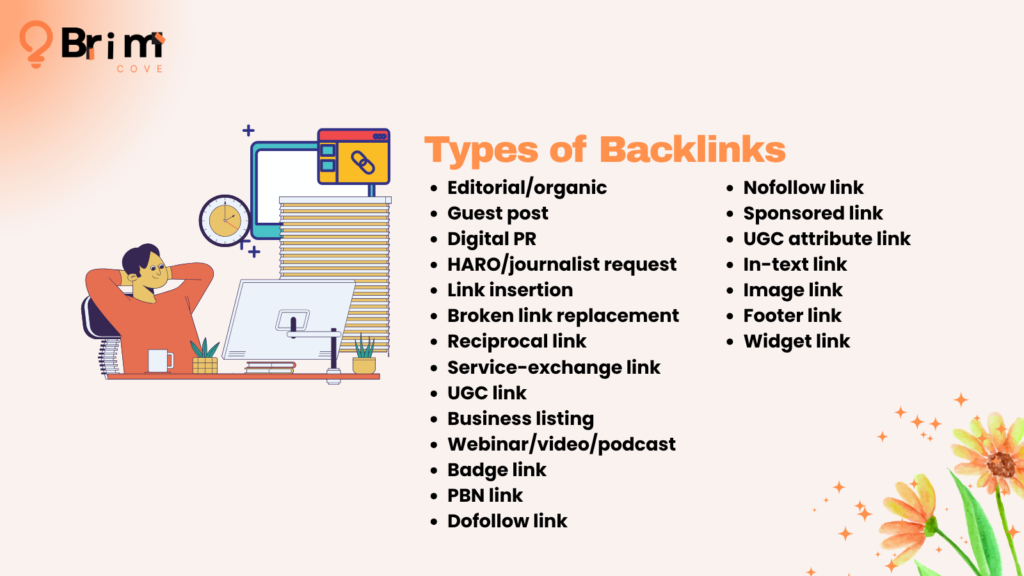
Backlinks are links from one website to another, and they remain an important part of how search engines discover and evaluate content. But getting more links is not the same as building a better backlink profile. A link from a relevant publication can be far more useful than dozens of unrelated directory links, while some methods can create more risk than value.
That is why understanding the Types of Backlinks matters. Different links are created in different ways, carry different attributes, appear in different parts of a page, and serve different purposes. Some can contribute to search visibility, while others are mainly useful for referral traffic, brand exposure, or credibility.
A healthy backlink profile is also rarely made up of one type alone. Natural websites tend to collect links from different sources over time: editorial mentions, industry publications, directories, podcasts, communities, and other relevant websites. The goal is not to manufacture a perfect ratio. It is to earn useful links that make sense for your audience and business.
Table of Contents
Backlink Types at a Glance
The table below gives you a quick way to compare the main types covered in this guide. “SEO value” is a practical indication rather than a guarantee; relevance, authority, placement, context, and how the link was acquired all matter.
| Backlink type | Typical source | Typical SEO value |
| Editorial/organic | Articles, research, guides, news stories | High |
| Guest post | Relevant industry publications | Situational |
| Digital PR | News sites, media coverage, industry publications | High |
| HARO/journalist request | Expert quotes and media articles | High |
| Link insertion | Existing relevant articles | Situational |
| Broken link replacement | Pages containing dead links | Medium |
| Reciprocal link | Partner or industry websites | Situational |
| Service-exchange link | Client/vendor websites | Low / risky |
| UGC link | Forums, Q&A sites, comments | Low |
| Business listing | Local and industry directories | Medium |
| Webinar/video/podcast | Event pages and media platforms | Medium |
| Badge link | Awards, certifications, recognition pages | Medium / situational |
| PBN link | Privately controlled websites | Risky |
| Dofollow link | Standard HTML link | High / situational |
| Nofollow link | Links marked rel=”nofollow” | Situational |
| Sponsored link | Paid placements or advertising | Low for ranking / useful for traffic |
| UGC attribute link | User-generated content | Low / situational |
| In-text link | Main body copy | High |
| Image link | Clickable images or banners | Situational |
| Footer link | Website footer | Low / situational |
| Widget link | Embedded tools or widgets | Risky / situational |
Backlink Types by Link-Building Process
The first way to understand backlinks is by how they are acquired. This is usually the most useful classification when planning a link-building campaign because it tells you what action is required to earn each link.
1. Editorial/organic backlinks
An editorial backlink is earned because another website genuinely wants to reference your content. The publisher chooses to link to your page without you arranging a direct exchange for the link.
For example, a marketing website might publish original research about consumer behavior and another publication may cite that research in an article. The resulting link is an editorial backlink.
These links can be especially valuable because they often come from relevant pages where the link has a clear reason to exist. Strong candidates for earning them include:
- Original research and surveys
- Useful statistics and industry data
- Detailed guides and resources
- Original tools or calculators
- Expert commentary
- Case studies
- Unique reports and studies
The challenge is that you cannot fully control when or where someone links to your content. Your job is to create something worth referencing and make it easy for publishers, writers, and readers to discover.
Best use: Build long-term authority and earn links naturally.
2. Guest post backlinks
Guest posting involves contributing an article to another website and receiving a link within the content or author information.
When done properly, guest content can introduce your expertise to a relevant audience and generate referral traffic as well as a backlink. The publication should be relevant to your subject, and the article should be useful on its own rather than existing mainly to place a link.
The biggest issue is scale. Publishing large numbers of low-quality articles on unrelated sites, especially with keyword-heavy anchors, can turn guest posting into a link scheme. Google specifically includes links in guest posts among the practices that can violate its spam policies when they are used to manipulate rankings.
A better approach is to prioritize relevance, editorial standards, and genuine expertise. One strong contribution to a respected industry publication can be more useful than dozens of thin guest posts.
Best use: Expertise, referral traffic, brand exposure, and selective link acquisition.
3. Digital PR backlinks
Digital PR focuses on getting your company, experts, research, or campaigns covered by online publications.
A successful digital PR campaign might involve:
- Publishing original research
- Releasing new industry data
- Offering expert commentary on current events
- Creating newsworthy campaigns
- Producing surveys or reports
- Pitching useful stories to journalists
The important distinction is that digital PR is not simply distributing a press release and expecting links. The story needs a reason for journalists and publications to care.
A media mention may include a link, but even when it does not, the exposure can still introduce your brand to new audiences. More importantly, strong PR coverage can lead to secondary editorial links when other writers discover and reference the story.
Best use: High-authority media exposure, brand awareness, referral traffic, and earning secondary links.
4. HARO and journalist-request backlinks
Journalist-request platforms connect reporters or publishers with people who can provide expert information for their stories. A successful response may result in your quote, expertise, or company being mentioned in an article, sometimes with a link.
The HARO ecosystem has changed considerably, so older SEO guides can contain outdated information. Cision discontinued its version of Connectively in December 2024, but Featured acquired HARO in 2025 and relaunched it. In 2026, HARO operates as a journalist-request newsletter, while Connectively has also returned as a searchable platform under the same ownership.
Other journalist-request services also exist, so the basic tactic remains the same: monitor relevant requests, respond quickly, and provide a concise answer that demonstrates genuine expertise.
A strong pitch should answer the journalist’s question directly instead of sending a generic biography or promotional paragraph. If the response is selected, the resulting coverage can provide a valuable mention from a publication relevant to your field.
Best use: Earned media, expert positioning, relevant editorial links, and brand visibility.
5. Link insertions
A link insertion is added to an existing article or resource rather than a newly published piece.
Suppose you have a detailed guide about choosing commercial insurance. You find an established article about business insurance that discusses the topic but does not reference a useful resource. You can contact the publisher and explain why your guide would improve that section.
The strongest opportunities are pages where your resource genuinely fills a gap. If the only reason for contacting the website is to place a link, the request is much less convincing.
Best use: Strengthening existing relevant content when your resource genuinely adds information.
6. Broken link replacement
Broken link building starts with a dead or outdated link on another website. You then identify a relevant page on your own site that could replace the missing resource.
The process is straightforward:
- Find relevant pages containing broken external links.
- Check what the original resource was about.
- Create or identify a suitable replacement.
- Contact the site owner or editor.
- Explain the problem and suggest your resource as an alternative.
The key is relevance. A broken link about technical SEO should not be replaced with a generic homepage simply because the domain has strong authority.
Best use: Recovering lost usefulness on existing pages while earning contextually relevant links.
7. Reciprocal backlinks
A reciprocal backlink occurs when two websites link to each other.
There is nothing inherently unusual about websites linking to one another. Businesses, partners, associations, suppliers, and professional relationships naturally create these connections. The problem begins when exchanging links becomes the primary reason for creating the relationship.
Google lists excessive link exchanges and partner pages created mainly for cross-linking among its link-spam examples.
If two companies genuinely collaborate and each site independently has a reason to reference the other, the links can make sense. But arranging large-scale “you link to me, I link to you” campaigns is a different matter.
Best use: Genuine partnerships and useful cross-references, not ranking manipulation.
8. Service-exchange backlinks
Some websites receive links from clients or vendors after providing services such as design, development, consulting, hosting, or marketing.
For example, a web agency might build a website for a business and ask the client to place the agency’s link in the footer. Although this may look like a normal business relationship, exchanging goods or services specifically for links can fall under Google’s link-spam policies.
This makes service-exchange links a poor foundation for an SEO strategy. If a client independently chooses to mention your company because it genuinely worked with you, that is different from making the backlink a condition of the service.
Best use: Genuine client or partner references, without making the link part of a ranking-focused exchange.
9. UGC backlinks
UGC, or user-generated content, includes links placed by users rather than the site’s editorial team. Common examples include forums, community discussions, Q&A websites, reviews, and comments.
These links can bring useful referral traffic when they genuinely answer a question. For example, a specialist might participate in a relevant discussion and reference a detailed guide that helps solve the problem.
However, dropping links into unrelated discussions is unlikely to help. It can also create spam and damage the reputation of the brand being promoted.
Google recommends using the ugc attribute for links placed in user-generated content such as comments and forum posts.
Best use: Community participation, referral traffic, and brand discovery rather than aggressive link building.
10. Business listing and directory backlinks
Business listing links come from company profiles on directories, local platforms, professional associations, review sites, and industry-specific listings.
They are particularly useful for local businesses because the profile can connect your company with a specific location, service, and category. A complete listing may also provide customers with your address, phone number, opening hours, reviews, and website.
The important part is quality over quantity. Creating profiles on hundreds of weak directories just to collect backlinks is unlikely to create meaningful value. Focus on established platforms, legitimate local directories, and directories that are genuinely relevant to your industry.
For local businesses, a consistent and complete online presence can support discovery beyond the backlink itself.
Best use: Local visibility, referral traffic, citations, and basic authority signals.
11. Webinar, video, and podcast backlinks
Appearing as a guest on a webinar, podcast, interview, or video can create several opportunities for links. A host may link to your website from the episode page, speaker profile, show notes, or video description.
The SEO value varies significantly by platform. Some links may be useful for discovery and referral traffic without becoming a major ranking signal.
The bigger advantage is often the audience. A relevant podcast with a highly engaged niche audience can be worth pursuing even when the link itself contributes little direct ranking value.
Best use: Brand exposure, referral traffic, expert positioning, and relationship building.
12. Badge backlinks
Badge links are created when a website gives another business or organization a digital badge, award, certification, ranking, or recognition that links back to the awarding site.
For example, an industry publication could recognize the “Top 20 Local Agencies” and provide each winner with a badge linking to the ranking page.
This can work when the recognition itself is legitimate and useful. But creating fake awards solely to distribute backlinks can quickly become manipulative.
Best use: Genuine awards, certifications, rankings, and industry recognition.
13. PBN backlinks
A private blog network, or PBN, is a group of websites controlled by one person or organization and used to create backlinks to another site.
PBNs can appear attractive because the owner controls the websites, content, and links. That same control is the problem: the network is deliberately created to influence search rankings rather than because those websites independently deserve to exist.
Google’s spam policies prohibit link schemes designed to manipulate ranking signals, including tactics intended to artificially influence links and PageRank.
For a sustainable SEO strategy, PBNs should not be treated as a recommended link-building method. They may create short-term gains in some cases, but the underlying model depends on manipulating the link graph and carries unnecessary risk.
Best use: None as a recommended long-term strategy.
Backlink Types by Link Attribute
The way a backlink is marked in HTML tells Google more about the relationship between the linking website and the destination. The four attributes you will encounter most often are dofollow, nofollow, sponsored, and UGC.
Understanding these labels is important because a backlink’s value is not determined simply by whether it is technically “dofollow.” Context, relevance, placement, and the reason the link exists all matter.
1. Dofollow backlinks
A dofollow backlink is essentially a normal link without a rel attribute that tells Google to treat it differently. There is no actual rel=”dofollow” tag required.
For example:
<a href=”https://example.com/seo-guide”>SEO guide</a>
When a publisher naturally links to a useful resource and does not need to qualify the relationship, a standard link is appropriate. Google can crawl these links and uses links among its signals for discovering pages and understanding relevance.
However, dofollow does not automatically mean high value. A standard link from an irrelevant, low-quality page may be less useful than a nofollow link from a respected publication that sends highly relevant referral traffic.
That is why chasing a specific number of dofollow links is not a reliable SEO strategy.
Best use: Natural editorial references and genuine recommendations.
2. Nofollow backlinks
A nofollow backlink uses:
<a rel=”nofollow” href=”https://example.com”>Example</a>
Google originally introduced nofollow to help combat comment spam and later expanded its use to paid and other links that publishers did not want to endorse. Since 2020, Google treats nofollow as a hint rather than an absolute instruction for its search systems.
Google currently recommends nofollow when other relationship attributes do not apply and you do not want your site to be associated with the linked page or want to signal that Google should not follow the link from your site.
A nofollow link can still be useful. It can send visitors, increase brand awareness, help people discover your content, and potentially lead to additional organic mentions.
For example, a link from a major publication may be marked nofollow but still put your brand in front of thousands of relevant readers.
Best use: Untrusted external links, certain paid relationships, and situations where you do not want to imply endorsement.
3. Sponsored backlinks
A sponsored link uses:
<a rel=”sponsored” href=”https://example.com”>Example</a>
Google recommends the sponsored attribute for links created through advertising, sponsorships, or other compensation agreements.
This distinction matters because paying for a link and presenting it as an ordinary editorial recommendation can create a misleading signal. If a company pays a publisher for placement, the relationship should be identified appropriately.
Google still accepts nofollow for sponsored links, but recommends sponsored as the preferred attribute.
A sponsored link can still have considerable marketing value. The purpose of qualifying it is not to make the placement useless. It tells search engines what kind of relationship exists.
Best use: Paid articles, advertisements, sponsorships, and compensated placements.
4. UGC backlinks
The ugc attribute stands for user-generated content. Google recommends it for links placed in areas such as comments and forum posts.
Example:
<a rel=”ugc” href=”https://example.com”>Useful resource</a>
If your website allows users to submit content, automatically qualifying their links can help prevent your site from appearing to endorse every website that users mention. Google also allows ugc to be combined with nofollow, such as rel=”ugc nofollow”.
UGC links can still have practical value. A genuinely helpful forum answer can introduce your website to people who are actively looking for a solution. The objective should be participation and usefulness, not dropping links wherever possible.
Best use: Forums, comments, community posts, and other user-created content.
Backlink Types by Placement on a Page
Where a link appears can affect how useful it is to readers and how naturally it fits into the page. Placement also changes the context surrounding the link.
1. In-text backlinks
An in-text backlink appears within the main body of an article or resource.
For example, an article explaining technical SEO might naturally link to a detailed guide about crawling and indexing. Because the link is surrounded by relevant information, readers can immediately understand why it is there.
In-text links are generally the most natural type of editorial placement. The surrounding content provides context, while descriptive anchor text helps users and search engines understand the destination. Google recommends concise, descriptive, relevant anchor text rather than vague phrases.
This does not mean every in-text link is valuable. A link can still be weak if the page is irrelevant, the content is poor, or the placement is obviously promotional.
Best use: Editorial references, supporting evidence, resources, and relevant guides.
2. Image backlinks
An image backlink occurs when an image itself is clickable and points to another page.
Common examples include:
- Infographics
- Product images
- Brand logos
- Charts
- Badges
- Banners
- Original illustrations
For image links, Google can use the image’s alt text as anchor text, so descriptive alt text is important when the image serves as a link.
Image links can generate referral traffic and are particularly useful when the visual itself is the reason for the reference. For example, an original chart may be embedded by another publication with a link back to the research behind it.
However, using decorative images as a way to force keyword-rich backlinks is not a good strategy.
Best use: Original visuals, research graphics, infographics, and legitimate brand references.
3. Footer backlinks
Footer links appear at the bottom of a website and are usually repeated across many or all pages.
Some footer links are completely legitimate. A website may link to its parent company, professional association, developer, accessibility statement, or other important resource.
The problem is when a footer is used to create hundreds or thousands of keyword-rich external links purely for SEO.
A link appearing on every page does not automatically become more valuable because it is repeated. In fact, excessive sitewide external links can look unnatural when they have no clear purpose for users.
Best use: Necessary business, legal, ownership, attribution, or navigational references.
4. Widget backlinks
Widget links are associated with embedded tools, badges, calculators, maps, reviews, or other third-party widgets.
For example, a company may create an embeddable calculator that other websites add to their pages. If the widget automatically inserts an optimized backlink, the creator can end up with large numbers of links that were not independently chosen by site owners.
This is where caution is necessary. Automated links distributed through widgets can become a link-manipulation tactic when the primary purpose is generating backlinks rather than providing a useful tool.
A better approach is to make the widget genuinely useful and avoid forcing keyword-rich links into every installation.
Best use: Useful embedded resources, provided the linking setup does not attempt to manipulate rankings.
Which Backlinks Actually Help Rankings?
Not every backlink should be judged by the same standard. A link can be valuable without directly improving rankings, and a technically standard link can still have little practical impact.
The most useful links for SEO generally have several characteristics:
- They come from a relevant website or page.
- They are placed naturally within useful content.
- They exist because the destination provides genuine value.
- The linking page itself has a real audience.
- The anchor text makes sense in context.
- The link is not part of an obvious manipulation scheme.
Google says links can help its systems understand what content may be useful and can help it discover new pages. It also recommends earning links naturally rather than using methods that violate its link-spam policies.
| Backlink type | Ranking potential | Main benefit |
| Editorial backlink | High | Authority and relevance |
| Digital PR link | High / situational | Authority, visibility, referral traffic |
| Relevant expert/media link | High / situational | Trust and exposure |
| Strong guest post link | Situational | Expertise and referral traffic |
| Relevant link insertion | Situational | Contextual relevance |
| Broken-link replacement | Medium / situational | Relevant referral and authority |
| Business directory | Medium / situational | Local visibility and discovery |
| Podcast/webinar link | Medium / situational | Audience and brand exposure |
| UGC link | Low / situational | Referral traffic and community visibility |
| Nofollow media link | Situational | Traffic, awareness, possible indirect benefits |
| Sponsored link | Low for ranking | Paid exposure and traffic |
| Footer link | Usually low | Navigation or attribution |
| PBN link | Risky | Artificial ranking manipulation |
The important takeaway is that there is no single backlink type that guarantees rankings. A relevant editorial link can be excellent, but hundreds of irrelevant links will not necessarily outperform it.
Similarly, a nofollow link should not automatically be dismissed. If it sends qualified visitors, builds brand recognition, or helps a journalist discover your company, it can still contribute to your broader marketing goals.
How to Build a Healthy Backlink Mix
A natural backlink profile develops from different activities rather than one repeatable tactic.
Start by creating assets that people have a reason to reference. Original research, useful tools, expert commentary, statistics, strong guides, and genuinely helpful resources give other websites something worth linking to.
Then combine several acquisition methods.
Earn editorial mentions. Publish information that solves a real problem or provides something difficult to find elsewhere.
Use digital PR selectively. Give journalists a strong reason to cover your research, expertise, campaign, or data.
Build industry relationships. Partnerships, interviews, podcasts, webinars, conferences, and professional communities can create legitimate opportunities for exposure and references.
Pursue relevant link opportunities. Broken links and suitable existing articles can be worthwhile when your resource genuinely improves the page.
Maintain legitimate listings. For local and specialized businesses, relevant directories and associations can help customers find the company.
Do not force every link to look identical. Natural backlinks can point to different pages, use different anchor text, and come from different types of websites.
You also do not need to manufacture a specific percentage of nofollow, UGC, or dofollow links. There is no universal “perfect backlink ratio.” Instead, look at whether the links make sense based on how your business actually earns attention online.
A software company may naturally earn links from technology publications and review sites. A restaurant may receive links from local directories, food publications, travel websites, and bloggers. A university may attract references from research papers, news sites, academic resources, and organizations.
The backlink profile should reflect the business rather than an SEO template.
Common Backlink Mistakes to Avoid
1. Building only dofollow links
One of the most common mistakes is treating dofollow links as the only links worth pursuing.
Real websites naturally receive different kinds of mentions. Some links are nofollow, some are UGC, some are image links, and some may simply be citations or brand mentions without a ranking-focused purpose.
Focus on earning legitimate exposure rather than hitting a dofollow target.
2. Ignoring relevance
A link from a powerful website is not automatically useful if the topic has nothing to do with your business.
Relevance gives the link context. A backlink from a respected industry resource can make more sense than a link from an unrelated website with a higher general authority metric.
3. Using the same anchor text repeatedly
If every website uses exactly the same commercial keyword to link to your page, the pattern may look unnatural.
Anchor text should describe the destination and fit naturally into the sentence. Google recommends descriptive and relevant anchor text that helps readers understand the linked page.
4. Buying links for ranking purposes
Paying for advertising is not the same as secretly buying ranking signals.
If a placement is paid, Google recommends using rel=”sponsored” or, where appropriate, nofollow.
The problem is paying specifically for links that are intended to pass ranking credit while presenting them as ordinary editorial recommendations.
5. Overusing link exchanges
A genuine business relationship can naturally produce links in both directions. But creating partnerships mainly to swap backlinks turns the relationship into a link-building tactic.
Do not build a campaign around “I link to you if you link to me.”
6. Relying on PBNs
PBNs are designed around controlling websites so they can generate backlinks. That makes them fundamentally different from earning editorial references.
If the goal is sustainable SEO, invest in content, PR, partnerships, digital assets, and useful resources instead.
7. Ignoring the reason behind a link
Before pursuing any opportunity, ask one simple question:
Would this link make sense if Google did not exist?
If the answer is yes because it helps readers discover a useful resource, the opportunity is more likely to be worthwhile.
If the only reason for the link is to increase a backlink count, reconsider it.
FAQ
What is the most valuable type of backlink?
A relevant editorial backlink can be highly valuable because it is naturally placed within content and can provide both search-related value and referral traffic. Its actual impact depends on the authority, relevance, context, and quality of the linking page.
Are nofollow backlinks useless for SEO?
No. Nofollow links are not automatically useless. Google now treats nofollow as a hint, and such links can also generate referral traffic, brand awareness, and additional opportunities.
Are paid backlinks allowed?
Paid placements should be properly qualified. Google recommends rel=”sponsored” for links created through advertising, sponsorships, or other compensation arrangements. nofollow remains acceptable as well.
What is the difference between UGC and nofollow?
They describe different things. UGC identifies a link as coming from user-generated content, such as a forum or comment. Nofollow indicates that you do not want to imply an endorsement or otherwise want to qualify how Google treats the link. They can also be used together.
Are directory backlinks still useful?
Yes, when the directory is legitimate and relevant. Industry associations, local directories, and established business platforms can help people discover your business. Low-quality directories created mainly to sell or generate backlinks are much less useful.
Are guest post backlinks safe?
Guest posting can be useful when the content is genuinely valuable and published on relevant websites. The risk comes from using guest posts primarily to manipulate rankings, especially at scale or with low-quality content. Google has specifically warned about excessive guest-post and sponsored-post campaigns used for link manipulation.
Should I build backlinks from every possible source?
No. More variety is not automatically better. Prioritize links that are relevant, legitimate, useful to readers, and appropriate for your business. A smaller number of strong opportunities can be more valuable than a large collection of unrelated links.
What makes a backlink look natural?
A natural backlink usually has a clear reason to exist. It comes from relevant content, points to a useful destination, uses sensible anchor text, and is earned through genuine recognition, relationships, or useful resources rather than manufactured solely for rankings.
Conclusion
A strong backlink strategy is therefore less about collecting every possible link and more about earning the right references for the right reasons. Editorial mentions, relevant industry coverage, useful resources, legitimate business listings, and genuine relationships can work together to create a backlink profile that supports both SEO and broader marketing goals.
