
Internal linking is one of the most overlooked SEO strategies, yet it plays a critical role in helping search engines understand your website. A well-planned internal linking structure improves crawlability, distributes authority across pages, strengthens topical relevance, and guides visitors toward the information they need.
As AI-powered search experiences continue to evolve, the importance of clear content relationships is growing. Modern search systems don’t simply evaluate individual pages—they also analyze how topics connect across an entire website. Strategic internal links help organize these relationships, making content easier for both users and search engines to understand.
While there is no evidence that internal links alone improve visibility in AI-generated search results, they do support the semantic structure, navigation, and content hierarchy that modern search systems rely on. Combined with high-quality content and strong technical SEO, an effective internal linking strategy can strengthen your website’s overall discoverability.
In this guide, you’ll learn how internal linking supports traditional SEO, how AI-powered search interprets content relationships, practical frameworks for building topic clusters, common mistakes to avoid, and the best practices for creating a website architecture that serves both users and search engines.
Table of Contents
What Is Internal Linking?
Internal linking is the practice of connecting one page on your website to another using hyperlinks. These links help users navigate related content while allowing search engines to discover pages, understand site structure, and identify relationships between topics.
Internal links generally fall into several categories.
1: Navigation links
These appear in menus, headers, footers, and sidebars to help visitors move through the website.
2: Contextual links
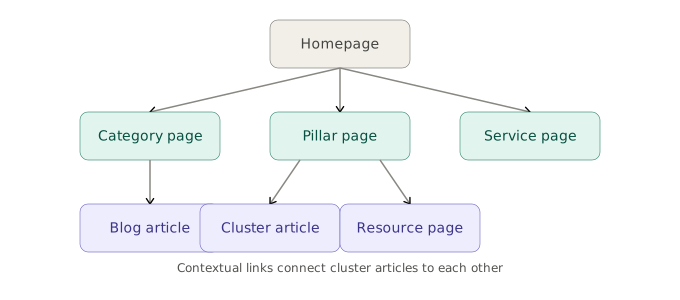
Contextual links are placed naturally within the main content of a page. Because they appear alongside relevant information, they often provide the strongest signals about how different topics relate to one another.
For example, an article about keyword research might naturally link to guides covering search intent, on-page SEO, and content optimization.
3: Breadcrumb links
Breadcrumbs show visitors where they are within your site’s hierarchy while providing additional internal links that improve navigation.
4: Related content links
Many websites recommend additional articles at the end of each page, encouraging readers to continue exploring related topics.
Each type serves a different purpose, but together they create a logical website structure that improves usability and discoverability.
Example
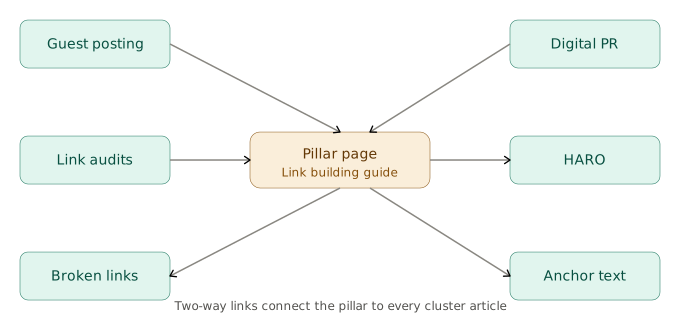
Imagine an SEO website with a pillar guide about link building.
Instead of treating every article as an isolated page, it links naturally to supporting resources covering:
- Guest posting
- Broken link building
- Anchor text optimization
- Digital PR
- Internal linking
- Backlink audits
Each supporting article links back to the main guide and to other closely related resources. This interconnected structure helps both readers and search engines understand that these pages belong to the same topic cluster.
Why Internal Linking Matters for SEO
Internal links influence nearly every aspect of technical and on-page SEO. Although they don’t replace high-quality backlinks or valuable content, they help search engines understand how your website is organized.
1: Improve crawlability
Search engine crawlers discover new pages by following links.
If important pages receive few or no internal links, they may be crawled less frequently or remain difficult to discover.
A strong internal linking strategy creates multiple pathways that help crawlers reach valuable content more efficiently.
2: Support indexation
Discovering a page doesn’t always guarantee that it will be indexed.
Pages that are well connected through relevant internal links generally have a better chance of being found, crawled, and evaluated within your website’s overall structure.
3: Distribute link equity
When authoritative pages receive backlinks from external websites, some of that value can be distributed across your website through internal links.
Strategically linking from high-authority pages to important commercial or informational pages helps strengthen your overall site architecture.
4: Strengthen website architecture
Internal links create clear relationships between pages.
Rather than appearing as disconnected articles, your content becomes part of a logical hierarchy that is easier for both users and search engines to understand.
5: Reinforce keyword relevance
Descriptive anchor text provides additional context about the destination page.
Instead of using vague phrases like “click here,” descriptive anchors help indicate what readers can expect after following the link.
6: Improve user experience
Visitors often have related questions after reading an article.
Contextual internal links guide them toward additional resources without requiring another search.
This creates a smoother user journey while increasing engagement across the website.
7: Reduce orphan pages
An orphan page has no internal links pointing to it.
Even valuable content can become difficult to discover if it isn’t connected to the rest of your website.
Regular internal linking audits help identify and fix orphan pages before they negatively affect discoverability.
8: Increase engagement
Relevant internal links encourage visitors to explore multiple resources.
This can increase:
- Pages per session
- Average engagement time
- Content discovery
- User satisfaction
Although these metrics aren’t direct ranking factors, they often indicate a better overall website experience.
Why Internal Linking Matters for AI Search
AI-powered search systems increasingly analyze relationships between topics rather than evaluating isolated pages.
Instead of focusing only on individual keywords, modern search experiences attempt to understand broader concepts, entities, and semantic connections.
Internal linking helps organize these relationships.
However, it’s important to separate established SEO principles from emerging AI optimization concepts.
Current evidence supports the idea that internal links improve crawlability, navigation, and topical organization. While these improvements may help AI systems understand how your content is connected, they should not be viewed as standalone ranking signals or guaranteed methods for appearing in AI-generated answers.
Internal links contribute by helping organize:
- Topic relationships
- Entity connections
- Content hierarchy
- Supporting resources
- User journeys
- Website architecture
For example, if your website contains a pillar guide on technical SEO that links to supporting articles about crawlability, Core Web Vitals, XML sitemaps, robots.txt, and structured data, both traditional search engines and AI-powered systems can more easily recognize that these pages collectively cover one broader subject.
This interconnected structure strengthens topical organization while making content easier to explore.
Good internal linking does not replace:
- Helpful content
- Technical SEO
- Strong external backlinks
- Accurate information
- Positive user experience
Instead, it supports these elements by creating a clearer framework for organizing your website.
How Search Engines and AI Interpret Internal Links
Internal links do more than connect pages. They provide signals that help search engines understand how your content is organized and which pages are most important.
Although Google’s algorithms and AI-powered search systems evaluate many ranking factors, internal linking helps establish meaningful relationships across your website.
1: Anchor text
Anchor text tells search engines what the linked page is about.
For example, an anchor like “technical SEO checklist” provides more context than a generic phrase such as “read more.”
Use descriptive, natural anchors that accurately reflect the destination page without forcing keywords.
2: Surrounding content
Search engines evaluate the text around a link to understand its context.
A contextual link placed within a paragraph discussing website architecture provides stronger topical relevance than a link placed randomly without explanation.
3: Content hierarchy
Well-organized websites help search engines recognize the relationship between broad topics and supporting content.
For example:
- Pillar Page: Link Building
- Supporting Guide: Guest Posting
- Supporting Guide: Digital PR
- Supporting Guide: Broken Link Building
- Supporting Guide: Anchor Text
- Supporting Guide: Link Audits
This structure helps establish topical depth.
4: Entity relationships
Modern search increasingly focuses on entities rather than individual keywords.
If several pages consistently discuss related concepts and link naturally to one another, they help reinforce semantic relationships across your website.
5: User intent
Internal links should match the reader’s next logical question.
Someone reading about keyword research may naturally want to learn about search intent, on-page SEO, or content optimization.
Relevant internal links improve navigation while helping users continue their journey.
6: Information architecture
Every website should have a logical structure that allows both users and crawlers to move from general topics to increasingly detailed content.
A clear architecture improves discoverability while reducing unnecessary crawl complexity.
Internal Linking Best Practices
Building internal links should never become a numbers game. Instead, focus on creating useful connections that improve navigation and strengthen your content structure.
1: Use descriptive anchor text
Choose anchors that clearly describe the destination page.
Good examples include:
- Technical SEO guide
- Link building checklist
- Keyword research process
- Content optimization tips
Avoid repeatedly using:
- Click here
- Learn more
- Read this
- Visit page
2: Link naturally within content
Internal links should support the topic being discussed.
Avoid forcing links into unrelated paragraphs simply because you want another page to receive more internal links.
3: Build topic clusters
Group related articles around one central subject.
Instead of publishing disconnected content, connect supporting pages back to a comprehensive pillar page.
This strengthens topical authority while improving user navigation.
4: Connect pillar and supporting pages
Every major topic should have:
- One comprehensive pillar guide
- Multiple supporting articles
- Two-way internal links between them
This creates a stronger semantic structure than isolated content.
5: Prioritize important pages
Commercial pages, cornerstone guides, service pages, and high-converting resources should receive links from relevant authoritative pages throughout your website.
6: Avoid excessive linking
Adding dozens of internal links to every page reduces their usefulness.
Prioritize quality over quantity.
Every link should have a clear purpose.
7: Update older articles
When publishing new content, revisit older pages and add relevant internal links where appropriate.
This helps both users and search engines discover new resources faster.
8: Review links regularly
Content evolves over time.
Regular audits help identify:
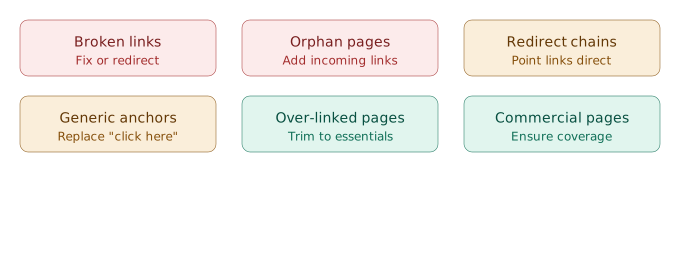
- Broken links
- Redirect chains
- Outdated destinations
- Orphan pages
- Missing contextual links
Pillar Pages vs Topic Clusters
A successful internal linking strategy usually begins with topic clusters.
Instead of publishing unrelated articles, organize content around broader themes.
1: Pillar pages
A pillar page provides a comprehensive overview of a broad subject.
Examples include:
- Complete Guide to Technical SEO
- Ultimate Link Building Guide
- SaaS SEO Guide
- Content Marketing Strategy
These pages act as central resources that connect to more detailed supporting articles.
2: Topic clusters
Cluster pages explore individual subtopics in greater detail.
For a Link Building pillar page, supporting articles might include:
- Guest Posting
- Broken Link Building
- Digital PR
- HARO
- Link Insertions
- Anchor Text
- Editorial Links
Each supporting article links back to the pillar while also linking to other closely related resources.
3: Why topic clusters work
Topic clusters help:
- Strengthen topical authority
- Improve internal navigation
- Reduce orphan pages
- Create logical content relationships
- Improve crawl efficiency
- Support semantic SEO
Internal Linking Framework
A structured process makes internal linking easier to manage as your website grows.
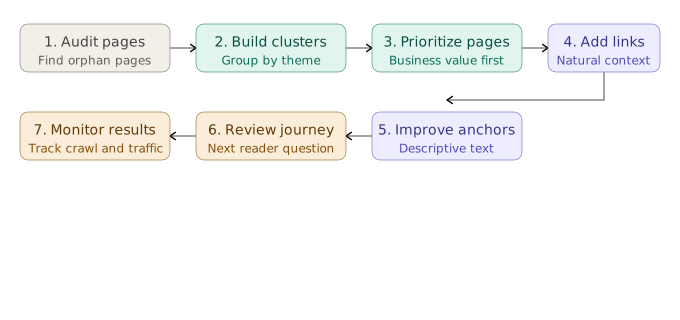
Step 1: Audit existing pages
Create a complete inventory of your content.
Identify:
- High-authority pages
- Commercial pages
- Blog articles
- Landing pages
- Orphan pages
Step 2: Build topic clusters
Group content into logical themes instead of isolated articles.
Every supporting article should contribute to a broader subject.
Step 3: Prioritize valuable pages
Determine which pages deserve additional internal authority based on business goals.
Examples include:
- Service pages
- Product pages
- High-converting landing pages
- Comprehensive guides
Step 4: Add contextual links
Review existing articles and naturally connect them to related content.
Focus on helping readers rather than maximizing link counts.
Step 5: Improve anchor text
Replace vague anchors with descriptive language that accurately represents the destination page.
Step 6: Review the user journey
Ask yourself:
“What would a reader want to learn next?”
The answer often reveals your best internal linking opportunities.
Step 7: Monitor performance
Track improvements using metrics such as:
- Indexed pages
- Crawl depth
- Organic traffic
- User engagement
- Internal link distribution
A successful internal linking strategy should evolve alongside your content rather than remain static.
Common Internal Linking Mistakes
Even well-designed websites often have internal linking issues that reduce crawl efficiency and weaken content relationships. Regular audits help identify and fix these problems.
1: Using generic anchor text
Anchors such as “click here,” “learn more,” or “read this” provide little context. Descriptive anchors help users understand where a link leads and give search engines clearer topical signals.
2: Broken internal links
Broken links create a poor user experience and waste crawl budget. Check your website regularly to find and fix links pointing to deleted or redirected pages.
3: Orphan pages
Pages without incoming internal links are difficult for users and search engines to discover. Every important page should be connected to at least one relevant page.
4: Too many links on one page
Adding excessive links can overwhelm readers and dilute the value of each recommendation. Include only links that genuinely help users continue learning.
5: Linking unrelated content
Every internal link should make sense within the surrounding content. Irrelevant links weaken topical relationships and create a confusing user experience.
6: Ignoring commercial pages
Many websites link only between blog articles while forgetting important service or product pages. Connect informational content to relevant commercial pages where it naturally helps readers.
7: Poor topical organization
Publishing isolated articles without connecting them into topic clusters makes it harder for search engines to understand your expertise.
8: Inconsistent anchor text
Using completely different anchors for the same destination page may create unnecessary inconsistency. While natural variation is healthy, anchors should accurately describe the linked content.
Tools for Internal Link Audits
Several SEO tools simplify the process of auditing and improving your internal linking strategy.
| Tool | What It Helps Identify |
| Google Search Console | Indexed pages, crawl issues, internal link reports |
| Screaming Frog | Broken links, orphan pages, crawl depth, redirects |
| Ahrefs | Internal link opportunities, top pages, link distribution |
| Semrush | Site audits, internal linking suggestions, crawl errors |
| Sitebulb | Visual website architecture, crawl analysis, orphan pages |
Each tool provides different insights, so many SEO teams combine several platforms during technical audits.
Measuring Internal Linking Success
Adding internal links is only the beginning. Measuring performance helps determine whether your strategy improves navigation, discoverability, and SEO.
Monitor these key performance indicators (KPIs):
1: Indexed pages
An increase in indexed pages may indicate that search engines are discovering more of your content through improved internal linking.
2: Crawl depth
Important pages should be reachable within a few clicks from your homepage. Lower crawl depth generally improves accessibility.
3: Organic traffic
Track whether improved internal linking helps important pages attract more organic visitors over time.
4: Keyword rankings
Better internal linking can strengthen topical relationships that support ranking improvements alongside quality content and other SEO efforts.
5: Time on page
Relevant internal links encourage visitors to continue exploring related resources, often increasing engagement.
6: Pages per session
Users who navigate multiple pages demonstrate stronger engagement with your website.
7: Internal link distribution
Review whether your most valuable pages receive sufficient internal links from relevant articles.
8: Orphan page reduction
As you strengthen your site architecture, the number of orphan pages should gradually decrease.
Internal Linking for AI-Ready Websites
AI-powered search systems increasingly evaluate how content is organized rather than viewing pages in isolation.
Although no evidence suggests that internal links alone improve visibility in AI-generated search experiences, a well-structured website makes content relationships easier for machines to interpret.
Focus on these emerging best practices.
1: Organize content around entities
Instead of publishing unrelated articles, build comprehensive topic clusters covering one subject from multiple angles.
2: Create semantic relationships
Link pages discussing closely related concepts so both readers and search systems can understand how they connect.
3: Use descriptive anchor text
Clear anchors provide better context than vague phrases and improve navigation.
4: Maintain consistent taxonomy
Use logical categories, URLs, navigation, and content organization across the website.
5: Strengthen pillar pages
Comprehensive pillar content supported by detailed cluster pages creates a stronger topical structure.
6: Improve navigation
Menus, breadcrumbs, and contextual links should guide visitors naturally through related information.
7: Support user intent
Every internal link should answer the reader’s next logical question rather than simply increasing link counts.
AI search optimization should complement—not replace—proven SEO fundamentals such as high-quality content, technical SEO, and helpful user experiences.
Frequently Asked Questions
What is internal linking?
Internal linking is the practice of connecting pages within the same website using hyperlinks. It helps users navigate related content while improving crawlability and website organization.
Why are internal links important for SEO?
Internal links help search engines discover pages, understand topic relationships, distribute link equity, and improve overall website architecture.
How many internal links should a page have?
There is no fixed number. Include as many relevant internal links as necessary to improve navigation without overwhelming readers.
What is an orphan page?
An orphan page is a page with no internal links pointing to it, making it difficult for users and search engines to discover.
Do internal links improve rankings?
Internal links support SEO by improving crawlability, content relationships, and user experience. They work best alongside high-quality content, technical SEO, and authoritative external backlinks.
What is topical authority?
Topical authority refers to demonstrating comprehensive expertise within a subject by publishing connected, high-quality content covering related topics.
How does internal linking help AI search?
Internal links help organize semantic relationships between pages, making it easier for AI-powered search systems to understand content structure. However, they are only one part of a broader optimization strategy.
What tools can audit internal links?
Popular tools include Google Search Console, Screaming Frog, Ahrefs, Semrush, and Sitebulb.
Should every blog post link to a pillar page?
Whenever relevant, linking supporting articles back to their pillar page strengthens topic clusters and improves content organization.
How often should I audit internal links?
Most websites benefit from conducting a comprehensive internal linking audit every three to six months or whenever significant new content is published.
Conclusion
An effective Internal Linking for AI and SEO strategy does far more than connect pages. It creates a logical website architecture that improves crawlability, distributes authority, strengthens topical relationships, and guides visitors toward valuable content.
As AI-powered search continues to evolve, organizing content into clear topic clusters may also help search systems better understand semantic relationships across your website. While internal linking alone won’t guarantee higher rankings or AI citations, it supports discoverability when combined with quality content and strong technical SEO.
Focus on these core principles:
- Build logical topic clusters.
- Connect pillar and supporting pages.
- Use descriptive anchor text.
- Eliminate orphan pages.
- Prioritize user experience.
- Audit internal links regularly.
- Measure performance over time.
A well-planned internal linking strategy is one of the most sustainable improvements you can make to your website. When supported by helpful content and technical SEO best practices, it strengthens both traditional search visibility and long-term content discoverability.
If you’d like to improve your website architecture, strengthen topical authority, or build a scalable SEO strategy, BrimCove’s SEO and Link Building specialists can help with a comprehensive internal linking audit and customized content strategy.
