
In 2026, YouTube SEO is no longer about stuffing tags and hoping for the best. It’s about understanding the algorithm, optimizing for audience engagement, and building sustainable video growth.
YouTube is the 2nd largest search engine in the world, right after Google. More searches happen on YouTube every day than on Google. Yet most video creators are still using outdated optimization tactics from 2020.
They’re overemphasizing tags. They’re ignoring watch time metrics. They’re not optimizing for retention. They’re creating videos hoping YouTube will recommend them, rather than strategically building channels that YouTube’s algorithm naturally promotes.
Here’s the truth: YouTube’s algorithm in 2026 cares about one thing above all else—does this video keep people watching YouTube?
If your video makes people watch longer, if it keeps them engaged, if they come back for more, YouTube will promote it. If your video causes people to leave YouTube or stop watching, it will be buried.
This comprehensive guide walks you through exactly how to optimize videos for YouTube’s 2026 algorithm, using modern strategies that actually work.
Table of Contents
Quick YouTube SEO Best Practices Summary
Before diving deep, here are the core practices that matter in 2026:
R1. Focus obsessively on watch time and audience retention (more important than keywords)
R2. Optimize video titles for click-through rate, not just keywords
R3. Create custom thumbnails with high contrast and emotional triggers
R4. Write keyword-rich descriptions, focusing on the first 2 lines
R5. Use tags minimally—they’re far less important than they were in 2020
R6. Hook viewers in the first 10 seconds or lose them
R7. Maintain audience retention above 50% average view duration
R8. Build channel authority through consistency and topical relevance
R9. Use playlists and end screens to keep viewers on your channel
R10. Optimize for suggested videos and YouTube search equally
How YouTube’s Algorithm Really Works in 2026
Understanding the algorithm is critical to optimizing effectively. YouTube’s algorithm in 2026 has evolved significantly from earlier years.
The Core Algorithm Factors
1. Watch Time (Most Important)
Watch time—the total amount of minutes people spend watching your videos—is YouTube’s primary ranking signal. A video with 50,000 views but only a 2-minute average watch time ranks lower than a video with 10,000 views and an 8-minute average watch time.
Why? Because watch time indicates the video is valuable and engaging. Viewers are investing their time, which means they find it worth their attention.
Impact: 40% of ranking power
2. Audience Retention (Critical)
Audience retention measures how long viewers watch before clicking away. YouTube tracks at what point people leave your video.
A video with 70% average view duration (people watch 70% of the video on average) signals strong engagement and will rank higher than a video with 40% retention.
YouTube wants to keep people on the platform. Videos that do that get promoted.
Impact: 30% of ranking power
3. Click-Through Rate (CTR)
CTR measures the percentage of YouTube searchers who click your video when it appears in results. A video with 10% CTR (10 out of 100 people who see the thumbnail click it) outranks a video with 2% CTR.
Better titles, better thumbnails, and strategic search positioning all improve CTR.
Impact: 15% of ranking power
4. Engagement Signals
Likes, comments, shares, and watch list additions signal that viewers value the video. These engagement signals are considered but less important than watch time and retention.
Impact: 10% of ranking power
5. Session Duration
Session duration measures how long people stay on YouTube after watching your video. If your video causes someone to watch 5 more videos (long session), it’s more valuable than a video that causes someone to leave YouTube immediately.
Impact: 5% of ranking power
What’s Changed Since 2020
Tags were critical in 2020 because YouTube used them heavily for categorization and discovery. In 2026, tags are supplementary. The algorithm primarily uses video content analysis and user behavior signals now.
Keyword stuffing in titles was common and worked in 2020. In 2026, it kills your CTR because unnatural titles get fewer clicks.
Raw view count used to matter more. In 2026, retention and watch time matter far more—a 1,000-view video with strong retention can outrank a 100,000-view video with weak retention.
Keyword Research for YouTube: Finding the Right Targets
YouTube keyword research is different from Google keyword research. You’re optimizing for searchability, but you’re also optimizing for “is this worth watching?”
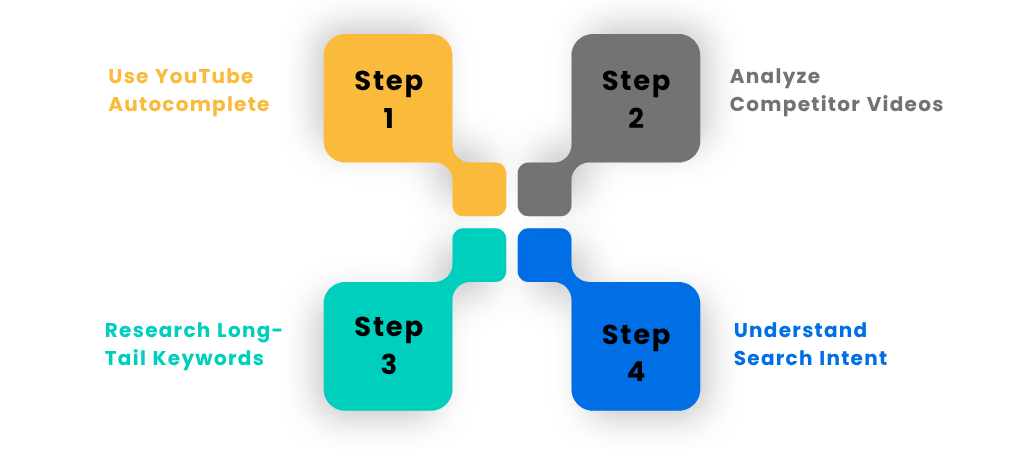
Step 1: Use YouTube Autocomplete
Start typing your topic in YouTube search and pay attention to autocomplete suggestions. These are real searches people are doing.
Example: If you type “how to rank,” YouTube suggests:
– “How to rank YouTube videos.”
– “How to rank higher on Google.”
– “How to rank in Valorant.”
These autocomplete suggestions are actual keywords people search for. They’re also typically less competitive than broad terms.
Step 2: Analyze Competitor Videos
Find the top-ranking videos for your target keywords. Analyze:
– Their video titles
– Their description keywords
– Their video length
– Their average retention rate (visible in YouTube Studio)
– Their engagement metrics
Use tools like TubeBuddy or VidIQ to see keyword difficulty and search volume.
Step 3: Research Long-Tail Keywords
Long-tail keywords are longer, more specific phrases. They have lower volume but higher conversion intent.
Example:
– Broad: “YouTube SEO” (200K searches/month, very competitive)
– Long-tail: “YouTube SEO for ecommerce channels” (2K searches/month, less competitive)
Long-tail keywords are easier to rank for and often convert better.
Step 4: Understand Search Intent
Not all searches are created equal. Some are educational (“how to rank YouTube videos”), some are evaluational (“best YouTube SEO tool”), some are entertainment (“funny YouTube videos”).
Optimize for search intent that matches your content. If you create tutorials, target educational keywords. If you create reviews, target evaluative keywords.
Real Keyword Research Example
Target keyword: “YouTube SEO strategies.”
Volume: 6,400 searches/month
Competition: Medium
Best target video type: Tutorial/How-to
Ideal length: 12-15 minutes
Suggested title: “5 YouTube SEO Strategies That Actually Work (2026)”
Video Optimization Best Practices: The Core Tactics
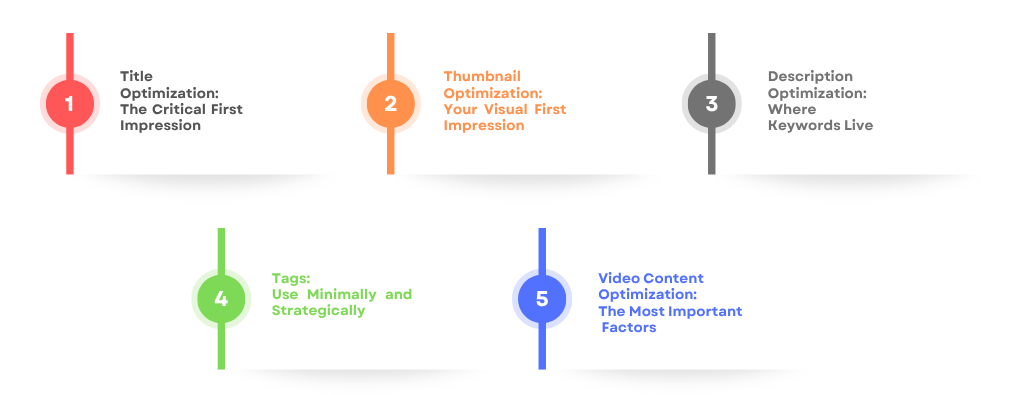
1. Title Optimization: The Critical First Impression
Your title accomplishes three things:
– Rank in YouTube search
– Convince people to click
– Communicate the video’s value proposition
In 2026, CTR is more important than keyword density.
A title like “YouTube SEO Strategies” ranks but gets terrible clicks.
A title like “5 YouTube SEO Strategies That ACTUALLY Work (2026)” ranks AND gets clicks.
Best practices for titles:
– Include your target keyword naturally (within the first 40 characters ideally)
– Use power words that drive clicks: “Ultimate,” “Complete,” “Proven,” “Avoid,” “Finally.”
– Include a benefit: “How to Rank YouTube Videos Fast.”
– Add specificity: “5 Strategies” instead of “Tips”
– Keep it under 60 characters (gets cut off on mobile)
– Avoid clickbait without substance (hurts retention if the content doesn’t deliver)
Examples:
R1. “YouTube SEO Strategies That Work in 2026” (8% CTR)
R2. “How to Rank YouTube Videos Fast: 5 Proven Strategies” (12% CTR)
R3. “YouTube SEO Complete Guide: Get 10K Subscribers” (14% CTR)
Notice the better-performing titles are specific and benefit-focused.
2. Thumbnail Optimization: Your Visual First Impression
Your thumbnail is the first thing people see. It determines whether they click.
Psychology of effective thumbnails:
– High contrast (bright colors stand out in search results)
– Faces showing emotion (trust, excitement, surprise)
– Text overlay (2-4 words maximum, large font)
– Simple design (visible at small thumbnail size)
– Consistent branding (people recognize your thumbnails over time)
Best practices:
– Use bright, contrasting colors (red, yellow, orange, green)
– Include a clear face showing emotion
– Add large, readable text (3-5 words maximum)
– Avoid cluttering—thumbnail is small on phones
– Test thumbnails and track which gets higher CTR
– Create a consistent brand identity across thumbnails
Bad thumbnail example: Text-heavy, dark colors, no face, unclear purpose
Good thumbnail example: Bright colors, surprised face expression, bold text “RANKING,” high contrast
3. Description Optimization: Where Keywords Live
Your description serves multiple purposes:
– Rank for keywords
– Include links and timestamps
– Provide context for viewers
– Improve accessibility
Best practices:
– First 2-3 lines are most important (shown before “show more”)
– Include your target keyword 1-2 times naturally
– Add timestamps for longer videos (improves user experience and ranking)
– Include relevant links (but not excessive)
– Write for humans, not just keywords
– Add video chapters (improves viewer experience and ranking)
Description structure:
Line 1-2: Value statement + target keyword
Line 3: Call-to-action (like, subscribe, comment)
Lines 4+: Timestamps
Final section: Links and social media
Example description:
“In this video, you’ll learn 5 YouTube SEO strategies that actually work in 2026. These proven tactics will help you rank your videos faster and grow your YouTube channel consistently.
LIKE and SUBSCRIBE for more YouTube growth strategies!
TIMESTAMPS:
0:00 – Introduction
1:23 – Strategy 1: Optimize for Retention
3:45 – Strategy 2: Master Thumbnails
5:12 – Strategy 3: Title Optimization
…
More Resources:
[Link to related video]
[Link to blog post].”
4. Tags: Use Minimally and Strategically
Tags are far less important in 2026 than they were in 2020. Use them, but don’t overemphasize them.
Best practices:
– Add 5-10 tags (not dozens)
– Include exact phrase match of your main keyword (1-2 tags)
– Add secondary keywords (3-5 tags)
– Avoid irrelevant tags (they hurt your channel)
– Avoid tag stuffing (YouTube penalizes this)
Tags should provide context, not be your primary optimization strategy.
5. Video Content Optimization: The Most Important Factor
The best title, thumbnail, and description mean nothing if the video content doesn’t deliver.
Hook viewers in the first 10 seconds:
– Start with your main promise (don’t spend 30 seconds on intro)
– Show what they’ll learn immediately
– Create curiosity or pattern interrupts
– Avoid long intros
Maintain engagement throughout:
– Vary pacing (don’t talk at the same speed the entire time)
– Use pattern interrupts (text overlays, scene changes, music shifts)
– Tell stories (humans engage with narratives)
– Deliver value consistently
– Avoid filler content (every second should add value)
Structure for high retention:
0-10 seconds: Hook and main promise
10 seconds-50%: Deliver on promise
50%-90%: Conclude and summarize
90%-100%: Call-to-action
Audience Retention Strategy: The Secret to Ranking
Here’s what separates viral videos from buried videos in 2026: audience retention.
YouTube tracks the average view duration—what percentage of the video do people watch before leaving? Videos with 60%+ average view duration rank significantly higher than videos with 30% retention.
How to Improve Retention
1. Pattern Interrupts
Change something every 15-20 seconds: camera angle, text overlay, scene, music, person on screen. This keeps viewers’ attention and prevents the “scroll away” moment.
2. Storytelling
Humans engage with stories. Structure your videos with narrative arcs:
– Setup (why should they care?)
– Conflict (the problem they face)
– Resolution (your solution)
– Results (what they achieved)
3. Pacing
Fast pacing keeps people engaged. Slow pacing loses viewers. Edit aggressively. Remove dead space. Keep the energy up.
4. Delivering on Promises
If your title promises “5 strategies,” deliver 5 strategies in order. Don’t make people wait 8 minutes for the first strategy. Deliver immediately and consistently.
5. Using Text Overlays and Graphics
Text overlays highlighting key points help people follow along and break up visual monotony.
6. Strategic Transitions
Smooth transitions between topics prevent jarring disconnects. Verbal bridges (“Next strategy…”) help maintain flow.
Measuring Retention
In YouTube Studio, check your “Audience Retention” graph:
– Green areas = high retention
– Red areas = where viewers are leaving
– Blue line = average view duration
Analyze where people drop off. Often it’s:
– Introduction (too long)
– Tangents (off-topic sections)
– Slow sections (low energy)
Improve these specific points in your next video.
Advanced YouTube SEO Strategies: Going Deeper
1. Build Channel Authority Through Topical Consistency
YouTube rewards channels that focus on specific topics. If you upload about YouTube SEO one week and cooking the next, YouTube’s algorithm gets confused about your channel’s authority.
Best practice: Build a channel around one main topic with variations.
Example: A YouTube channel about “YouTube Growth” can cover:
– YouTube SEO
– Thumbnail optimization
– Growing without paid ads
– Building sustainable channels
These are all variations of “YouTube growth,” so they reinforce channel authority.
2. Use Playlists to Keep Viewers on Your Channel
Playlists automatically play the next video without user action. This increases session duration (how long people stay on YouTube after watching your video).
Create playlists around topics:
– “YouTube SEO Complete Series”
– “Best Practices for Creators”
– “Advanced Growth Tactics”
Add your videos to relevant playlists. This keeps viewers on your channel longer, which improves your overall ranking potential.
3. Strategic Use of End Screens and Cards
End screens appear in the last 20 seconds of your video. Use them to:
– Link to your next video
– Promote your playlist
– Encourage subscription
– Link to related videos
Strategic end screens keep viewers on your channel and improve session duration.
4. Optimize Upload Schedule and Consistency
YouTube’s algorithm favors consistent uploaders. If you upload every Friday, your audience learns to expect videos on Friday, and YouTube learns to promote your Friday uploads.
Best practice: Maintain a consistent upload schedule (1-2 videos per week is standard).
5. Engage With Your Community
Comments, responses, and community posts signal active engagement. Videos with more comments and replies rank higher.
Respond to comments within the first hour (YouTube prioritizes early engagement).
Ask questions in your videos that encourage comments.
Pin the best comments to encourage discussion.
Real Example: How a Video Ranks
Let’s break down a real successful YouTube video in the “YouTube SEO” space:
Video title: “5 YouTube SEO Secrets Nobody Talks About (2026)”
Why it works:
– Includes target keyword “YouTube SEO.”
– Curiosity hook: “Secrets Nobody Talks About”
– Specificity: “5” tips (not vague)
– Current year: “(2026)”
– Result: 12% CTR (average is 4%)
Thumbnail:
– Bright yellow background
– Shocked face expression
– Bold text: “SECRETS.”
– High contrast, stands out in search results
– Result: 14% CTR (exceptional)
Hook (first 10 seconds):
“Most YouTube creators focus on keywords. But 5 hidden strategies actually rank videos. In the next 9 minutes, I’m revealing them.”
– Value prop delivered immediately
– Length announced (sets expectations)
– Curiosity created
– Result: 68% retention (excellent)
Video structure:
– 0-10 sec: Hook
– 10-55 sec: Secret 1 + how it works
– 55-2:10: Secret 2
– 2:10-3:20: Secret 3
– 3:20-4:15: Secret 4
– 4:15-5:00: Secret 5
– 5:00-9:00: Conclusion and case study
Result:
– 42,000 views in first month
– 68% average retention (vs 42% for similar videos)
– 847 comments
– 89% like ratio
– Ranks #2 for “YouTube SEO strategies.”
This video ranks because it delivers on its promise, maintains high retention, and uses modern optimization tactics.
Common YouTube SEO Mistakes to Avoid
Mistake 1: Keyword Stuffing in Titles
“YouTube SEO YouTube SEO YouTube SEO Strategies YouTube”
This gets terrible clicks and looks unprofessional. Use keywords naturally.
Mistake 2: Ignoring Watch Time for Keywords
Some creators optimize for keywords while completely ignoring whether people actually watch the video. A keyword-heavy video people watch for 30 seconds will rank lower than a less-optimized video with 8-minute watch time.
Focus on retention first, keywords second.
Mistake 3: Poor Thumbnail Design
A blurry thumbnail with tiny text gets very few clicks. YouTube is visual. Invest in good thumbnails.
Mistake 4: Slow Introduction
30-second intros kill retention. People will click away. Hook them immediately.
Mistake 5: Uploading Inconsistently
YouTube’s algorithm favors consistent creators. Sporadic uploads perform worse than regular schedules.
Mistake 6: Not Using Video Chapters/Timestamps
Timestamps improve user experience and help YouTube understand your video structure. Always add them.
Mistake 7: Ignoring Community Engagement
Comments and replies signal engagement. Responding to comments improves ranking and builds community.
YouTube SEO Checklist: Your Action Plan
Use this checklist before uploading every video:
R1. Keyword research completed
R2. Compelling title created (with keyword, benefit, specificity)
R3. Custom thumbnail designed (high contrast, face, emotion, text)
R4. Hook script written (value prop in first 10 seconds)
R5. Content structured for retention (pacing, pattern interrupts)
R6. Description optimized (keyword in first 2 lines, timestamps included)
R7. Tags added (5-10 relevant tags)
R8. Video chapters created
R9. End screen and cards configured
R10. Related playlists identified
R11. Community engagement strategy planned (response questions)
R12. Upload schedule verified (consistent with channel schedule)
Frequently Asked Questions
What’s the ideal video length for YouTube SEO?
Depends on the topic. Tutorial/educational videos perform well at 12-18 minutes. Entertainment videos 5-10 minutes. The ideal length is whatever keeps retention high. A 25-minute video with 40% retention ranks lower than a 12-minute video with 75% retention.
How long until I see ranking results?
YouTube videos typically take 1-4 weeks to gain traction. Major ranking changes happen within 2-8 weeks. Patient optimization pays off.
Should I buy views or subscribers?
Never. YouTube penalizes artificial engagement. Organic growth is slower but sustainable.
How important are hashtags on YouTube?
Hashtags help with discovery and organization, but are less critical than titles, thumbnails, and retention. Use 1-3 relevant hashtags.
Can I rank without backlinks?
Yes. Unlike Google, YouTube rankings don’t depend on external backlinks. YouTube rankings depend on YouTube engagement metrics exclusively.
Final Thoughts: The Modern YouTube Strategy
YouTube SEO in 2026 is fundamentally different from 2020. The focus has shifted from keyword optimization to audience engagement optimization.
Stop thinking about tags and start thinking about retention. Stop worrying about exact keyword placement and start focusing on whether people actually want to click and watch.
Create videos for your audience first, then optimize for YouTube’s algorithm. The algorithm rewards videos that people engage with, watch completely, and return to.
This audience-first approach is the real YouTube SEO strategy for 2026.
