
Click-through rate (CTR) has become one of the most debated signals in SEO. Can artificially increasing clicks improve your rankings? The short answer is complicated.
CTR matters in SEO because it signals relevance. When many people click your result over competitor results, Google interprets that as a signal that your result is more relevant to the query. Higher CTR correlates with higher rankings. But correlation isn’t causation.
This has led some SEOs down a dangerous path: CTR manipulation —artificially generating clicks to signal relevance and improve rankings. The promise is appealing: increase your CTR and watch your rankings climb.
The reality is far more nuanced. While organic CTR absolutely matters, artificially manipulating it is risky, often ineffective, and potentially against Google’s guidelines.
This comprehensive guide explains what CTR manipulation is, how it actually works, whether it affects rankings, the risks involved, and most importantly, the ethical ways to genuinely improve your organic CTR that actually move the needle.
Table of Contents
What Is CTR Manipulation in SEO?
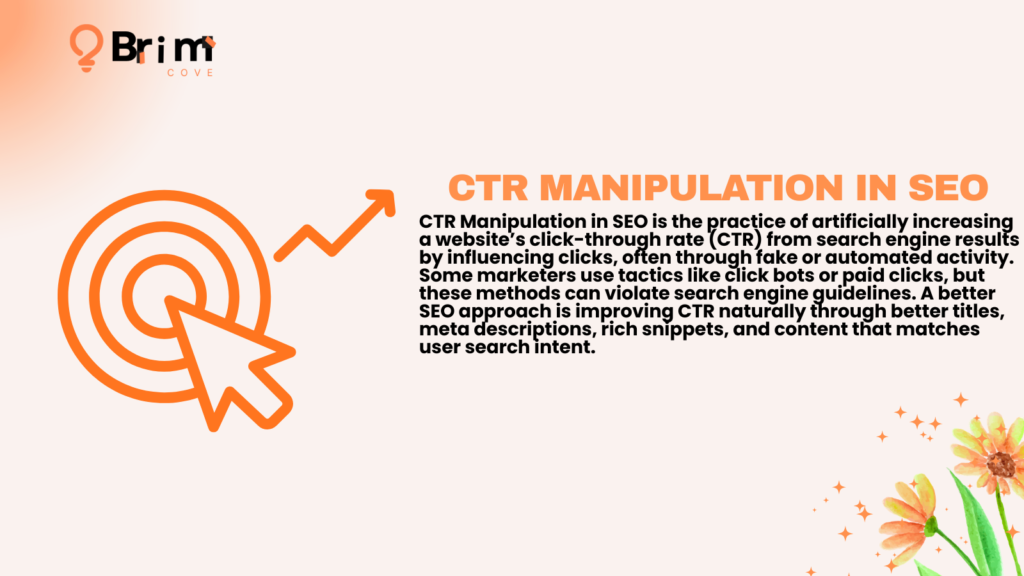
Click-through rate (CTR) is the percentage of people who see your result in Google search and click it. CTR manipulation is artificially inflating this percentage through fake clicks, bots, or deceptive traffic to signal fake relevance and influence rankings.
The Theory Behind CTR Manipulation
The theory goes like this: Google uses user behavior signals (like clicks) to determine if a result is relevant. If result #5 gets clicked more than result #1, maybe result #5 is actually more relevant. So if you can artificially increase your CTR, you signal to Google that your content is more relevant, and you should rank higher.
This theory is rooted in Google’s RankBrain algorithm, which uses machine learning to understand search intent and ranking relevance. Early discussions suggested that engagement metrics (clicks, time on page, pogo-sticking) might be signals RankBrain uses.
Why CTR Matters Organically
Naturally, higher CTR signals better relevance:
– Better titles get more clicks (people find your result more appealing)
– Better meta descriptions get more clicks (people see your result is relevant)
– Better keyword matching gets more clicks (your result appears for relevant searches)
– Strong brands get more clicks (people recognize and trust your domain)
This organic CTR improvement is legitimate and valuable. The problem is trying to artificially inflate it.
How CTR Actually Works in Google Search
Understanding CTR precisely is critical before discussing manipulation.
The Basic Formula
CTR = (Clicks ÷ Impressions) × 100
Example:
– Your website appears in Google results 1,000 times (impressions)
– 50 people click your result (clicks)
– Your CTR = (50 ÷ 1,000) × 100 = 5%
What Affects Natural CTR
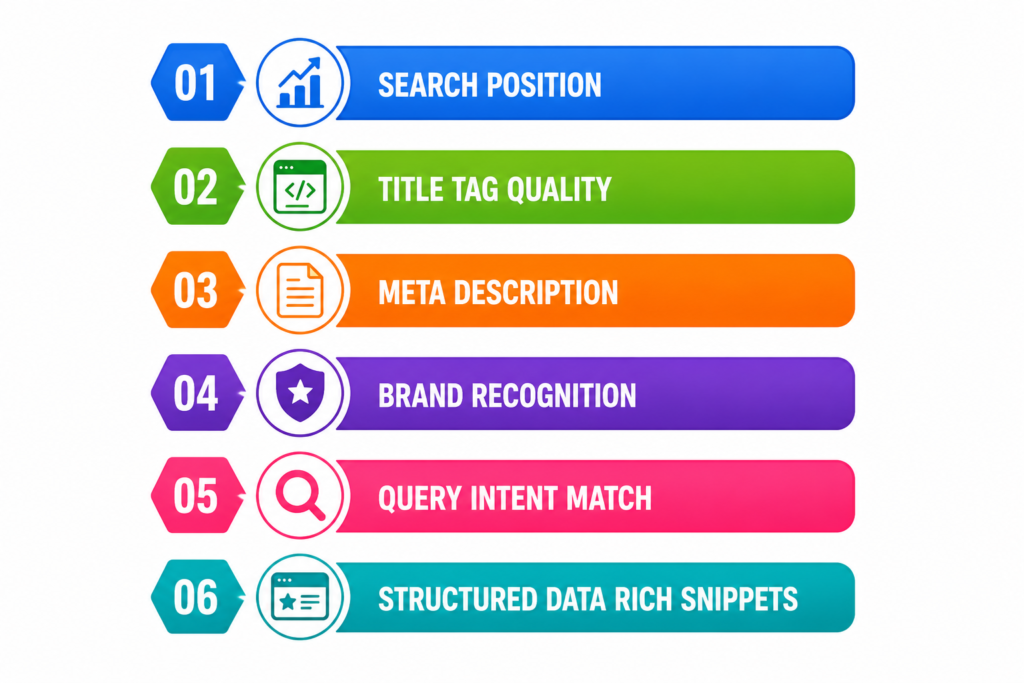
1. Search Position
Position #1 results average 30-35% CTR. Position #5 averages 5-10%. Lower positions get drastically fewer clicks. This is expected and natural.
2. Title Tag Quality
Better titles get more clicks. A title with a number (“5 Ways to…”) gets more clicks than a generic title (“Guide to…”).
3. Meta Description
Descriptions that clearly show a value proposition get more clicks than vague descriptions.
4. Brand Recognition
Well-known brands get more clicks. People recognize and trust them.
5. Query Intent Match
When your result clearly matches what the searcher wants, it gets more clicks.
6. Structured Data Rich Snippets
Results with stars, pricing, or other rich snippets get more clicks because they stand out.
The Problem with Artificial CTR
When you artificially inflate CTR through bots or fake clicks:
– Clicks don’t come from real searchers with real intent
– The clicks don’t represent genuine relevance signals
– Google’s sophisticated systems can detect unnatural click patterns
– The artificial signal becomes noise rather than useful information
Does CTR Actually Affect SEO Rankings?
This is where the debate gets interesting. The answer: probably yes, but not in the way CTR manipulators hope.
What Google Has Said
Google’s John Mueller has stated that user behavior signals (like clicks) are used by RankBrain, but he’s been deliberately vague about how much they matter. He’s also warned against trying to artificially manipulate them.
Key quote: “We do use click data from Google Search Console to better understand how users perceive your site in search results.”
This is telling. Google uses click data, but specifically their own data (Search Console), not external traffic signals.
The Correlation vs Causation Problem
Higher CTR correlates with better rankings. But this correlation likely exists because:
1. Better content naturally gets better CTR
2. Better keyword matching naturally gets better CTR
3. Better titles naturally get better CTR
The ranking improvement comes from the underlying content and relevance improvements, not the CTR itself.
Analogy: Temperature and ice cream sales correlate. But temperature doesn’t cause ice cream sales—warm weather causes both. Similarly, content relevance causes both better rankings and higher CTR. The CTR is a symptom, not the cause.
RankBrain and User Signals
RankBrain uses machine learning to understand query intent and match content quality. It likely considers:
– Dwell time (how long someone stays on a result)
– Pogo-sticking (clicking back to search for another result)
– Click depth (how far users get in your content)
But these signals are much harder to artificially manipulate than simple CTR, because they require genuine user behavior.
Common CTR Manipulation Methods
Here’s how people attempt to manipulate CTR, and why each is problematic:
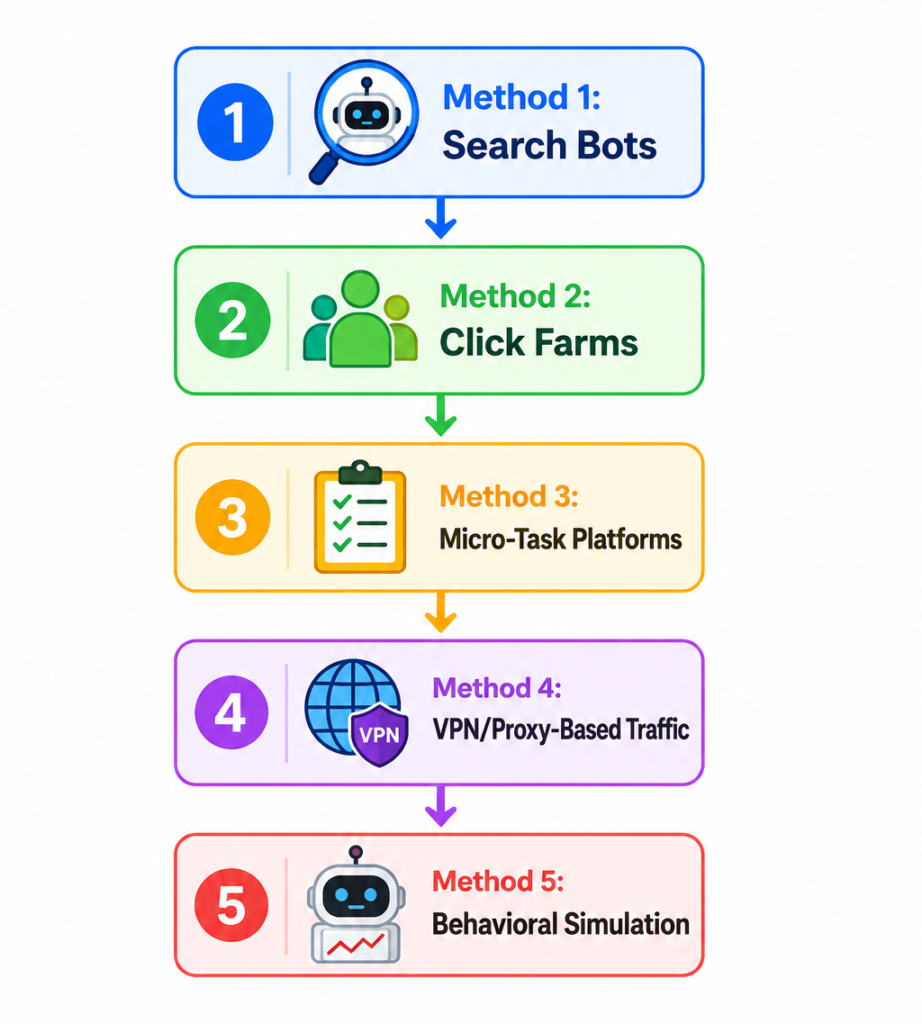
Method 1: Search Bots
Automated bots that simulate users searching for your keywords and clicking your results.
How it works: The bot searches for “your keyword,” finds your result, clicks it, and spends time on the page.
Why it doesn’t work: Google detects bot traffic patterns easily. Bots from the same IP, with identical behavior, visiting at exact intervals, are obviously fake.
Risk level: High (likely violates Google’s guidelines)
Method 2: Click Farms
Companies that employ people to click on your results.
How it works: Pay a service to have real people click your results from search results.
Why it doesn’t work: While real clicks are harder to detect, they still show unnatural patterns. Clicks from the same geographic area with identical behavior still look artificial.
Risk level: High (expensive, ineffective, violates guidelines)
Method 3: Micro-Task Platforms
Services like MTurk, where you pay people small amounts to click on your result.
How it works: Post task: “Search for ‘X keyword’ and click my result.” Thousands do it for $0.10 each.
Why it doesn’t work: Clicks aren’t from real search intent. Micro-task workers search unnaturally and behave differently from real users.
Risk level: High (expensive, obvious patterns, violates guidelines)
Method 4: VPN/Proxy-Based Traffic
Using VPNs or proxies to simulate clicks from different locations.
How it works: Same machine, different VPN IP, searches and clicks.
Why it doesn’t work: VPN traffic is identifiable. Google knows which IP ranges are VPNs. Even with different IPs, the behavior pattern is identical and obviously artificial.
Risk level: High (easily detectable)
Method 5: Behavioral Simulation
More sophisticated bots that simulate realistic user behavior (varying click timing, dwell time, depth).
How it works: Advanced scripts that mimic realistic user behavior—varying wait times, clicking links, scrolling depth.
Why it doesn’t work: While more sophisticated, Google’s AI systems are equally sophisticated at detection. Behavioral patterns are still statistically impossible (too perfect).
Risk level: Very high (difficult to execute, high risk if caught)
Why CTR Manipulation Doesn’t Actually Work in 2026
Even if you could generate artificial CTR without detection, here’s why it wouldn’t improve rankings:
Google’s AI Is Smarter Than Manipulators
Google uses AI to detect unnatural patterns. Even sophisticated behavioral simulation is statistically detectable. Machines beat machines at this game.
Signal Quality Over Signal Volume
Google doesn’t just count clicks—it evaluates click quality. One click from a high-intent searcher is worth more than 100 clicks from micro-task workers.
Search Console Data Matters More
Google stated that they use Search Console data for understanding user signals. That’s first-party data that can’t be manipulated. External CTR manipulation doesn’t affect this.
The Dwell Time Problem
Even if you get clicks, if users don’t stay on your page (dwell time is low), Google detects that the click didn’t result in satisfaction. Dwell time is much harder to artificially inflate.
Pogo-Sticking Detection
If people click your result, then immediately go back to search and click another result (pogo-sticking), that signals your content didn’t satisfy them. This is easily detected and works against you.
Risks of CTR Manipulation: What Actually Happens
Detection and Manual Action
Google’s team actively monitors for unnatural CTR patterns. When detected, they can:
– Ignore the artificial clicks entirely (making the manipulation pointless)
– Apply a manual action penalty (removing your site from rankings temporarily)
– Suppress rankings algorithmically (automatic penalty)
Temporary Ranking Fluctuations
Even if undetected, artificial CTR might cause temporary ranking fluctuations as Google’s algorithm processes the signal. Once the pattern is detected, rankings fall faster than they rose.
Wasted Budget
Click farm services charge £500-5,000+ per month. You’re spending money on something that doesn’t work and risks your site.
Lost Time and Opportunity Cost
Time and resources spent on CTR manipulation could have been invested in actual content improvement, which has a positive ROI.
Reputation Risk
If CTR manipulation is discovered, it damages your credibility. SEO clients and agencies don’t want to work with practitioners using black-hat tactics.
Long-Term Sustainability Issues
Even if CTR manipulation worked, it would only work temporarily. You’d need to continuously generate fake clicks, which is unsustainable and increasingly risky as detection improves.
Ethical Ways to Actually Improve Organic CTR
This is where real SEO wins happen. Here are legitimate tactics that consistently improve CTR:
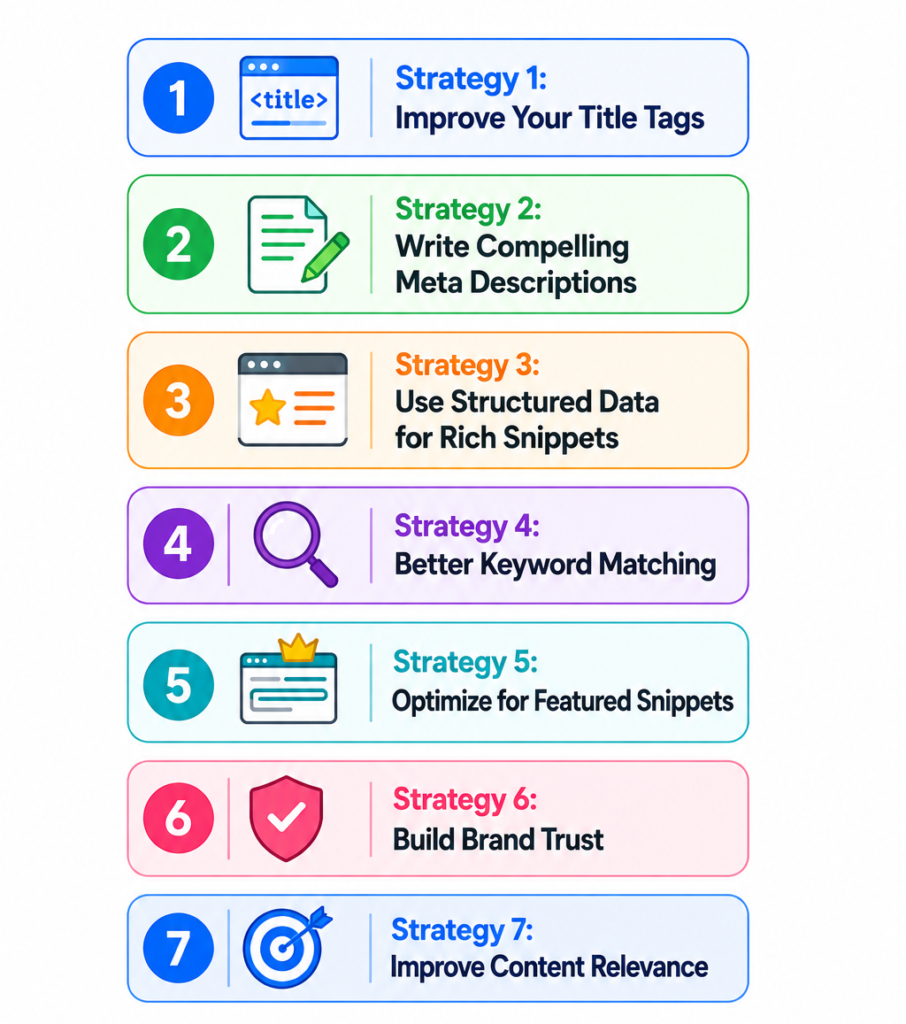
Strategy 1: Improve Your Title Tags
What works:
– Numbers: “5 Ways to…” gets more clicks than “Guide to…”
– Power words: “Ultimate,” “Complete,” “Proven.”
– Benefit-focused: “How to X” performs better than “X explained”
– Length: Optimal is 50-60 characters (full display on mobile)
Real example:
“Email Marketing Tips” (generic, low CTR)
vs
“23 Email Marketing Tips That Actually Increase Open Rates” (specific, benefit-focused, higher CTR)
Strategy 2: Write Compelling Meta Descriptions
What works:
– Clear value proposition (what will they learn?)
– Emotional trigger: curiosity, fear, desire
– Call to action: “Learn,” “Discover,” “Find out.”
– Matching search intent exactly
Real example:
“Learn about email marketing” (vague)
vs
“Increase email open rates by 45% with these science-backed tactics—including examples from top brands” (compelling, specific benefit)
Strategy 3: Use Structured Data for Rich Snippets
Rich snippets make your result stand out:
– Review schema: Shows star ratings
– FAQ schema: Shows questions directly in results
– Rating schema: Shows pricing for products
– News schema: Shows publication date
Results with rich snippets get 20-30% more clicks because they’re more visually distinctive.
Strategy 4: Better Keyword Matching
Matching search intent precisely improves CTR:
– Query: “best project management software for agencies.”
– Poor title: “Project Management Software.”
– Good title: “Best Project Management Software for Agencies.”
Exact phrase matching shows searchers you have what they want.
Strategy 5: Optimize for Featured Snippets
Featured snippets sit above position #1 and get massive CTR:
– Define your term in 40-60 words
– Use lists (3-5 items)
– Use tables for comparisons
– Answer “how” and “why” questions directly
Featured snippets can increase CTR by 100%+ for target keywords.
Strategy 6: Build Brand Trust
Strong brands get more clicks:
– Author expertise indicators (bylines, credentials)
– Trust signals (security badges, reviews)
– Brand mention in SERP (branded results get ~40% higher CTR)
– Media mentions and credibility indicators
Strategy 7: Improve Content Relevance
The most important factor: your actual content must match what people search for.
If your title promises “5 Ways to Increase Email Open Rates” and your content delivers exactly that, people stay, and Google sees positive dwell time. This improves CTR naturally over time.
How to Measure CTR Performance
Use Google Search Console
Search Console shows:
– Impressions (how many times you appeared)
– Clicks (how many people clicked)
– CTR (automatic calculation)
– Average position
Track these by query to see which keywords get good CTR and which underperform.
Analyze by Position
Position #1 should average 30%+ CTR. If your position #1 result has 10% CTR, your title or meta description needs improvement.
Compare to Industry Benchmarks
Typical CTR by position:
– Position 1: 30-35%
– Position 2: 15-20%
– Position 3: 10-15%
– Position 5: 5-10%
– Position 10: 2-5%
If your results underperform these benchmarks, optimize your titles and descriptions.
Segment by Query Type
Informational queries (“how to”) get lower CTR than commercial queries (“buy X”). Compare apples to apples.
Best Tools for CTR Analysis and Optimization
Google Search Console — Free, shows real CTR data for your site
Ahrefs — Competitor CTR analysis, title/description suggestions

Semrush — Similar to Ahrefs, also includes landing page optimization

Screaming Frog — Audit title and meta description problems at scale
CTR Manipulation vs Ethical CTR Optimization
The choice is clear: ethical optimization always wins.
The Future of CTR and User Signals in SEO
AI Search and Behavioral Signals
As Google integrates AI search (AI Overviews), traditional CTR becomes less important. AI-generated summaries reduce CTR for featured snippets because answers appear in results.
However, satisfying searcher intent remains critical. AI just changes how satisfaction is measured.
Search Experience Signals Over Raw CTR
Google is moving toward sophisticated “search experience” signals:
– Did the searcher get a satisfying answer?
– Did they have to search again?
– Did they stay in the Google ecosystem or leave?
These are harder to manipulate than raw CTR clicks.
Entity and Semantic Understanding
Future ranking improvements come from entity understanding and semantic relevance, not click manipulation. A page about “project management for remote teams” will rank better for related searches like “distributed team tools” because of entity relationships, not CTR.
Frequently Asked Questions
What Is CTR Manipulation?
CTR manipulation artificially increases clicks on your search results through bots, click farms, or fake traffic to signal relevance and improve rankings. It violates Google’s guidelines and rarely works.
Does CTR Manipulation Actually Work?
In theory, yes. In practice, no. Google’s detection systems identify artificial CTR patterns. Even if undetected, artificial signals are lower quality than genuine signals. Risks far outweigh potential benefits.
Is CTR a Direct Ranking Factor?
Not directly. CTR correlates with rankings because better content naturally gets better CTR. But CTR itself isn’t a ranking factor—relevance is.
Can Google Detect Fake Clicks?
Yes, easily. Google detects unnatural patterns: clicks from the same IP, identical behavior, unusual geographies, bot signatures, and behavioral inconsistencies. Google’s AI is sophisticated at separating real from fake signals.
How Do I Improve Organic CTR Safely?
Improve title tags, write better meta descriptions, use structured data for rich snippets, match search intent precisely, optimize for featured snippets, and build brand trust. These work consistently.
What’s a Good Organic CTR?
Position #1 should get 25-35% CTR. Position #3 should get 10-15%. Position #10 should get 2-5%. If you’re underperforming these benchmarks, optimize your titles and descriptions.
Are User Signals Really Important for Rankings?
Yes, but not in the way CTR manipulators think. Genuine engagement signals (people finding your content satisfying, staying on your page, not pogo-sticking) matter. But these require quality content, not fake clicks.
Conclusion: CTR Matters, But Not How Manipulators Think
CTR is important in SEO—but not as something to artificially inflate. Higher CTR is a symptom of better content, better titles, and better keyword matching. It’s a result of doing SEO right, not a shortcut.
The SEOs winning in 2026 aren’t trying to manipulate CTR. They’re:
– Writing compelling titles that get clicks naturally
– Creating content so relevant that people don’t pogo-stick
– Using structured data to stand out in results
– Building brands that people recognize and trust
These approaches compound over time. They have zero risk. They align with Google’s interests (showing the most relevant results). And they actually work.
CTR manipulation is a dead-end path. It wastes money, risks your site, and rarely works. The future of SEO belongs to those who optimize for genuine relevance and user satisfaction.
That’s the real way to improve your CTR—and your rankings.
