
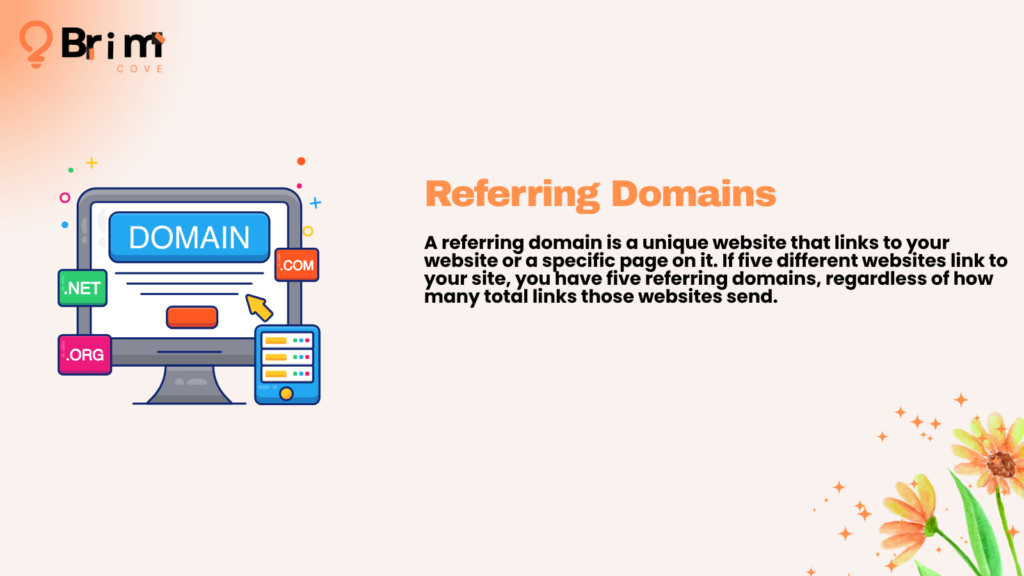
A referring domain is a unique website that links to your website or a specific page on it. If five different websites link to your site, you have five referring domains, regardless of how many total links those websites send.
Referring domains are an important part of understanding your backlink profile. They show how many different websites are choosing to reference your content, rather than simply counting every individual link.
Table of Contents
Referring Domains vs. Backlinks
The terms are closely related, but they measure different things.
A backlink is an individual hyperlink pointing from another website to your website. A referring domain is the unique website that contains one or more of those backlinks.
Here is a simple example:
Imagine your website receives:
- 5 links from example.com
- 3 links from anothersite.com
- 2 links from newswebsite.com
You have 10 backlinks from 3 referring domains.
If example.com adds another 10 links to your site, your backlink total increases from 10 to 20. Your referring-domain count stays at 3 because all those additional links come from the same website.
This distinction matters when analyzing link growth. A website with thousands of backlinks may have received most of them from a relatively small number of domains. Another site might have fewer total backlinks but links from many different relevant websites.
Ahrefs defines referring domains as the unique websites from which a target receives one or more backlinks. Its research also found a positive correlation between the number of unique referring domains and organic search traffic, although correlation alone does not prove that one causes the other.
In practice, you should look at both metrics. Backlinks tell you how many links you have; referring domains tell you how widely your website is being referenced across the web.
Why Referring Domains Matter for SEO
Search engines use links to discover relationships between pages and understand how content fits within the wider web. Google describes links as one way it understands what content may be useful to searchers.
A link from a relevant, established website can therefore contribute to the strength and visibility of your site’s backlink profile. But the source matters. Ten links from unrelated, low-quality websites are not automatically better than a few genuinely relevant links.
This is why referring-domain diversity is useful when evaluating link acquisition. If several independent websites find your content worth referencing, your backlink profile can become more robust than one built around repeated links from the same few domains.
The goal is not to reach an arbitrary number of referring domains. It is to earn links from websites that are relevant, credible, and useful to the audience.
How to Check Your Referring Domains
You can review referring domains with several popular SEO tools.
Ahrefs: Enter your website into Site Explorer and open the Referring domains report. You can see the websites linking to you, the number of links from each domain, and additional metrics. Ahrefs also lets you analyze competitors and identify websites linking to them but not to you.
Semrush: Use its backlink analysis tools to review referring domains, authority metrics, backlink types, and competitor link profiles.
Moz: Its link analysis tools can help identify linking domains and evaluate the broader strength of a site’s backlink profile.
Different platforms may report different numbers because their crawlers discover and process links differently. So do not expect Ahrefs, Semrush, and Moz to show identical totals.
For competitor research, the more useful question is often not “How many referring domains do they have?” but “Which relevant websites link to them that could also be relevant to us?”
That turns a metric into an actionable link building opportunity.
What Makes a Referring Domain High Quality?
Not every referring domain deserves the same weight. A useful evaluation should consider relevance, authority, and trust rather than relying on one metric.
Relevance: A website covering your industry or a closely related subject is usually a more natural source of referral traffic and editorial links than an unrelated site.
For example, a cybersecurity company receiving a link from a respected technology publication is a more relevant opportunity than receiving a link from an unrelated general directory.
Authority: Established websites with strong backlink profiles can provide more valuable links than newly created sites with little history. Tools such as Ahrefs’ Domain Rating can help compare backlink-profile strength, but Ahrefs itself recommends not using DR as a standalone measure of website quality.
Trust and editorial quality: Look at whether the website publishes useful original content, has a real audience, maintains clear editorial standards, and links to sources naturally.
Page-level context: The actual page containing your link matters too. A relevant editorial mention inside useful content is generally more meaningful than a link buried in a footer, sidebar, or low-value page.
Real traffic: A referring domain that can send interested visitors has practical value beyond SEO metrics. When evaluating prospects, check whether the website appears to attract genuine search or referral traffic.
Avoid treating a high authority score as a guarantee of quality. A website can have a strong metric while publishing unrelated or low-value content.
Google specifically lists low-quality directory links, paid links intended to manipulate rankings, and other manipulative link-building practices among examples of link spam. Paid or sponsored links can be used legitimately for advertising, but Google recommends qualifying them appropriately with rel=”sponsored” or rel=”nofollow”.
How to Build More Referring Domains
Building referring domains is less about collecting links and more about giving other websites a reason to mention yours.
1. Use Relevant Directories and Niche Platforms
Not every directory is worth pursuing. Focus on legitimate industry directories, professional associations, local business listings, and niche platforms that are genuinely useful to their users.
For example, a software company may look for reputable software directories, while a local service business can benefit from relevant local or industry-specific listings.
Avoid submitting your website to hundreds of generic directories simply because they accept links. Google specifically identifies low-quality directory links as an example of link spam.
2. Turn Unlinked Brand Mentions Into Links
If another website mentions your company, product, research, or founder but does not link to you, that can be a straightforward outreach opportunity.
First, find the mention and check whether a link would genuinely help readers. Then contact the author or site owner with a short, useful request.
For example:
“Thanks for mentioning [Brand] in your article. If useful for your readers, you could also link the brand name to our original guide here: [URL].”
Do not demand a link. The strongest outreach explains why adding one improves the existing page.
3. Use Guest Posting Selectively
Guest posting can help you earn referring domains when you contribute genuinely useful content to relevant publications.
The key is editorial fit. Choose websites whose readers would actually benefit from your expertise, then pitch a specific topic instead of offering generic “high-quality content.”
Avoid producing large volumes of similar guest posts solely for links. Google lists optimized links in articles and guest posts among examples of link spam when they are used to manipulate rankings.
A useful guest post should work even if the backlink were removed.
4. Try Broken Link Building
Broken link building involves finding a relevant page that contains a dead external link, creating or identifying a resource that can replace it, and contacting the website owner.
Start by finding authoritative pages in your niche with broken outbound links. Then check whether your existing content provides a suitable replacement.
If it does not, consider whether creating a genuinely better resource is worthwhile.
The outreach should be simple: identify the broken link, explain where it appears, and suggest your resource as a possible replacement.
This works best when your page closely matches the original resource. A loosely related page inserted just to obtain a backlink is unlikely to provide much value.
5. Build Resource Page Links
Resource pages exist specifically to point readers toward useful websites, guides, tools, and references. Find relevant resource pages in your industry and check whether your content genuinely fills a gap.
The strongest approach is to suggest a resource that adds something the page does not already provide. A generic homepage is rarely a compelling recommendation; an original guide, research report, calculator, or detailed tutorial is much easier to justify.
6. Use Digital PR and HARO-Style Outreach
Digital PR can generate referring domains by putting your expertise, data, or original research in front of journalists and publishers.
Traditional HARO has changed over time, but the basic approach remains useful: respond to relevant journalist requests with a specific, quotable answer rather than sending a generic company introduction.
For example, if a journalist asks for expert opinions on ecommerce trends, provide a concise observation backed by your experience or data. If the publisher uses your contribution, you may earn a brand mention and potentially a link.
The quality of the response matters more than sending dozens of pitches. Focus on requests that closely match your expertise.
7. Create Linkable Assets
One of the strongest ways to earn referring domains is to create something other websites actually want to reference.
Examples include:
- Original industry research
- Surveys and datasets
- Free calculators or tools
- Templates and checklists
- Original studies
- Detailed visual guides
A useful asset gives publishers a reason to link without you having to ask for a generic mention.
Original data can be especially effective because writers often need sources to support their own articles. A well-designed study can therefore attract links from several different publications over time.
The key is to create something genuinely useful or difficult to reproduce, not simply turn an ordinary blog post into a “resource.”
Common Referring Domain Mistakes
Chasing quantity over quality: Having more referring domains is not automatically better. A large number of irrelevant or low-quality links can add little value.
Ignoring relevance: A link should make sense in the context of both websites. Prioritize sites that share a meaningful connection with your subject or audience.
Buying low-quality links: Purchasing links purely to influence rankings can violate Google’s spam policies. Google specifically includes buying or selling links for ranking purposes and low-quality directory links among examples of link spam.
Relying on one metric: Domain Rating, Domain Authority, and similar scores are third-party metrics, not Google ranking factors. Use them alongside relevance, traffic, content quality, and editorial standards.
Getting multiple links from the same domain: Ten backlinks from one website still represent only one referring domain. If your goal is to expand the diversity of your backlink profile, look for additional relevant websites.
Using the same outreach message everywhere: Generic outreach is easy to ignore. Personalize your reason for contacting each publisher and explain why your resource fits.
Ignoring lost links: Links can disappear when pages are deleted, updated, redirected, or replaced. Regularly reviewing your backlink profile can help you identify valuable links that may be recoverable.
FAQ
What are referring domains in SEO?
Referring domains are unique websites that contain one or more backlinks pointing to your website. For example, links from five different websites represent five referring domains.
What is the difference between referring domains and backlinks?
A backlink is an individual link, while a referring domain is the unique website providing that link. One referring domain can provide multiple backlinks.
How do I find my referring domains?
You can use tools such as Ahrefs, Semrush, or Moz. These platforms show which websites link to your site and provide additional information for evaluating those links.
Are more referring domains always better?
No. Quality and relevance matter more than raw quantity. A few relevant, trustworthy websites can be more useful than many unrelated or low-quality domains.
What is a good number of referring domains?
There is no universal target. The appropriate number depends on your industry, competitors, website age, content, and overall link profile. Instead of chasing a fixed number, compare your site with relevant competitors and focus on realistic opportunities.
How can I get more referring domains?
You can earn them through relevant directories, unlinked brand mentions, guest posting, broken link building, resource pages, digital PR, original research, and useful tools or other linkable assets.
Are referring domains a ranking factor?
Google does not publish a specific ranking factor called “referring domains.” However, links are used by Google’s systems to discover and understand content, and relevant, editorially earned links can contribute to a site’s search visibility.
Can one website give me multiple referring domains?
No. A single website or domain counts as one referring domain, regardless of how many backlinks it provides. Ten links from one domain are still one referring domain.
Conclusion
Referring domains tell you how many unique websites link to your site, while backlinks tell you how many individual links you have.
For SEO, the goal should not be to collect the biggest possible number. Focus on earning links from relevant websites with useful content, genuine audiences, and strong editorial standards.
Start by analyzing your existing referring domains, identify gaps compared with competitors, and then pursue opportunities that make sense for your business. Build useful assets, promote original information, and use outreach where you can offer genuine value.
A smaller backlink profile built from relevant, independent websites is often a much better foundation than a large collection of low-quality links.
