

If you’ve ever wondered why some keywords bring in a flood of qualified traffic while others attract nothing but bounces, the answer often comes down to keyword modifiers. These small but powerful words or phrases turn generic searches into highly targeted ones that match exactly what your audience is looking for.
In 2026, with AI overviews and zero-click searches becoming more common, understanding and using keyword modifiers correctly can make or break your organic visibility. They help search engines (and users) understand intent better, improve your chances of ranking in featured snippets, and dramatically boost conversion rates compared to broad keywords.
This complete guide explains exactly what keyword modifiers are, why they matter more than ever, the different types you should be using, how to find them, and practical ways to weave them into your content strategy. Whether you’re a content marketer, SEO specialist, or business owner, you’ll walk away with actionable tactics you can start applying today.
Table of Contents
What Are Keyword Modifiers?
Keyword modifiers are words or short phrases added to a core keyword to make it more specific. They narrow down the search and signal stronger user intent.
For example:
– Core keyword: “running shoes.”
– With modifier: “best running shoes for flat feet 2026.”
The modifier (“best…for flat feet 2026”) tells Google exactly what the searcher wants — a recommendation, for a specific foot type, and current information.
Modifiers work because modern search engines are incredibly good at understanding context and intent. A single modifier can change a broad informational query into a commercial or transactional one, which is why pages targeting modified keywords often convert 3–5 times better than broad ones.
Why Keyword Modifiers Matter for SEO
Broad keywords are extremely competitive and usually have low conversion rates. Keyword modifiers solve both problems at once.
They:
– Reduce competition by making the keyword more specific
– Align perfectly with user intent (informational, navigational, commercial, transactional)
– Improve relevance signals for Google’s algorithms
– Increase the likelihood of ranking in featured snippets and AI overviews
– Drive higher-quality traffic that is further along in the buying journey
In 2026, Google’s focus on helpful content and search intent means that pages targeting well-chosen modifiers consistently outperform generic content. Sites using modifier strategies see steadier ranking growth and better ROI from organic traffic.
Keyword Modifiers vs. Long-Tail Keywords
Many people use the terms interchangeably, but there’s a subtle difference.
Long-tail keywords are simply longer phrases (usually 3+ words) with lower search volume. Keyword modifiers are the specific words you add to a head term to create those long-tail variations.
Example:
– Head term: “coffee maker.”
– Long-tail keyword: “best coffee maker under 100 dollars 2026.”
– The modifiers here are “best”, “under 100 dollars”, and “2026.”
All long-tail keywords contain modifiers, but not every modifier creates a long-tail keyword. Understanding this distinction helps you build smarter content clusters.
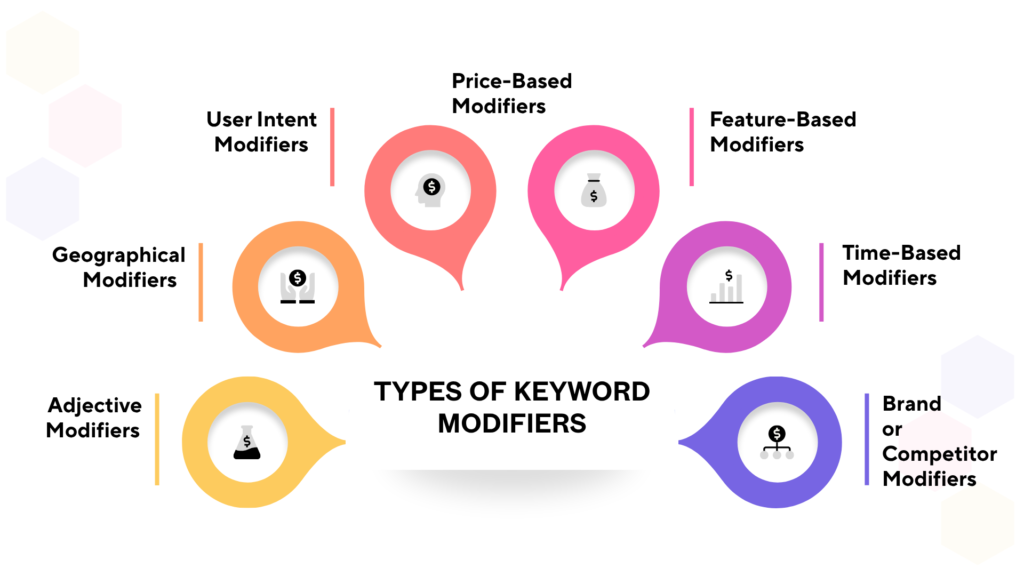
Types of Keyword Modifiers
Here are the most effective types in 2026, with real examples you can use immediately.
Adjective Modifiers
Words that describe quality, size, or opinion.
Examples: best, cheap, free, fast, easy, top, premium, beginner-friendly
“best noise cancelling headphones under 200”
Geographical Modifiers
Location-based terms that trigger local or near-me intent.
Examples: near me, in [city], online, delivery, local
“Plumber near me open now.”
User Intent Modifiers
Words that reveal what the searcher wants to do.
Examples: how to, review, guide, tutorial, comparison, alternatives
“How to start a podcast in 2026.”
Price-Based Modifiers
Budget or value signals.
Examples: cheap, affordable, luxury, under $50, budget, discount
“affordable web hosting for small business”
Feature-Based Modifiers
Specific attributes or functions.
Examples: wireless, AI-powered, waterproof, witha camera, for beginners
“AI-powered email marketing tool”
Time-Based Modifiers
Temporal signals that show urgency or freshness.
Examples: 2026, fast, quick, same-day, 2025 review
“SEO trends 2026.”
Brand or Competitor Modifiers
Direct comparison or branded searches.
Examples: vs, alternative, vs [competitor]
“Notion vs Evernote 2026”
Using a mix of these types across your content creates a well-rounded keyword strategy that covers multiple stages of the customer journey.
How to Find Keyword Modifiers
Finding good modifiers is easier than most people think.
1. Start with a core keyword in Google and note the “People Also Ask” and related searches at the bottom.
2. Use free tools like AnswerThePublic or Google’s autocomplete.
3. In Ahrefs or SEMrush, enter your main keyword and look at the “Phrase Match” or “Related Keywords” reports — filter for modifiers.
4. Check competitor pages that rank well and extract the modifiers they use in titles and headings.
5. Tools like AlsoAsked and Keyword Surfer give instant modifier suggestions while you browse.
Pro tip: Create a simple spreadsheet with columns for core keyword, modifier type, full phrase, search volume, and difficulty. This becomes your content roadmap.
How to Use Keyword Modifiers in Content
Place modifiers strategically:
– Page Title & Meta Description: Put the strongest modifier at the beginning for maximum click-through rate.
– Headings: Use them in H2s and H3s to create a clear structure.
– URL: Keep it clean — “/best-running-shoes-flat-feet” works better than generic.
– Body Content: Naturally weave them into the first 100 words and throughout the article.
– Image Alt Text: “best running shoes for flat feet 2026 review” instead of just “shoes”.
The key is natural placement. Google rewards content that reads well for humans while still containing the right modifiers.
Best Practices for Targeting Keyword Modifiers
– Group modifiers into content clusters (one pillar page + supporting modifier articles)
– Monitor performance monthly and refresh content when modifiers lose relevance
– Combine modifiers with question words for featured snippet opportunities
– Test different modifier combinations in A/B title experiments
– Always prioritize relevance over search volume
Common Mistakes to Avoid
– Overusing the same modifier across too many pages (cannibalization)
– Ignoring search intent behind the modifier
– Stuffing modifiers unnaturally into content
– Focusing only on high-volume modifiers instead of conversion-focused ones
– Forgetting to update modifiers as trends change (especially time-based ones)
Conclusion
Keyword modifiers are one of the simplest yet most powerful ways to improve your SEO results in 2026. They help you target the right audience, create more relevant content, and rank for searches that actually convert.
Start by picking 3–5 core keywords in your niche and brainstorming modifiers for each. Build content around them, track performance, and refine over time. The sites that win in the coming years won’t be the ones with the most content — they’ll be the ones with the smartest, most intent-focused content.
Ready to put keyword modifiers to work for your business? The Brimcove team helps companies build targeted SEO strategies that actually drive revenue. Book a free keyword strategy session and let’s map out modifiers that will move the needle for you.
FAQs
What are keyword modifiers?
Keyword modifiers are words or short phrases added to a main keyword to make it more specific and targeted. They help search engines understand exactly what the user is looking for and improve the chances of matching the right content to the right query. Common examples include adjectives like “best” or “cheap,” location terms like “near me,” or intent words like “how to.” Using them correctly can dramatically improve both rankings and conversion rates compared to broad keywords.
Why are keyword modifiers important in SEO?
They reduce competition, align with user intent, and help pages rank for more specific, higher-converting searches. In 2026, Google’s algorithms reward relevance more than ever. A well-chosen modifier can turn a competitive head term into a winnable long-tail opportunity that brings qualified traffic ready to take action.
How do keyword modifiers differ from long-tail keywords?
Long-tail keywords are the full phrases that result from adding modifiers. Keyword modifiers are the building blocks (the extra words) you add to a core term. Every long-tail keyword contains one or more modifiers, but understanding the individual modifiers helps you scale content creation and target variations systematically.
How do you find keyword modifiers?
Use a combination of Google Autocomplete, “People Also Ask,” AnswerThePublic, and paid tools such as Ahrefs or SEMrush. Look at competitor titles and headings for patterns. Also, check trending topics and seasonal terms. The best approach is to start with your main keywords and systematically add different modifier types (adjective, location, intent, price, etc.) to generate hundreds of variations.
What tools help find keyword modifiers?
Ahrefs, SEMrush, and Moz are excellent for bulk discovery. Free options include Google Keyword Planner, AnswerThePublic, and AlsoAsked. Keyword Surfer (Chrome extension) shows modifiers directly in search results. Combine 2–3 tools for the most comprehensive list.
How often should I update keyword modifiers?
Review and refresh them at least every quarter. Time-based modifiers (2026, 2027) need annual updates. Trend-related modifiers should be monitored monthly. Core adjective and intent modifiers tend to stay stable longer but still benefit from seasonal checks.
Can keyword modifiers improve ranking?
Yes — often significantly. They lower competition while increasing relevance signals. Pages targeting well-chosen modifiers frequently rank faster and hold positions longer than pages targeting only broad terms. They also improve click-through rates because the title matches the searcher’s exact need.
Do keyword modifiers affect conversion rates?
They usually improve conversions substantially. Someone searching with a modifier like “best” or “for small business” is further along in their decision process than someone using just the core keyword. This intent targeting leads to higher engagement and better conversion rates from organic traffic.
Are keyword modifiers only for long-tail SEO?
No. While they create long-tail phrases, you can also use them in short, high-volume titles and meta descriptions. They work across all content types — from blog posts to product pages to landing pages. The key is matching the modifier to the user’s stage in the buying journey.
What mistakes should I avoid with keyword modifiers?
The biggest mistakes are over-optimizing (stuffing too many modifiers), ignoring search intent, using outdated modifiers, and creating separate pages for every variation (causing cannibalization). Always prioritize natural language and user value over forcing modifiers into every sentence.
