
Brand mentions are no longer limited to social media posts or news articles. People discover and evaluate businesses through social platforms, review sites, forums, search results, and increasingly AI tools such as ChatGPT, Perplexity, Gemini, and Google AI Overviews.
A brand mentions tool helps marketers, PR teams, and SEOs monitor these conversations without manually searching for their brand every day. Depending on the platform, you can track mentions, analyze sentiment, compare competitors, receive alerts, and discover opportunities to improve visibility.
This guide compares popular brand mention tracking tools in 2026. Instead of naming one universal winner, we group the tools by strengths so you can choose based on your budget, channels, team size, and monitoring needs.
Pricing and features were checked against vendor pages where available and should be verified again before publishing because SaaS pricing changes frequently.
Table of Contents
What Is a Brand Mentions Tool?
A brand mentions tool monitors the internet for references to a company, product, person, or other tracked keyword. Depending on the platform, it can find mentions across websites, news publications, social networks, forums, reviews, and AI search results.
The basic process is simple: you enter a brand name or relevant keywords, and the tool searches supported sources for matching conversations.
More advanced platforms can also provide:
- Real-time or scheduled alerts when new mentions appear
- Sentiment analysis to identify positive, negative, or neutral conversations
- Competitor monitoring to compare share of voice
- Mention analytics such as reach, engagement, and trends
- Source analysis to show where people are discussing your brand
- AI visibility tracking across emerging search and answer engines
- Unlinked mention discovery for SEO and link-building campaigns
This makes brand mention tracking useful for more than reputation management. PR teams can identify coverage, marketers can measure awareness, and SEOs can turn relevant unlinked brand mentions into potential backlinks.
What to Look for in a Brand Mentions Tool
Not every brand monitoring tool covers the same sources. Before choosing one, consider these factors.
Coverage: Check whether the tool monitors social networks, websites, news, forums, reviews, or AI search engines. A tool that only monitors social media may not be enough for an SEO-focused campaign.
Alert speed: Some platforms provide near-real-time alerts, while others update hourly, daily, or even less frequently. Choose based on how quickly you need to respond.
Sentiment accuracy: Automated sentiment analysis is useful for processing large volumes of mentions, but it is not perfect. Sarcasm, slang, and context can lead to incorrect classifications.
Competitor tracking: If competitive research matters, look for tools that allow multiple brands or keywords to be monitored together.
Pricing structure: Some platforms charge per user or seat, while others price by keywords, mentions, prompts, projects, or usage. A seemingly inexpensive plan can become costly as your monitoring requirements grow.
Unlinked mentions: For SEO teams, this is particularly important. Look for ways to identify pages that mention your brand without linking to your website.
AI search coverage: If visibility in ChatGPT, Perplexity, Gemini, or Google AI results matters to your business, choose a platform that explicitly monitors these environments rather than assuming traditional web monitoring covers them.
Quick Comparison of Brand Mention Tools
| Tool | Best for | Starting price | Free plan | Main coverage |
| Ahrefs Brand Radar | AI search visibility + SEO | From £159/mo | Limited/free features | Web, AI search, Reddit, YouTube |
| Peec AI | AI search analytics | $95/mo | Trial | AI search engines |
| Sprout Social | Social listening + management | $79/seat/mo | No | Social |
| Hootsuite | Social management + monitoring | $99/user/mo | No | Social |
| Brandwatch | Enterprise consumer intelligence | Custom | No | Social, web, media, AI |
| Mention | Web + social monitoring | $599/mo annually | No | Web, social, news |
| Brand24 | Brand monitoring for growing teams | $249/mo | 14-day trial | Web, social, news |
| Alertmouse | Simple web alerts | Free | Yes | Web |
| Google Alerts | Basic mention alerts | Free | Yes | Web, news, blogs |
| Google Trends | Search interest trends | Free | Yes | Google search data |
Pricing shown is approximate and reflects publicly available vendor pricing checked in August 2026. (Ahrefs)
AI search has created a new type of brand visibility to monitor. Instead of checking whether your company ranks for a keyword, you may want to know whether an AI system mentions, recommends, or compares your brand when someone asks a relevant question.
1. Ahrefs Brand Radar
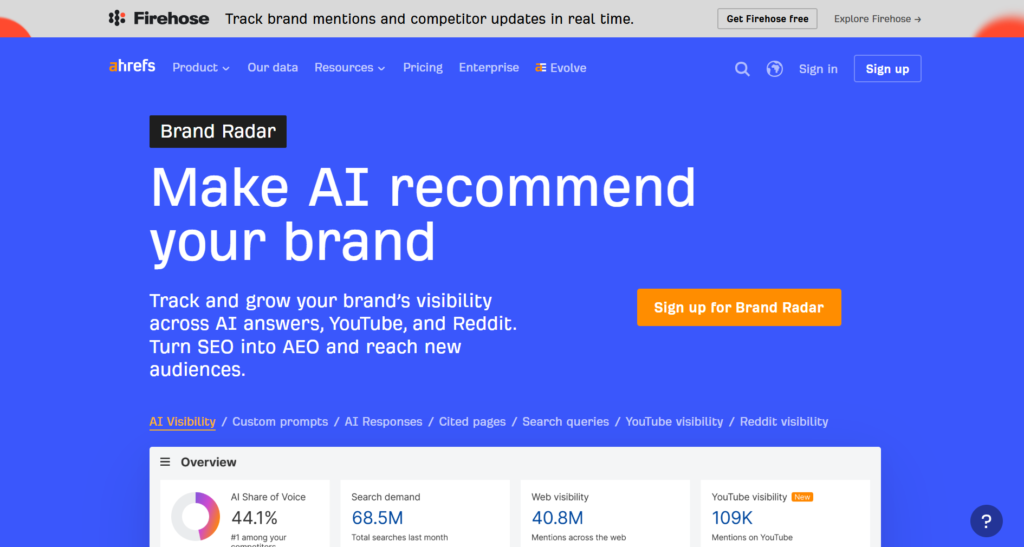
Ahrefs Brand Radar is designed for marketers and SEOs who want to understand brand visibility in AI-generated answers. It can analyze how brands appear across AI search and identify pages and domains that influence those answers.
Best for: SEO teams combining traditional search and AI visibility research.
Strength: It connects AI visibility data with SEO-related information, including cited pages, search demand, Reddit, and YouTube.
Limitation: The standalone AI Visibility Index starts at £159 per month, while more extensive tracking can increase the cost. (Ahrefs)
2. Peec AI
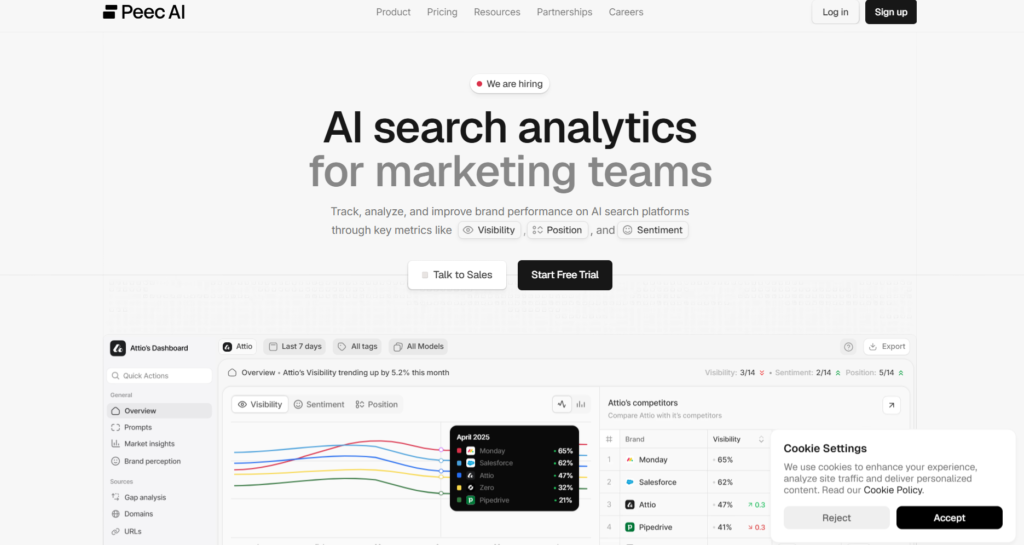
Peec AI focuses specifically on AI search analytics. It tracks brand visibility across platforms including ChatGPT, Google AI Overviews, Google AI Mode, Microsoft Copilot, Perplexity, and Gemini.
Its Starter plan is listed at $95 per month with 50 prompts, three models, one project, and daily tracking. Pro is $245 per month and Advanced is $495 per month when billed annually. (peec.ai)
Best for: Marketing and SEO teams focused specifically on AI search visibility.
Strength: It provides structured visibility, position, and competitive insights across multiple AI models.
Limitation: It is specialized for AI search, so it does not replace a traditional social listening platform for broad web and social monitoring.
3. Sprout Social
Sprout Social combines social media management with monitoring and analytics. Its Standard plan starts at $199 per seat per month, while its Essentials plan is available at $79 per seat per month when billed annually. Standard includes keyword and location monitoring, while higher plans add more advanced analytics and sentiment capabilities. (Sprout Social)
Best for: Teams that want brand monitoring alongside publishing, engagement, and social analytics.
Strength: Its monitoring features sit inside a broader social management workflow.
Limitation: Per-seat pricing can become expensive for larger teams, particularly when monitoring is only one part of what you need.
4. Hootsuite
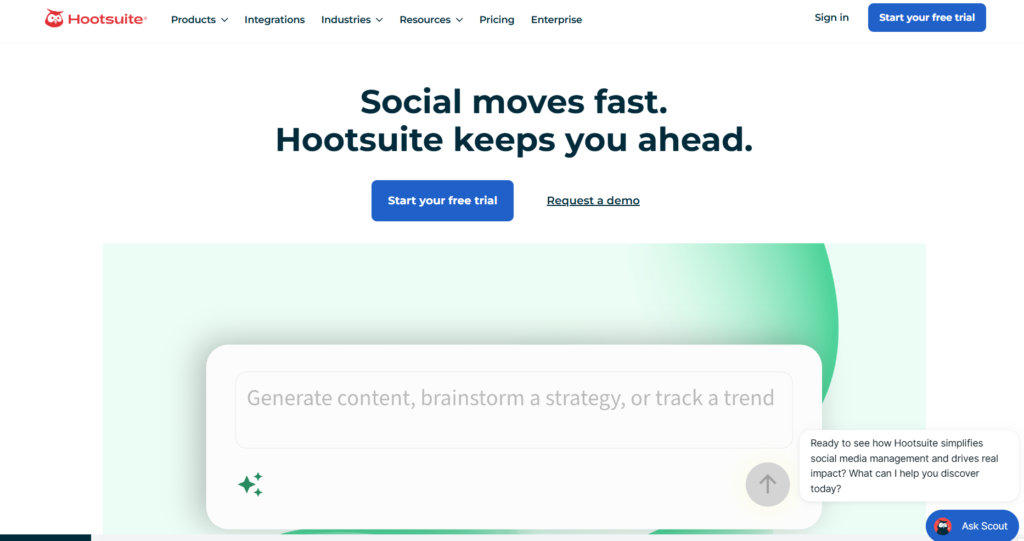
Hootsuite is primarily a social media management platform but also includes brand and competitor monitoring. Its published pricing starts at $99 per user per month for Standard, with Professional at $199 and Advanced at $399 per month when billed annually. (Hootsuite)
Best for: Social teams that need monitoring and publishing in one platform.
Strength: It supports multiple social accounts from a centralized dashboard.
Limitation: It is more focused on social channels than broad web mention discovery or AI search monitoring.
5. Brandwatch
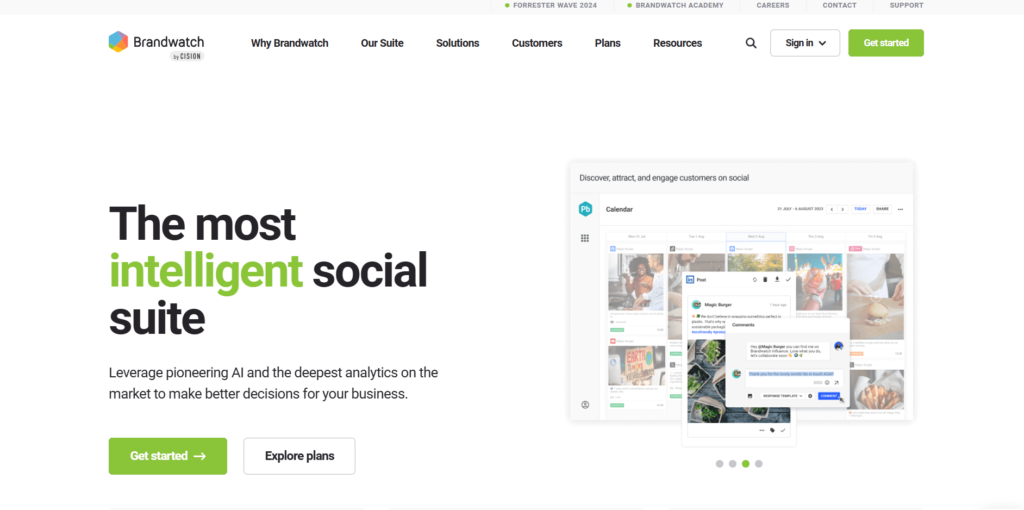
Brandwatch is built for large-scale consumer intelligence and social listening. It can help organizations analyze online conversations, build dashboards, monitor trends, and distribute alerts.
Best for: Enterprise companies, researchers, and large communications teams.
Strength: Its strength is the scale and depth of consumer conversation analysis.
Limitation: Pricing is custom, so it is less suitable for buyers who want a simple, transparent self-service plan. (Brandwatch)
6. Mention
Mention monitors social platforms and the wider web, including news, blogs, forums, and review sites. It supports real-time monitoring, sentiment analysis, competitor analysis, Boolean searches, and alerts.
Mention currently lists a Company plan starting at $599 per month when billed annually. (Mention)
Best for: Organizations that need structured web and social listening.
Strength: Its combination of Boolean monitoring, social coverage, sentiment analysis, and competitive intelligence makes it flexible.
Limitation: The current Company plan is considerably more expensive than lightweight alert tools.
7. Brand24
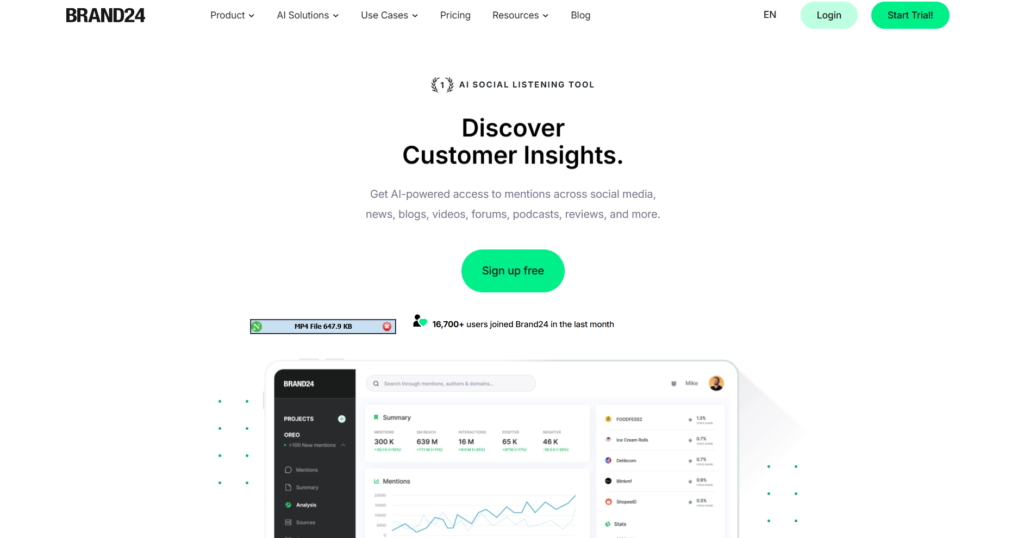
Brand24 provides broad online monitoring with mention analytics, sentiment analysis, reach measurement, source analysis, influencer information, and AI-assisted insights.
Its Individual plan is currently listed at $249 per month, with lower effective pricing on annual billing, and it offers a 14-day trial. (Brand24)
Best for: Growing brands that need more than basic alerts without moving immediately to an enterprise platform.
Strength: It combines monitoring with useful analytics and sentiment features.
Limitation: The price is significantly higher than basic alert services, especially for small businesses that only need occasional monitoring.
8. Alertmouse
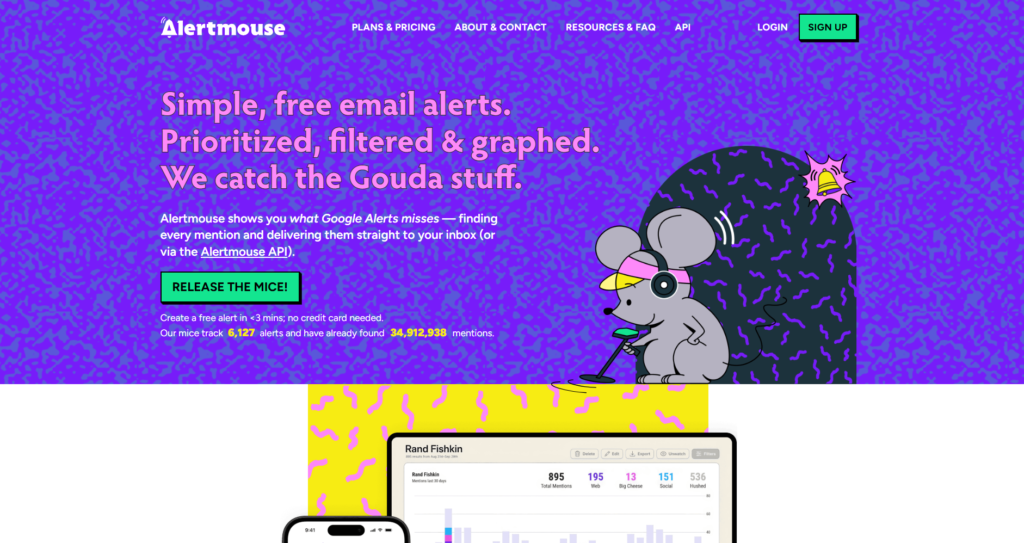
Alertmouse is a simpler option for monitoring web mentions. Its free Nibble plan includes one alert and up to 10 mentions per day. Paid plans start at $10 per month when billed annually, with higher tiers offering more alerts, users, and history. (Alertmouse)
Best for: Individuals and small businesses that want straightforward web alerts.
Strength: The pricing is simple and substantially more accessible than enterprise monitoring platforms.
Limitation: It does not provide the broad social listening, AI visibility, or deep analytics available in larger platforms.
9. Google Alerts
Google Alerts remains one of the easiest ways to monitor basic web mentions at no cost. You can create an alert for a brand name and choose how frequently Google sends results. Options include as-it-happens, daily, or weekly alerts, along with filters for sources, language, and region. (Google)
Best for: Beginners and businesses with very basic monitoring needs.
Strength: It is free, easy to set up, and requires no specialized software.
Limitation: Coverage can be inconsistent or delayed, and it lacks advanced sentiment analysis, competitive reporting, and comprehensive social listening.
10. Google Trends
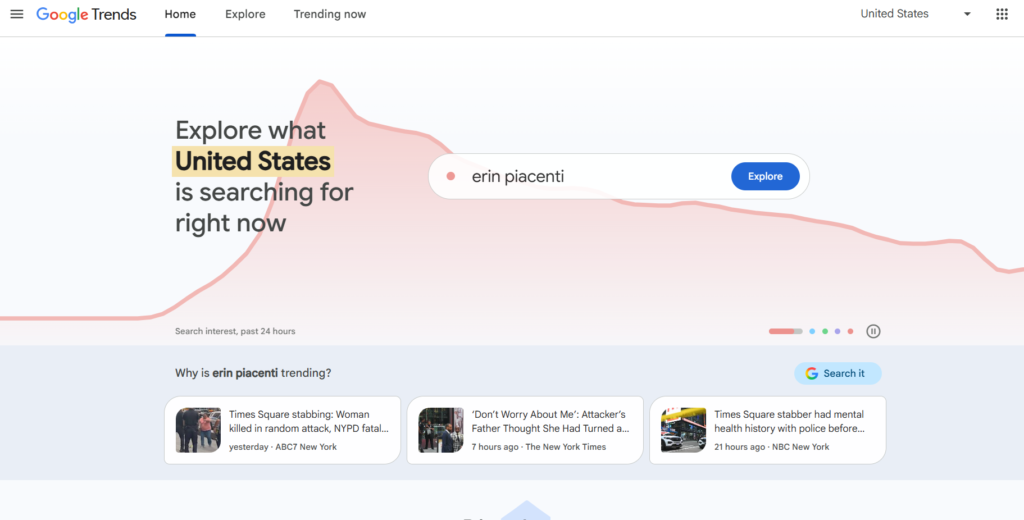
Google Trends is not technically a brand mention monitoring tool. Instead, it shows relative search interest over time and lets you compare search demand between terms. (Google Trends)
Best for: Measuring changes in search interest around a brand.
Strength: It is free and useful for identifying spikes, seasonal patterns, and shifts in search behavior.
Limitation: It does not show the actual content mentioning your brand, so it cannot replace a monitoring platform.
Brand Mentions and Link Building
For SEOs, one of the most useful applications of brand mention tracking is finding unlinked brand mentions.
An unlinked mention occurs when another website names your company, product, founder, or resource but does not include a hyperlink to your website.
These mentions can become backlink opportunities.
A simple workflow looks like this:
Find the mention → Check the page → Confirm there is no link → Evaluate relevance and authority → Contact the publisher → Request a relevant link
Not every mention is worth pursuing. Prioritize pages that are relevant to your industry, already mention your brand positively, and have a genuine reason to link to your website.
For example, if an industry publication describes your company but links to several other businesses in the same article, a polite outreach email asking whether they would consider linking your brand name can be reasonable.
Brand mention tools can speed up the discovery stage, but the outreach and qualification process still requires human judgment.
Once you’ve identified a large number of potential opportunities, a dedicated link-building service such as Brimcove’s can be useful for handling prospecting, outreach, and backlink acquisition at scale.
Brand Mentions in the Age of AI Search
AI search makes brand monitoring more complicated because visibility is no longer limited to traditional search rankings.
AI systems generate answers by drawing on information from websites and other sources. If your brand is repeatedly discussed, cited, recommended, or criticized across the web, those signals can influence what users encounter when they ask AI systems about your industry.
This does not mean every online mention directly changes an AI answer. AI systems have different datasets, retrieval methods, update schedules, and ranking processes.
However, tracking AI visibility can reveal gaps that traditional brand monitoring misses.
For example, you might discover that:
- Competitors are mentioned more often than your brand for important questions.
- AI answers repeatedly cite a third-party page about your company.
- Your brand is associated with outdated information.
- Customers or publishers describe your product differently from your own positioning.
- Your competitors receive citations from sources you have not yet earned coverage from.
Traditional web monitoring and AI visibility tracking therefore solve related but different problems. For businesses competing in AI-driven discovery, using both can provide a more complete picture.
How to Choose the Right Tool for Your Situation
For a very small budget: Start with Google Alerts or Alertmouse. They are enough for basic web monitoring if you do not need sophisticated analytics.
For SEO and AI visibility: Ahrefs Brand Radar or Peec AI makes more sense when your priority is understanding how your brand appears in AI-generated answers.
For social media teams: Sprout Social or Hootsuite is more suitable if monitoring needs to work alongside publishing, engagement, and social reporting.
For broader brand monitoring: Brand24 or Mention can provide more extensive web and social coverage.
For enterprise research: Brandwatch is better suited to organizations that need large-scale consumer intelligence, complex analysis, and customized solutions.
For link building: Prioritize coverage of websites, news, blogs, and other sources where unlinked mentions can be discovered. A social-only platform may not provide enough SEO value.
Also consider how pricing scales. A per-seat platform can become expensive as your team grows, while usage-based tools may become costly as you increase keywords, prompts, mentions, or projects.
FAQ
What’s the difference between a brand mentions tool and a social listening tool?
A brand mentions tool is a broad term for software that tracks references to a brand. A social listening tool usually focuses more heavily on social networks and adds features such as sentiment analysis, audience insights, engagement, and competitive analysis. Some modern platforms combine both.
Is Google Alerts still worth using in 2026?
Yes, if you only need basic and free web alerts. However, Google Alerts should not be treated as a complete monitoring solution because coverage can be inconsistent and it lacks advanced analytics, sentiment analysis, competitor tracking, and AI search monitoring.
How do brand mention tools help with link building?
They can identify websites that mention your brand without linking to it. SEO can then review those pages and contact relevant publishers to request a backlink where appropriate. The tool finds potential opportunities; outreach is what turns suitable mentions into links.
Can brand mention tools track ChatGPT and AI Overviews?
Some can, but traditional monitoring tools generally do not provide the same AI visibility data as specialized platforms. Ahrefs Brand Radar and Peec AI are examples of tools designed to track brand visibility across AI search environments. Coverage varies by platform, model, prompt type, and plan.
Should I choose a free or paid brand monitoring tool?
Choose a free tool if you only need occasional alerts for a small number of keywords. A paid platform becomes more useful when you need real-time monitoring, sentiment analysis, competitor tracking, historical data, reporting, social listening, or AI search visibility.
Can one tool track social, web, and AI mentions?
Some platforms cover multiple channels, but no tool should automatically be assumed to provide identical coverage everywhere. Check the vendor’s current source list and plan limits before purchasing, especially if AI search monitoring is a requirement.
