Your backlinks just disappeared overnight. One morning, you wake up to a 22% drop in organic traffic because three high-authority sites removed the links you worked months to earn. Sound familiar? That exact scenario happens to thousands of site owners every month.
Here’s the thing most people miss. Backlinks are still one of Google’s strongest ranking signals in 2026, but they’re fragile. A single toxic link, a site redesign, or a disgruntled webmaster can wipe out months of SEO progress in days. That’s exactly why backlink monitor software has become non-negotiable for anyone serious about SEO.
This guide walks you through everything: what backlink monitor software actually does, how the best tools work in 2026, which ones are worth your money, and exactly how to set one up and use it daily. Whether you’re a solo blogger, in-house marketer, or running an agency, you’ll leave with a clear plan to track backlinks, catch problems early, and turn monitoring into a real competitive advantage.
Table of Contents
What is backlink monitoring?
Backlink monitoring is the ongoing process of tracking every link that points to your website (or your competitors’). A backlink monitor software tool automatically scans the web, alerts you when new links appear, when existing ones disappear, and flags any that could hurt your rankings.
Why does this matter so much? Backlinks are votes of confidence from other sites. Google still uses them heavily to determine authority and relevance. But links aren’t static. Sites get redesigned, content gets deleted, webmasters change their minds, or spam filters kick in. Without monitoring, you’re flying blind.
The benefits are concrete. You catch lost backlinks before traffic tanks. You spot toxic or spammy links early so you can disavow them. You see which content actually attracts links so you can double down on what works. And you can quietly track competitor backlinks to steal their best opportunities.
In 2026, with Google’s continued emphasis on link quality and the rise of AI-driven spam detection, proactive monitoring isn’t optional — it’s table stakes.
How backlink monitor software works
Most backlink monitor software follows a similar process, just with different speeds and depths.
First, you add your domain (and optionally competitors’). The tool crawls billions of pages using its own index or integrations with Google Search Console. It builds a database of every referring domain, page, anchor text, and status.
Then it runs regular checks — daily for paid tools, weekly for lighter ones. When it detects a change (new link, lost link, nofollow added, page de-indexed), it sends an alert via email or dashboard notification.
Key metrics tracked include:
- Domain Rating / Authority (DR/DA)
- Anchor text and surrounding context
- Follow vs nofollow status
- Spam/toxicity score
- Whether the linking page is still indexed
- Traffic potential of the referring page
The best tools also let you tag links, create disavow files, and export reports for clients or bosses.
Here’s a quick real-world example. Say you ran a guest post campaign last quarter. Without monitoring, you might never notice that two of those posts got deleted during a site refresh. With backlink monitor software, you get an alert the same day, reach out to the webmaster, and often recover the link within 48 hours.
Top features to look for in backlink monitor software
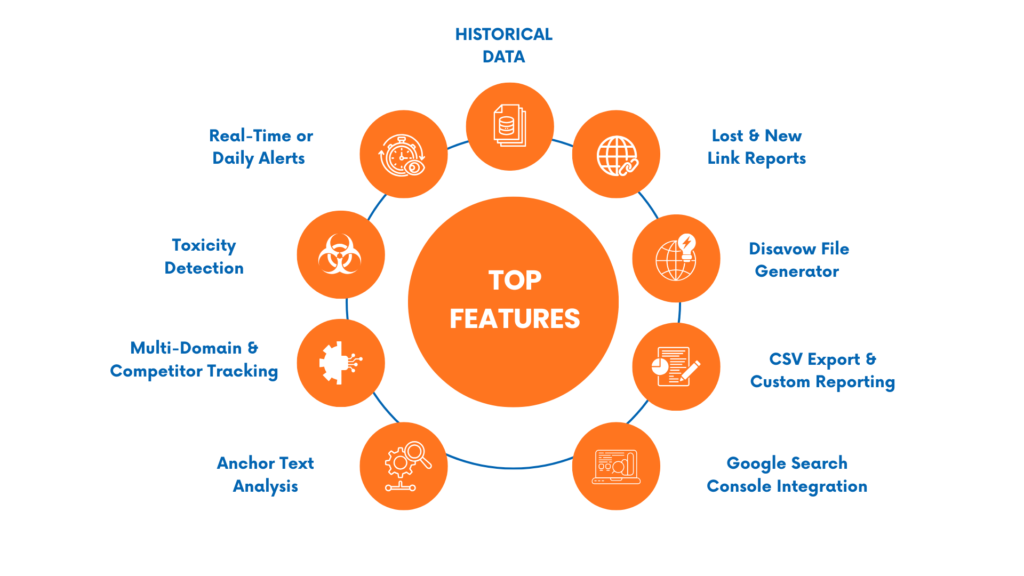
Not all tools are created equal. Here’s what actually matters in 2026:
- Real-time or daily alerts — Email/Slack notifications the moment a link changes.
- Toxicity detection — Automatic spam scoring so you don’t have to manually review every link.
- Multi-domain & competitor tracking — Monitor your site plus 5–10 competitors at once.
- Anchor text analysis — See if your profile looks natural or over-optimized.
- Lost & new link reports — With one-click outreach templates.
- Disavow file generator — Ready to upload to Google Search Console.
- CSV export & custom reporting — Essential for agencies.
- Google Search Console integration — For index status checks.
- Historical data — So you can see trends over months, not just today.
Tools missing two or more of these feel outdated fast.
Best backlink monitor software in 2026
After testing and reviewing the latest data, here are the seven tools that actually deliver in 2026. I ranked them by balance of power, price, and ease of use.
| Ahrefs | In-depth analysis | $129/mo | Largest index + competitor data | Steeper learning curve |
| Tool | Best For | Starting Price (2026) | Key Strength | Main Drawback |
| Semrush | All-in-one teams | $129/mo | Toxic link audit + disavow help | Can feel overwhelming |
| SE Ranking | Budget-conscious agencies | $55/mo | Dedicated monitor + alerts | Smaller index |
| Linkody | Simple daily tracking | $14.90/mo | Affordable multi-site | Fewer advanced metrics |
| Monitor Backlinks | Link builders | $29/mo | Lost link recovery focus | Basic interface |
| Majestic | Trust Flow specialists | $49.99/mo | Unique Flow metrics | Less frequent updates |
| LinkChecker.pro | Chrome extension users | $25/mo | Quick index verification | Limited to monitored links |
Ahrefs and Semrush still dominate for serious users, but SE Ranking and Linkody give you 80% of the value at a fraction of the cost.
How to track your backlinks effectively
Set a weekly rhythm. Every Monday morning, open your dashboard and review the “lost links” report first — those are the ones costing you traffic right now. Reach out within 24–48 hours while the webmaster still remembers your content.
Tag every new link immediately: “guest post,” “resource page,” “editorial,” or “toxic.” This turns raw data into strategy.
Watch your anchor text distribution. If 40%+ of new links use the same money keyword, you’re waving a red flag at Google.
For competitors, pick your top three rivals and monitor their new links monthly. You’ll spot patterns — maybe they’re getting links from podcast show notes or HARO responses — and replicate the tactic.
Common mistake: setting it and forgetting it. The best users treat backlink monitor software like a living dashboard, not a set-it-once tool.
Backlink monitoring for SEO success
Monitoring feeds directly into your link-building strategy. You recover lost authority, disavow toxic links before Google penalizes you, and prove ROI to clients with before/after reports.
It also reveals content gaps. If certain topics attract high-quality links, create more of that content.
In 2026, Google’s spam updates are stricter. A clean, monitored link profile is one of the easiest ways to stay in Google’s good graces.
Free vs paid backlink monitor software
Free options like Google Search Console give you basic indexing data and some referring domains, but no alerts, no toxicity scoring, and no competitor tracking.
Paid tools become worth it the moment you have more than a handful of important links or multiple domains. The time saved (and traffic protected) easily covers the cost.
Start free if you’re testing the waters. Upgrade once you have 50+ tracked links or when you notice traffic fluctuations you can’t explain.
Step-by-step: set up your backlink monitoring
Using SE Ranking (budget-friendly choice):
- Sign up and connect your Google Search Console account.
- Add your domain in the Backlink Monitor section.
- Set daily alerts for new/lost/toxic links.
- Upload any existing disavow file.
- Create your first report and schedule weekly email summaries.
Using Ahrefs (power-user choice):
- Go to Site Explorer → enter your domain.
- Click “Backlinks” then “New & Lost.”
- Set up custom alerts for DR 30+ lost links.
- Add competitors under “Competing Domains.”
- Export your first full link profile CSV.
Do this once, and you’ll never fly blind again.
Frequently asked questions
What is a backlink monitor?
A backlink monitor is specialized software that continuously scans the web for links pointing to your site. It notifies you in real time or daily when new backlinks appear, when existing ones are removed, or when a link turns toxic. Unlike a one-time backlink checker tool, it provides ongoing protection and insights so you can maintain a healthy link profile month after month. In 202,6 this has become essential because Google penalizes spammy or unnatural link patterns faster than ever.
How does backlink monitoring improve SEO?
It protects the authority you’ve already built. Lost backlinks can tank rankings within days. Monitoring lets you recover them quickly, disavow harmful ones before they cause damage, and replicate the content that attracts good links. Agencies using dedicated link monitoring software report 15–30% higher retention of earned links and steadier traffic growth. It also gives you competitor intelligence — seeing where others are getting links helps you outmaneuver them.
Can I track competitor backlinks with backlink monitor software?
Yes — most paid tools let you add competitor domains alongside your own. You’ll see their new and lost links, anchor text patterns, and which pages attract the most authority. This is completely white-hat and gives you a massive strategic edge. For example, if you notice a competitor getting links from industry roundups, you can pitch the same sites with better content.
How often should I check backlinks?
Daily alerts for critical sites, weekly full reviews for most users. The best backlink monitor software runs automated scans every day, so you don’t have to remember. Set it up once, and the tool does the heavy lifting. Checking manually once a month is still useful for deeper analysis and planning your next link-building campaign.
How do I fix broken or lost backlinks?
First, confirm the link is actually gone using the tool’s live checker. Then reach out politely to the webmaster with the original URL, your content link, and a short reminder of the value it provided. Offer to update the anchor text or provide a refreshed version of the content. About 30–40% of lost links can be recovered this way if you act fast. For the rest, focus on earning replacement links from similar sites.
Do free backlink monitor software tools work well enough?
Free tools like Google Search Console show some referring domains and indexing status, but they lack alerts, toxicity scoring, historical trends, and competitor tracking. They’re fine for very small sites with under 50 links. Once you’re serious about SEO, paid link monitoring software pays for itself by saving hours of manual work and preventing ranking drops.
Can backlink monitoring software detect spam or toxic links?
The better ones absolutely can. Tools like Semrush, Ahrefs, and SE Ranking use spam scores, trust metrics, and pattern recognition to flag PBNs, low-quality directories, or sudden link spikes that look unnatural. You get a clear “toxic” label and a one-click way to add them to a disavow file. This has saved many sites from manual penalties in 2026.
What metrics should I watch in my backlink profile?
Focus on: number of referring domains (not just raw links), average DR/DA of linking sites, anchor text diversity, follow vs nofollow ratio, and lost vs gained links over time. A healthy profile in 2026 shows steady growth in quality domains and natural-looking anchor text.
Does backlink monitor software integrate with Google Analytics or other SEO tools?
Most do. SE Ranking and Semrush connect directly with Google Search Console and Analytics, so you can correlate link changes with traffic movements. Ahrefs has its own robust reporting that many teams export into Google Data Studio or Looker Studio for client dashboards.
How much does good backlink monitor software cost in 2026?
Entry-level dedicated tools start around $15–$30 per month. Full-featured platforms like Ahrefs or Semrush run $129+ per month but give you far more than just monitoring. For most users, a $25–$60 tool is plenty until you manage multiple client sites.
Is there a difference between a backlink checker tool and backlink monitor software?
Yes. A checker gives you a snapshot at one moment. Monitor software tracks changes over time with alerts and historical data. Think of the checker as a photo and the monitor as a security camera.
Can I monitor backlinks for multiple websites at once?
Absolutely. Almost every paid tool supports multi-domain tracking. Agencies love this feature because they can monitor every client in one dashboard and set client-specific alert rules.
How accurate are the backlink indexes in these tools?
Ahrefs and Semrush have the largest and most frequently updated indexes in 2026. They miss very few legitimate links. Smaller tools are accurate for the links they do find,d but may have gaps on newer or less popular sites.
What should I do if I see a sudden drop in backlinks?
Open your backlink monitor software immediately. Sort by “lost this week.” Check if the drop is from one big site (site-wide removal) or scattered (possible spam filter). Reach out to recover what you can and disavow anything toxic. Then analyze what content was attracting those links so you can create more of it.
Do I need backlink monitoring if I only do white-hat link building?
Yes. Even the cleanest links can disappear when sites are redesigned, get acquired, or go offline. Monitoring protects your investment and gives you early warning signs before traffic dips.
How do I export reports from Backlink Monitor software for clients?
Every major tool has CSV or PDF export. The best ones let you brand the reports and schedule them automatically. Include before/after charts showing link growth and recovered authority — clients love seeing the numbers.
Conclusion
Backlink monitor software turns a reactive, stressful part of SEO into a predictable, controllable system. In 2026, the sites that win are the ones that protect what they’ve earned while quietly studying their competitors.
Pick one tool from the comparison above, set it up this week using the step-by-step instructions, and start reviewing your alerts every Monday. Within a month, you’ll catch issues you never knew existed and start recovering links you thought were gone forever.
Your next move is simple: open the tool that fits your budget, add your domain, and turn on the alerts. The data is waiting — go use it.
