
Link building for fintech works when every backlink you earn could survive two reviews: Google’s, and your own compliance team’s. Most fintech SEO advice stops at the first. It says finance is YMYL, relevance beats Domain Rating, and leaves you there.
This guide covers the rest for fintech founders, marketing leads, and SEO managers: which backlinks count in finance, where to earn them, nine strategies that work, how to handle compliance and brand safety, what it costs, and how to measure results.
This is marketing guidance, not legal advice. Your compliance or legal team has the final word on what you publish.
What Is Link Building for Fintech?
Link building for fintech is the process of earning backlinks from relevant, trusted finance websites to a fintech company’s site. It helps payments, lending, banking, investing, and crypto brands rank for competitive finance keywords, build E-E-A-T signals Google expects on financial pages, and get cited in AI search answers.
Why backlinks matter more for fintech SEO
- Finance is YMYL. Google treats “Your Money or Your Life” topics with a stricter quality bar, because bad financial information can hurt people. Trust signals, including who links to you, carry more weight.
- E-E-A-T is judged off-site too. Experience, expertise, authoritativeness, and trust aren’t only about your content. Mentions and links from respected finance sources show Google that others vouch for you.
- Money keywords are crowded. Terms like business checking, payment gateway, or personal loans are contested by banks and large fintechs with huge link profiles. Content alone rarely closes that gap.
- AI answers lean on trusted sources. ChatGPT, Perplexity, and Google AI Overviews are cautious with finance questions and tend to cite brands that trusted sites already discuss.
What Makes Link Building for Fintech Different
Link building for fintech companies differs from general link building in five ways: placements can count as regulated marketing, three audiences judge your backlink profile, product terms change while published pages don’t, finance editors guard their independence, and the sites linking to you shape how AI systems describe your brand.
1. A placement can be a regulated communication
In most niches, a guest post is just content. In fintech, a page you commissioned on someone else’s site can count as your advertisement or financial promotion. If it quotes a rate, fee, return, or insurance status, it can fall under the same rules as your own landing pages, which changes who approves it and what records you keep.
2. Three audiences read your backlink profile
Google reads it for ranking signals. AI answer engines read the text around your brand to decide what you are and when to cite you. The third audience is humans doing diligence: bank partners, enterprise buyers, investors, and auditors search your name before they sign. A link from a gambling-adjacent “finance” blog doesn’t just waste budget. It ends up in someone’s due-diligence notes.
3. Your terms change, the web doesn’t
APRs move, fee schedules get revised, and partner banks change. Every third-party page that printed your old terms keeps showing them until someone fixes it. In fintech, an outdated mention can be a misleading claim with your name on it.
4. Finance editors separate editorial from commercial
The biggest personal finance sites earn revenue from affiliate and lead-gen listings, and their editorial teams protect that wall. Pitches that look like a backdoor into a “best of” list get ignored. Pitches that offer data, expertise, or a story get answered.
5. Neighborhood matters more
Finance attracts more spam than almost any niche: loan lead farms, crypto pump sites, casino networks posing as money blogs. When your brand sits on those domains, it shares their context, both for Google and for AI systems.
What Makes a High-Quality Fintech Backlink
A high-quality fintech backlink comes from a site that covers finance, has real organic traffic, publishes under an editorial process, places your link in relevant content, and says nothing about you that you can’t stand behind. In link building for fintech, topical relevance outweighs Domain Rating: a DR 40 payments blog beats a DR 80 general news site with no finance readers.
| Quality signal | What to check | Why it matters in fintech |
|---|---|---|
| Topical relevance | The site and the page cover finance, banking, payments, or your buyers’ industry | Relevance is the strongest trust signal in YMYL niches |
| Real organic traffic | Verified traffic in Ahrefs or Semrush, ideally from finance keywords | Traffic shows Google trusts the site; dead sites pass little value |
| Editorial standards | Named authors, an editorial policy, posts that get rejected | Editorial links signal genuine endorsement |
| Contextual placement | Your link sits in body content on a related topic, not a footer or author farm | Context tells Google and AI systems what you’re known for |
| Authority | DR or DA as a rough filter, never the deciding factor | Useful for shortlisting, misleading on its own |
| Claim safety | The page won’t state rates, fees, returns, or insurance status about you | Keeps the link from becoming a compliance problem |
Map Your Compliance Rules Before Your First Fintech Backlink
Before you brief an agency or send a pitch, list which marketing rules apply to your products and markets. A broker-dealer, a lender, a neobank, and a crypto exchange face different rules, and selling into the UK or EU adds more. That list decides which link building tactics you can use and how much review each one needs.
Fintech marketing rules by market
| Market | Rule set | Who it hits | What it means for links |
|---|---|---|---|
| US | FINRA Rule 2210 | Broker-dealers | Public content counts as retail communication; approval and record-keeping apply, including sources for charts and stats |
| US | SEC Marketing Rule (206(4)-1) | Registered investment advisers | Content you commission elsewhere can be your advertisement; claims must be provable on demand; paid endorsements need disclosure |
| US | Regulation Z (1026.24) | Consumer lenders and card issuers | Payment amounts, terms, or down payments in third-party content trigger full credit disclosures |
| US | FDIC Part 328 | Neobanks and BaaS brands on partner banks | Third-party pages calling you “FDIC insured” can misstate your status |
| US | FTC Endorsement Guides | Everyone | Paid or gifted coverage needs a clear disclosure |
| UK | FCA financial promotions regime (FSMA s21) | Anyone promoting financial products to UK consumers | Promotions must be fair, clear, and not misleading; crypto has been in scope since 8 October 2023, including firms based abroad |
| EU | MiCA (Articles 7, 29, 53, 66) | Crypto issuers and crypto-asset service providers | Marketing must be identifiable, fair, clear, not misleading, and consistent with the white paper; fully in force since 30 December 2024 |
Sort every placement with a claim ladder
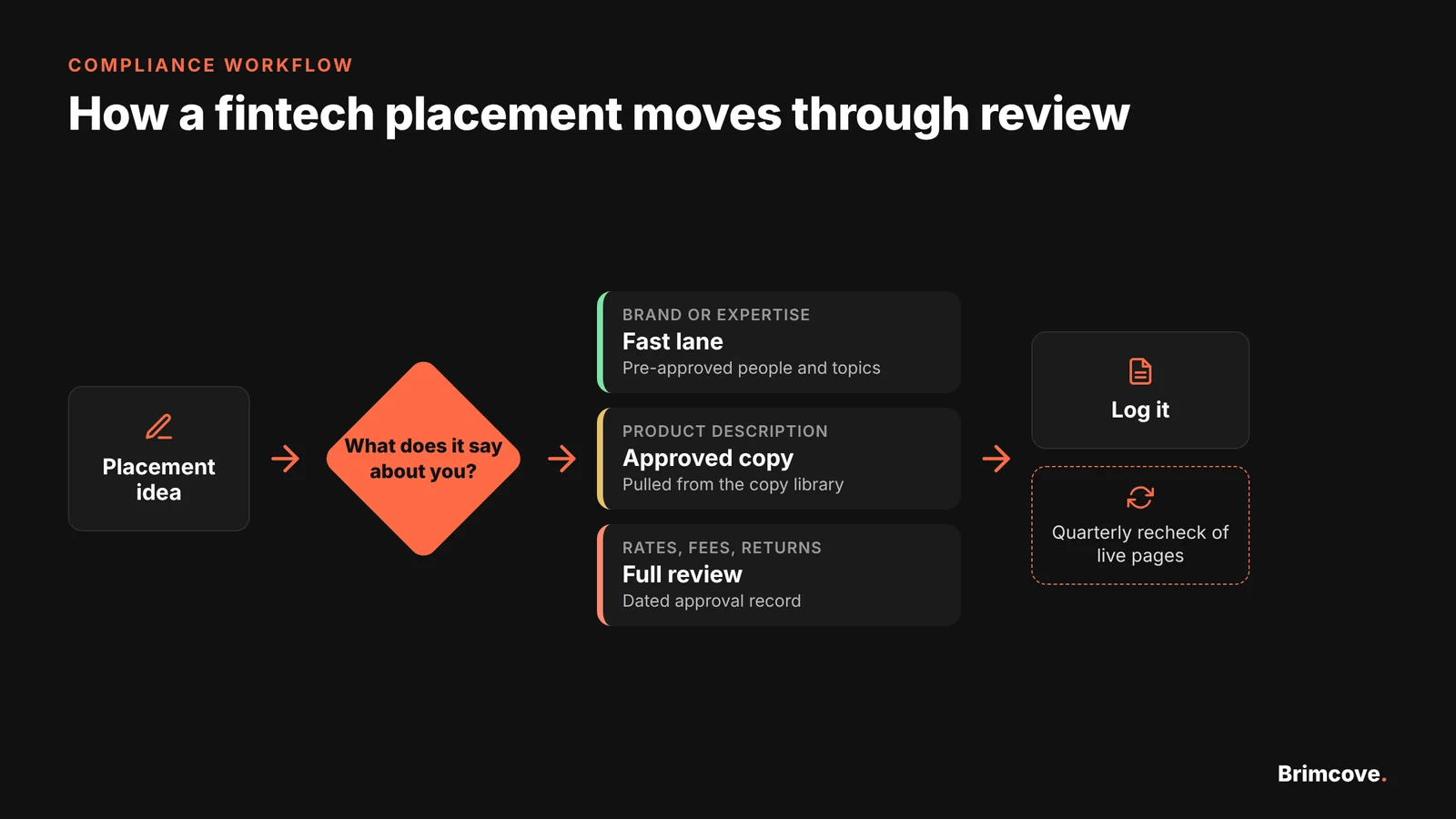
The fastest way to keep compliance from becoming a bottleneck is to sort placements by what they say about you:
| Level | What the placement says | Example | Review effort |
|---|---|---|---|
| 0. Brand mention | Your name and category only | “Payments firm Acme found that…” | Light |
| 1. Expertise | A view on the market, no product claims | Your head of risk explains a new fraud pattern | Light to standard |
| 2. Capability | What your product does | “Acme lets SMBs send same-day ACH” | Standard, from approved copy |
| 3. Terms | Rates, fees, returns, insurance, approval odds | “Acme’s savings account pays 4.1% APY” | Full review plus ongoing monitoring |
Levels 0 and 1 carry most of the SEO and AI-visibility value, and they clear review fastest. Level 3 placements matter for money keywords, but they’re the most expensive to approve and the most likely to go stale. Build most of your fintech link building program on levels 0 to 2.
Agree on review speed with compliance once, by level: pre-approved spokespeople and topics for levels 0 and 1, an approved copy library for level 2, and full review plus a quarterly recheck for level 3. Log every placement with its URL, date, what it says about you, and who approved it.
Brand Safety: Backlinks a Fintech Should Refuse
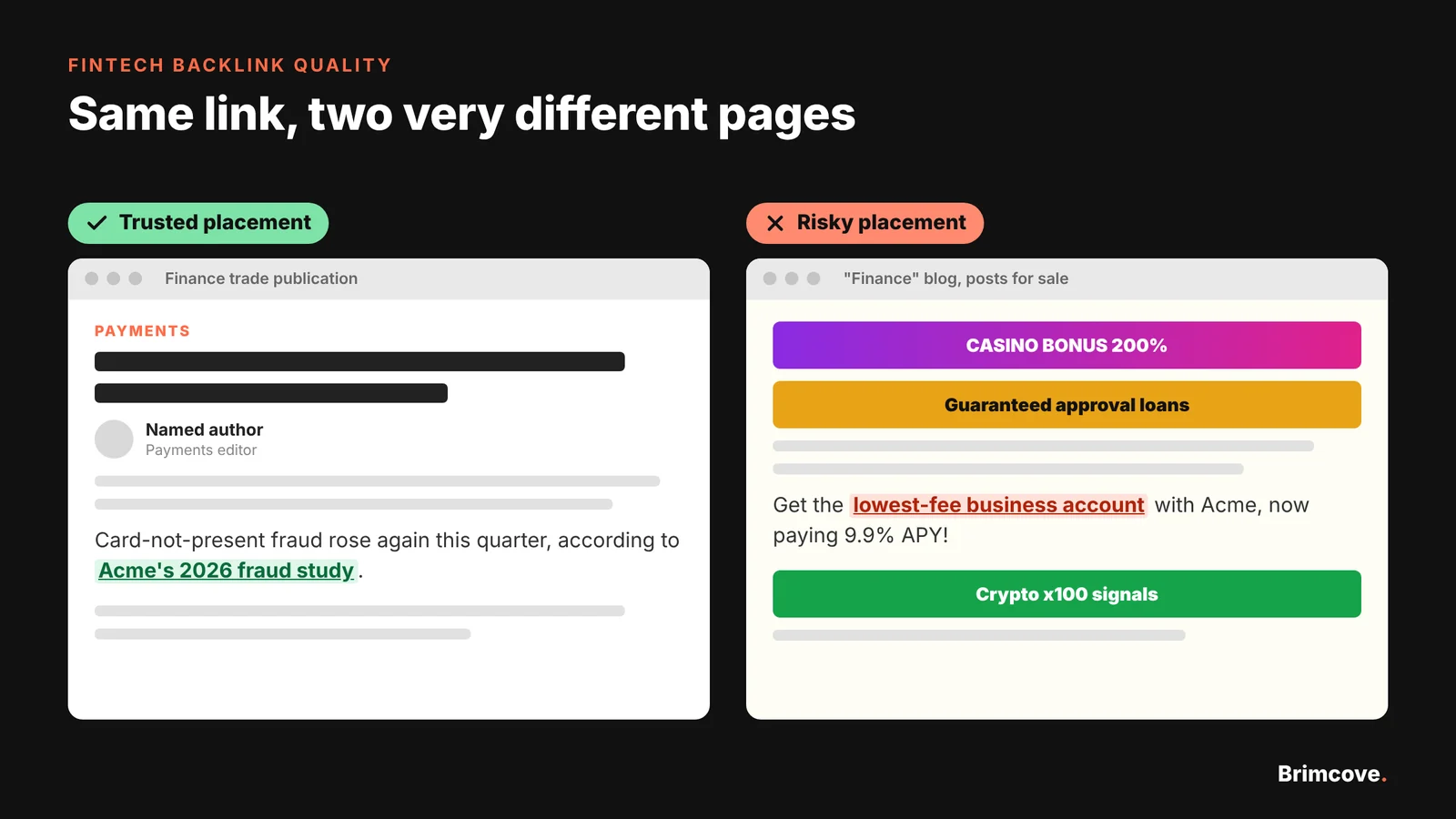
Safe link building for fintech means refusing links from sites that host gambling, payday, adult, or crypto-scam content, sites that sell posts to anyone, PBNs and link farms, and pages that print product claims you can’t control. These placements add little ranking value and create real risk with Google, partners, auditors, and AI systems.
The 8-point vetting check for finance backlinks
- Outbound neighborhood. Scan the site’s outbound links in Ahrefs or Semrush. Casino, CBD, payday, or “guaranteed approval” links are an instant no.
- Finance traffic, not just traffic. Filter its organic keywords for finance terms. A DR 70 site with no finance rankings is a weak fit.
- Real bylines. Look for named authors with verifiable finance experience, an editorial policy, and a corrections policy.
- Sold-to-anyone footprint. A “write for us” page with a price list and posts on every topic means Google likely discounts its links.
- Hosted third-party reviews. Loan or crypto review sections bolted onto an unrelated site are a pattern Google’s site reputation abuse policy targets.
- Claims on the page. If the page will state rates, insurance status, or returns about you, it needs full review or gets dropped.
- Disclosure handling. If money changes hands, the link needs rel=”sponsored” and the content needs a visible disclosure.
- Would you show it to your bank partner? If you hesitate, skip it.
Where Fintech Backlinks Carry the Most Weight
In link building for fintech, the backlinks that count come from six places: national financial press, fintech and banking trade media, personal finance editorial, the vertical press your buyers read, your partners and integrations, and financial education sites. Each tier needs a different approach and pays off in a different way.
| Tier | Examples | How you earn it | What it does for you |
|---|---|---|---|
| 1. National financial press | Bloomberg, Reuters, Financial Times, CNBC, Business Insider | Original data, timely expert commentary | Brand mentions, credibility, syndication. Links are often nofollow or absent |
| 2. Fintech and banking trade | Finextra, The Financial Brand, American Banker, Payments Dive, Banking Dive, Tearsheet, Fintech Futures | Bylined articles, commentary, data | Topical relevance, reach with bank partners and enterprise buyers |
| 3. Personal finance editorial | NerdWallet, Bankrate, Investopedia, Kiplinger | Data and expert quotes for editorial guides | Strong topical links for B2C fintech, separate from affiliate listings |
| 4. Buyer-vertical press | Accounting Today, CPA Practice Advisor, Retail Dive, Small Business Trends | Use-case stories, practitioner bylines | Links from the pages your customers read |
| 5. Partners and integrations | Xero and QuickBooks app stores, Shopify App Store, Salesforce AppExchange, partner bank sites, investor portfolio pages, associations | Integrations, partnerships, memberships | Highly relevant links you’re often already entitled to |
| 6. Financial education | University financial literacy pages, credit unions, nonprofits, small business development centers | Free tools, guides, and calculators | .edu and .org links with lasting trust |
Tiers 1 and 3 often give you the mention more than the link, and that still counts because AI systems and journalists read mentions. Tier 5 is the most overlooked: many fintechs integrate with ten platforms and are listed by two.
Start With a Competitor Backlink Gap Analysis
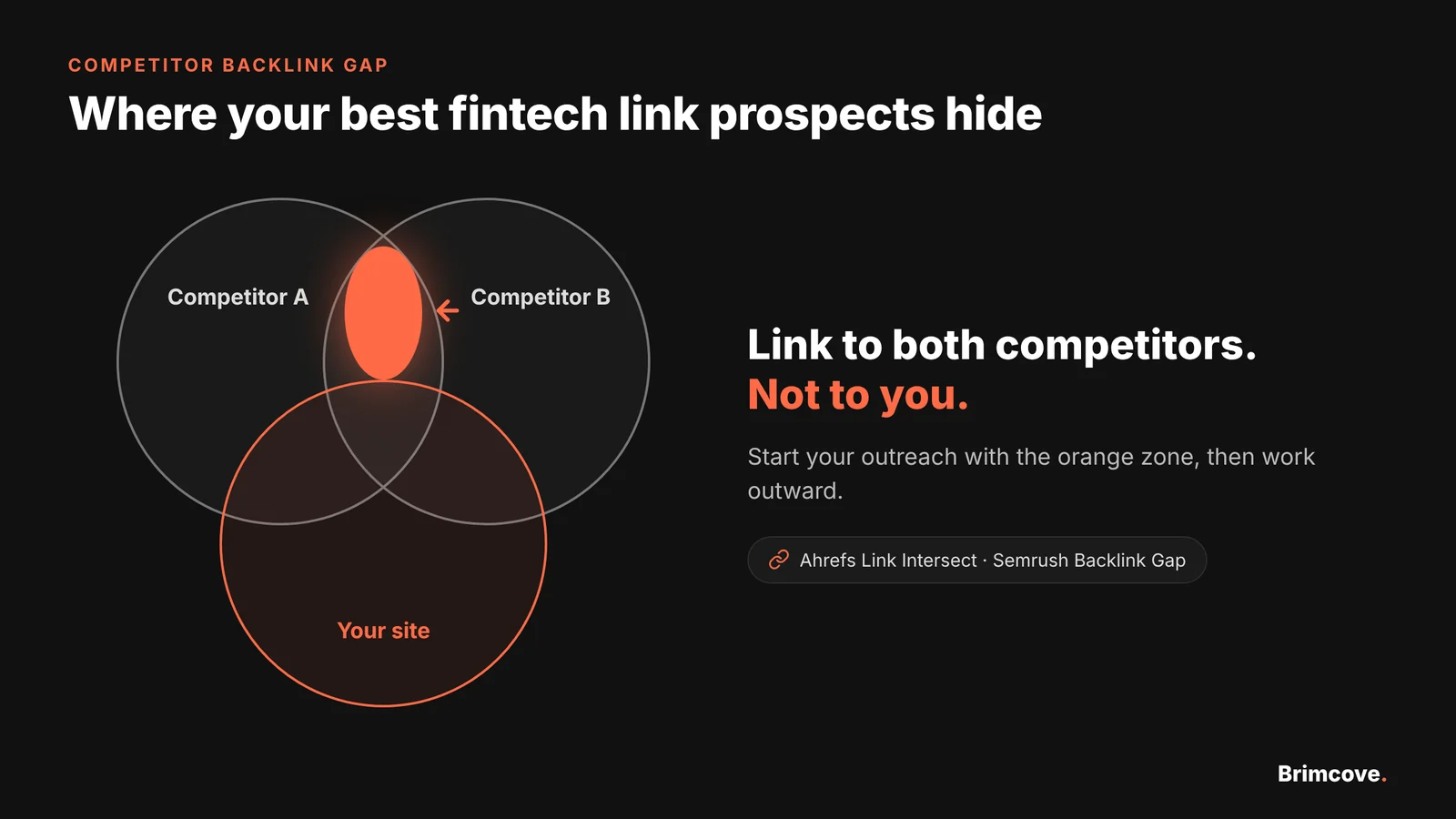
The fastest way to start link building for fintech is to see which finance sites link to two or more of your competitors but not to you. Those sites already link to companies like yours, so they’re the most likely to say yes. A backlink gap analysis turns a blank prospect list into a ranked one in an afternoon.
- Pick three to five real competitors. Choose the fintechs ranking for your target keywords, not only the brands you compete with for customers.
- Run a gap report. Use Ahrefs Link Intersect or Semrush Backlink Gap with your domain and theirs.
- Filter for relevance. Keep finance, banking, payments, and buyer-industry sites. Run the rest through the vetting check above.
- Label each link by how it was earned. Data study, partner listing, byline, expert quote, resource page, or roundup. Patterns show you which tactics work in your segment.
- Check their most-linked pages. Ahrefs’ Best by Links report shows which of their assets attract links. Build something more useful, more current, or better sourced.
Skip the competitor links you shouldn’t copy: paid posts on general blogs, link farms, and spammy directories. Copy the method, not the mistakes.
9 Link Building for Fintech Strategies That Work
The link building for fintech strategies that work best are data-driven digital PR, expert commentary, guest posts on finance publications, contextual link insertions, linkable tools for resource pages, partner and integration links, broken link building, founder and author authority, and reclaiming unlinked mentions. Most sit at levels 0 to 2 of the claim ladder, so they earn trusted backlinks without heavy legal review.
1. Digital PR built on your own data
Fintechs sit on data journalists can’t get anywhere else: transactions, applications, payment flows, spending patterns. Turned into an aggregate study, that data earns coverage competitors can’t copy.
A fintech example that works: Ramp’s AI Index tracks how many US businesses pay for AI tools, using aggregated card and bill pay data. Ramp publishes it monthly with a named economist, a public methodology, and stated limits. The series is listed on the St. Louis Fed’s FRED database, and outlets like TechCrunch have reported on it. Here’s what made it link-worthy:
- It recurs. A monthly index gives journalists a reason to come back and link again.
- It has a human face. A named economist gives reporters someone to quote.
- It shows its working. The methodology and caveats sit on a public page, which editors and compliance teams both want.
- It isn’t about Ramp’s product. It sits at level 0 of the claim ladder.
Make your data study compliance-ready:
- Publish aggregates only, and suppress small groups so no customer can be identified.
- Confirm your privacy notice covers aggregated research use.
- Write a methodology page with sample size, date range, definitions, and limits.
- State that the findings don’t indicate company or product performance.
- Record the source of every number in a claims log before release.
Study ideas by segment: checkout drop-off by payment method (payments), time-to-funding for small business loans (lending), small business hiring by state (payroll), the gap between advertised and real FX costs (cross-border), or invoice payment times by industry (AP and invoicing). No data yet? Commission a survey and publish the sample size, dates, and questions.
2. Expert commentary on the finance news cycle
Finance news runs on a predictable calendar: central bank rate decisions, inflation releases, earnings, new rules, holiday fraud spikes. Journalists covering those stories need quotes fast, and a fintech with a ready spokesperson wins those links week after week.
- Build a spokesperson bench. Two to four people with real titles: CFO, head of risk, chief economist, head of compliance. Each gets a pre-approved bio and a list of topics.
- Write a comment bank. Draft pre-cleared positions on stories you know are coming, so you can respond in an hour instead of waiting three days for review.
- Watch the request platforms. HARO is back under Featured.com’s ownership since April 2025. Qwoted, Featured, and Source of Sources are also active. Filter for finance, banking, payments, and small business queries. See our list of HARO alternatives.
- Pitch reporters directly. Keep a short list of fintech and banking reporters and offer expertise before the story, not after.
A pitch that gets answered: “Our head of fraud has tracked a rise in synthetic identity attempts on small business accounts since July. Happy to share what the pattern looks like and how banks are responding, for background or on the record.”
Keep product claims out of quotes. Journalists cut them anyway, and they push a level 1 placement into level 3.
3. Guest posts on finance and fintech publications
Guest posting still works for fintech, but only on sites your buyers and partners read. Trade outlets like Finextra, The Financial Brand, and Accounting Today accept contributed pieces from practitioners. Smaller finance blogs with real traffic and editorial standards are also worth pitching.
- Write as a named expert, not as the brand.
- Pick angles only an operator could write: launching in a new market, cutting chargeback rates, running compliance review for marketing.
- Expect one or two links, usually in the body where relevant and in the author bio.
- Get your bio approved once and reuse it everywhere.
Skip general business blogs with a “finance” category and a price list. That’s the footprint Google’s spam policies describe. If you want help with placements, our guest posting service only uses traffic-verified, niche-relevant sites.
4. Contextual link insertions on existing finance articles
A link insertion (also called a niche edit) adds your link to an existing article that already ranks and gets traffic. For fintech, it’s one of the most efficient tactics because the host page has already earned Google’s trust.
- Target articles that cover your exact topic, such as an explainer on ACH transfers for a payments company.
- Make sure your link adds something the article lacks: a source, a data point, a deeper guide.
- Keep the surrounding sentence claim-free. Link to an educational page, not a rate page.
- Recheck the page every quarter, since older articles get edited.
Learn more about niche edits and link insertions.
5. Linkable tools for resource pages
Resource pages on university, credit union, nonprofit, and small business sites link to useful tools, and fintechs are well placed to build them:
- Loan, payment, or amortization calculators
- FX fee and real-cost calculators
- Cash runway or burn calculators for startups
- Late-payment fee and interest calculators for invoices
- Plain-English explainers of new rules, such as open banking or BNPL regulation
- Templates for invoices, budgets, and cash flow forecasts
Fintech caution: a lender’s calculator that outputs payment amounts can trigger credit disclosure rules. Show assumptions, label results as illustrations, and clear the tool with compliance before launch.
Where to pitch it: search for pages like "financial literacy" intitle:resources, "small business" inurl:resources "cash flow", or "helpful links" budgeting site:.edu. Email the page owner one sentence on what the tool does and who it helps. Our guide to resource page link building covers the full process.
6. Partner and integration links
Most fintechs have more earned backlinks sitting in their partner list than in any outreach campaign. List every company you:
- Integrate with (accounting software, ecommerce platforms, CRMs, ERPs)
- Bank with or issue through (sponsor banks, card programs)
- Raised from (investor portfolio pages) or graduated from (accelerators)
- Belong to (industry associations and payment networks)
- Serve (customers who’d host a joint case study)
Then check which of them actually links to you. Gaps are common, and closing them takes an email, not a campaign.
Example: an accounts payable tool that integrates with QuickBooks Online and Xero should have a marketplace listing on each, a setup help article, and ideally a co-written case study with a shared customer. Each is a relevant, permanent link from a site your buyers already trust.
Compliance note: partner bank pages and co-marketing copy should carry the exact disclosure language your bank partner requires, such as who provides the banking services. Agree on it once and reuse it.
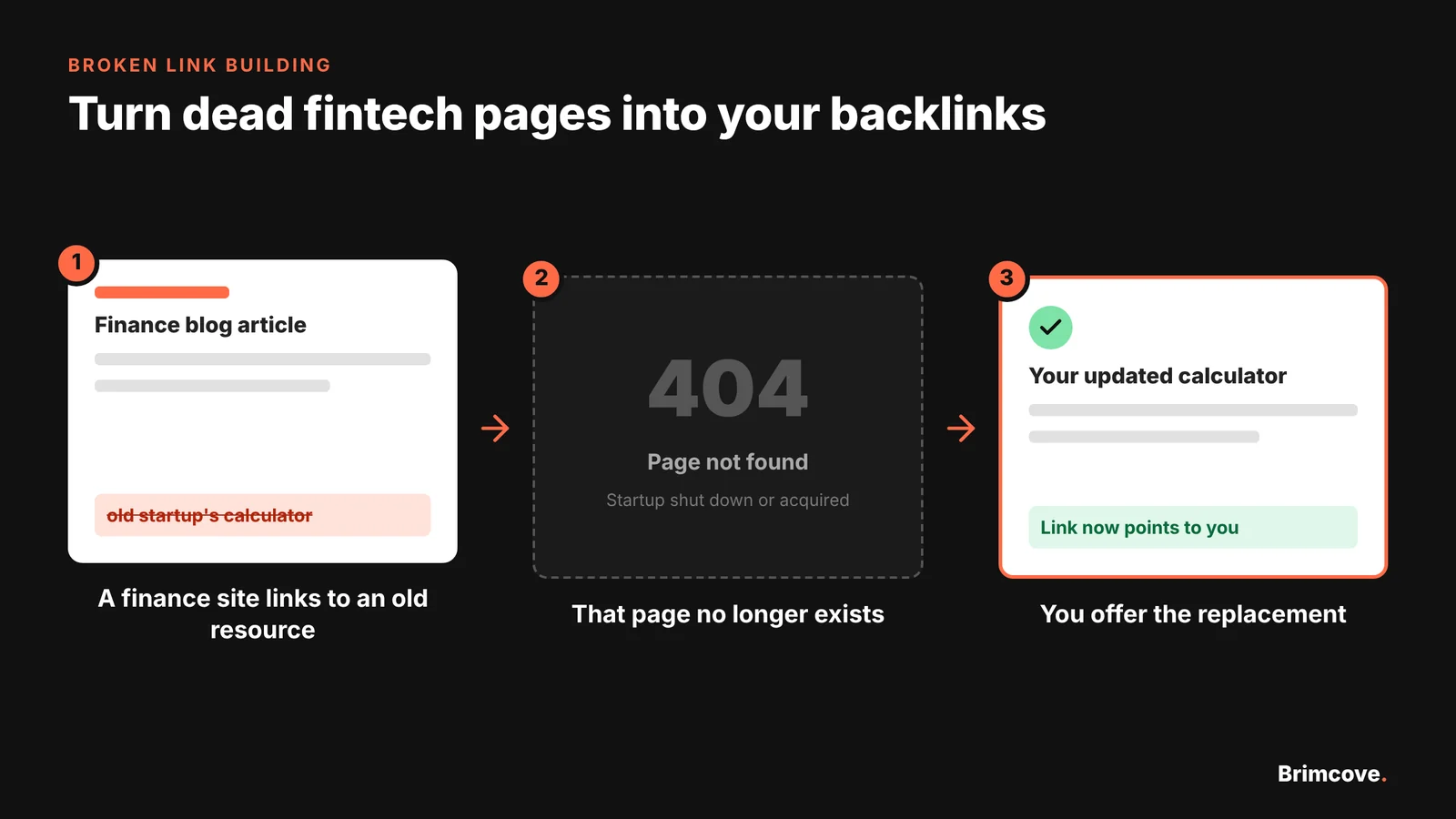
7. Broken link building on dead fintech resources
Fintech has a high turnover of companies and products. Startups shut down, get acquired, or retire tools, and the guides and calculators they hosted disappear. Finance sites that linked to them are left with broken links.
- Find defunct or acquired fintech domains in your category and check their backlinks in Ahrefs.
- Look for links pointing to pages that now return 404 errors.
- Create or update a resource that covers the same need.
- Email the linking site: point out the broken link and offer your page as a replacement.
This works because you’re fixing a problem for the editor, not asking for a favor. Tools like the Ahrefs broken link checker speed up the search.
8. Founder and author authority
Google and AI systems look at who stands behind finance content. Building the public authority of your founders and authors creates links and strengthens E-E-A-T at the same time.
- Author pages: give every writer and spokesperson a page with credentials, experience, and links to their profiles.
- Podcasts: fintech and small business podcasts link to guests in show notes.
- Conferences: speaker pages at events like Money20/20 and Finovate list speakers with links.
- Consistent bios: use the same approved bio everywhere so search engines connect the person to your brand.
9. Unlinked mentions and corrections
Fintechs get mentioned in news, roundups, and analyst notes far more often than they get linked. Set up mention alerts in Ahrefs, Semrush, or Google Alerts, and when a credible page names you without a link, a short, polite request often converts it.
Use the same sweep to catch outdated claims such as old rates, old fees, or wrong insurance status. Fixing them protects you, and asking for a link in the same email is reasonable. See our guide to link reclamation for templates.
Anchor Text Strategy for Fintech Backlinks
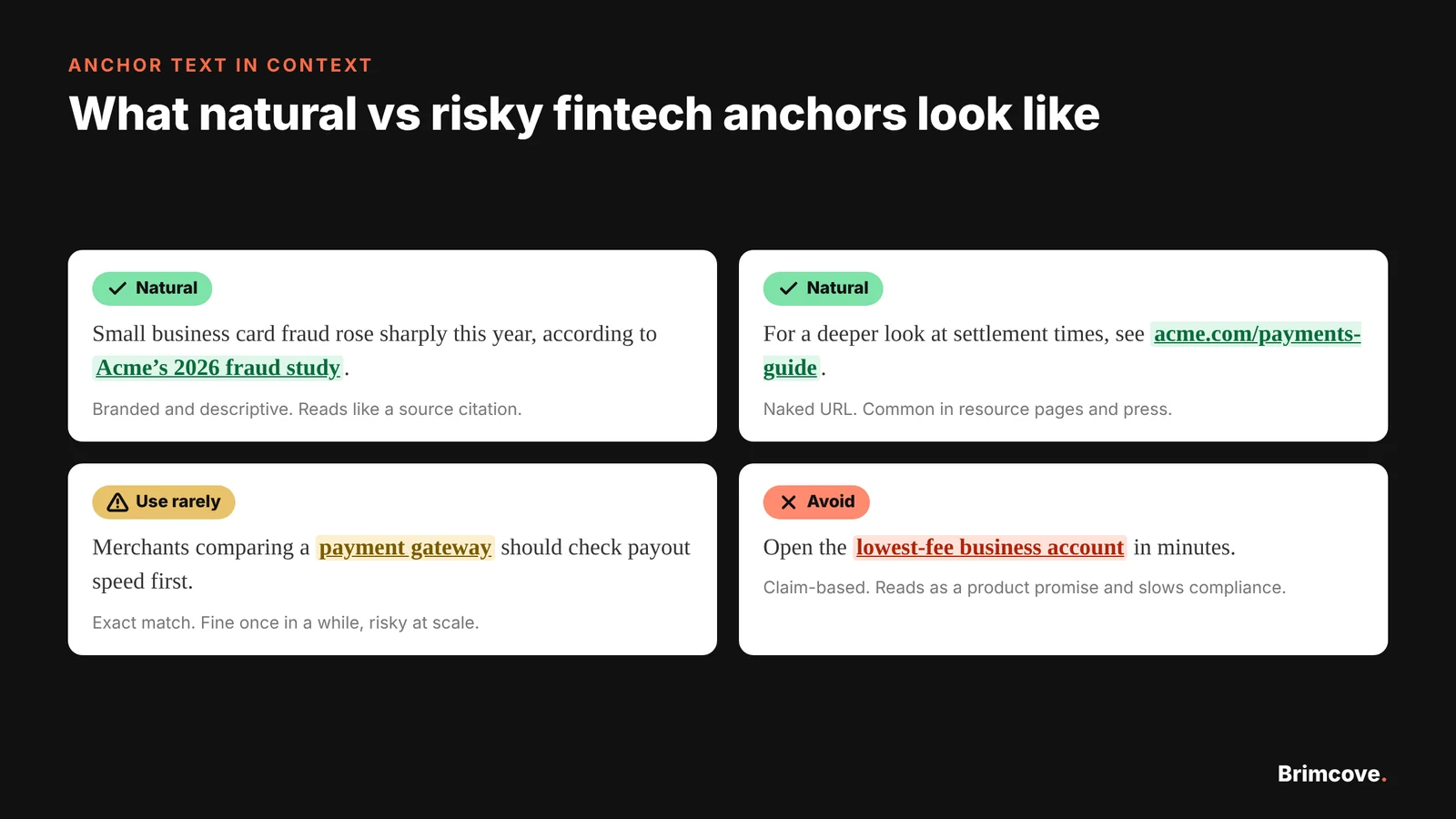
Fintech backlinks should use mostly branded, URL, and descriptive anchor text, with exact-match keyword anchors kept rare. In finance, anchors like “best personal loan” read as product claims, slow compliance review, and look manipulative to Google. Natural anchors are safer and build the brand signals AI systems rely on.
| Anchor type | Example | How to use it |
|---|---|---|
| Branded | Acme, Acme Payments | Your main anchor type; safest and best for brand recognition |
| Naked URL | acme.com | Natural, common in press and resource pages |
| Descriptive | small business payments platform | Use for topical relevance without making claims |
| Generic | this report, learn more | Fine in small amounts; looks natural |
| Exact match | payment gateway | Use sparingly and only where it reads naturally |
| Claim-based | lowest-fee business account | Avoid; reads as a product claim |
For more detail, read our guide to anchor text in SEO.
Link Building for Fintech Startups vs Established Brands
Fintech startups should start with links they’re already entitled to and build authority before chasing tier 1 press, while established fintechs should invest in recurring data studies and money-keyword placements. A startup needs depth over volume: a small number of relevant, trusted links in the first six months beats dozens of random ones.
For fintech startups
- Claim partner, integration, investor, and accelerator links first.
- Set up profiles that matter in your category, such as app marketplaces and B2B review sites like G2 or Capterra.
- Publish founder bylines and do podcast interviews to build personal authority.
- Turn early product or survey data into a small study, even with a modest sample.
- Use backlink gap analysis to copy the repeatable wins of larger competitors.
For established fintechs
- Run a recurring data index that earns links every time it updates.
- Build a standing spokesperson bench for reactive PR.
- Target money-keyword pages with monitored placements and link insertions.
- Audit old placements for outdated claims and reclaim unlinked mentions at scale.
Link Building for Fintech in the Age of AI Search
Link building for fintech now also drives visibility in AI search. ChatGPT, Perplexity, and Google AI Overviews tend to name brands that trusted finance sources mention consistently. Backlinks help, but brand mentions in editorial text, clear descriptions of what you do, and repeated presence in category explainers matter just as much.
- Earn mentions, not just links. A nofollow mention in a trusted outlet still feeds the text AI systems learn from.
- Describe yourself the same way everywhere. Use one consistent line for what you do across bylines, partner pages, and profiles.
- Get into category explainers. Aim for placements in “how X works” and “types of X” articles, not only “best of” lists.
- Track it. Run a fixed set of category prompts each month and note when you’re named.
Our brand mentions service focuses on this kind of AI search visibility.
Fintech Link Building by Segment
Link building for fintech isn’t one plan: a payments API and a consumer lender shouldn’t run the same one. Use this table to pick the two or three tactics that fit your segment, the sources worth chasing first, and the main risk to watch.
| Segment | Best-fit tactics | Sources to chase first | Main risk to watch |
|---|---|---|---|
| Payments and merchant services | Checkout and fraud data studies, integration marketplace listings | Payments trade press, ecommerce platforms’ app stores and blogs | Stating fees or rates that later change |
| Consumer lending and cards | Expert credit commentary, calculators | Personal finance editorial, credit union and university education pages | Payment amounts or terms in roundups triggering credit disclosures |
| Neobanks and BaaS | Saving and spending studies, financial literacy tools | Personal finance editorial, nonprofits, banking trade press | Third parties calling you a bank or “FDIC insured” |
| Wealth and investing | Market commentary from credentialed staff, trade bylines | Financial press, adviser trade media | Performance claims, testimonials, paid endorsements |
| Crypto and digital assets | Research reports, developer and open-source content | Regulated-market outlets, developer communities | UK and EU promotion rules, spam-heavy link neighborhoods, paid press release networks |
| B2B fintech (AP, spend, payroll, accounting) | Partner marketplaces, benchmark reports, practitioner bylines | Accounting and small business press, integration directories | Using customer data or logos without written permission |
| Insurtech | Risk and claims data, consumer guides | Personal finance editorial, industry trade press | State insurance advertising rules |
| Regtech and infrastructure APIs | Developer docs, open-source tools, conference talks | Developer communities, compliance associations, banking trade press | Naming bank clients without approval |
A 90-Day Fintech Link Building Plan
A realistic first quarter of link building for fintech spends month one on rules, research, and quick wins, month two on building assets, and month three on launching them and scaling outreach. Expect partner links and reclaimed mentions within weeks, and ranking movement over three to six months.
Days 1 to 30: set the foundation
- Map the rule sets that apply to your products and markets.
- Agree on the claim ladder and review speeds with compliance.
- Run a competitor backlink gap analysis and build a vetted prospect list.
- Run the partner audit and request every missing partner link.
- Sweep existing mentions for outdated claims and missing links.
Days 31 to 60: build the assets
- Scope one data study, write the methodology, and get it through review.
- Build one linkable tool that fits your segment.
- Pitch two to four guest posts or trade bylines from your spokespeople.
- Start link insertions on relevant, traffic-verified finance articles.
- Answer relevant journalist requests every day.
Days 61 to 90: launch and scale
- Release the study to a short list of tier 1 to 3 journalists, under embargo if it’s strong.
- Run resource page and broken link outreach for your tool and guides.
- Pitch a second angle from the same data to trade and regional press.
- Review results and pick next quarter’s study. Recurring beats one-off.
For more on pacing, see our breakdown of link building timelines.
How to Measure Fintech Link Building Results
Measure fintech link building by relevance and trust, not volume: the share of new links from finance-relevant sites, mentions in trusted outlets, how often AI answers cite you, rankings and traffic for target pages, and how many live placements show outdated terms. Domain Rating alone hides most of what matters in this niche.
| Metric | How to track it | Why it matters |
|---|---|---|
| Finance-relevant referring domains | Tag new referring domains by topic in Ahrefs or Semrush | Relevance is the main quality signal in YMYL niches |
| Tier mix | Count new links and mentions by tier each month | Shows if you’re stuck in easy tiers |
| Brand mentions in tiers 1 to 3 | Mention alerts | Mentions shape journalist and AI perception, even without a link |
| AI citation share | Run a fixed set of 20 to 30 category prompts in ChatGPT, Perplexity, and Google AI Overviews each month; record if you’re named | Tracks visibility where buyers now research |
| Rankings and traffic | Google Search Console for target category and money pages | Ties links to business outcomes |
| Anchor text mix | Anchor report in Ahrefs or Semrush | Catches over-optimization before it becomes a problem |
| Stale claims open | Count of live placements showing outdated terms | Your risk metric |
How Much Does Fintech Link Building Cost?
Fintech link building costs depend on the tactics you choose. In-house work costs tools and team time. Individual guest posts on vetted sites typically cost from under a hundred to a few hundred dollars each. Managed campaigns run as monthly retainers, and digital PR with data studies costs more because of research and review time.
As a reference point, Brimcove’s guest posts range from $69 on DR 20+ sites to $389 on DR 70+ sites, and our managed link building runs from $499 to $5,000 a month depending on scope. Be wary of fintech link building services priced far below the market: in finance, cheap links usually mean PBNs, link farms, or sold-to-anyone sites.
How to choose a fintech link building agency
- Finance experience: ask for sample placements on finance or fintech sites, not just high-DR general sites.
- Transparent vetting: they should share their criteria for relevance, traffic, and editorial quality.
- No PBNs or link farms: get this in writing.
- Site approval: you should see and approve target sites before anything goes live.
- Compliance-friendly process: they should work with your review steps, not around them.
- Clear reporting: a live log of every placement, its URL, anchor, and status.
- Guarantee: a replacement policy if a link drops.
Fintech Link Building Mistakes to Avoid
The costliest mistakes in link building for fintech are chasing Domain Rating over relevance, buying cheap link packages, briefing outreach before compliance, using keyword-rich anchors that read as claims, and forgetting old placements. Each one wastes budget or leaves you with risks you can’t control.
- Chasing DR over relevance. A high-DR site with no finance audience adds little to fintech rankings.
- Buying bulk or cheap link packages. They create a spam footprint in a niche Google watches closely.
- Briefing an agency before mapping your rules. You’ll pay for pitches compliance later kills.
- Using exact-match or claim-based anchors. They slow review and look manipulative.
- Gifting accounts or waiving fees for coverage without disclosure. That’s a link scheme for Google and an undisclosed endorsement for regulators.
- Forgetting old placements. Every live page with your old rate is a liability until someone fixes it.
Final Thoughts on Link Building for Fintech
Link building for fintech rewards patience and precision. A handful of relevant, trusted links from finance publications, partners, and education sites will do more for your rankings and AI visibility than hundreds of random ones, as long as every placement can stand up to Google’s standards and your compliance team’s.
Start with the links you’re already entitled to, build one asset worth citing, and grow from there.
Want a team to handle fintech link building for you?
Brimcove’s managed link building is built for finance and other trust-sensitive brands: hand-vetted, niche-relevant placements, fully manual outreach, and a 6-month replacement guarantee on every link.
Book a Free Strategy CallLink Building for Fintech: FAQs
What is link building for fintech?
Link building for fintech is earning backlinks from relevant, trusted finance websites to a fintech company’s site. It helps fintech brands rank for competitive finance keywords, build E-E-A-T trust signals, and appear in AI search answers.
How is link building for fintech different from regular link building?
Fintech sites face stricter quality standards from Google, and placements that mention products can count as regulated marketing. You need finance-relevant sources, a review process with compliance, and ongoing checks that third-party pages don’t show outdated rates, fees, or insurance claims.
What are the best link building strategies for fintech companies?
The best strategies are data-driven digital PR, expert commentary, guest posts on finance publications, contextual link insertions, linkable tools for resource pages, partner and integration links, broken link building, founder authority, and reclaiming unlinked mentions.
Does every fintech backlink need compliance approval?
Not at the same depth. Brand mentions and expert commentary need light review from pre-approved spokespeople and topics. Product descriptions use approved copy. Anything stating rates, fees, returns, or insurance status needs full review and monitoring.
Can fintech companies pay for guest posts?
Paid placements must carry rel=”sponsored” or rel=”nofollow” under Google’s spam policies, and paid content may need a visible disclosure under advertising rules. Earned bylines in trade publications usually deliver more value with fewer complications.
How many backlinks does a fintech startup need?
There’s no fixed number. Compare yourself with the pages ranking for your target terms and close the relevance gap, not the count gap. A dozen links from finance trade media, partners, and education sites often outperform hundreds from unrelated domains.
How long does fintech link building take to show results?
Partner links and reclaimed mentions can land within weeks. A data study usually takes six to ten weeks to produce and approve. Ranking changes for competitive finance terms typically show over three to six months.
Do backlinks help fintech brands appear in AI search?
Yes. AI systems lean on sources they consider reliable for finance questions, so backlinks and brand mentions in trusted trade and financial press make your brand more likely to be named in AI answers.
