
A power dialer is calling software that dials your list one number at a time, the moment you finish the last call.
Because you skip manual dialing and the waiting between calls, more of your phone time goes to actual conversations.
The best power dialers in 2026 are CloudTalk, Allo, JustCall, Mojo, PhoneBurner and Orum, and the right one depends on how many people dial and what you pay per conversation.
Key Takeaways
CloudTalk — best value for small teams
$40/user/month for the Starter plan plus the Power Dialer add-on, with no seat minimum and local caller ID.
Allo — budget pick with AI notes
A flat $50/month dialer add-on for the whole team, on top of the $32/user/month Business plan billed yearly.
JustCall — scripts and coaching
$49/user/month billed yearly on the Pro plan, with a 2-seat minimum.
Mojo — the real estate speed pick
Triple-line dialer at $149/month per caller ($139 plus $10 access), month to month.
PhoneBurner — pure power dialer
$140/user/month billed yearly, with one-click voicemail drop and a built-in CRM.
Orum — parallel dialing for SDR teams
Built for volume and budget, but pricing is quote-only and starts at 9 seats.
What Makes a Power Dialer Different From Parallel and Predictive Dialers
All three dial for you, so you don’t need to actually type numbers. They differ in how many numbers ring at once and who ends up waiting.
With a power dialer, the caller waits for the prospect. With parallel and predictive dialers, the prospect can end up waiting for the caller, which is where dropped and silent calls come from.
Power dialer: calls one number at a time. When a call ends, the next one starts automatically. You only talk to people you meant to call — no dead air and no abandoned calls.
Parallel dialer: rings several numbers at once and connects you to the first person who answers. The other lines drop. It multiplies live conversations per hour, but it burns through lists faster and can hang up on people who answer second.
Predictive dialer: uses an algorithm to dial ahead of your agents, guessing when someone will be free. It suits large call centers. For small teams, it often means a pause after “hello,” which prospects notice.
For most callers, a power dialer is the right starting point. Move to parallel dialing once you have more good data than hours to call it.
Best Power Dialers Compared (2026)
The table puts the six power dialer tools side by side, with each one’s cheapest setup that includes a power dialer.
G2 ratings were checked on Oct. 20, 2026, and review counts range from 28 for Mojo to 2,395 for JustCall. A rating carries more weight when it comes from thousands of reviewers.
| Dialer | Attribute | Detail |
|---|---|---|
| CloudTalk | Best for | Small calling teams that want a full phone system |
| Lines | 1, or up to 10 with the Parallel Dialer add-on | |
| Starting price | $40/user/month billed yearly (Starter $25 + Power Dialer $15) | |
| Seat minimum | None on Starter (3 on Expert, which includes the dialer) | |
| G2 rating | 4.4/5 (1,941 reviews) | |
| Edge | Caller ID that matches each contact’s area code, or rotates across your numbers | |
| Allo | Best for | Small teams on a budget that want AI notes on every call |
| Lines | 1 on the Business plan, 3 to 5+ with parallel dialing on the Ultra plan | |
| Starting price | $82/month for one user ($32 Business plan + $50 dialer add-on) | |
| Seat minimum | None | |
| G2 rating | 4.7/5 (209 reviews) | |
| Edge | One flat dialer price for the whole team, AI summaries included | |
| JustCall | Best for | Teams that want scripts and coaching in the same tool |
| Lines | 1 (predictive up to 10 lines on SalesPro, quote only) | |
| Starting price | $49/user/month billed yearly on Pro | |
| Seat minimum | 2 | |
| G2 rating | 4.3/5 (2,395 reviews) | |
| Edge | Call scripts, local presence, follow-up texts and live call monitoring | |
| Mojo | Best for | Real estate agents and high-volume solo callers |
| Lines | 1 or 3 | |
| Starting price | $99/month per caller ($89 single-line + $10 access), month to month | |
| Seat minimum | None | |
| G2 rating | 4.1/5 (28 reviews) | |
| Edge | Triple-line dialing, optional real estate lead data | |
| PhoneBurner | Best for | Full-time callers who want a dedicated power dialer |
| Lines | 1 | |
| Starting price | $140/user/month billed yearly ($165 monthly) | |
| Seat minimum | None listed | |
| G2 rating | 4.8/5 (294 reviews) | |
| Edge | One-click voicemail drop and a built-in CRM | |
| Orum | Best for | SDR teams with high volume and budget |
| Lines | Parallel | |
| Starting price | Quote only | |
| Seat minimum | 9 | |
| G2 rating | 4.6/5 (1,099 reviews) | |
| Edge | Parallel dialing with AI answer detection and coaching add-ons |
Best Power Dialers Reviewed
We looked for power dialers aimed at teams that make their own calls, with published prices where possible. We left out Kixie and Nooks, since neither publishes prices.
Orum stays in as the parallel-dialing option for larger teams. Here are the six we’d shortlist.
1. CloudTalk — Best Value for Small Calling Teams
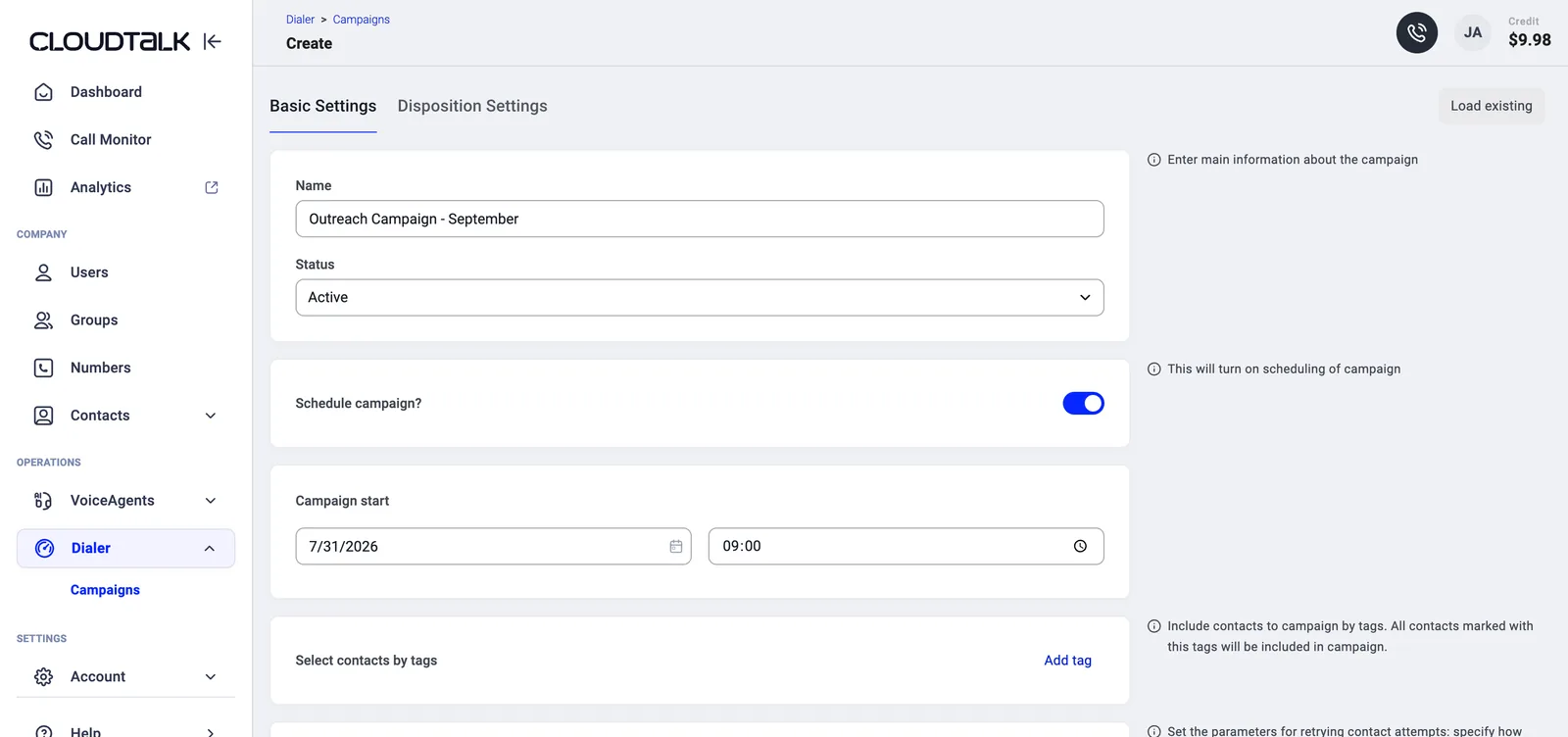
CloudTalk is a business phone system with a power dialer you can add to any plan. You build a campaign from a tag or a CRM list and start a session.
CloudTalk dials the next contact after a short countdown. You can turn auto-dial off if you want to preview each contact first.
Caller ID is handled inside the dialer. By default, CloudTalk shows a number that matches each contact’s area code, and it can rotate across your numbers to keep any single one from getting flagged.
When one line isn’t enough, the Parallel Dialer add-on rings up to 10 contacts at once.
On G2, CloudTalk holds 4.4/5 from 1,941 reviews. One sales team liked having recordings next to the dialer:
Key Features
- Power dialer on Expert, or as a $15/user/month add-on on Starter and Essential
- Local caller ID by area code, or number rotation
- One-click voicemail drop
- Contact lists from HubSpot, Salesforce, Pipedrive and Zoho CRM, with outcomes synced back
- Parallel Dialer add-on that dials up to 10 lines at once (add-on)
- AI call summaries with Conversation Intelligence (add-on)
- Lowest five-seat cost in this comparison ($200/month)
- Caller ID tools built into the dialer
- Room to grow into parallel dialing in the same app
- AI features and parallel dialing are add-ons
- Expert, the plan that includes the dialer, needs at least 3 users
- Large list imports can be clunky: “Uploading and updating larger contact lists could be more intuitive” (Bent K., Sept. 2026, G2 review)
Who should use CloudTalk? Small calling teams that want the dialer inside their phone system and care about caller ID health. It’s also a good fit for teams that call several countries, with local numbers in 160+ of them.
Teams of three or more have two ways in: the Starter plan with the add-on at $40 a user, or the Expert plan with the dialer included at $49. If the dialer is all you need, the Starter route saves $9 per caller each month.
2. Allo — Best Budget Pick With AI Notes
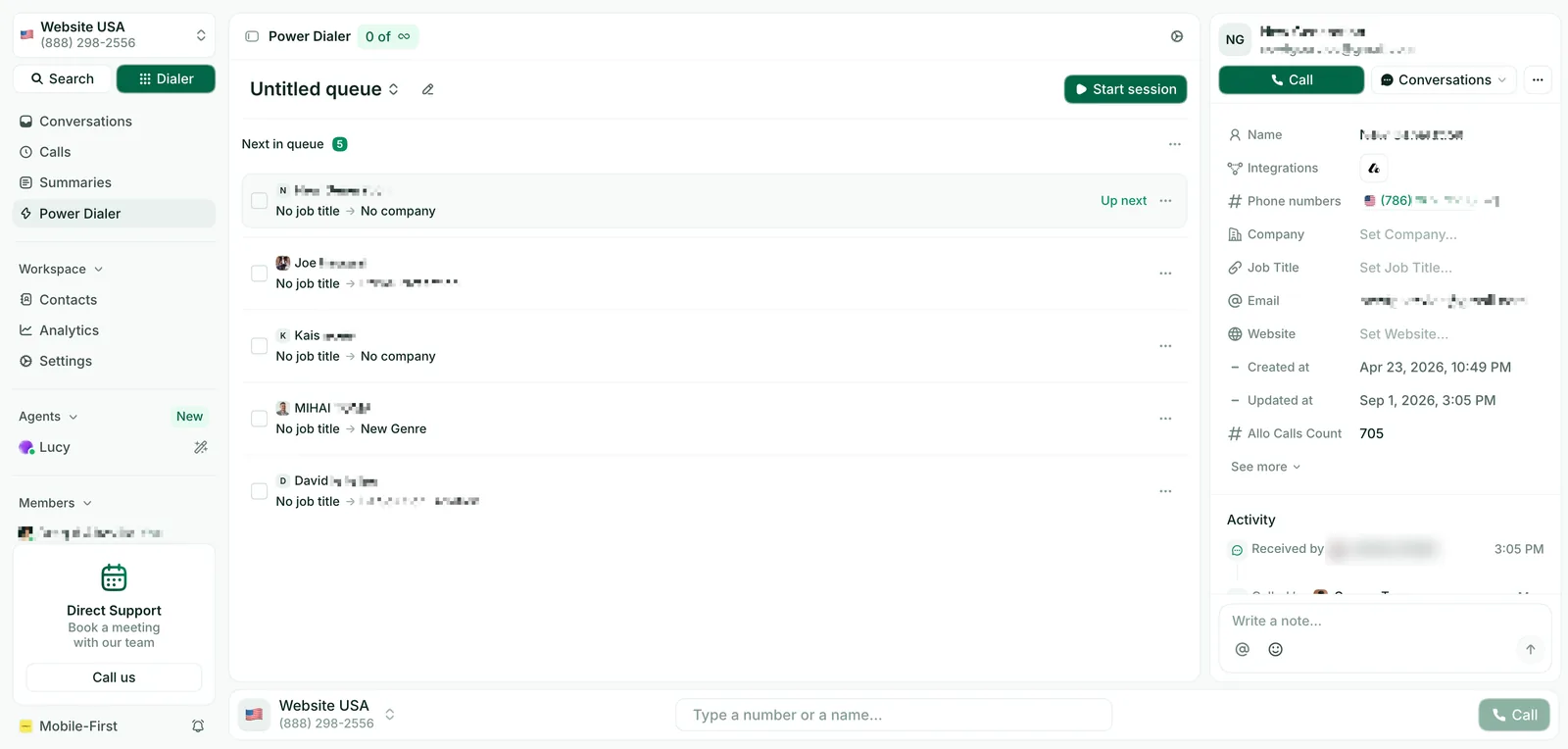
Allo is an AI phone system for small teams. Its power dialer is an add-on with one flat price for the whole team: $50 a month billed yearly, no matter how many people dial.
You upload a CSV file or push a filtered list from HubSpot or Salesforce, and Allo calls the queue back to back. You can pause, skip, tag and take notes between calls.
Every call is transcribed and summarized with AI, and calls sync back to your CRM with their tags and notes. Allo holds 4.7/5 on G2 from 209 reviews.
The power dialer calls one contact at a time and runs on desktop only. It also skips voicemails instead of leaving a recorded message. Parallel dialing, which rings 3 to 5 contacts or more at once, comes with the Ultra plan ($100 per user/month billed yearly).
Key Features
- Power dialer add-on for a flat $50/month per team (included in the Ultra plan)
- Lists from a CSV file, pasted numbers, HubSpot or Salesforce
- Automatic voicemail detection that skips to the next contact
- Call recordings, with AI transcripts and summaries
- Sync to HubSpot, Salesforce, Pipedrive, Attio, Folk and Odoo
- Local numbers in 80+ countries
- The dialer price doesn’t grow with your team
- AI summaries on every call without an extra license
- No seat minimum
- Parallel dialing only on the Ultra plan ($100/user/month)
- No prerecorded voicemail drop
- Desktop only
Who should use Allo? Small teams where a few people call part of the day and everyone needs clean notes in the CRM afterward. For a five-person team, it’s one of the cheapest ways to get a power dialer with AI summaries.
3. JustCall — Best for Scripts and Coaching
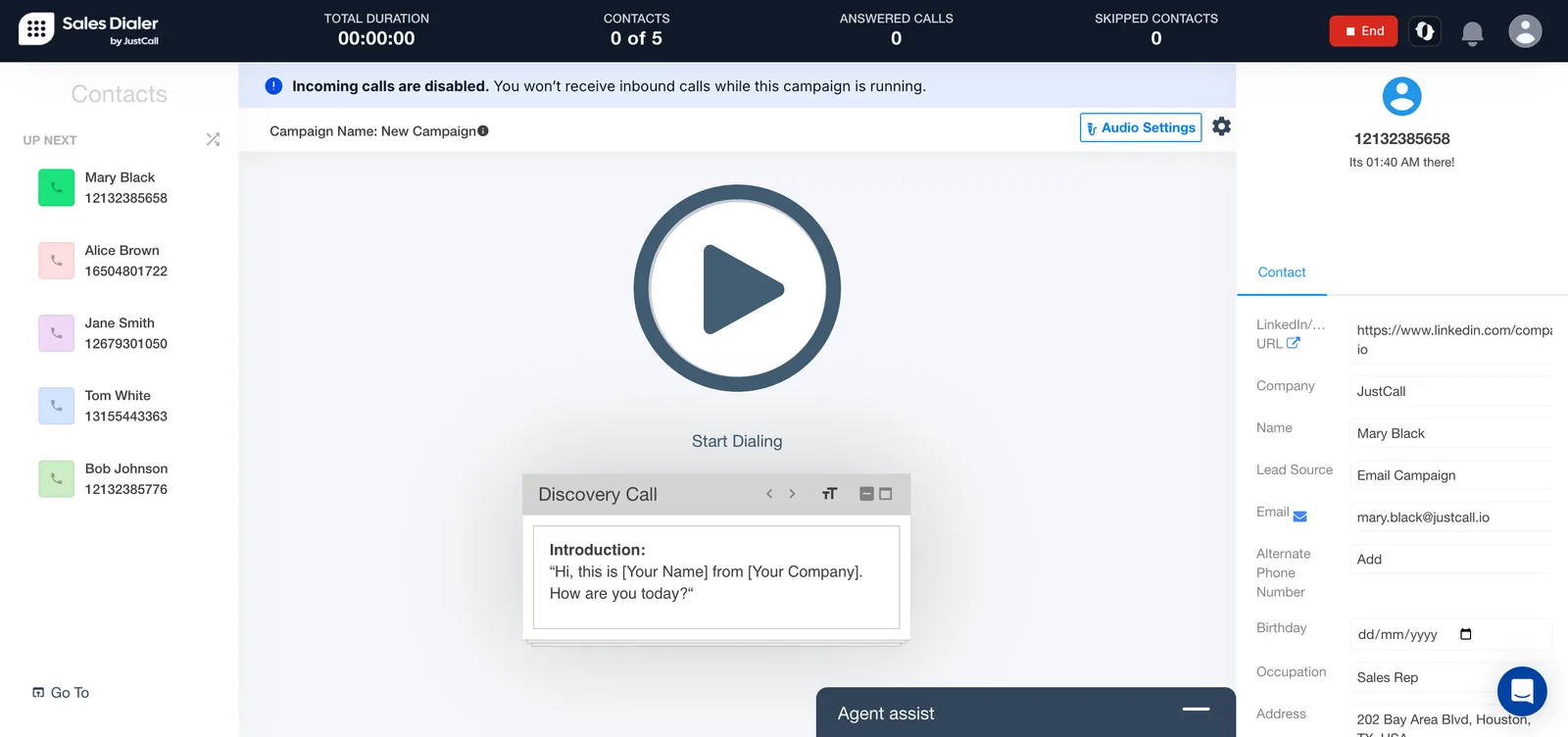
JustCall’s power dialer works through your list one contact at a time, with a short wrap-up window after each call that you can adjust.
When you attach a script to a campaign, it opens with every call. New callers follow the same flow as your best ones.
It handles the details that slow callers down. Calling windows hold contacts until their local business hours, and no-answers go back into the queue on a schedule.
When nobody picks up, a text can go out automatically. Managers can listen in on live calls and whisper tips to the caller.
JustCall has the most G2 reviews of the six, 2,395, at 4.3/5. One prospector summed up the dialer this way:
Key Features
- Power dialer on Pro and higher plans
- One-click voicemail drop, plus an automatic text after missed calls
- Call scripts attached to campaigns
- Local presence caller ID
- Calling windows and reattempt rules
- HubSpot, Salesforce and Pipedrive sync, with dispositions and notes
- Scripts and coaching tools in the dialer
- Calling windows help you stay inside allowed hours
- AI transcription included from the Team plan
- 2-seat minimum: one caller still pays for two ($98/month)
- Monthly prices aren’t published
- Advanced AI coaching needs Pro Plus ($89/user/month)
Who should use JustCall? Teams of two or more that want scripted, coached calling and automatic follow-up texts in one tool, for less than a dedicated dialer costs.
4. Mojo Dialer — Best for Real Estate Agents
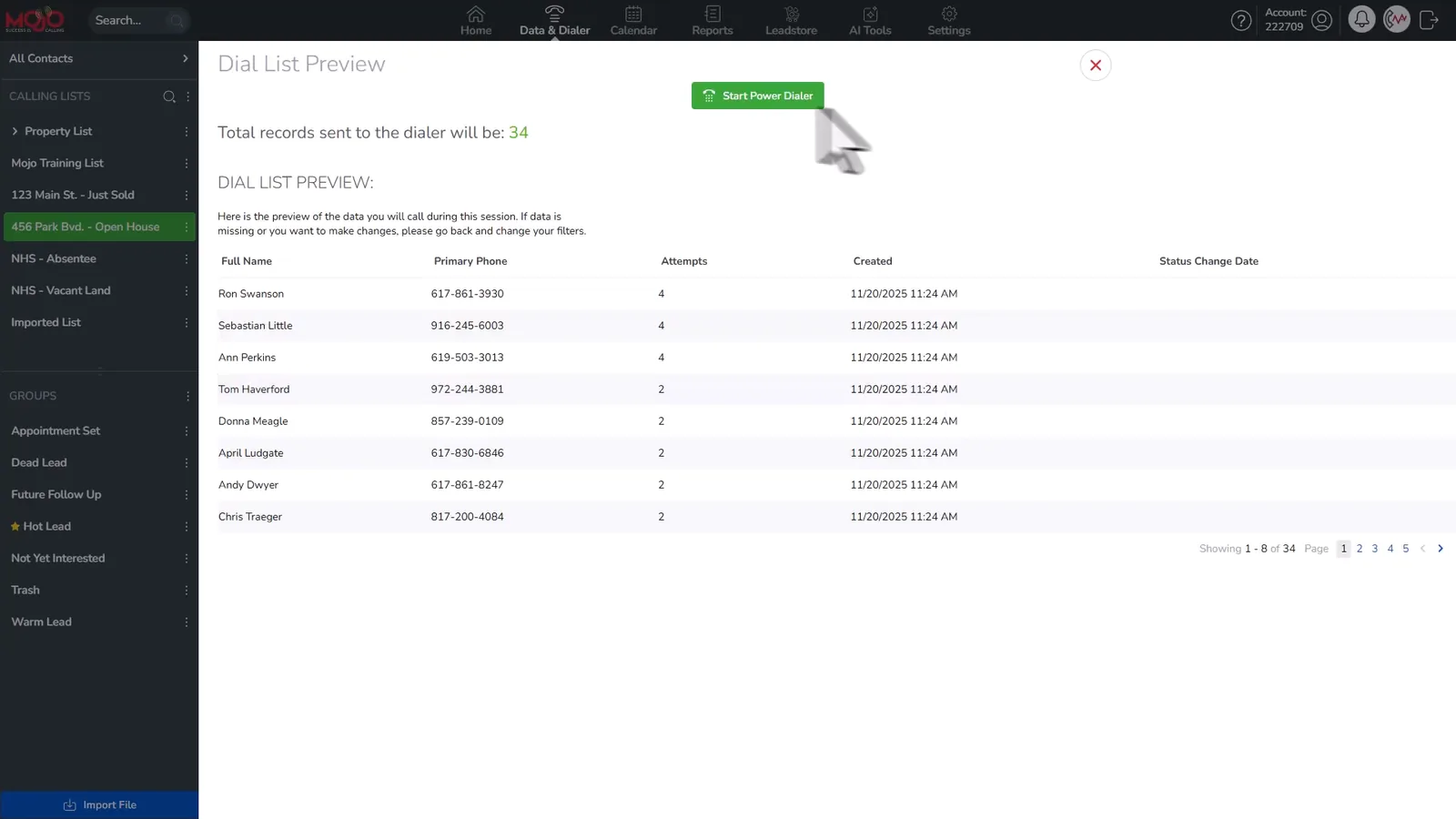
Mojo targets real estate agents, and its triple-line dialer is the main draw. It calls three numbers at once and connects you to whoever answers, which Mojo says can reach up to 300 calls per hour.
Pricing is modular and month to month, with no contract or setup fee. You pay $10 a month for access, then $89 for the single-line dialer or $139 for triple-line.
Real estate data is optional. For sale by owner (FSBO) and for rent by owner (FRBO) leads cost $25 a month per county, and expired listings cost $50.
Its 4.1/5 G2 rating is the lowest here, though it comes from only 28 reviews. Many of those reviews are a few years old, with several from 2019 to 2022.
Key Features
- Single-line or triple-line dialing with unlimited minutes
- Mojo Lead Manager included
- Optional lead data: expired listings, FSBO, FRBO, pre-foreclosures and neighborhood search
- Call recording add-on ($25/month)
- Custom caller ID add-on ($10)
- External CRMs through Zapier and API Nation
- Triple-line dialing for a single caller ($149/month)
- No contracts, so you can scale up or down each month
- Pay only for the data you need
- Recording and caller ID cost extra
- Data is U.S.-only
- Few native CRM integrations
- Some users report dropped calls: “it hangs up on customers mid sentence” (Oct. 2025, G2 review)
Who should use Mojo Dialer? Real estate agents and investors who spend hours a day on the phone and want multi-line speed without a team contract.
With expired listings added, a solo agent on the triple-line dialer pays $199 a month ($149 plus $50).
5. PhoneBurner — Best for Full-Time Callers
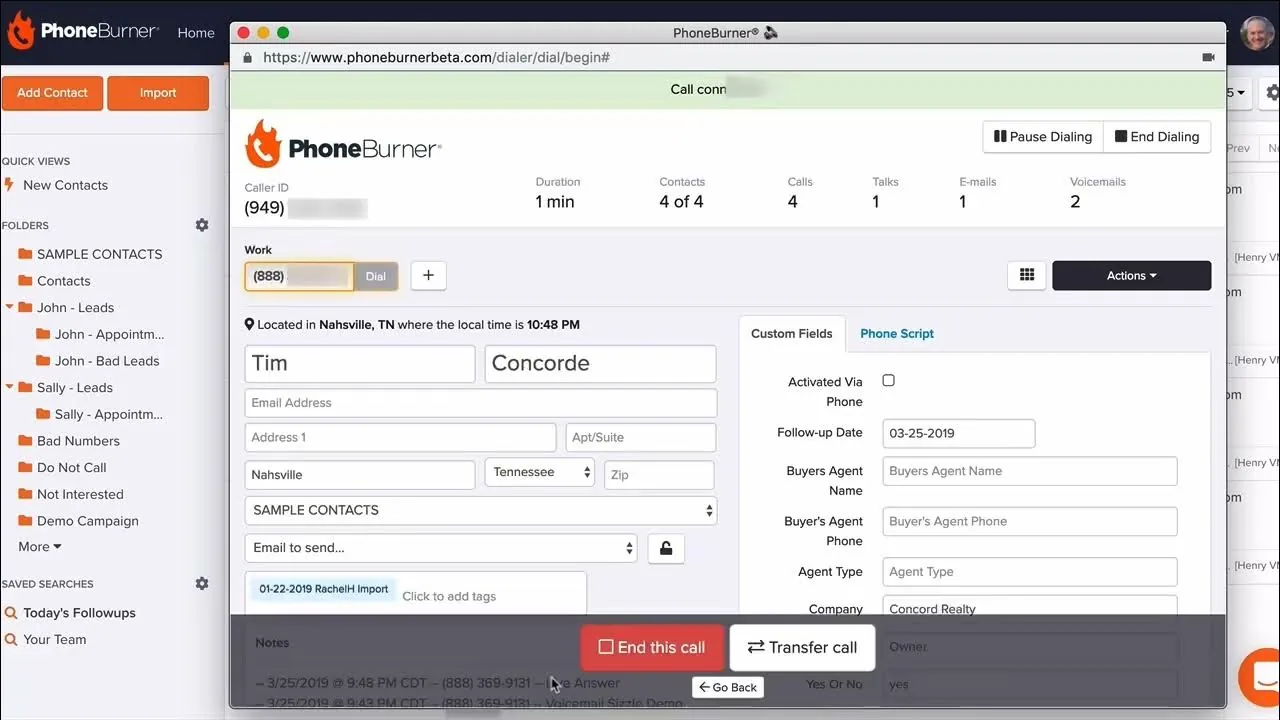
PhoneBurner is a power dialer first, and everything else in the product supports the dial session. You just need to load a list and start dialing.
The next call begins as soon as you hang up. If you reach a voicemail, one click leaves a prerecorded message and moves you on.
Every plan includes unlimited power dialing and a built-in CRM, plus 100+ integrations if you’d rather keep your own.
At $140/user/month billed yearly, it costs three to four times what a phone system with a dialer add-on does, and number monitoring (ARMOR) is sold separately.
It does have the highest G2 rating of the six: 4.8/5 from 294 reviews. Most reviewers talk about the time it saves.
Key Features
- Unlimited single-line power dialing on every plan
- One-click voicemail drop
- Built-in CRM, with 100+ CRM integrations
- Call recording (30 days on Standard, 90 on Professional, unlimited on Premium)
- ARMOR number monitoring and spam remediation (add-on)
- Live call monitoring and coaching on Professional and Premium
- Built entirely around the dial session
- Voicemail drop and call recording on every plan
- Free trial with included minutes
- The priciest single-line dialer in this comparison
- Number reputation tools cost extra
- Text messages (SMS) only on the Premium plan ($183/user/month billed yearly)
Who should use PhoneBurner? Full-time callers and outbound teams who spend most of the day in dial sessions and want a dedicated tool for it.
If calling is only part of your job, a phone system with a dialer add-on costs about a third as much ($40 to $49 per user a month).
6. Orum — Best for Large SDR Teams
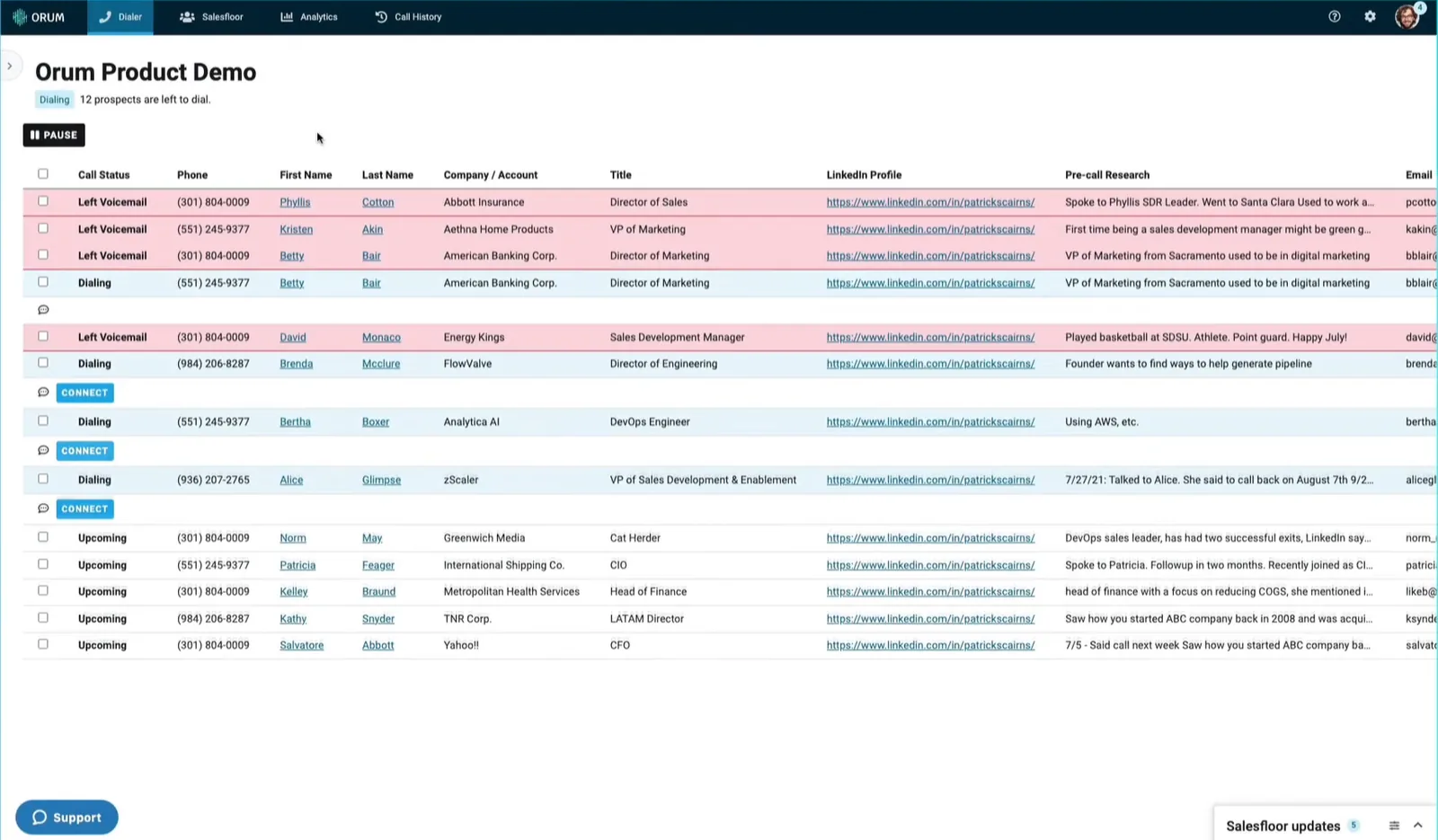
Orum is a parallel dialer for SDR teams that live on the phone.
It dials several prospects at once, drops voicemails, gets through phone trees, and puts your caller on the line only when a person answers.
AI does a lot of the work. Orum writes call summaries and flags objections, and a coaching add-on adds AI roleplay and scorecards.
It plugs into Salesforce, HubSpot, Outreach and Salesloft.
Its 4.6/5 G2 rating comes from 1,099 reviews. One rep compared it with other dialers:
Key Features
- Power and parallel dialing
- AI answer detection that connects only live people
- Voicemail drop and voicemail sequences
- AI call summaries and objection detection
- AI Coaching add-on with roleplay agents and scorecards
- Salesforce, HubSpot, Outreach and Salesloft integrations
- More live conversations per hour than single-line dialing
- AI roleplay agents and scorecards for SDR coaching
- Free trial with 500 dials
- Quote-only pricing
- 9-seat minimum
- Parallel dialing uses up lists quickly
- Answer detection can lag: “that delay can cost you the opening of a conversation” (Zak B., Aug. 2026, G2 review)
Who should use Orum? SDR teams of nine or more with large, clean lists and a budget for a dedicated dialer. For smaller teams, the seat minimum alone rules it out.
What a Power Dialer Really Costs a 5-Caller Team
Seat prices don’t show what flat fees and add-ons do to the total. Here’s what five callers would pay each month, billed yearly where that option exists.
The last column divides that cost by 2,000 conversations, assuming each caller holds 20 conversations a day over 20 working days.
| Dialer | Setup | Monthly Cost for 5 Callers | Cost per Conversation |
|---|---|---|---|
| CloudTalk | Starter + Power Dialer add-on | $200 | $0.10 |
| Allo | Business plan + dialer add-on | $210 | $0.105 |
| JustCall | Pro plan | $245 | $0.12 |
| Mojo | Single-line ($10 access + $89) | $495 (triple-line: $745) | $0.25 ($0.37) |
| PhoneBurner | Standard plan | $700 | $0.35 |
| Orum | Quote only | 9 seats minimum | Quote only |
These totals leave out optional add-ons. For Mojo, that means Mojo Voice ($30 per agent) and call recording ($25). For PhoneBurner, it means ARMOR.
Use the last column to compare tools. Your real numbers depend on your list and your connect rate. A pricier dialer has to earn its price in extra conversations.
Mojo’s triple-line dialer costs about 50% more than single-line for the same team. It pays off only if it brings at least 50% more conversations. That’s realistic for agents calling all day and unlikely for someone who dials for an hour.
The same math is harsher for PhoneBurner. At $140 a seat against CloudTalk’s $40, a PhoneBurner caller needs about 3.5 times as many conversations to cost the same per conversation.
Team size also changes the order. Allo’s dialer fee stays at $50 however many people dial, while CloudTalk’s add-on costs $15 per caller. The totals meet at about six callers. At seven, Allo costs $274 a month and CloudTalk $280, and the gap widens from there.
How to Choose the Right Power Dialer
Two questions help you narrow the list: how many calls each person makes a day, and how many people make them.
A solo agent dialing all afternoon needs different things than a 10-person SDR team logging every call in Salesforce. Find your situation below, then check the cost table for your team size.
For Solo Callers
Choose a dialer with no seat minimum and low-commitment billing. CloudTalk ($40/month with the Power Dialer add-on) and Mojo ($99/month) fit. Allo costs $82/month for one caller, because the dialer needs the Business plan. Avoid tools with 2+ seat minimums, since you’d pay for a seat nobody uses.
For High-Volume Prospectors
Look for voicemail drop, local caller ID or number rotation, multi-line or parallel dialing once your list is big enough, and keyboard shortcuts for dispositions. PhoneBurner, Mojo’s triple-line dialer, CloudTalk’s parallel add-on and Orum cover this.
For SDR Teams in a CRM
Your dialer should pull lists from the CRM and write every outcome back without manual logging. Check which CRMs sync both ways, and whether notes and recordings land on the contact. Orum suits large teams; JustCall and CloudTalk suit smaller ones.
For Calling Agencies
Agencies calling for several clients need healthy local numbers across many area codes and recordings for quality checks. CloudTalk’s area-code caller ID and number rotation fit the first need; JustCall’s recordings and live call monitoring fit the second.
For Budget-Conscious Teams
Add up the full monthly cost: seats, the dialer add-on, caller ID or reputation tools, call recording and any data. CloudTalk is the cheapest option up to six callers. From seven callers, Allo’s flat dialer fee makes it cheaper than CloudTalk.
Stay Compliant While You Dial
A power dialer doesn’t change the rules for cold calling, but it makes breaking them easier at scale. Dialing hundreds of numbers a day means one unscrubbed list reaches a lot of people fast.
In the U.S., the Telephone Consumer Protection Act (TCPA) and the Federal Communications Commission (FCC) rules set the basics:
- Call only between 8 a.m. and 9 p.m. in the recipient’s local time.
- Scrub your list against the National Do Not Call (DNC) Registry at least every 31 days, and keep your own internal do-not-call list.
- Get consent before using prerecorded messages or autodialing cell phones for telemarketing.
- If you use parallel or predictive dialing, keep abandoned calls under 3% of answered calls per campaign over 30 days.
Many states add their own rules on top. Voicemail drops may also count as prerecorded messages. Check with your legal counsel before you use them or scale a campaign.
You can read the full FCC telemarketing rules.
Should You Use a Power Dialer or Outsource Cold Calling?
A power dialer makes sense when you have the time and the people to make the calls. If dialing is pulling you away from closing deals, outsourcing can be the better trade.
A trained calling team brings its own dialers and scripts, and hands you booked appointments.
The Bottom Line
The best power dialer is the one that gets you the most conversations for the money. CloudTalk is the best value for small teams, and Allo is the budget pick if you want AI notes on every call.
JustCall adds scripts and coaching, and Mojo is the speed pick for real estate. PhoneBurner is the dedicated pick for full-time callers, and Orum is for large SDR teams ready for parallel dialing.
Whichever you choose, the dialer only speeds up the dialing. A clean list and a healthy caller ID decide how many of those calls become conversations.
For a broader comparison, including dialers built into phone systems, see Allo’s guide to the best power dialers.
