
One common question many website owners have is whether backlinks still matter. There is no single answer to this question. But one thing is clear. Search engines do view backlinks as a token of trust.
A backlink from a strong site can uplift your site’s trust in the view of search engines, which may result in improved traffic. On the other hand, a spammy link can do the opposite. That means not every backlink is worth it.
So what should you look for before selecting a backlink opportunity? Let’s learn the key factors you should consider when looking for backlink opportunities.
Table of Contents
Why Backlinks Are Important for Your Site
Before we head right into discussing the key factors for selecting a backlink opportunity, let’s take a moment to discuss what a backlink does for your site.
1. They Can Support Search Rankings
Search engines may use multiple ranking signals when deciding which page to appear first in the search results. And the links pointing to your site are one of those signals.
When other sites link to your content, they are basically making a link from their page to yours. If these links are from relevant and trustworthy sources, it can help boost the overall authority and credibility of your site.
2. Can Bring Referral Traffic
Backlinks should not be viewed only for SEO purposes. They can bring referral traffic to your website as well.
For example, a famous marketing site posts a blog on content marketing and links to one of your guides for readers who want to dig deeper. People reading that article might click on your link and visit your site.
Those visitors have some interest in your topic already. They are not coming randomly. Referral traffic from a relevant site can be especially useful here.
3. Help Search Engines Discover Your Content
First, search engines have to find the web pages so that they can process and index them correctly. Backlinks can help in this process of discovery.
Search engine crawlers follow links from pages that they already know about to find other pages that they are linked to. This can be especially helpful for new sites or pages that have little internal or external link equity.
For instance, you may write a detailed article on a topic that hasn’t been covered much on your site. If another relevant site links to that article, the link provides another way for users and crawlers to get to it.
That doesn’t mean it will be indexed or ranked.” Search engines have their own systems to determine which pages they will crawl, index, and rank. But linking your content to other related pages helps make your content easier to find.
4. Can Build Your Website’s Reputation
Think about how people find businesses and publications. If a website is cited frequently by well-known sources, it can gain name recognition in its industry. The same is true of backlinks.
If a number of relevant websites cite your research, guides, studies, or other useful resources, then your website may begin to be seen by more people as a site worth visiting. This can happen over time naturally.
For example, a website that publishes original research might be cited by bloggers, journalists, and industry publications. Every mention has the potential to reach new people.
The benefit goes beyond just rankings. Some of those readers may return at a later date, subscribe to the site, share your content, or mention it elsewhere.
Increase Exposure to a Relevant Audience
It’s good to get visitors. But getting the right visitors is better. When you get a backlink from an existing site that is already attracting people interested in the same topic as yours, you get a chance to show your content to a relevant audience.
Let’s say an accounting software website gets backlinks from a business finance publication. It can introduce the software to readers who want to manage their finances.
However, it is unlikely that linking to an unrelated entertainment website would have the same audience value. This is one reason why relevance is essential in backlink building. You are not just trying to gather links. You are attempting to get links to sites whose visitors might actually be interested in what you have to offer.
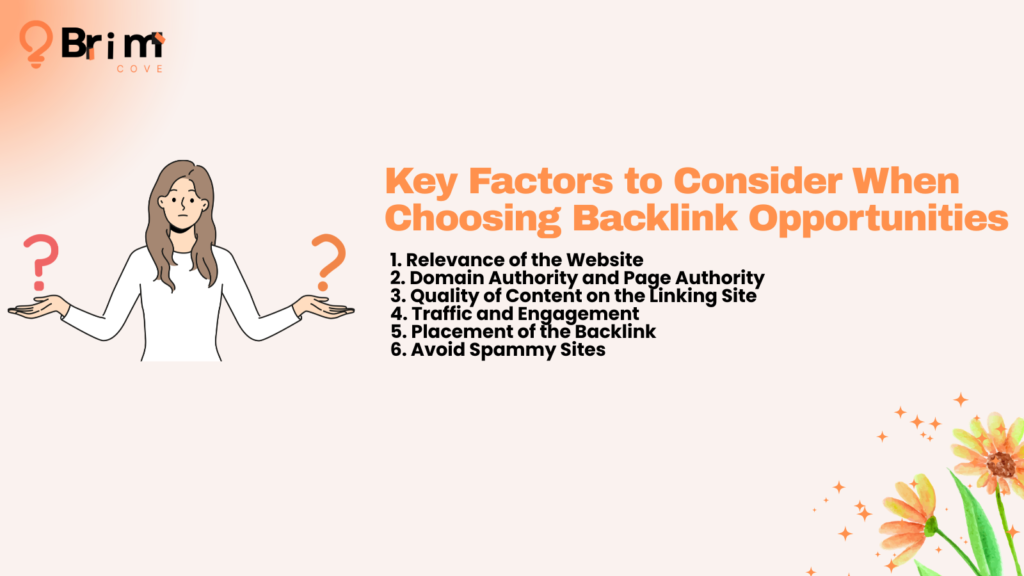
Key Factors That Matter in Backlink Selection
Now that you know the value of backlinking. Let’s discuss the main elements you should look for when selecting a backlink opportunity.
1. Relevance of the Website
One of the main things you may check right after opening a site is whether it is relevant to your site. A backlink should be relevant to your site and related to your topic.
For instance, consider that your site is about fitness. A link from a health blog makes sense. But a link from a finance site may provide little value if there is no meaningful connection between the two pages.
Search engines consider context. They check the relevance of the linking site to your content. Links to relevant content look natural. They also bring related traffic. Users visiting your site through relevant backlinks are more likely to stay on your site.
2. Domain Authority and Page Authority
You might have heard about these metrics before. Domain authority and page authority are 3rd party SEO metrics created by Moz to estimate the ranking potential of a website or a particular web page in the search results. Both use a 1-to-100 scale, with higher scores indicating greater estimated authority.
Checking these scores is simple. You can utilize DA PA Checker to review these values. It can help you evaluate the authority of a site.
However, these metrics are not officially endorsed by Google. So, they should not be considered as a final judgement factor.
3. Quality of Content on the Linking Site
One simple way to know if a website is of high-quality is to check the quality of its content. Poor-quality content indicates that the website doesn’t work to maintain high standards.
Check a few recent posts and see how well they are written. If they aren’t useful and seem just filled with keywords, it often means the content has low standards.
A backlink from low-quality content might seem spammy even if the site possesses good authority. So it is better to skip such content. On the other hand, good content shows effort, carries a lot of value, and can be a better choice for getting a backlink.
4. Traffic and Engagement
Another simple way to evaluate whether a site or page is worth getting a backlink from is to check how much traffic it receives. If a website is getting visitors, it is more valuable than one that is getting none. You can easily check any website’s traffic using any website traffic checker like the one by Semrush.
Also, look at the user activity, comments, and shares. These are easy checks, and they show engagement from the users’ side. If you get a backlink from a busy site, it can bring referral traffic.
But traffic should be evaluated alongside relevance, content quality, and the overall quality of the linking site.
5. Placement of the Backlink
You may check the website’s authority, engagement, and relevance. Everything feels quite good, but you can’t just get a link from anywhere on the page. Placement is more important than you think.
A backlink is most effective when it is from the body of the content. It should be a natural part of the conversation. A link that backs the subject makes it more trustworthy for the readers, and they are more likely to click on it.
In contrast, links in footers, sidebars, or random areas often have less value. They appear less relevant. Sometimes they are ignored by users.
When considering backlink placement, you should take a look at the text around it. The content around your link should be relevant to your topic. Relevant surrounding content can provide additional context about the relationship between the linked pages.
6. Avoid Spammy Sites
Not all backlinks are worth your time. Some sites are just there to sell links or put up random guest posts. They can seem good at first. But a closer look reveals the problems with the site.
You may see bad content. Topics that are not related. Too many outbound links on one page. No specific audience. Nothing worth reading.
These sites are not helpful for backlinking. In some cases, they might even pose a risk to your site. Spammy patterns are detectable by search engines. So it is better to be careful. Focus on clean and reliable sources. A few strong backlinks are always better than a lot of weak ones.
Final Thoughts
Backlinks can contribute to a website’s search visibility, particularly when they come from relevant and reputable sources. When opting for a backlink opportunity, there are a few key factors you should consider. Check the relevancy of the site and see if it follows the same niche as you have. Domain authority and page authority metrics by Moz are frequently used to estimate the strength of a site.
Read the content of the page thoroughly to see if it is of high quality. Low-quality content doesn’t pass much value. Also, if the domain or page is getting visitors, it is more valuable, as readers find it valuable. Getting a backlink from such a site may help get referral traffic.
Placement of the link matters a lot. You should opt to get a backlink from the body of the content and not from random places like the header or footer. You must avoid spammy sites. These may pose a risk to your own site. These are some of the key factors you should consider. Next time you are opting for a backlink, make sure you keep these in mind.
