“How long does link building take?” is one of the most common questions businesses ask before investing in SEO.
It’s a fair question. Whether you’re a SaaS founder, marketing manager, or business owner, you want to know when you’ll start seeing more traffic, higher rankings, and a return on your investment.
The reality is that link building timelines vary from one website to another. Some websites notice early improvements within a few months, while others need six months or longer before meaningful SEO gains appear.
That’s because backlinks are only one part of Google’s ranking system. Search performance also depends on content quality, technical SEO, competition, website authority, search intent, and how quickly Google discovers and evaluates new links.
Instead of looking for shortcuts, it’s better to understand how link building works over time and what milestones you can realistically expect throughout a campaign.
In this guide, you’ll learn what influences link building timelines, why results differ across industries, how to measure progress before rankings improve, and what businesses can do to achieve sustainable organic growth.
Table of Contents
What Are Link Building Timelines?
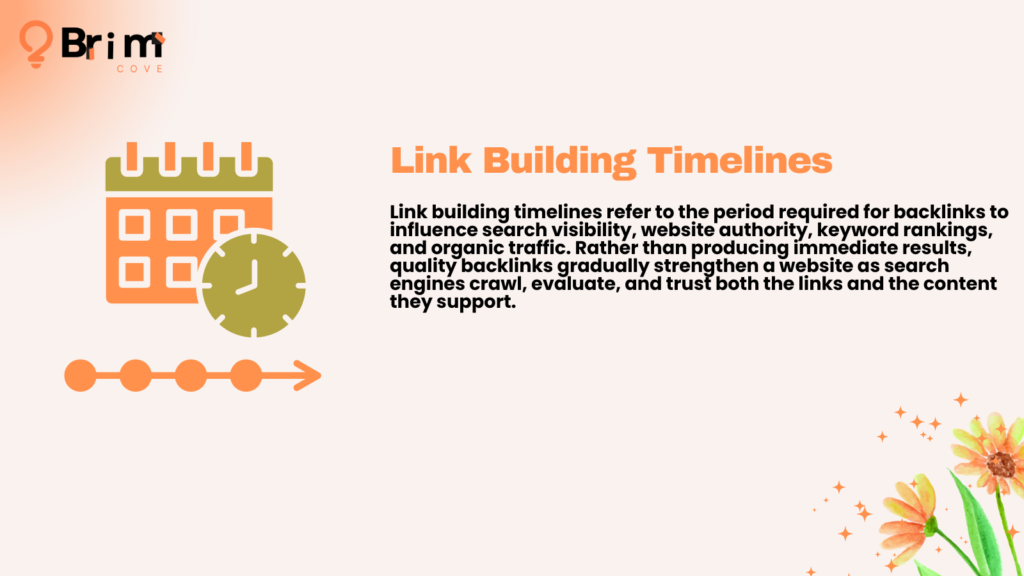
Link building timelines refer to the period required for backlinks to influence search visibility, website authority, keyword rankings, and organic traffic. Rather than producing immediate results, quality backlinks gradually strengthen a website as search engines crawl, evaluate, and trust both the links and the content they support.
Think of link building as building a professional reputation.
One recommendation helps, but consistent endorsements from respected sources create lasting credibility. Search engines similarly evaluate backlinks.
For example, if a SaaS company earns several editorial backlinks from respected marketing websites, Google won’t immediately move every page to the top of the search results. Instead, the search engine gradually assesses the new links alongside other ranking factors before adjusting rankings.
This is why experienced SEO professionals treat link building as a long-term strategy rather than a quick ranking tactic.
Why Link Building Takes Time
Many businesses expect rankings to improve as soon as new backlinks go live.
In reality, several processes happen before backlinks can influence search performance.
1: Google Must Crawl the New Links
Search engines first need to discover the page containing your backlink.
If Google hasn’t crawled that page yet, it cannot evaluate the link.
The crawling schedule varies depending on how frequently the referring website is updated and how important Google considers it.
2: Links Need to Be Indexed
After crawling, Google processes the page and determines whether the backlink should become part of its search index.
Not every discovered link is processed immediately.
Some pages are indexed within days, while others take significantly longer.
3: Trust Builds Gradually
One backlink rarely transforms a website overnight.
Google looks for consistent signals from multiple trustworthy websites over time.
As more relevant websites reference your content naturally, your authority grows steadily rather than instantly.
4: Content Still Matters
Even excellent backlinks cannot compensate for weak content.
If the destination page doesn’t satisfy search intent, rankings may remain unchanged despite acquiring new links.
Successful campaigns combine quality backlinks with valuable, well-optimized content.
5: Competition Influences Timelines
Ranking for a local service page is very different from competing for high-volume SaaS or finance keywords.
Competitive industries usually require:
- More authoritative backlinks
- Better content
- Stronger topical authority
- Longer campaign durations
The tougher the competition, the longer it generally takes to achieve meaningful results.
6: Authority Takes Time to Build
Google evaluates overall website reputation rather than individual links in isolation.
Consistently earning editorial backlinks from relevant websites strengthens authority over months and years instead of days.
7: Algorithm Updates Can Affect Progress
Google continually updates its ranking systems.
These updates may accelerate, slow, or temporarily change ranking trends depending on how well your website aligns with current quality standards.
For this reason, no reputable SEO agency can guarantee fixed timelines or ranking dates.
Factors That Influence Link Building Timelines
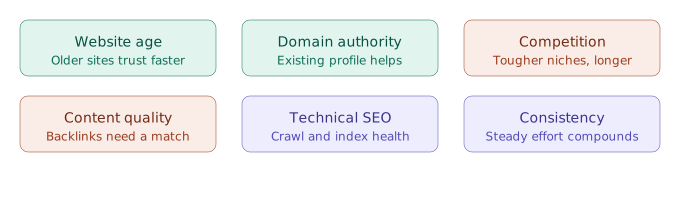
Every campaign progresses differently because every website starts from a different position.
Below are the biggest factors influencing how quickly results appear.
1: Website Age
Older websites with an established history often build trust faster than newly launched domains.
A brand-new website usually needs more time to develop authority before backlinks have their full impact.
2: Existing Domain Authority
Websites that already have a healthy backlink profile generally see faster improvements than websites starting from scratch.
Building on an existing foundation is easier than creating authority from zero.
3: Current Backlink Profile
Quality matters more than quantity.
A website with fewer high-quality editorial backlinks often performs better than one with hundreds of low-quality links.
Before launching a campaign, evaluate:
- Referring domains
- Link relevance
- Anchor text diversity
- Toxic backlinks
- Lost backlinks
Understanding your current profile helps identify opportunities for improvement.
4: Industry Competition
Competition significantly affects timelines.
For example:
| Industry | Competition | Typical Timeline |
| Local Services | Low–Medium | Faster |
| SaaS | High | Moderate–Long |
| Ecommerce | High | Long |
| Finance | Very High | Long |
| Healthcare | Very High | Long |
| Legal | Very High | Long |
Highly competitive industries usually require stronger authority and more consistent link acquisition before rankings improve.
5: Search Intent
Some keywords are easier to rank because they have lower competition and clearer search intent.
Informational content often gains traction faster than highly competitive commercial keywords.
Matching search intent with valuable content improves the effectiveness of every backlink earned.
6: Content Quality
Backlinks work best when they point to pages people genuinely want to visit.
High-performing pages usually include:
- Original research
- Helpful guides
- Practical examples
- Updated information
- Clear structure
- Strong user experience
Quality content naturally attracts additional backlinks over time, creating a compounding effect.
7: Technical SEO Health
Technical problems can delay SEO progress even when link building is successful.
Common issues include:
- Slow loading pages
- Broken links
- Poor mobile usability
- Duplicate content
- Crawl errors
- Indexing problems
Resolving technical issues helps search engines crawl and understand your website more efficiently.
8: Internal Linking
Internal links distribute authority across your website.
A strong internal linking structure helps search engines discover important pages and reinforces topical relevance.
Pages supported by strategic internal links often benefit more from external backlinks.
9: Link Quality vs. Quantity
Ten editorial backlinks from respected, relevant websites often outperform hundreds of low-quality links.
Focus on earning backlinks that provide genuine value rather than chasing large numbers.
Editorial relevance, trust, and contextual placement matter far more than volume alone.
10: Budget and Campaign Consistency
SEO rewards consistency.
Businesses investing steadily in content, outreach, and authority building generally achieve more sustainable results than those running short-term campaigns.
Stopping link building after a few months often limits long-term growth.
A consistent strategy allows authority to compound, making future rankings easier to achieve.
Typical Link Building Timeline (Month-by-Month)
Every campaign progresses differently, but most successful link-building strategies follow a similar pattern. These milestones are illustrative—not guarantees—as results depend on your website, competition, content quality, and Google’s algorithms.
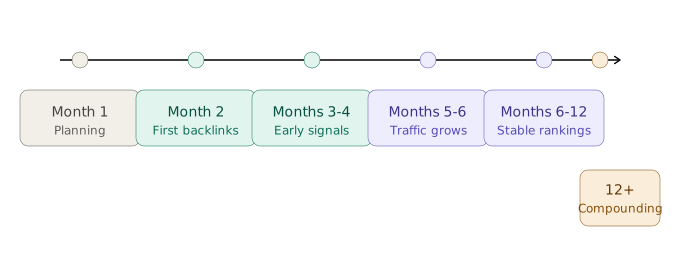
| Timeline | Typical Activities | Possible Outcomes |
| Month 1 | SEO audit, competitor research, content planning, outreach preparation | Strategy finalized and target pages identified |
| Month 2 | Outreach begins, first editorial backlinks acquired | Initial backlinks indexed and authority starts building |
| Months 3–4 | Consistent link acquisition and content publishing | Early keyword movement and increased search impressions |
| Months 5–6 | Authority grows through additional quality backlinks | Organic traffic begins increasing for selected pages |
| Months 6–12 | Ongoing outreach and optimization | More stable rankings, stronger authority, and improved lead generation |
| 12+ Months | Long-term content and link building continue | Sustainable organic growth and compounding SEO benefits |
Month 1: Planning the Campaign
The first month focuses on preparation rather than rankings.
Typical tasks include:
- Website audit
- Competitor analysis
- Keyword research
- Content evaluation
- Prospect research
- Outreach strategy
- Anchor text planning
Building a strong foundation prevents wasted effort later in the campaign.
Month 2: Initial Backlink Acquisition
Once outreach begins, quality backlinks start appearing.
At this stage, Google may begin crawling and indexing new links, but noticeable ranking improvements are usually limited.
Focus on:
- Editorial backlinks
- Relevant websites
- High-quality outreach
- Relationship building
Early placements lay the groundwork for future SEO growth.
Months 3–4: Early SEO Signals
This is often when websites begin seeing the first measurable improvements.
Possible indicators include:
- More keyword impressions
- Improved average rankings
- Faster page indexing
- Increased referring domains
- Higher crawl frequency
Traffic growth may still be modest, but positive trends often become visible.
Months 5–6: Organic Growth Becomes Noticeable
As authority strengthens, rankings become more consistent.
Many businesses begin seeing:
- More organic visitors
- Better rankings for medium-competition keywords
- Increased branded searches
- Higher referral traffic
- More qualified leads
Campaigns supported by excellent content typically perform better during this stage.
Months 6–12: Sustainable Growth
By this point, consistent white-hat link building can significantly improve overall website authority.
Many websites experience:
- Better rankings across multiple pages
- Higher topical authority
- More natural backlinks
- Increased conversions
- Stronger brand recognition
Instead of isolated ranking improvements, the entire website often becomes more competitive.
Beyond 12 Months
The biggest SEO gains frequently come after a year of consistent effort.
Authority compounds over time.
As more reputable websites reference your content, earning future backlinks often becomes easier because your brand is already recognized within the industry.
This is why successful businesses treat SEO as an ongoing investment rather than a one-time project.
Link Building Timelines by Industry
Not every industry progresses at the same speed.
Competition, regulations, search intent, and backlink difficulty all influence timelines.
1: Local Businesses
Examples:
- Plumbers
- Dentists
- Landscapers
- Electricians
- Local restaurants
Local SEO campaigns often produce results sooner because competition is limited to a specific geographic area.
Businesses targeting local keywords may notice improvements within several months when supported by quality backlinks and optimized Google Business Profiles.
2: SaaS
SaaS companies usually compete against well-established websites with strong backlink profiles.
Success often requires:
- Educational content
- Product-led SEO
- Digital PR
- Thought leadership
- Editorial backlinks
Building topical authority is particularly important in competitive SaaS markets.
4: Ecommerce
Online stores typically compete across hundreds or thousands of product pages.
Successful campaigns combine:
- Category page optimization
- Buying guides
- Product comparisons
- Digital PR
- Resource link building
Because competition is often intense, ecommerce SEO generally requires consistent long-term investment.
5: Healthcare
Healthcare belongs to Google’s YMYL (Your Money or Your Life) category.
Google applies higher quality standards because medical information can affect people’s health.
Successful campaigns require:
- Trusted content
- Expert authors
- Authoritative backlinks
- Strong E-E-A-T signals
Ranking improvements usually take longer than in less competitive industries.
6: Finance
Finance websites face similar challenges.
Trust, authority, and credibility play a significant role in rankings.
Editorial backlinks from respected financial publications are often more valuable than a large number of average-quality links.
7: Legal
Law firms operate in one of the most competitive SEO industries.
High-value keywords often require:
- Strong local authority
- Consistent Digital PR
- Quality content
- High-authority backlinks
- Long-term investment
Quick SEO wins are uncommon in highly competitive legal markets.
8: Enterprise Websites
Large enterprise websites often benefit from existing authority but face technical complexity.
Challenges may include:
- Large site architecture
- Thousands of indexed pages
- Multiple stakeholders
- Content governance
Although authority helps, implementation can sometimes take longer.
9: Startups
New websites begin with little authority.
Early priorities include:
- Publishing valuable content
- Building brand awareness
- Earning initial editorial backlinks
- Establishing topical relevance
Startups often experience slower early growth before authority begins compounding.
What Speeds Up Results?
Although no strategy guarantees faster rankings, several factors can improve campaign efficiency.
Strong Technical SEO
Fixing crawl issues, improving site speed, optimizing Core Web Vitals, and ensuring proper indexing helps search engines process your content more effectively.
High-Quality Content
Exceptional content naturally attracts more backlinks and provides stronger landing pages for outreach.
Useful resources include:
- Original research
- Industry reports
- Case studies
- Comprehensive guides
- Free tools
- Templates
Existing Website Authority
Established websites often benefit more quickly from new backlinks because they already have trust signals.
Growing an existing reputation is generally easier than creating one from scratch.
Digital PR
Newsworthy campaigns can generate multiple editorial backlinks from respected publications.
Examples include:
- Original studies
- Industry surveys
- Company reports
- Expert commentary
- Data-driven research
Digital PR often complements traditional link-building efforts.
Consistent Content Publishing
Publishing helpful content regularly gives outreach campaigns more opportunities to earn backlinks.
Fresh content also demonstrates ongoing expertise within your niche.
Topical Authority
Creating comprehensive coverage around a specific subject helps search engines understand your expertise.
Instead of publishing unrelated articles, focus on building interconnected content clusters.
Strategic Internal Linking
Internal links distribute authority throughout your website.
A logical structure helps both users and search engines discover important pages while reinforcing topical relationships.
What Slows Down Results?
Even the best outreach campaign can struggle if your website has underlying issues. These factors commonly delay link-building success.
Poor Website Structure
Confusing navigation, orphan pages, and weak internal linking make it harder for search engines to crawl and understand your site.
Thin or Outdated Content
Backlinks work best when they point to valuable pages. If your content lacks depth or doesn’t satisfy search intent, rankings may remain stagnant.
Low-Quality Backlinks
Spammy directories, private blog networks (PBNs), and irrelevant websites can weaken your backlink profile instead of strengthening it.
Inconsistent Campaigns
Building links for a month and then stopping rarely produces lasting results. Consistency is essential for sustainable authority growth.
Highly Competitive Keywords
Trying to rank immediately for high-volume keywords can slow progress. Targeting a mix of low-, medium-, and high-competition terms often delivers better long-term results.
New Domains
New websites need time to build trust. Even excellent backlinks may take longer to influence rankings compared to established domains.
Poor User Experience
Slow page speed, intrusive pop-ups, poor mobile usability, and confusing layouts can reduce engagement, limiting the impact of your SEO efforts.
Metrics to Track Before Rankings Improve
Waiting for rankings alone doesn’t provide the full picture. Several leading indicators show whether your campaign is moving in the right direction.
1: Referring Domains
The number of unique websites linking to your content is one of the clearest indicators of link-building progress.
Quality referring domains are generally more valuable than multiple links from the same website.
2: Backlink Quality
Evaluate backlinks based on:
- Topical relevance
- Editorial placement
- Website authority
- Organic traffic
- Natural anchor text
A smaller number of trusted links often delivers stronger long-term value
3: Keyword Impressions
Google Search Console often shows rising impressions before rankings improve significantly.
Growing impressions indicate that your pages are appearing in more search results.
4: Indexed Pages
Monitor whether new content is being crawled and indexed successfully.
Unindexed pages cannot generate organic traffic regardless of backlink quality.
5: Organic Clicks
As visibility improves, organic clicks should gradually increase.
Compare click growth alongside impressions and average ranking positions.
6: Referral Traffic
High-quality backlinks can send visitors directly to your website before organic rankings improve.
Track referral traffic using Google Analytics to identify which placements generate meaningful engagement.
7: Branded Searches
Successful Digital PR and authority-building campaigns often increase branded search volume.
More users searching specifically for your company is a positive trust signal.
8: Engagement Metrics
Monitor user behavior such as:
- Time on page
- Bounce rate
- Pages per session
- Conversion rate
- Lead generation
Quality traffic is often more valuable than traffic volume alone.
Common Mistakes That Delay Link Building Success
Many businesses slow their own SEO progress by making avoidable mistakes.
Expecting Results in 30 Days
SEO is a long-term investment. Most successful campaigns require several months before significant improvements appear.
Prioritizing Quantity Over Quality
Hundreds of weak backlinks rarely outperform a handful of strong editorial placements.
Always prioritize relevance and authority.
Ignoring Content Quality
Even excellent backlinks cannot compensate for outdated or unhelpful content.
Create pages that genuinely deserve links.
Stopping Campaigns Too Early
Authority compounds over time.
Businesses that discontinue outreach after a few months often miss the long-term benefits of sustained link acquisition.
Focusing Only on Domain Rating
Metrics like Domain Rating (DR) and Domain Authority (DA) are useful benchmarks, but Google doesn’t use them as ranking factors.
Evaluate backlinks based on relevance, editorial quality, and user value rather than third-party metrics alone.
Neglecting Technical SEO
Broken pages, crawl errors, duplicate content, and slow loading speeds reduce the effectiveness of link-building campaigns.
Strong technical SEO supports every backlink you earn.
Frequently Asked Questions
How long does link building take?
Most businesses begin seeing early SEO signals within three to six months, while significant improvements often require six to twelve months of consistent effort. Timelines vary depending on competition, content quality, and website authority.
When will I see SEO results?
Some indicators, such as impressions and indexed pages, may improve within weeks. Rankings and organic traffic generally take longer because Google evaluates multiple ranking signals over time.
Can backlinks improve rankings immediately?
Usually not. Search engines must crawl, index, and evaluate new backlinks before they influence rankings.
How many backlinks do I need?
There is no universal number. A few highly relevant editorial backlinks often provide more value than hundreds of low-quality links.
Does link quality matter more than quantity?
Yes. Editorial backlinks from trusted, relevant websites typically have greater long-term SEO value than large volumes of weak links.
Can new websites rank quickly?
New websites can achieve early success by targeting less competitive keywords and publishing exceptional content, but building authority generally takes time.
Is link building still effective?
Absolutely. High-quality, white-hat link building remains an important part of SEO when combined with valuable content and a strong technical foundation.
Which industries take the longest?
Highly competitive and YMYL industries—including finance, healthcare, legal, and enterprise SaaS—typically require longer investment horizons due to stronger competition and higher trust requirements.
What is link velocity?
Link velocity refers to the rate at which a website earns backlinks over time. A steady, natural growth pattern is generally healthier than sudden spikes from artificial link-building tactics.
Should I hire a link building agency?
Businesses without the time or expertise to manage outreach internally often benefit from working with an experienced agency that focuses on ethical, white-hat strategies and transparent reporting.
Conclusion
Successful Link Building Timelines are measured in months rather than weeks. While every website is different, sustainable SEO growth comes from consistently earning relevant, high-quality backlinks supported by valuable content and a technically sound website.
Instead of focusing only on rankings, monitor leading indicators such as referring domains, search impressions, indexed pages, referral traffic, and user engagement. These metrics often reveal progress long before major ranking improvements become visible.
Businesses that invest in quality content, ethical outreach, and long-term authority building are far more likely to achieve lasting organic growth than those chasing quick wins or low-quality backlinks.
If you’re planning a long-term SEO strategy, a professional backlink audit or customized link-building campaign can help identify opportunities, prioritize high-impact actions, and build a stronger, more sustainable backlink profile through proven white-hat methods.
