
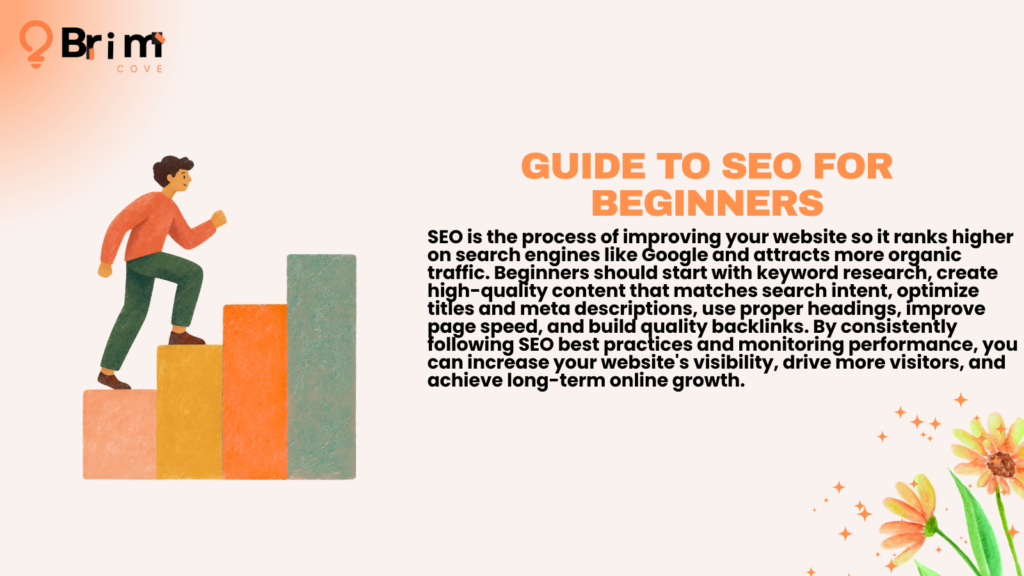
If you’ve ever wondered why some websites consistently appear at the top of Google while others are difficult to find, the answer often comes down to Search Engine Optimization (SEO).
This guide to SEO for beginners explains how SEO works in simple, practical terms—even if you’ve never optimized a website before. You don’t need a technical background or years of marketing experience to understand the fundamentals. With the right approach, anyone can learn how to improve a website’s visibility in search results.
Search engines process billions of searches every day. Whether someone is looking for a local restaurant, researching a product, or searching for an answer, search engines determine which pages appear in the results. Websites that follow SEO best practices have a better chance of ranking higher, attracting relevant visitors, and reaching their target audience.
Unlike paid advertising, SEO focuses on earning organic traffic—visitors who discover your website naturally through search engines. Although SEO takes time and consistent effort, it can support long-term visibility, credibility, leads, and business growth.
In this beginner’s guide, you’ll learn:
- What SEO is and why it matters
- How search engines crawl, index, and rank websites
- The three main types of SEO
- How to conduct keyword research
- How search intent influences rankings
- The basics of on-page and technical SEO
- Beginner-friendly link-building strategies
- The fundamentals of Local SEO
- Essential SEO tools
- Common mistakes to avoid
- How long SEO takes to produce results
- A practical roadmap for learning SEO
By the end, you’ll have a clear understanding of SEO fundamentals and a practical starting point for optimizing your own website.
Table of Contents
What Is SEO?
SEO or Search Engine Optimization, is the process of improving a website so it can appear more prominently in search engine results for relevant searches.
The goal isn’t simply to attract more visitors. Effective SEO attracts people who are genuinely interested in your content, products, or services.
For example, imagine you own a bakery in Karachi. If someone searches for “best birthday cakes in Karachi,” you’d want your website to appear near the top of the results. SEO helps improve your chances of being discovered when potential customers search for what you offer.
SEO involves improving several aspects of a website, including:
- Content quality and relevance
- Website structure
- Keyword targeting
- User experience
- Technical performance
- Internal linking
- Backlinks from other websites
Organic Traffic vs. Paid Traffic
Organic traffic comes from unpaid search results. Paid traffic comes from advertisements, such as Google Ads.
Paid advertising can provide immediate visibility, but the traffic usually decreases when the advertising budget stops. SEO generally takes longer to produce results, but a well-optimized page can continue attracting organic visitors for months or even years.
What Are SERPs?
Search Engine Results Pages, commonly called SERPs, are the pages displayed after you perform a search.
A SERP may include:
- Organic search results
- Paid advertisements
- Featured snippets
- People Also Ask sections
- Images and videos
- Local business listings
Higher rankings generally increase visibility and the likelihood that users will click on your website. This can lead to more traffic, brand awareness, leads, sales, and credibility.
How Search Engines Work
Search engines don’t display websites randomly. They use automated systems to discover web pages, understand their content, and determine where those pages should appear in search results.
This process can be simplified into three stages:
Crawling: Search engines discover web pages.
Indexing: They analyze and store information about those pages.
Ranking: They determine which pages are most relevant to a user’s search.
Crawling
Crawling is the process search engines use to discover web pages. Automated programs called crawlers or bots, such as Googlebot, browse the internet by following links between pages.
Search engines can discover new pages through:
- Internal links
- Backlinks from other websites
- XML sitemaps
- Previously crawled websites
If a page is blocked by technical problems, broken links, or incorrect settings, search engines may struggle to discover it.
Indexing
After discovering a page, a search engine analyzes its content to understand what the page is about. If the page meets certain quality and technical requirements, it may be added to the search engine’s index.
Google may analyze elements such as:
- Page content
- Titles and headings
- Images
- Internal links
- Structured data
- Technical information
The index is essentially a massive database of web pages. If a page isn’t indexed, it generally cannot appear in Google Search results.
Ranking
Once a page has been indexed, search engines determine where it should appear for different searches.
Ranking systems consider many signals, including:
- Relevance to the search query
- Content quality
- Search intent
- Website authority
- Backlinks
- Page experience
- Mobile usability
- Page speed
- Technical SEO
- Content freshness when relevant
For example, if someone searches for “how to bake a chocolate cake,” Google will try to show pages that provide a clear, useful, and relevant answer. A page that matches the searcher’s needs and provides a good experience has a better chance of ranking well.
Why SEO Is Important
SEO helps people discover your website when they are actively searching for information, products, or services related to your business.
Organic traffic: Well-optimized pages can attract visitors without requiring you to pay for every click.
Brand visibility: Appearing repeatedly in search results helps users become familiar with your brand.
Qualified leads: SEO can attract people who are already searching for a solution you provide. Someone searching for “SEO consultant near me,” for example, may already be looking to hire an SEO professional.
Credibility: Strong rankings, helpful content, positive reviews, secure websites, and reputable backlinks can all contribute to trust.
Long-term growth: Unlike advertising, SEO doesn’t necessarily stop producing results as soon as a campaign ends. A strong page can continue generating traffic long after publication.
SEO is not a shortcut to instant results. It is a long-term strategy that becomes more valuable as your website builds content, authority, and trust.
The Three Main Types of SEO
SEO is usually divided into three major areas: on-page SEO, off-page SEO, and technical SEO. These areas work together to improve a website’s visibility and performance.
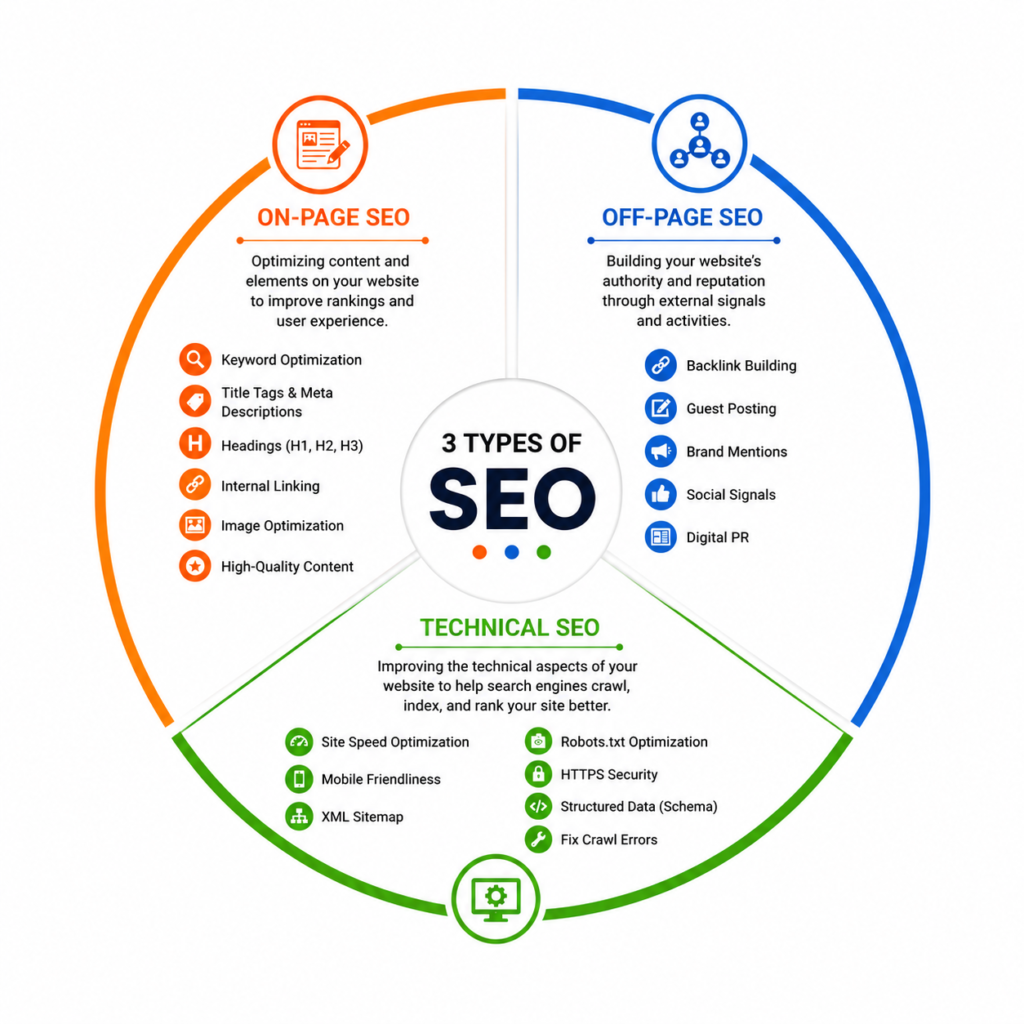
A strong SEO strategy usually requires attention to all three.
Keyword Research for Beginners
Keyword research is the process of discovering the words and phrases people use when searching for information online.
For example, someone interested in photography might search for:
- Beginner photography tips
- Best DSLR camera
- How to take better pictures
- Photography courses for beginners
These searches represent potential keywords for content.
The best keywords are not necessarily those with the highest search volume. A keyword should also be relevant to your audience, realistic for your website to target, and aligned with what users expect to find.
Search Intent
Search intent refers to the reason behind a search query.
For example:
- “What is SEO?” has informational intent.
- “Ahrefs login” has navigational intent.
- “Best SEO tools” has commercial intent.
- “Hire an SEO consultant” has transactional intent.
Understanding intent is essential because search engines aim to show results that satisfy what users are actually trying to accomplish.
Long-Tail Keywords
Long-tail keywords are longer and more specific search phrases.
Instead of targeting the broad keyword “SEO,” a new website might target:
- SEO for beginners
- How to learn SEO at home
- Beginner SEO checklist
- SEO tutorial for small businesses
Long-tail keywords often have lower search volume but may have less competition and attract more targeted visitors.
Keyword Difficulty and Search Volume
Keyword difficulty estimates how challenging it may be to rank for a particular search term. Highly competitive keywords are often dominated by established websites with strong authority.
Search volume refers to how often a keyword is searched during a specific period, usually monthly.
When choosing keywords, consider:
- Search volume
- Competition
- Relevance
- Search intent
- Your website’s authority
A lower-volume keyword that closely matches your audience’s needs can be more valuable than a highly competitive keyword with a large audience.
How to Find Keyword Ideas
Beginners can use several tools and methods to discover keyword opportunities.
Google Autocomplete: Start typing a topic into Google and review the suggested searches. These suggestions can provide ideas based on common search behavior.
Google Keyword Planner: This free tool provides keyword ideas, estimated search volume, competition information, and related terms.
Ahrefs: Ahrefs provides advanced keyword research, competitor analysis, keyword difficulty data, click estimates, and content opportunities.
Semrush: Semrush combines keyword research with competitor analysis, keyword tracking, content optimization, and keyword gap analysis.
Ubersuggest: Ubersuggest offers a beginner-friendly way to explore keyword ideas, search volume, SEO difficulty, competitor information, and content ideas.
Understanding Search Intent
Choosing a keyword is only part of the SEO process. You also need to understand what the searcher expects to find.
There are four primary types of search intent.
Informational intent: The user wants to learn something or find an answer. Examples include “what is SEO?” and “how does Google rank websites?” Suitable content includes guides, tutorials, blog posts, and educational resources.
Navigational intent: The user wants to visit a specific website or page, such as “Google Search Console” or “Semrush pricing.”
Commercial intent: The user is researching options before making a decision. Examples include “best SEO tools,” “Ahrefs vs. Semrush,” and “top SEO agencies.” Comparison articles, reviews, and buyer’s guides are often suitable for these searches.
Transactional intent: The user is ready to take action. Examples include “buy SEO course,” “hire SEO consultant,” and “download SEO checklist.” These searches may lead to product pages, service pages, or landing pages.
Matching content to search intent is one of the most important parts of SEO. A page explaining the history of running shoes is unlikely to satisfy someone searching for “best running shoes.” Similarly, someone searching “what is SEO?” probably wants an explanation rather than a sales page.
Before creating content, ask: What is the searcher actually trying to accomplish?
On-Page SEO Basics
On-page SEO includes the elements you optimize directly on your website. These optimizations help search engines understand your content and make pages easier for users to read and navigate.
SEO-Friendly Titles
The title tag tells users and search engines what a page is about. A good title should clearly describe the topic, include the primary keyword naturally when appropriate, and encourage clicks.
Weak title: Page About SEO
Stronger title: Guide to SEO for Beginners: Learn SEO Step by Step
Keep titles concise and descriptive. Avoid forcing keywords into a title if doing so makes it sound unnatural.
Meta Descriptions
A meta description summarizes a page in search results. Although it is not generally a direct ranking factor, a clear and compelling description can encourage users to click.
A strong meta description should:
- Accurately summarize the page
- Include the primary keyword naturally
- Explain what the reader will learn
- Encourage the user to visit
Header Structure
Headings organize content and create a clear structure for readers and search engines.
A typical structure is:
- H1: Main page title
- H2: Major sections
- H3: Subsections when necessary
Use one clear H1 for the main topic and organize the rest of the page logically. Headings should help users navigate the content rather than exist only to insert keywords.
URL Structure
SEO-friendly URLs are short, descriptive, and easy to understand.
Poor URL: example.com/post?id=4589&category=seo
Better URL: example.com/guide-to-seo-for-beginners
A clean URL helps users understand the page before clicking and is easier to share.
Internal Linking
Internal links connect pages within the same website. They help users discover related information and help search engines understand the relationships between pages.
For example, an SEO guide could link to related pages about keyword research, technical SEO, link building, or content optimization.
Use descriptive anchor text and add links naturally where they provide value.
Image Optimization
Images can improve the user experience, but they should be optimized to avoid slowing down your website.
Best practices include:
- Use descriptive file names
- Write meaningful alt text
- Compress large images
- Use suitable image formats
- Avoid unnecessarily large image dimensions
For example, seo-keyword-research-guide.jpg is more descriptive than IMG_12345.jpg.
Content Optimization
Content optimization means improving a page so it satisfies user intent and provides a useful experience.
Rather than repeating the same keyword, focus on covering the topic naturally and comprehensively. For an article about keyword research, related concepts might include search intent, search volume, keyword difficulty, long-tail keywords, and competitor research.
The goal is to create content for people first while making it easy for search engines to understand.
Creating Helpful SEO Content
Publishing content can improve a website’s visibility, but SEO success is not about producing the largest possible number of articles. Quality, relevance, and usefulness matter more than publishing volume alone.
Before creating a piece of content, consider:
- What problem is the reader trying to solve?
- What questions do they have?
- What information is missing from existing content?
- What practical advice can you provide?
Build Topic Clusters
Topic clusters organize related content around a broader subject.
For example, a website focused on SEO might create a central guide supported by articles about:
- Keyword research
- Technical SEO
- Link building
- Local SEO
- On-page SEO
- SEO tools
These pages can link to one another and to the main guide, creating a logical content structure.
Keep Important Content Updated
SEO is not a one-time task. Information, statistics, recommendations, and search trends change over time.
Review important pages regularly and update:
- Outdated statistics
- Broken links
- Old examples
- Screenshots
- Recommendations
- Industry information
Refreshing useful content can improve its relevance and maintain a better experience for readers.
Understand E-E-A-T
Google’s E-E-A-T framework stands for Experience, Expertise, Authoritativeness, and Trustworthiness.
You can strengthen these qualities by:
- Sharing first-hand experience where relevant
- Providing accurate information
- Using trustworthy sources
- Keeping content updated
- Demonstrating knowledge of the subject
- Writing clearly and honestly
Practical examples often make content more useful and credible than generic definitions.
Avoid Thin Content
Thin content provides little value to readers. Examples include pages that are extremely short, copied, repetitive, or created only to target a keyword.
Instead of publishing many low-quality pages, focus on creating fewer resources that genuinely answer the user’s questions.
Technical SEO for Beginners
Technical SEO focuses on the infrastructure that helps search engines crawl, understand, and index a website.
You don’t need to be a developer to understand the basics.
Website speed: Slow pages can frustrate visitors and contribute to a poor user experience. Improve performance by compressing images, reducing unnecessary scripts and plugins, using reliable hosting, and applying suitable caching or CDN solutions.
Mobile friendliness: Google uses mobile-first indexing, so websites should work properly on smartphones and tablets. Text should be readable, buttons should be easy to tap, and content should not overflow the screen.
HTTPS: HTTPS encrypts the connection between a website and its visitors. It improves security and user trust and is essential for websites that handle personal or payment information.
XML sitemaps: An XML sitemap lists important URLs and helps search engines discover website content more efficiently.
Robots.txt: This file provides instructions to crawlers about which areas they should or should not access. Incorrect settings can accidentally block important content, so it should be edited carefully.
Indexability: A page must generally be indexed before it can appear in search results. Common indexability problems include noindex tags, blocked URLs, server errors, broken links, and duplicate content.
Google Search Console can help website owners monitor indexing and identify technical issues.
Link Building for Beginners
Link building is the process of earning links from other websites to your own. These links are called backlinks.
Search engines may view relevant backlinks from reputable websites as signals that your content is useful and trustworthy. However, quality matters far more than quantity.
A single relevant editorial link from a respected website may be more valuable than dozens of low-quality links from unrelated sites.
Beginner-friendly link-building strategies include:
Guest posting: Write useful, original content for reputable websites in your industry. The focus should be on providing value rather than publishing solely to obtain a link.
Resource pages: Some websites maintain lists of useful tools, guides, and resources. If your content genuinely adds value, you can suggest it for consideration.
Link reclamation: If another website mentions your brand but doesn’t link to your website, you can politely ask whether they would consider adding a link.
Digital PR: Original research, surveys, statistics, case studies, and newsworthy insights can attract attention from journalists and industry publications.
Brand mentions: Monitoring brand mentions can help identify opportunities to build relationships and potentially earn relevant links.
Avoid buying large numbers of cheap, manipulative backlinks. Sustainable link building is based on relevance, quality, and genuine value.
Local SEO Basics
Local SEO helps businesses attract customers in specific geographic areas.
For example, someone searching for “coffee shop near me” or “dentist in Lahore” may see local businesses in the search results.
Google Business Profile
A Google Business Profile allows eligible businesses to appear in Google Search and Google Maps.
A complete profile should include accurate:
- Business name
- Address
- Phone number
- Website
- Business hours
- Category
- Services
- Photos
Keeping this information updated makes it easier for customers to find and contact the business.
Local Citations and NAP Consistency
A local citation is an online mention of a business’s name, address, and phone number, often referred to as NAP.
These details should remain consistent across the website, business directories, review platforms, and other online listings.
Inconsistent information can make it more difficult for search engines and customers to verify the correct business details.
Customer Reviews
Genuine customer reviews can build trust and support local visibility.
Encourage satisfied customers to leave honest feedback and respond professionally to both positive and negative reviews. Never create fake reviews or manipulate customer feedback.
Essential SEO Tools for Beginners
You don’t need dozens of tools to begin learning SEO. A small selection of reliable platforms can help you monitor performance, research keywords, identify technical issues, and analyze competitors.
Google Search Console: Monitor search performance, indexed pages, keyword impressions, clicks, and crawling issues.
Google Analytics 4: Understand website traffic, user behavior, engagement, traffic sources, and conversions.
Ahrefs: Conduct keyword research, analyze backlinks, research competitors, audit websites, and track rankings.
Semrush: Research keywords, analyze competitors, perform technical audits, track rankings, and support content optimization.
Screaming Frog: Crawl websites to identify broken links, missing metadata, duplicate content, redirects, and other technical issues. The free version supports smaller websites.
Ubersuggest: Explore keyword ideas, search volume, SEO difficulty, competitor information, and content opportunities.
Beginners can start with free tools and gradually explore paid platforms as their needs and skills grow.
Beginner SEO Checklist
Before publishing a page, review the following:
- Keyword research completed
- Primary keyword used naturally
- SEO-friendly title written
- Meta description created
- Clear H1 and logical H2 structure used
- URL is short and descriptive
- Internal links added
- Relevant external sources included where appropriate
- Images compressed and optimized
- Descriptive alt text added
- Page is mobile-friendly
- Page speed checked
- Content matches search intent
- Content reviewed for accuracy, grammar, and readability
- XML sitemap submitted where appropriate
- Google Search Console configured
A checklist helps prevent important SEO tasks from being overlooked.
Common SEO Mistakes Beginners Make
Keyword stuffing: Repeating the same keyword unnaturally creates a poor reading experience. Use keywords naturally and focus on covering the topic thoroughly.
Ignoring search intent: A page can target the right keyword and still fail if it doesn’t provide the type of content users expect.
Publishing low-quality content: Thin, copied, vague, or repetitive content rarely provides a strong user experience. Focus on useful, accurate, and original information.
Neglecting technical SEO: Slow pages, broken links, mobile usability problems, security issues, and indexing errors can prevent good content from performing well.
Buying spammy backlinks: Large numbers of low-quality or manipulative links can damage a website’s reputation. Focus on earning relevant, trustworthy links.
Failing to track results: Without monitoring traffic, rankings, impressions, clicks, and conversions, it’s difficult to understand what is working.
SEO should be treated as an ongoing process of testing, measuring, and improving.
How Long Does SEO Take?
There is no universal timeline for SEO. Results depend on competition, website authority, content quality, technical health, and consistency.
A new website targeting highly competitive keywords may take much longer to see significant results than an established website targeting specific, low-competition topics.
A general timeline may look like this:
- 1–3 months: Technical improvements and early content performance
- 3–6 months: Noticeable growth for some websites
- 6–12 months: Stronger rankings for more competitive topics
- 12+ months: Greater potential for sustained organic growth
These are general estimates, not guarantees. SEO is usually a long-term strategy, and consistent improvement is more important than chasing instant results.
How to Learn SEO Faster
The most effective way to learn SEO is to combine theory with practical experience.
Month 1: Learn the fundamentals. Understand crawling, indexing, ranking, keyword research, search intent, on-page SEO, and basic technical SEO.
Month 2: Build a small website. Create a simple website around a topic you’re interested in, such as travel, food, technology, education, or business.
Month 3: Publish optimized content. Practice keyword research, writing titles and meta descriptions, using headings, adding internal links, and optimizing images.
Month 4: Learn link building. Explore guest posting, resource pages, brand mentions, digital PR, and relationship-based outreach.
Month 5: Analyze performance. Use Google Search Console and Google Analytics to see which pages receive traffic, which keywords generate impressions, and where improvements are needed.
Month 6: Improve and scale. Update older content, strengthen internal linking, target new keywords, and continue publishing useful resources.
The more you practice on a real website, the faster you’ll understand how SEO works in practice.
Frequently Asked Questions
What is SEO in simple words?
SEO is the process of improving a website so it can appear more prominently in search results and attract relevant organic traffic.
Is SEO difficult to learn?
The basics are relatively easy to understand. Becoming an advanced SEO professional requires ongoing practice and learning, but beginners can start with keyword research, search intent, content optimization, and technical fundamentals.
How long does SEO take?
SEO is a long-term strategy. Some improvements may appear within weeks, while meaningful growth often takes several months or longer. The timeline depends on competition, website authority, content quality, and consistency.
Is SEO free?
You don’t pay search engines directly to rank organically. However, SEO may involve costs for content creation, tools, technical improvements, or professional services.
Can I learn SEO by myself?
Yes. Many SEO professionals are self-taught. Studying reliable resources, experimenting on your own website, and analyzing real results are effective ways to build practical skills.
What is a keyword?
A keyword is a word or phrase people enter into a search engine. Examples include “guide to SEO for beginners,” “best running shoes,” and “how to bake bread.”
What is technical SEO?
Technical SEO focuses on website infrastructure, including speed, mobile usability, HTTPS, crawling, indexing, XML sitemaps, and other technical elements.
Do backlinks still matter?
Yes. Relevant, high-quality backlinks remain important signals of authority and trust. Quality and relevance are more important than simply acquiring a large number of links.
What is on-page SEO?
On-page SEO includes optimizations made directly on your website, including content, titles, meta descriptions, headings, URLs, internal links, images, and keyword usage.
Which SEO tools should beginners use?
Google Search Console, Google Analytics 4, Google Keyword Planner, Ubersuggest, and Screaming Frog are useful starting points. Ahrefs and Semrush offer more advanced features as your SEO needs grow.
How much traffic can SEO generate?
There is no fixed amount. Results depend on your industry, competition, content strategy, website authority, and consistency. A successful website can attract hundreds, thousands, or millions of organic visitors over time.
Is SEO worth learning in 2026?
Yes. SEO remains a valuable digital marketing skill for businesses, marketers, freelancers, content creators, and website owners. It can improve visibility, attract qualified traffic, generate leads, and support long-term growth.
Conclusion
SEO may seem complicated at first, but its fundamentals can be learned step by step.
In this guide, you’ve learned how search engines crawl, index, and rank web pages, why keyword research and search intent matter, how to optimize content, and how technical SEO affects website performance. You’ve also explored link building, Local SEO, essential tools, common mistakes, and practical ways to continue learning.
The most important SEO principles are simple:
- Create helpful, user-focused content.
- Match content to search intent.
- Build a strong on-page and technical foundation.
- Earn relevant, high-quality backlinks.
- Monitor your performance and improve consistently.
- Avoid shortcuts and manipulative tactics.
The best way to learn SEO is to practice it. Start with a website or project, research what your audience is searching for, publish useful content, measure the results, and improve over time.
Search engines continue to evolve, but the fundamental goal remains the same: provide users with the most relevant, helpful, and trustworthy information possible. Websites that consistently focus on quality and user experience are better positioned to achieve sustainable organic growth.
SEO is not a quick fix. It is a long-term investment in visibility, credibility, and growth. The sooner you begin applying what you learn, the faster you’ll build the experience needed to improve your website and develop stronger SEO skills.
