
SEO agencies love to quote $1,000–$5,000 per month. Many small business owners hear that number and assume ranking on Google is only for companies with deep pockets. The truth is different. You can get real results with low cost SEO — often under $100 a month — if you follow a smart system instead of throwing money at random tools or cheap backlinks.
Here’s the promise: this guide gives you a complete, step-by-step, low cost SEO system you can start today. No fluff. No long tool directories. Just the exact framework, strategies, and actions that work in 2026 for businesses on a budget.
You’ll learn how to find low-competition keywords, create content that ranks, build links without big spending, fix technical issues for free, and track real progress. Many solo entrepreneurs and small teams have used similar approaches to grow organic traffic by 200–500% without hiring expensive agencies.
Table of Contents
What is low cost SEO
Low cost SEO means optimizing your website for search engines using mostly free or very affordable methods while focusing on high-impact activities. It’s strategic, not cheap in quality.
There’s a big difference between cheap SEO and low cost SEO. Cheap SEO often means buying low-quality backlinks, using spun content, or paying for shady services that promise quick results but risk penalties. Low cost SEO (or affordable SEO) is smart and sustainable — you invest time and a small budget in the right places to build real authority over time.
Example: Spending $50 on spammy backlinks might give a temporary bump, but often leads to a ranking drop when Google updates hit. In contrast, spending the same $50 on a good keyword tool and creating one high-quality long-tail page can bring steady traffic for months or years.
The goal with low cost SEO is simple: rank for keywords people actually search, create content that helps them, and make small improvements that compound.
Why most low cost SEO fails
Most budget SEO attempts flop for predictable reasons.
People buy cheap backlinks from Fiverr and wonder why rankings tank after the next update. Others jump between 20 different free tools without a plan and burn out. Many create generic blog posts that nobody reads or shares. Some expect results in two weeks and quit when nothing happens immediately.
Real scenario: A local service business spent $200 on “SEO backlinks” from a marketplace. Traffic spiked briefly, then disappeared after a spam update. They lost time and money with nothing to show. Another business tried DIY SEO by publishing 50 short articles with no strategy — they got almost zero traffic because the content didn’t match what people were searching for.
The common thread? No clear framework, no focus on low-competition keywords, and no patience for compounding results.
The low cost SEO framework (your core weapon)
Here’s the simple 4-Pillar Low Budget SEO System that actually works in 2026:
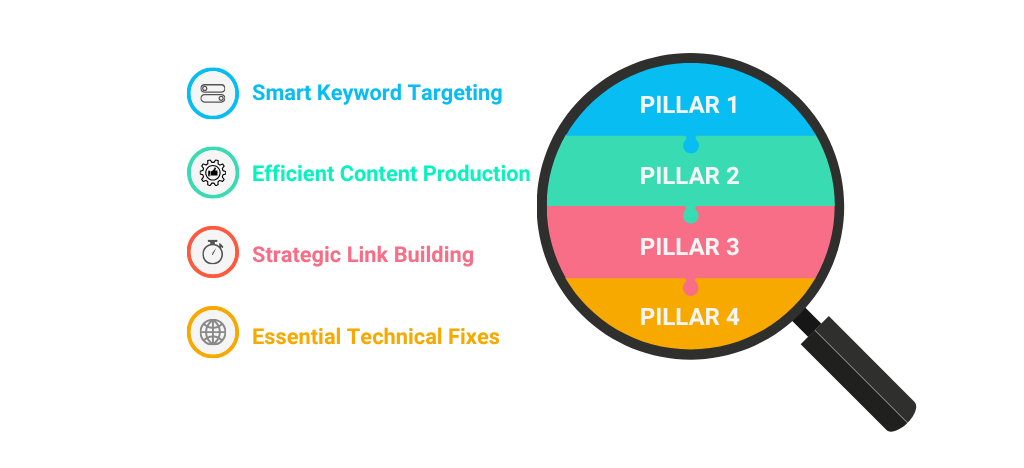
Pillar 1: Smart Keyword Targeting — Find low-competition, high-intent keywords you can rank for quickly.
Pillar 2: Efficient Content Production — Create helpful content in batches without burning out.
Pillar 3: Strategic Link Building — Earn or build links without big budgets.
Pillar 4: Essential Technical Fixes — Make sure Google can find and love your pages using mostly free tools.
Follow these four pillars in order, and you’ll build momentum without wasting money.
Keyword strategy for low cost SEO
The secret to low cost SEO success is targeting keywords with decent search volume but low competition.
Focus on long-tail phrases — specific questions or problems people type when they’re closer to making a decision. These are easier to rank for and often convert better.
Formula that works: low competition + decent search volume + buyer intent = fast wins.
Examples of good low cost SEO keywords:
- “best CRM for small business under $50”
- “cheap cybersecurity tools for startups”
- “How to fix a slow WordPress site 2026.”
Use free or cheap tools like Google Keyword Planner, Ubersuggest (free tier), or KeySearch (~$17/month) to find them. Look for keywords with difficulty scores under 30 and some commercial intent.
Content strategy that actually ranks on a budget
Don’t write random articles. Build topic clusters.
Choose one pillar topic (e.g., “email marketing for small businesses”), create one detailed pillar page, then write 8–12 supporting blog posts that link back to it. This builds topical authority cheaply.
Content batching saves huge time: research 10 related keywords in one sitting, outline all posts, then write 2–3 per week.
One real example: A freelance consultant created one pillar page on “low cost marketing tools” and 10 cluster articles. Within 6 months, the cluster drove consistent leads with almost no paid promotion.
Optional advanced tip: Use programmatic SEO for location or tool comparison pages if it fits your niche — but only if you can keep the content helpful and unique.
Best low cost SEO tools (only the essentials)
You don’t need 22 tools. Here are 7 that deliver the most value on a budget:
Keyword research: Google Keyword Planner (free) or KeySearch ($17/mo) — find low-competition terms fast.
Content optimization: Surfer SEO (pay-per-use) or free Chrome extensions like Keyword Surfer.
Technical SEO: Google Search Console (free) + PageSpeed Insights (free).
Link opportunities: Ahrefs free backlink checker or manual Google searches for “write for us” + your niche.
Analytics: Google Analytics 4 (free).
Content creation support: ChatGPT or Claude (free tiers) for outlines and drafts — always edit heavily.
Rank tracking: SE Ranking or free Google Sheets manual tracking.
Use one tool per category. Master it before adding another.
Link building on a budget
You don’t need to buy links. Focus on smart, free, or low cost methods.
Real strategies that work:
- Guest posting: Find relevant blogs that accept contributions and offer genuine value.
- HARO (Help a Reporter Out): Respond to journalist queries with expert insights.
- Resource page outreach: Find pages listing “best tools” in your niche and suggest your content.
- Community participation: Answer questions on Reddit, Quora, or industry forums with helpful links.
Step-by-step outreach process:
- Find the right site or page.
- Read their content and note a specific gap.
- Send a short, personalized email explaining the value you can add.
- Follow up once after 7–10 days if no reply.
Start with 5–10 outreaches per week. Quality beats quantity.
Technical SEO simplified for low budget
You can handle most technical fixes yourself with free tools.
Key tasks:
- Submit your sitemap and request indexing in Google Search Console.
- Fix broken links using free checkers.
- Improve page speed by compressing images and enabling caching (plugins like WP Rocket have free alternatives or lite versions).
- Make sure your site is mobile-friendly.
These changes often give quick wins without spending anything.
Cost breakdown for low cost SEO
Here’s a realistic 2026 breakdown:
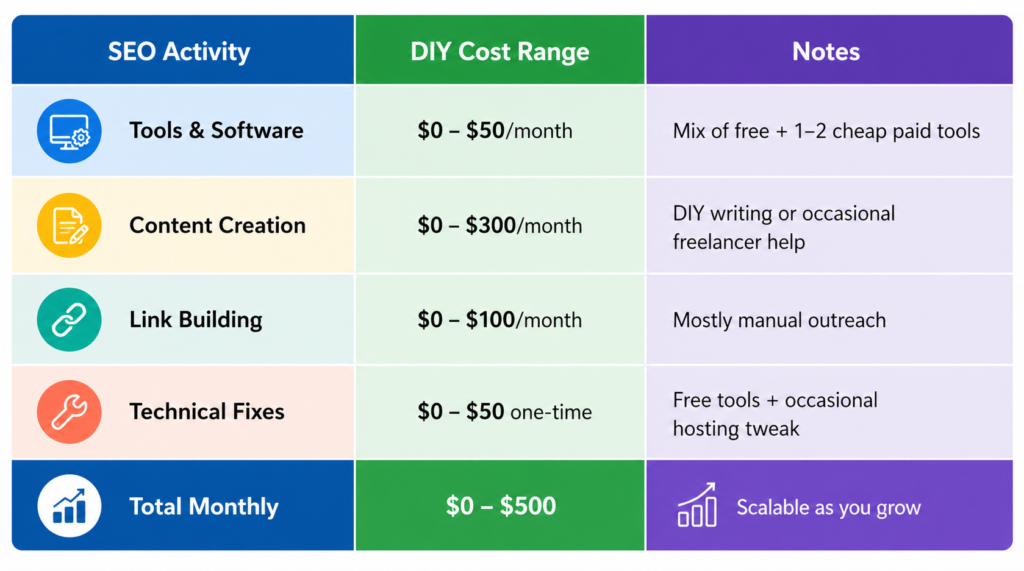
Many successful sites stay under $100/month for the first 6–12 months.
DIY vs hiring help
DIY works great when you have time and want full control. Outsource when you need speed or specialized skills (e.g., technical audits or advanced content).
The best model for most people is hybrid: handle strategy and most content yourself, then hire freelancers for specific tasks like link outreach or design tweaks when budget allows.
Common mistakes to avoid
- Buying cheap backlinks that get your site penalized.
- Creating too much low-quality content instead of fewer strong pieces.
- Expecting overnight results — low cost SEO rewards patience and consistency.
- Getting addicted to new tools instead of executing the basics well.
Step-by-step action plan
Follow this 30-day starter plan:
| Week | Tasks | Details |
|---|---|---|
| 🟦 Week 1 | Setup & Research | Set up Google Search Console and Analytics. Find 10–15 low-competition keywords. |
| 🟩 Week 2 | Content Planning | Create your first pillar page and outline 5 supporting posts. |
| 🟨 Week 3 | Optimization | Optimize on-page elements and fix basic technical issues. |
| 🟥 Week 4 | Execution & Outreach | Publish content, start manual outreach for 5–10 backlinks, and track early results. |
Repeat and scale. Review progress monthly and adjust.
Conclusion
Low cost SEO works when you treat it as a system, not a collection of random tactics. Start small, stay consistent, and focus on value. You’ll build rankings and traffic without breaking the bank.
Open Google Keyword Planner today, find your first 5 target keywords, and write one strong piece of content this week. The results will come faster than you expect when you follow a real framework.
SEO agencies love to quote $1,000–$5,000 per month. Many small business owners hear that number and assume ranking on Google is only for companies with deep pockets. The truth is different. You can get real results with low cost SEO — often under $100 a month — if you follow a smart system instead of throwing money at random tools or cheap backlinks.
Here’s the promise: this guide gives you a complete, step-by-step, low cost SEO system you can start today. No fluff. No long tool directories. Just the exact framework, strategies, and actions that work in 2026 for businesses on a budget.
You’ll learn how to find low-competition keywords, create content that ranks, build links without big spending, fix technical issues for free, and track real progress. Many solo entrepreneurs and small teams have used similar approaches to grow organic traffic by 200–500% without hiring expensive agencies.
