
Cyber threats are exploding. Businesses lost an estimated $10.5 trillion to cybercrime in 2025, and the number continues to climb. Yet most cyber security companies struggle to appear in front of the very people who need their help — the CISOs, IT leaders, and executives searching Google every day for solutions.
The problem isn’t a lack of expertise. It’s that ranking cyber security websites in 2026 requires far more than basic SEO. Google applies stricter YMYL standards here because bad advice can lead to real breaches, financial loss, or compromised safety.
This guide changes that. You’ll get a complete, actionable blueprint for cyber security that covers keyword strategy, content clusters, on-page and technical optimization, link building, conversion tactics, and a clear step-by-step roadmap. Follow it, and you’ll build topical authority, earn trust faster, and turn more organic traffic into qualified leads.
Table of Contents
What is cyber security SEO?
Cyber security SEO is the specialized practice of optimizing websites in the cyber security niche to improve visibility in search engines for relevant queries. It blends traditional SEO techniques with extra emphasis on trust, accuracy, and expertise because this content directly impacts people’s security and finances.
What sets it apart from regular SEO? Cyber security topics fall under Google’s YMYL (Your Money or Your Life) category. That means pages are judged more harshly on E-E-A-T — Experience, Expertise, Authoritativeness, and Trustworthiness. A generic blog post won’t cut it. Readers and Google both expect proof that the information comes from people who have actually defended against real attacks.
Common challenges include explaining complex technical concepts to mixed audiences (technical pros and business decision-makers), keeping content fresh as threats evolve weekly, and standing out in a crowded field dominated by big vendors and research firms.
Take a real example: A mid-sized managed detection and response (MDR) provider wanted to rank for “best MDR solutions for mid-market companies.” They succeeded by publishing detailed comparison guides with anonymized case studies from their SOC team, not just feature lists. The result was higher rankings and better lead quality.
How Google ranks cyber security websites
Google uses the same core signals as other industries, but weights them differently for cyber security sites.
E-E-A-T with practical examples
Experience means showing real-world work. An author bio that says “led incident response for Fortune 500 companies during ransomware attacks” carries far more weight than a generic “10 years in IT.”
Expertise appears through certifications, original research, or clear explanations of complex topics like zero-trust architecture. Authoritativeness comes from being cited by reputable sources such as NIST, Gartner, or major security publications. Trustworthiness shows in transparent sourcing, regular content updates, HTTPS, and clear privacy practices.
Topical authority
Google rewards sites that demonstrate depth across a subject. Instead of scattered posts, build interconnected content clusters. A pillar page on “Zero Trust Security” should link to supporting articles on implementation steps, common pitfalls, and real-world deployments.
Brand and entity signals
Consistent brand mentions across the web, strong user engagement signals (long dwell time on key pages), and proper entity schema help Google understand who you are and why you’re credible.
Keyword strategy for cyber security seo
Smart keyword strategy separates successful cyber security sites from the rest.
TOFU, MOFU, and BOFU intent
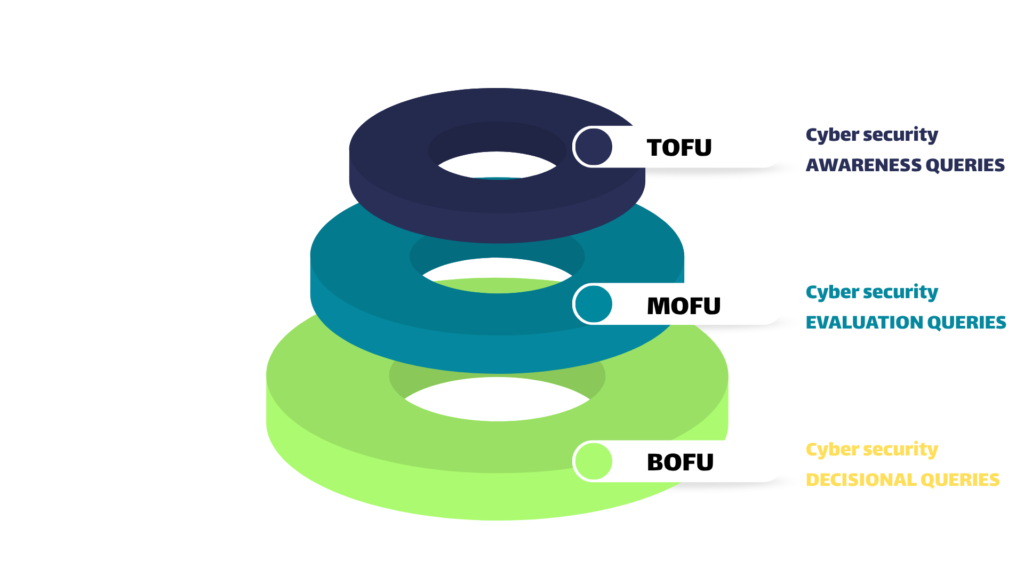
- Top of Funnel (TOFU): Awareness queries like “what is endpoint detection and response” or “how do ransomware attacks work.”
- Middle of Funnel (MOFU): Evaluation terms such as “EDR vs XDR comparison 2026” or “how to choose a SOC provider.”
- Bottom of Funnel (BOFU): Decision-stage searches like “managed detection and response pricing” or “cyber security services for healthcare compliance.”
Building keyword clusters
Group keywords around core topics. For cloud security, create content on misconfigurations, identity access management, compliance frameworks, and real breach examples.
Use tools like Ahrefs, SEMrush, and Google’s own search suggestions to find clusters. Focus on question-based long-tails that match how buyers actually search.
Keyword table example:
| Stage | Keyword Example | Approx. Monthly Search | Competition | Recommended Content Type |
| TOFU | What is zero-trust security | High | Medium | In-depth explainer + diagram |
| MOFU | MDR vs SIEM differences | Medium | High | Comparison table + checklist |
| BOFU | best MDR provider for mid-size business | Medium | High | Case study + pricing guide |
Content strategy
Content in cyber security must educate deeply while remaining accessible.
Topic clusters and pillar pages
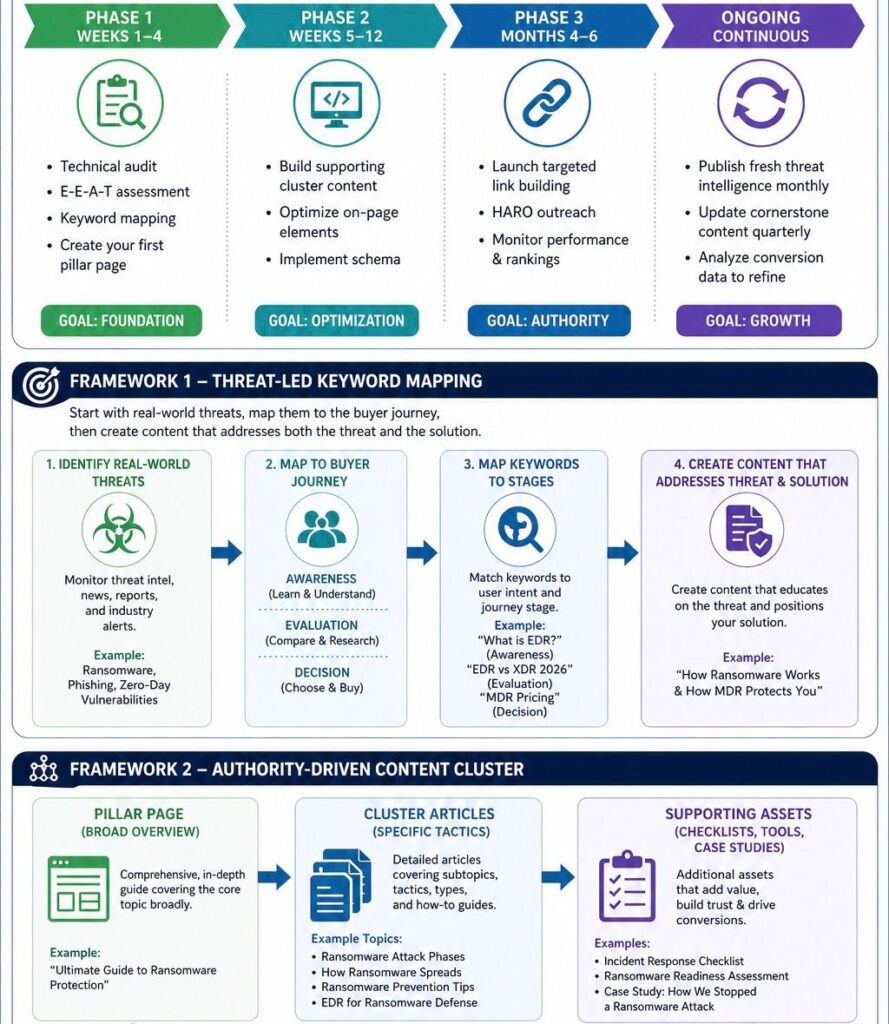
Build one comprehensive pillar page per major topic and support it with 8–15 cluster articles. This structure helps Google see you as an authority while guiding readers through their journey.
Example pillar page structure for “Endpoint Security”:
- Current threat landscape with recent stats
- How modern EDR works with clear diagrams
- Implementation checklist
- Common mistakes and how to avoid them
- Real (anonymized) case study
- FAQ section
- Strong CTA for a consultation or demo
Keep content fresh. Publish regular threat intelligence updates to show you’re actively monitoring the evolving landscape.
On-page SEO best practices
Every page needs careful optimization.
Effective title formulas:
- “Zero Trust Security Explained: Benefits, Implementation, and 2026 Best Practices”
- “EDR vs XDR: Which Should Your Company Choose in 2026?”
Use clear H2/H3 headings, natural internal links to related cluster pages, and schema markup (FAQPage or HowTo) to enhance visibility in rich results.
Link building for cyber security websites
Focus on quality and relevance over quantity.
- HARO and journalist outreach: Position your experts as sources for ransomware, breach, or compliance stories.
- Original research and reports: Publish annual threat reports or survey data — these naturally attract links from industry sites.
- Strategic outreach process: Identify relevant publications or associations, offer genuine value (exclusive data or expert quotes), and follow up thoughtfully.
Guest posting still works when the content adds real insight to respected security blogs.
Technical SEO essentials
Technical performance directly impacts trust and rankings.
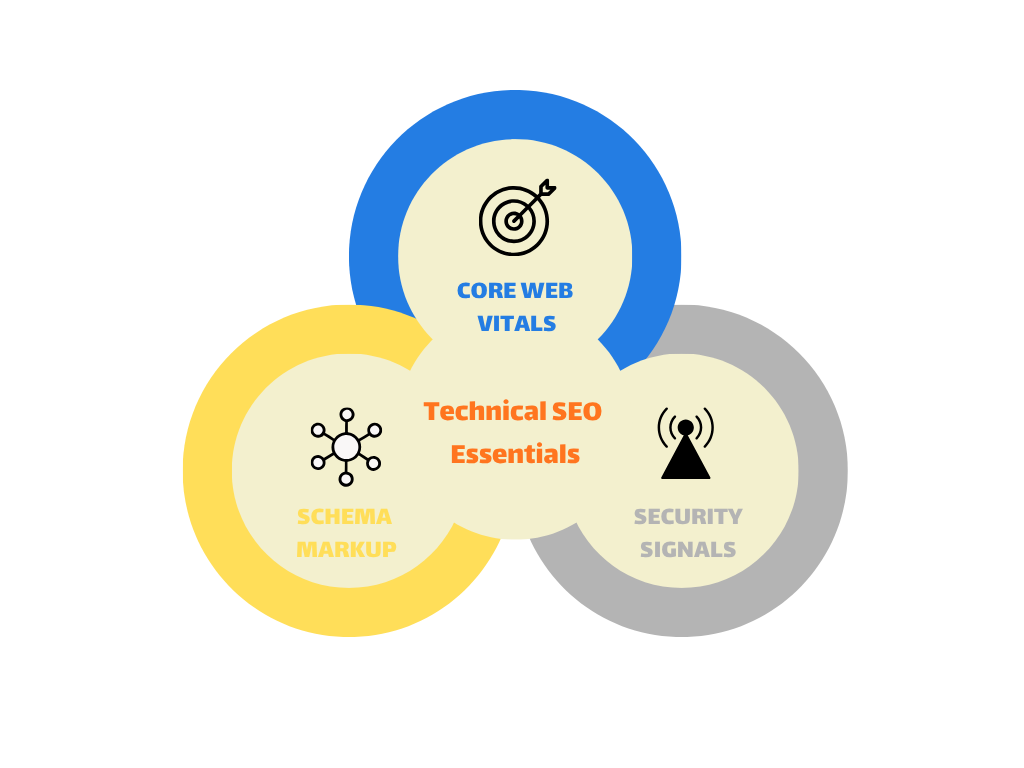
- Core Web Vitals: Aim for excellent scores. Slow pages make users (and Google) question your competence in protecting digital assets.
- Schema markup: Implement Organization, FAQ, and HowTo schema to help rich snippets appear.
- Security signals: Proper HTTPS, security headers, clear privacy policies, and transparent data handling act as indirect trust and ranking factors.
Conversion SEO: Turning traffic into leads
Rankings alone don’t pay bills.
- Place contextually relevant CTAs on pillar and cluster pages (“Schedule a free risk assessment”).
- Add strong trust signals: client logos, certifications (SOC 2, ISO 27001), measurable case studies, and expert author bios.
- Optimize dedicated landing pages for high-intent keywords with minimal friction forms and clear value propositions.
Common mistakes to avoid
- Overloading pages with jargon without clear explanations for business readers.
- Ignoring search intent — ranking a sales page for an educational query.
- Weak trust signals, such as missing author information or outdated content dates.
- Focusing purely on traffic volume instead of lead quality.
Strategy blueprint: step-by-step roadmap
Conclusion
Cyber security SEO in 2026 is about more than rankings — it’s about building genuine authority and trust in a high-stakes field. By focusing on strong E-E-A-T, smart keywords and content clusters, technical excellence, and conversion-focused optimizations, you can rank higher while attracting the right clients.
Start today: Audit your top pages for E-E-A-T signals and map your first keyword cluster. Consistent execution of this blueprint will help your cyber security website stand out, earn trust, and drive sustainable growth.
The organizations that treat SEO as a long-term authority-building strategy — not a quick traffic tactic — will dominate search results for years to come.
