
You pour weeks into outreach, land a handful of links, and then watch your rankings stay flat while traffic barely moves. It’s frustrating — and far too common. Yet some campaigns deliver explosive results: hundreds of quality backlinks, top-three rankings, and steady organic growth that lasts through algorithm updates.
That difference comes down to strategy, execution, and measurement. A well-documented link building case study shows you exactly how the winners do it. In 2026, backlinks remain one of Google’s top three ranking factors, but the rules favor relevance, context, and genuine value over volume. Top pages still gain 5–14% more followed links monthly on average, proving consistent link acquisition strategy pays off when done right.
This comprehensive guide delivers everything you need. You’ll learn what makes a strong link building case study, why backlinks still drive SEO success, five detailed real-world examples with measurable 2025–2026 results, the exact strategies behind them, common tactics broken down with pros and cons, and a repeatable step-by-step process you can launch yourself. Plus, you get a bulky FAQ section targeting the questions real SEO professionals ask every day. By the end, you’ll have the blueprint to create your own backlink case study and turn link acquisition into predictable growth.
Table of Contents
What is a link building case study?
A link building case study is a detailed, transparent breakdown of a real campaign from start to finish. It covers the original objective, the exact tactics chosen, the tools used, the outreach process, the results (backlinks, traffic, rankings, revenue impact), and the key lessons learned. Unlike vague “we got links” posts, a good case study shows cause-and-effect so you can replicate or adapt the approach.
These studies matter more than ever in 2026 because the link acquisition strategy has evolved. Google’s focus on helpful content and entity understanding means spammy or irrelevant links get ignored or penalized. Documented examples cut through the noise and prove which methods still work. For SEO professionals, content marketers, and business owners, reading a solid link building case study is like free consulting — you see real numbers, real timelines, and real mistakes to avoid.
Think of it as a before-and-after story backed by data. One financial services company turned an interactive retirement calculator into a link magnet that earned over 1,200 backlinks in its first year with almost no paid promotion. That single link building example became the foundation for their entire content strategy moving forward.
Importance of link building for SEO
Backlinks are still powerful signals of authority and trust. They tell Google that other relevant sites vouch for your content. In 2026, pages that consistently earn high-quality followed links see steadier rankings and better performance in AI Overviews.
Role of backlinks in search rankings
Google uses backlinks as votes of confidence, but context matters. A link from a relevant, authoritative site in the same niche carries far more weight than a generic directory link. Recent data shows top-ranking pages gain 5–14% more followed links monthly on average, creating a compounding authority effect that helps them hold or improve positions even after core updates.
Authority, trust, and referral traffic
Beyond rankings, strong backlinks build brand signals that help with entity understanding and AI search visibility. They also deliver direct referral traffic — often highly targeted visitors who convert better than cold search traffic. A single well-placed editorial link can bring hundreds of qualified visitors while boosting domain-wide trust across your entire site.
The bottom line: link building done right is one of the highest-ROI activities in SEO. It compounds over time, protects against algorithm changes, and delivers both short-term wins and long-term authority.
Real-life link building case studies
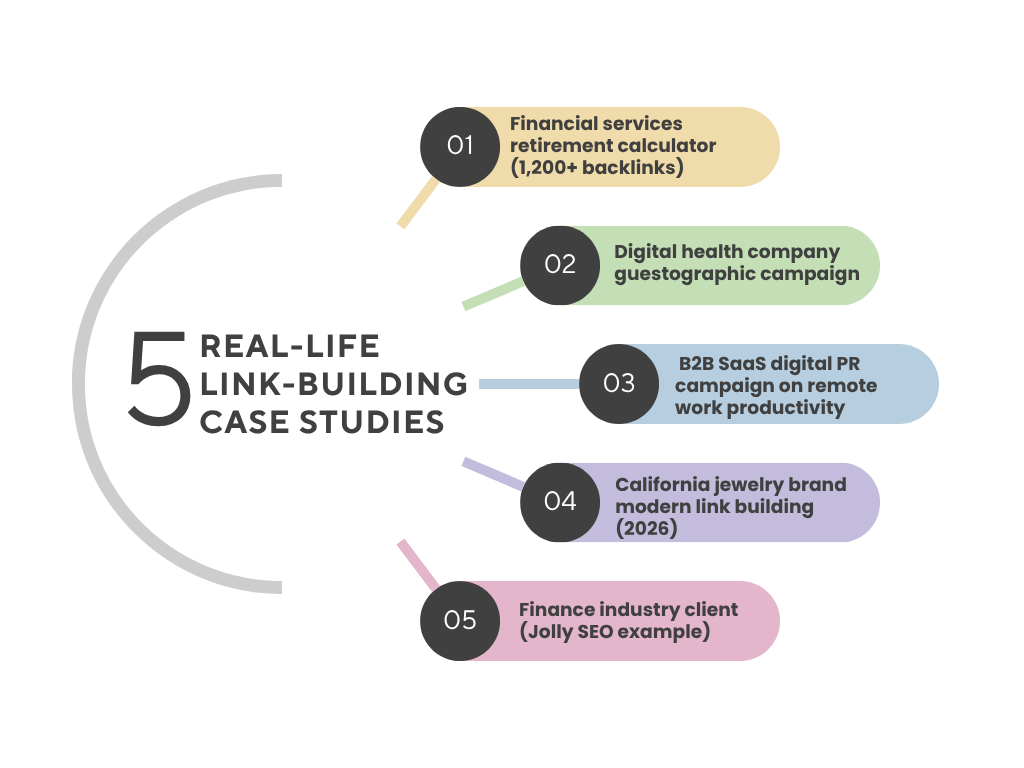
Case Study 1: Financial services retirement calculator (1,200+ backlinks)
Objective: Become the go-to resource for retirement planning tools and content.
Strategy: Instead of another blog post, the team built a free interactive retirement calculator with customizable inputs and shareable results. They promoted it through targeted resource page outreach and industry forums.
Tools used: Ahrefs for competitor gap analysis and outreach tracking.
Results: Over 1,200 backlinks in the first year, many from finance blogs and educational sites. Organic traffic to the tool page grew steadily, and related keyword rankings improved significantly.
Lessons learned: Interactive tools attract natural links far better than static content. When you create something genuinely useful that other sites want to reference, promotion becomes easier, and results compound faster.
Case Study 2: Digital health company guestographic campaign
Objective: Earn high-authority links in the competitive health niche.
Strategy: Produced a detailed “guestographic” — an infographic-style guest post packed with original data — and pitched it to 25 carefully selected sites.
Tools used: SEMrush for topic research and BuzzStream for outreach management.
Results: 68% acceptance rate, multiple links from DR 70+ domains, and clear ranking lifts for target keywords within four months.
Lessons learned: Visual assets combined with strong, personalized outreach dramatically improve response rates over plain text guest posts. Relevance and quality beat volume every time.
Case Study 3: B2B SaaS digital PR campaign on remote work productivity
Objective: Get featured in major publications and build editorial authority.
Strategy: Published original research based on their own user data and pitched journalists with exclusive angles and quotes.
Tools used: Google Alerts, HARO, and custom pitch tracking.
Results: 43 links from DR 70+ sites, features in TechCrunch, Business Insider, and Forbes, 8,500+ targeted visitors in the first month, plus citations in Google AI Overviews for 17 queries.
Lessons learned: Data-driven stories create earned media that traditional outreach rarely matches. One strong digital PR push can deliver links, traffic, and brand mentions simultaneously.
Case Study 4: California jewelry brand modern link building (2026)
Objective: Compete in a visual, competitive B2C niche.
Strategy: Combined digital PR, resource link building on style and sustainability topics, and relationship-based outreach to lifestyle blogs.
Tools used: Ahrefs + custom CRM.
Results: Significant organic growth, authority gains, and steady backlink acquisition throughout 2026.
Lessons learned: Even niche B2C brands succeed by focusing on storytelling and relevance rather than generic tactics. Building relationships first makes outreach warmer and more effective.
Case Study 5: Finance industry client (Jolly SEO example)
Objective: Increase organic traffic through targeted backlinks.
Strategy: Combined HARO responses and keyword-specific outreach campaigns.
Tools used: Proprietary outreach platform + Ahrefs.
Results: 126% organic traffic increase in 12 months, plus major ranking improvements for money keywords.
Lessons learned: Consistent, multi-channel link acquisition strategy (HARO + targeted outreach) delivers scalable results even in competitive verticals.
Common link building strategies illustrated
Guest posting
Still effective in 2026 when the content adds real value and the site is relevant. The digital health guestographic example hit a 68% acceptance rate by pairing high-quality visuals with personalized pitches.
Resource link building
Create ultimate guides, statistics pages, or tools that other sites naturally want to reference. Resource pages actively seek valuable references, making conversion rates higher when your asset truly fills a gap.
Broken link building
Find dead links on relevant pages, then reach out with a better replacement. In 2026, this tactic works best when the new resource is noticeably superior, and the outreach feels helpful rather than salesy.
Outreach campaigns
Personalized emails based on real research outperform templates. Track everything in a spreadsheet or dedicated tool, follow up once, and focus on mutual value.
| Strategy | Best For | Typical Response Rate | Time to Results | Difficulty |
| Guest Posting | Niche authority | 20–68% (with visuals) | 4–8 weeks | Medium |
| Resource Link Building | Evergreen content | 15–40% | 6–12 weeks | Medium |
| Broken Link Building | Quick wins | 10–30% | 2–6 weeks | Low |
| Digital PR | Brand mentions & big wins | 5–15% (high value) | 8–16 weeks | High |
Step-by-step guide to conducting your own link building case study
- Set clear, measurable objectives — Decide if you want more traffic, better rankings, or brand mentions. Write them down with target numbers.
- Choose and research your strategy — Match it to your niche, audience, and resources. Use Ahrefs or SEMrush to find gaps.
- Create a link-worthy asset — Make something useful: a tool, original research, in-depth guide, or infographic.
- Identify and qualify targets — Build a list of 50–200 relevant sites using SEO tools. Score them by authority and relevance.
- Run personalized outreach — Craft emails that show you’ve read their content. Track everything.
- Monitor and document results weekly — Use Google Analytics, Search Console, and backlink tools to track new links, traffic, and rankings.
- Analyze and turn it into your own case study — Compile the data, lessons, and screenshots into a shareable format for your site or clients.
Recommended 2026 tools: Ahrefs ($129+/mo), SEMrush ($129+/mo), BuzzStream for outreach, and Google Data Studio for dashboards.
FAQs – Link building case study
What is a link building case study?
It’s a complete, data-backed story of a real campaign that shows the goal, the exact tactics used, the tools, the outreach process, the results (backlinks, traffic, rankings), and the lessons. It goes far beyond “we got links” and gives you a repeatable blueprint you can adapt to your own site or client work.
How do you measure success in link building?
Look at new referring domains (not just raw links), organic traffic growth, keyword ranking improvements, referral traffic, link retention rate, and business outcomes like leads or revenue. The best campaigns show a clear correlation between links gained and real results, not vanity metrics.
Can small websites do link building case studies?
Yes — many of the strongest examples come from smaller sites or solo operators. Start with one focused strategy, like broken link building or a single high-value resource page. Document every step,p and you’ll quickly have proof that even modest budgets can deliver big SEO wins.
How long does a link building campaign take to show results?
Most see initial links within 2–4 weeks and meaningful ranking or traffic movement in 2–6 months. Consistent effort over time beats one-off pushes. Digital PR campaigns can take longer but often deliver bigger, longer-lasting results.
Which tools are best for tracking backlinks in a case study?
Ahrefs and SEMrush remain the top choices for comprehensive data and historical trends. Google Search Console gives free basics, but paid tools provide competitor insights and alert features that make documentation much easier.
Is guest posting still effective in 2026?
Absolutely — when the content adds genuine value and the site is relevant. The digital health company example achieved a 68% acceptance rate by using strong visuals and personalized pitches. Quality and relevance matter more than ever.
What’s the difference between link building and link acquisition strategy?
Link building is the tactical work of earning links. Link acquisition strategy is the bigger plan that includes research, asset creation, outreach, measurement, and iteration — the full framework you document in a link building case study.
How important are backlinks for SEO in 2026?
They remain a top-three ranking factor. Top pages continue gaining quality followed links monthly, and editorial links especially help with AI Overviews and entity signals. The focus has shifted to relevance and authority over sheer volume.
Can I run a link building case study for a local business?
Yes. Local link building often uses sponsorships, community features, and resource pages. Document the campaign the same way, and you’ll have clear proof that local SEO link tactics deliver measurable ROI in traffic and leads.
Should I include disavow or toxic link cleanup in my case study?
Only if it were part of the campaign. Most modern case studies focus on positive acquisition, but showing how you monitored and cleaned up any low-quality links demonstrates a responsible link acquisition strategy.
Conclusion & key takeaways
A strong link building case study proves that smart, targeted effort still delivers impressive results in 2026. The common thread across every successful example is simple: create something genuinely useful, target the right sites with personalized outreach, track everything, and learn from the data.
Key takeaways you can use today:
- Interactive tools and original research attract links with less effort.
- Digital PR often outperforms traditional guest posting for authority and traffic.
- Relevance beats volume every single time.
- Documentation turns one campaign into a repeatable system.
Start small. Pick one strategy from the examples above, document your process from day one, and turn your next campaign into your own link building case study. The data you collect will become your biggest competitive advantage for years to come.
Ready to build? Open Ahrefs or SEMrush, identify one piece of content worth linking to, and send your first 20 personalized outreach emails this week. The results will speak for themselves — and you’ll have the case study to prove it.
